
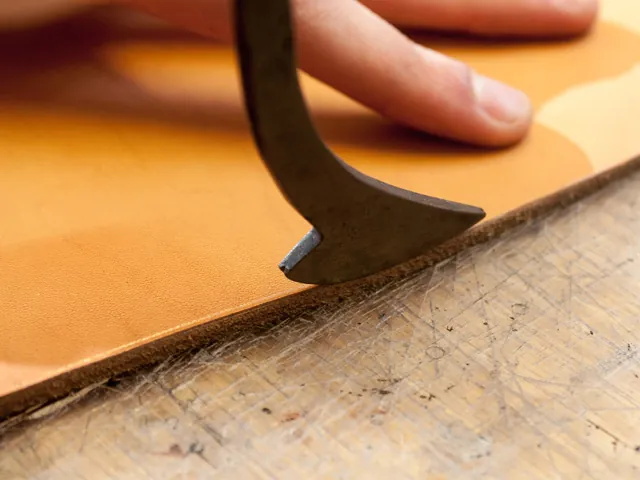
Streicheisen
by Ibrahim Anwar · July 24, 2025
Streicheisen, a German word meaning “stroking iron”, is an essential tool in the art of sixteenth-century bookbinding. It is not an ordinary stamp but a tool for creating decoration through the technique of blind tooling (blind stamping), which presses a pattern into leather without using ink or gold. Known through the historic woodcut by Jobst Amman, the tool is shaped like a pointed spade whose sides carry double or triple grooves. By pressing and drawing this tool across dampened leather, a bookbinder can “paint” with shadow and texture, creating the elegant, tactile geometric designs that are characteristic of Renaissance bookbinding.
Long before book covers were mass-printed in bright colours, the beauty of a book was often measured by the smoothness of its leather and the intricacy of the decoration worked by hand. In the bookbinder’s repertoire there are tools whose purpose is to add the glint of gold, and others whose purpose is quieter and plainer: to speak through texture. Among them, the Streicheisen is one of the most fundamental and the most poetic. It leaves no colour, only a trace. It does not shout; it whispers. To understand the Streicheisen is to travel back to the workshop of a sixteenth-century craftsman, where patience and the right pressure could turn a plain sheet of leather into a work of miniature relief.
This simple tool is proof that decoration does not always require luxury. It represents a design philosophy in which beauty is found in the interplay of light and shadow, in the contours rising from a surface, and in the tactile sensation of fingers tracing lines pressed into leather. The Streicheisen is a bridge between pure handcraft and artistic expression, a tool that lets a bookbinder become a sculptor at miniature scale, shaping the landscape of a book cover line by line.
A Window on the Past: the Streicheisen in Jobst Amman’s Engraving
What we know about many historic bookbinding tools, the Streicheisen among them, owes a great deal to artists such as Jobst Amman. In his well-known woodcut “Der Buchbinder” (The Bookbinder), made in 1568, Amman gives us a detailed picture of a German bookbinding workshop of the Renaissance. Among the stacks of books, the presses and the various implements, we can see the craftsmen at work, and one of the tools shown again and again is the Streicheisen.
A Closer Look at “Der Buchbinder”
Amman’s engraving is not merely a picture; it is a historical document. In it we see the whole process of binding a book: one man sewing the book block, another working a large press to flatten the book, and, most important for our purposes, a craftsman decorating a cover. The tool he uses to draw straight lines on the leather cover is the Streicheisen. The image confirms the shape and the function of the tool, showing it as the standard means of its day for creating decorative panels and frames.
Anatomy and Etymology
The name “Streicheisen” already explains what the tool does. It comes from German: “streichen” means to stroke, to rub, or to draw a line, and “Eisen” means iron. So, literally, this is “an iron for drawing lines”.
Its design is remarkably clever in its simplicity:
- Basic shape: Resembling a small spade or a spearhead, with a wooden handle so that it sits comfortably in the hand.
- Grooved sides: This is the most innovative part. One side of the tool has two parallel grooves, the other has three. Pressed and drawn across the leather, this side creates two or three perfect raised lines at once. That is far more efficient than trying to make several straight lines one at a time.
- Pointed tip: The pointed end of the tool can be used to make dots, or to finish a line neatly in the corners.
The Streicheisen adds nothing to the leather; it only rearranges what is already there, creating beauty out of pressure and shadow.
The Art of Blind Tooling: Painting Without Paint
The Streicheisen is a tool made specifically for the technique called blind tooling, or blind stamping. Unlike gold tooling, which uses gold leaf to create a glittering design, blind tooling relies on pressure alone (and sometimes heat) to make a permanent impression in the leather.
A Process Full of Feeling
The process demands sensitivity and experience. The craftsman must prepare the leather properly, usually by dampening it a little so that it takes the impression more readily. Then the Streicheisen (which can be used cold or slightly warmed) is pressed down firmly and drawn evenly along a straightedge to create a straight line.
- Pressure: The pressure must be consistent. Too little produces a shallow, indistinct line. Too much can damage or even tear the leather.
- Moisture: The moisture level of the leather matters a great deal. Leather that is too dry will not take an impression well, while leather that is too wet can darken or be damaged under the tool.
- Heat (optional): Warming the tool a little can produce a darker, sharper line in the leather (the effect is called pyrogravure). It also raises the risk. A tool that is too hot will scorch the leather, leaving a burn mark that cannot be repaired.
The result is a design that merges with the material itself. The colour often goes a little darker where the tool has pressed, creating a subtle, elegant contrast. This is decoration designed to be felt as much as seen.
Cultural Context: an Aesthetic of Simplicity
Although gold tooling already existed in the sixteenth century, blind tooling remained very popular, especially in Germany and northern Europe. There are several reasons for that:
- Economics: Gold is expensive. Blind tooling offered a far more affordable way to decorate a book intricately without the added cost of a precious metal.
- Religious aesthetics: Many of the books bound in that period were religious texts produced in monasteries. The plain, unshowy aesthetic of blind tooling was often preferred to the luxury of gold, in keeping with the values of humility and piety.
- Durability: A blind-tooled design lasts extremely well. Because it is an integral part of the leather itself, it will not flake or fade the way gold does.
The Streicheisen in Use: Building a Design Line by Line
The main function of the Streicheisen is to create a geometric framework on a book cover. A craftsman would use it to make:
- Frames: One or more sets of parallel lines around the edge of the cover, creating a neat frame.
- Panels: Dividing the cover into several compartments or panels (a large central panel with smaller corner panels, for example).
- Grid patterns: Diagonal lines crossing one another to create a diamond or lattice pattern.
Once that basic framework has been made with the Streicheisen, the craftsman can fill the empty panels with individual decorative stamps (called hand stamps or pallets) carrying floral, animal or other figurative motifs. The Streicheisen is, in that sense, the tool that builds the decorative foundation.
The Legacy of the Streicheisen in Modern Craft
Over time the function of the Streicheisen was largely taken over by a more efficient tool, the fillet wheel or finishing roll. This is a brass wheel with a pattern engraved on its edge which, rolled across the leather, creates a continuous straight or curved line far more easily. The principle behind the Streicheisen, though, is still very much alive.
Its Trace in Modern Debossing
Every time you see a name, a logo or a design pressed into the cover of a leather notebook without ink, you are looking at a direct descendant of blind tooling. The process we now call debossing uses exactly the same principle: applying pressure to create a decorative or useful impression.
The Hibrkraft Perspective: Valuing the Subtle Touch
At Hibrkraft we hold the handcraft heritage the Streicheisen represents in high regard. When we offer the option of personalising a name or a logo by debossing on our leather journals, we are carrying on a tradition centuries old. We believe there is a unique beauty in personalisation that does not shout, but merges with the material.
A debossed design has a quality that does not age. It will not flake or fade. It creates an intimate interaction between the product and its owner, inviting a finger to feel the texture of their name or logo. It is the most elegant and the most personal form of personalisation there is, a nod of respect to the craftsmen of the past who, with a tool as simple as the Streicheisen, were able to create beauty that lasts forever.
FAQ (Frequently Asked Questions)
1. Is the Streicheisen still in use today?
Very rarely. A modern bookbinder working on historical reproductions might make or use a Streicheisen replica for authenticity. For everyday work, though, most craftsmen use fillet wheels to draw lines and flat pallets to press panels, because they are quicker and more versatile.
2. What is the difference between embossing and debossing?
Both are blind stamping techniques. Embossing creates a design that is raised above the surrounding surface (usually done with a male and a female die pressing the material from both sides). Debossing, which is the Streicheisen technique and the most common form of modern personalisation, creates a design that is sunk or pressed into the surface.
3. How do you recognise a sixteenth-century binding that used this technique?
Look for a leather cover (usually pigskin or cowhide) with a strong geometric pattern. Note the frames made of 2 or 3 parallel lines. Check the panels filled with small repeating stamps. Look closer and you may be able to detect slight imperfections or variations in the pressure of a line, which are the signature of a hand-operated tool such as the Streicheisen.
References
- Needham, Paul. “The Development of Sixteenth-Century Bindings.” The Book Collector, 1979.
- Books Tell You Why. “A Brief History of Bookbinding.” (the original link is dead; the reference is kept without a link)
- Video by a historical bookbinding specialist demonstrating the blind tooling technique (as a visual example of the process).
- Ligatus Language of Bindings Thesaurus. “Blind Tooling.” (the original link is dead; the reference is kept without a link)

Custom Notebook
A handmade leather notebook you can design yourself — for a gift, for a memory, or for plans still to come.
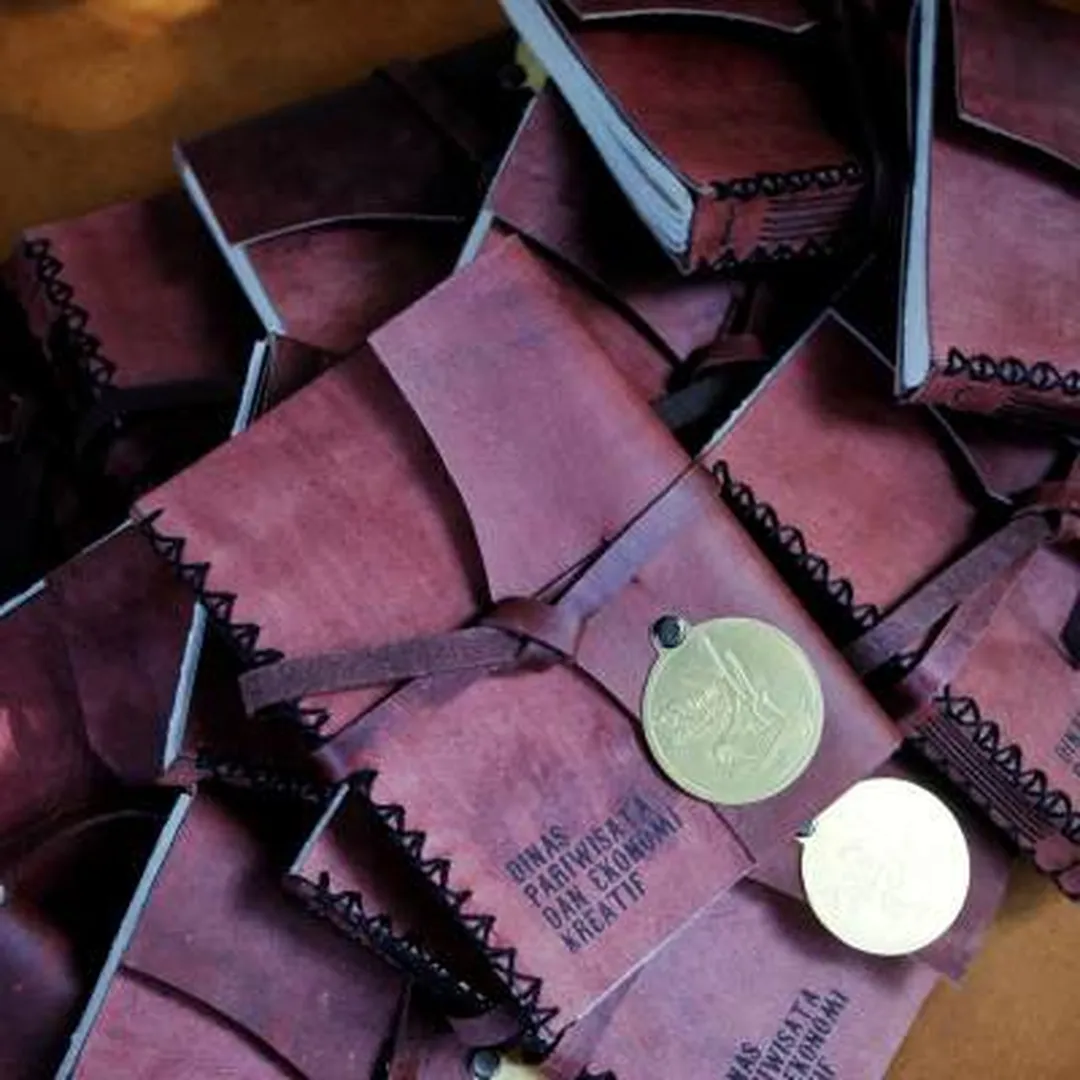
Business & Whitelabel
Business and corporate gift solutions in the form of exclusive agendas carrying your company’s logo.
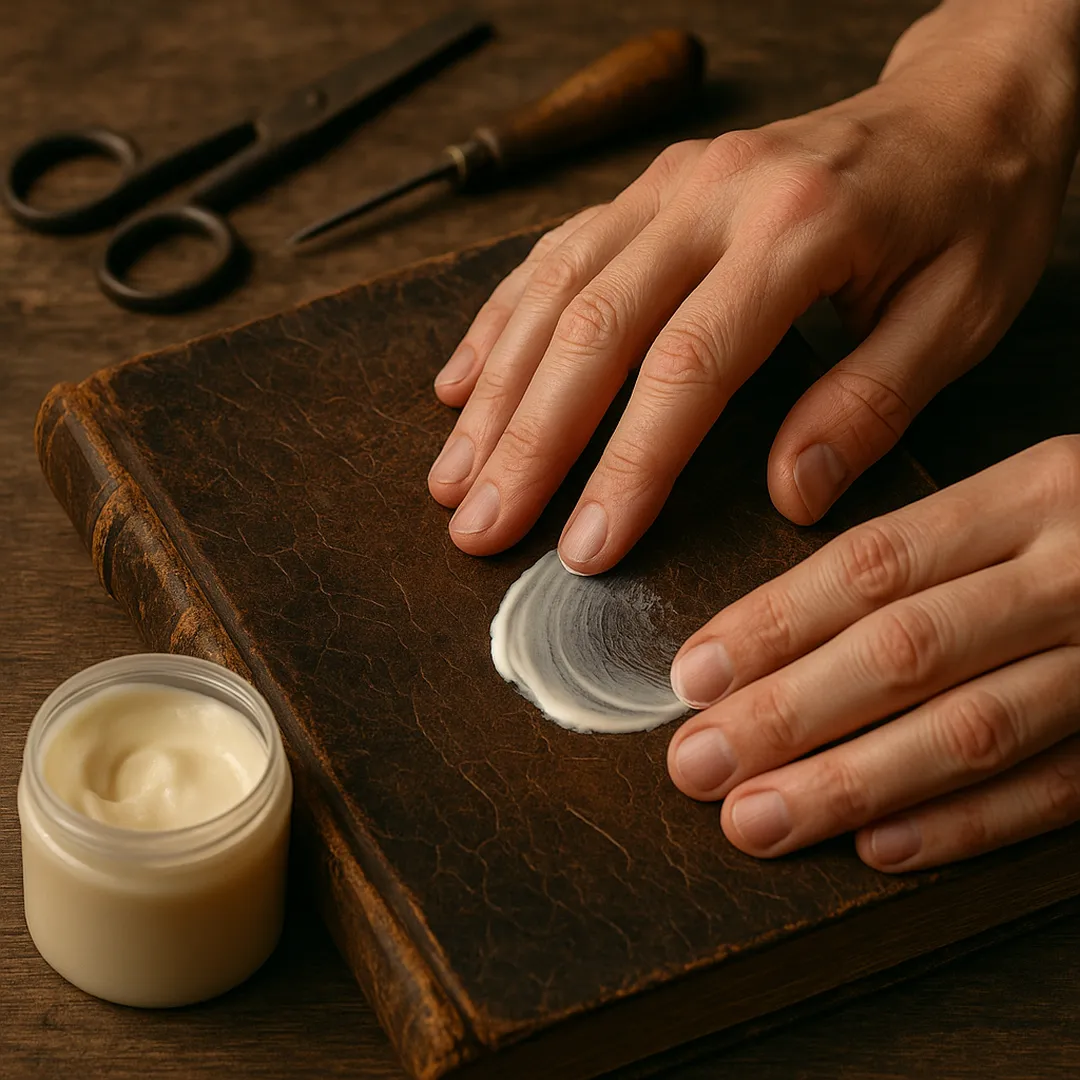
Book Repair & Conservation
Repair and conservation for antique books, family heirlooms, or private collections of historical value.