
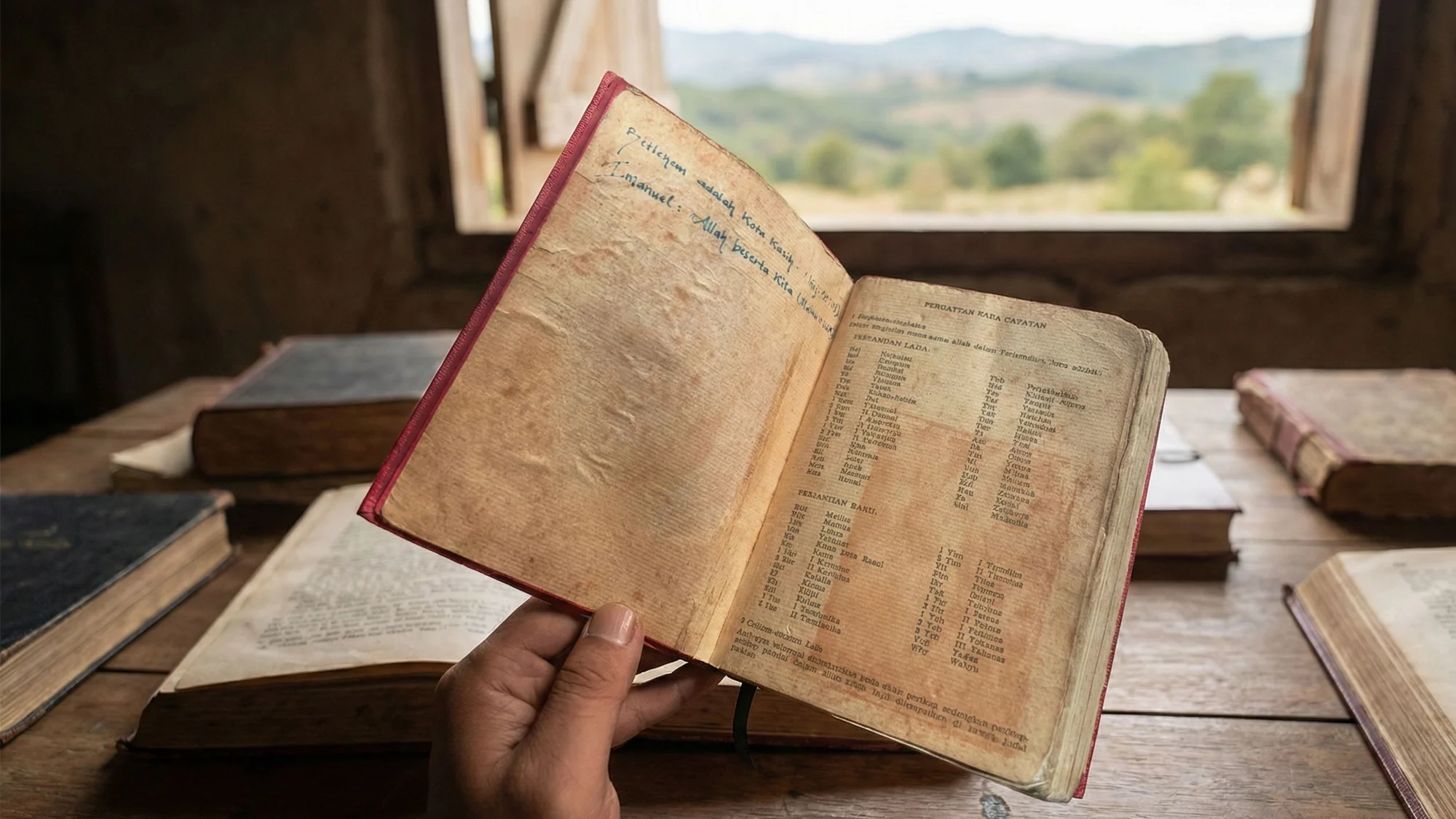
Professional Book Repair, Restoration and Reconditioning by Hibrkraft. Serving all of Indonesia.
Whether it is your parents’ treasured book beginning to grow fragile, a rare volume that demands precise restoration, or the handbook you open and close every single day, the Hibrkraft team tends to every page with trained hands, the best materials, and undivided attention.
Every book and every document has a story of its own. We are the ones who keep it.
As a member of the International Institute for Conservation of Historic and Artistic Works (IIC), we bring world conservation standards into respectful hands in Bogor, and to the whole of Indonesia.
Track Record
- 15 Years of Work
- 100,000+ Products Made
- 4.9 Google Rating · 85 reviews
- 5 Countries UAE · MY · CA · DE · NL
- 2,000 pcs Capacity / Month
- Trusted by
- Pertamina · POLRI · PPLi · Unilever
- Covered by
- TVRI · Trans7 · MNC Home Living · iNews Radio
- In print
- Tabloid Nova · Bogor Today · Tren Bogor
- Awards
- UDUNAN 2020 Winner · Ekraf Jabar · Mitra Jabar
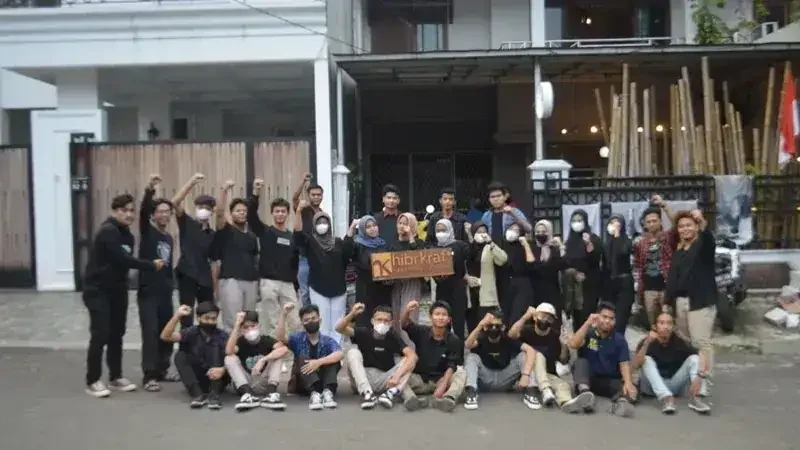



For vendor applications, tenders and corporate partnerships.
Four tiers
Catur Karya
Every book is damaged in its own way, so there is no single price. Ordered here from the lightest work upward.
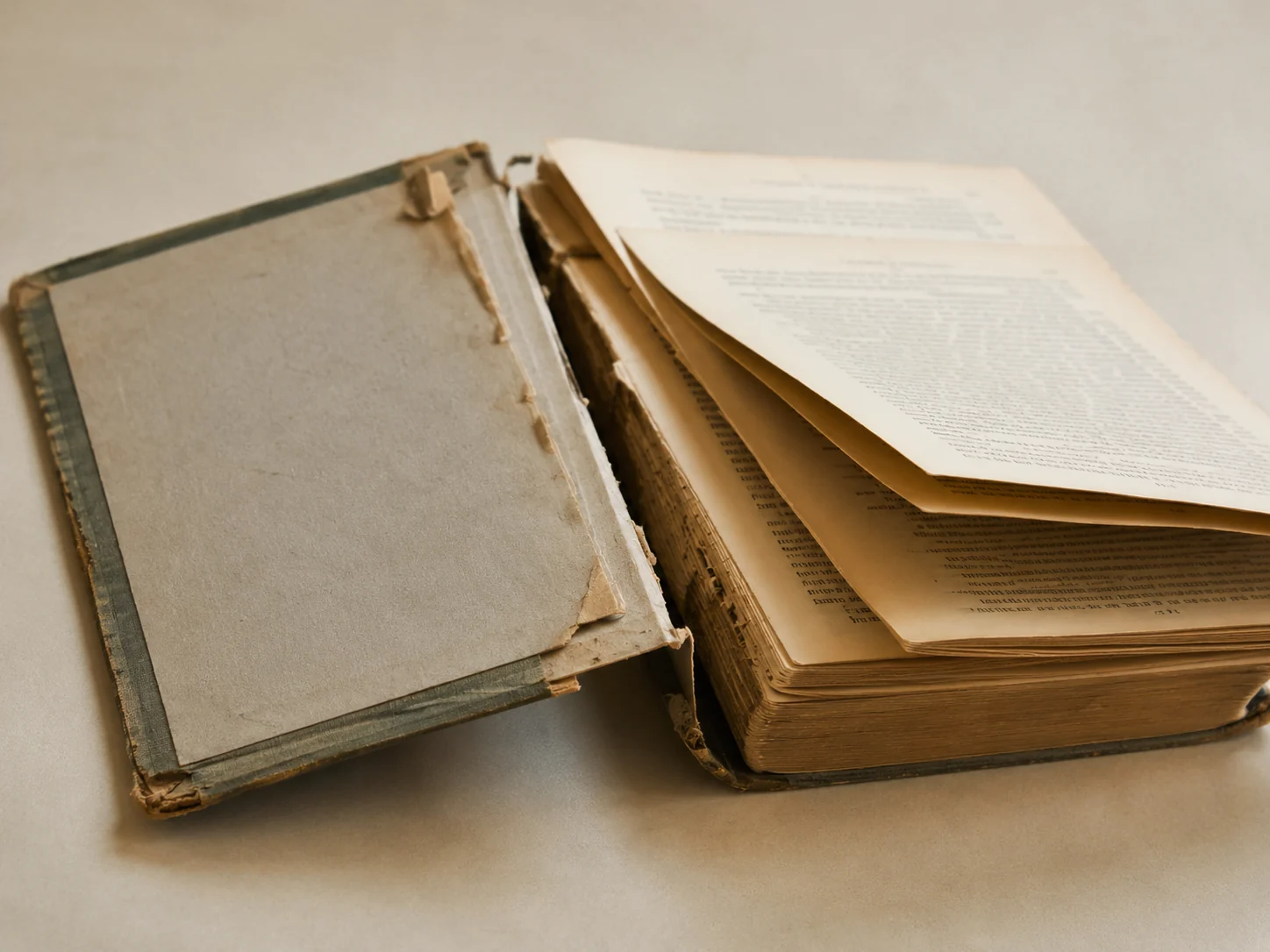
Repair
Rp 35.0003–5 working days
Careful repair of physical damage: tears, a loosened binding, or pages that have come away.
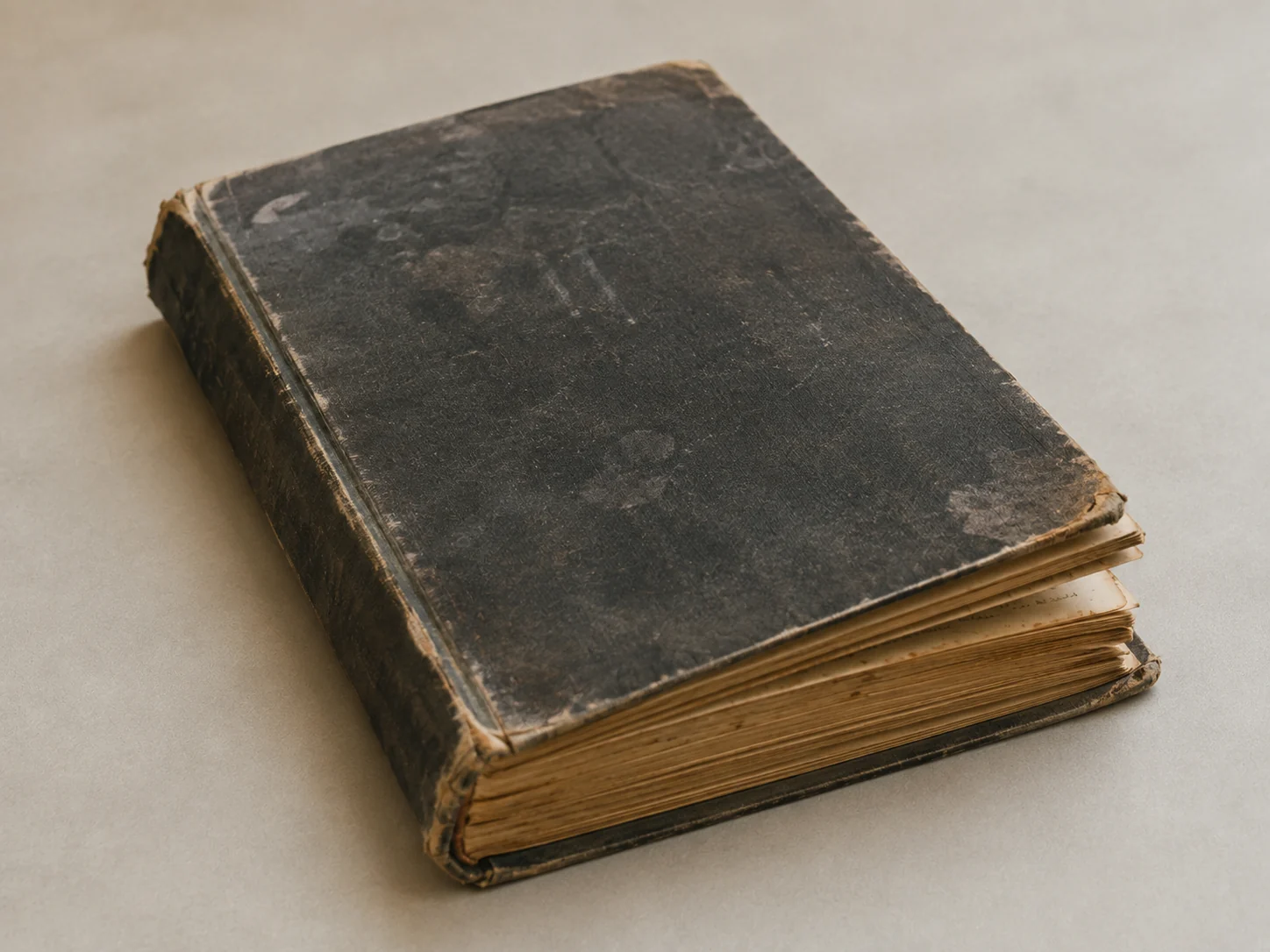
Reconditioning
Rp 45.0005–7 working days
Bringing a damaged book back to a handsome state without stripping away the character it already has.
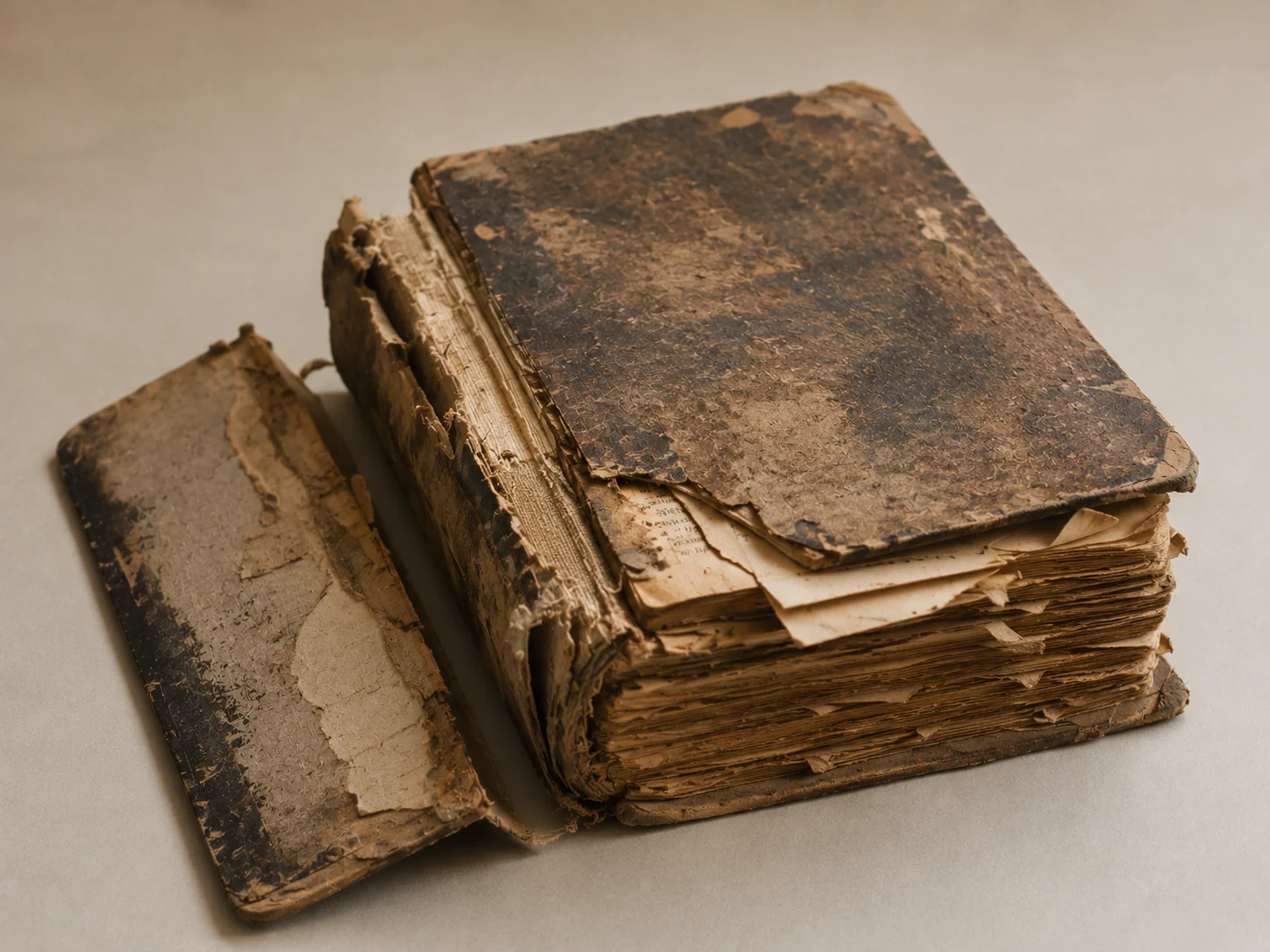
Restoration
Rp 85.0007–10 working days
A complete renewal of a damaged book, replacing elements and components. Structural change is included.
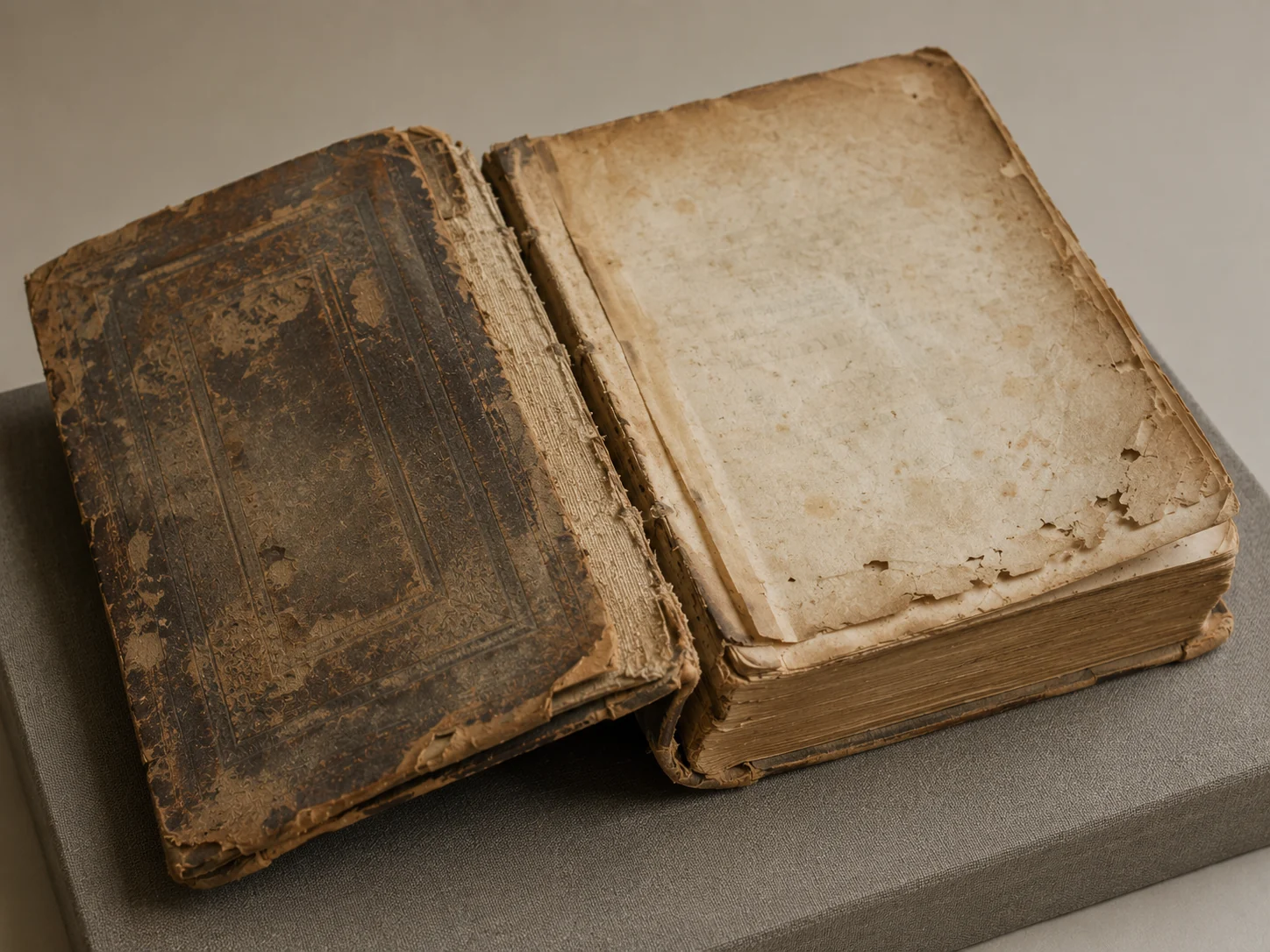
Conservation
Rp 125.00010–20 working days
Long-term preservation for rare or historic books, using reversible materials and recording every step taken.
First assessment
Which tier does your book fall into?
Two questions, and you know the tier, the starting price and how long the work takes — before contacting anybody.
| Condition of the book | Tier | From | Time |
|---|---|---|---|
| Still comfortable to read, only minor damage | Repair | Rp 35.000 | 3–5 working days |
| Still readable but dull or dirty, wants tidying | Reconditioning | Rp 45.000 | 5–7 working days |
| Dull and wanted like new, or fairly badly damaged on an ordinary book | Restoration | Rp 85.000 | 7–10 working days |
| Fairly badly damaged, and the book is historic or antique | Conservation | Rp 125.000 | 10–20 working days |
An estimate, not a quotation. The final price follows the size, the number of pages and the materials — send photographs and we will work it out for you, free.
Work on film
The process, filmed
Click to play. The video only loads from YouTube once you press play — before that this page contacts no server but our own.
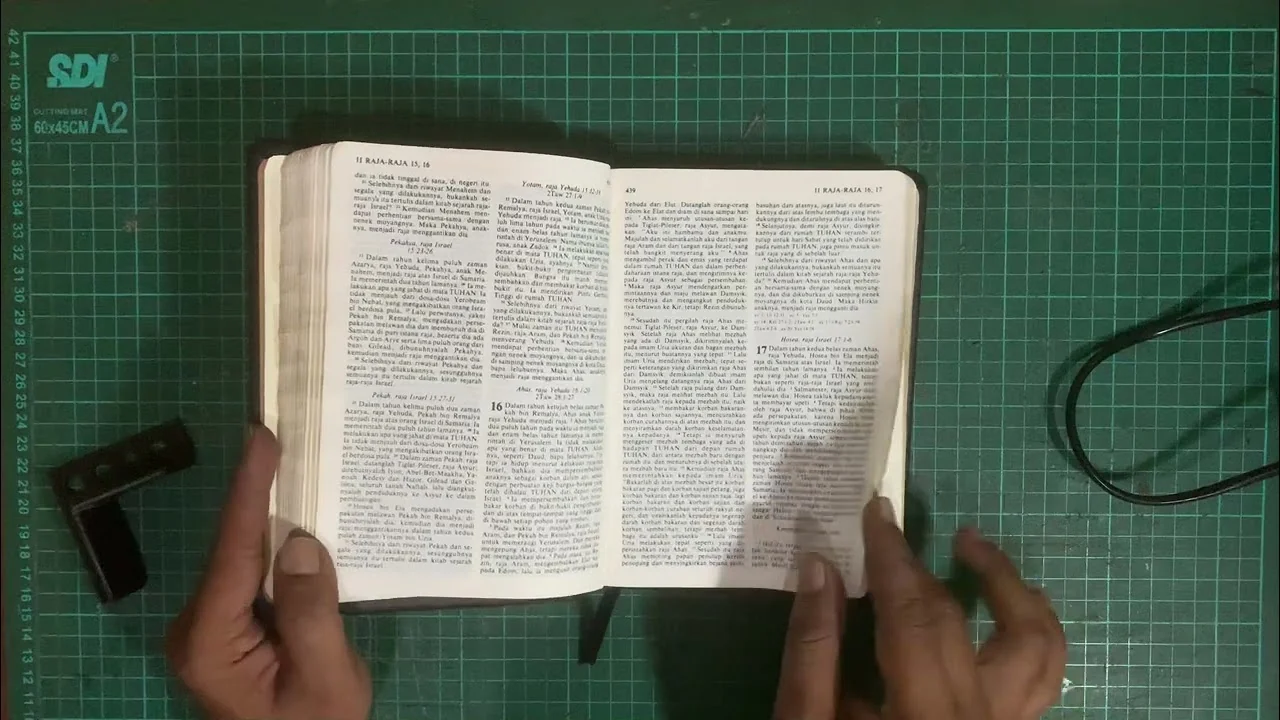 The finished result: a Bible rebound in genuine leatherThe old cover replaced with genuine leather, the text block resewn.
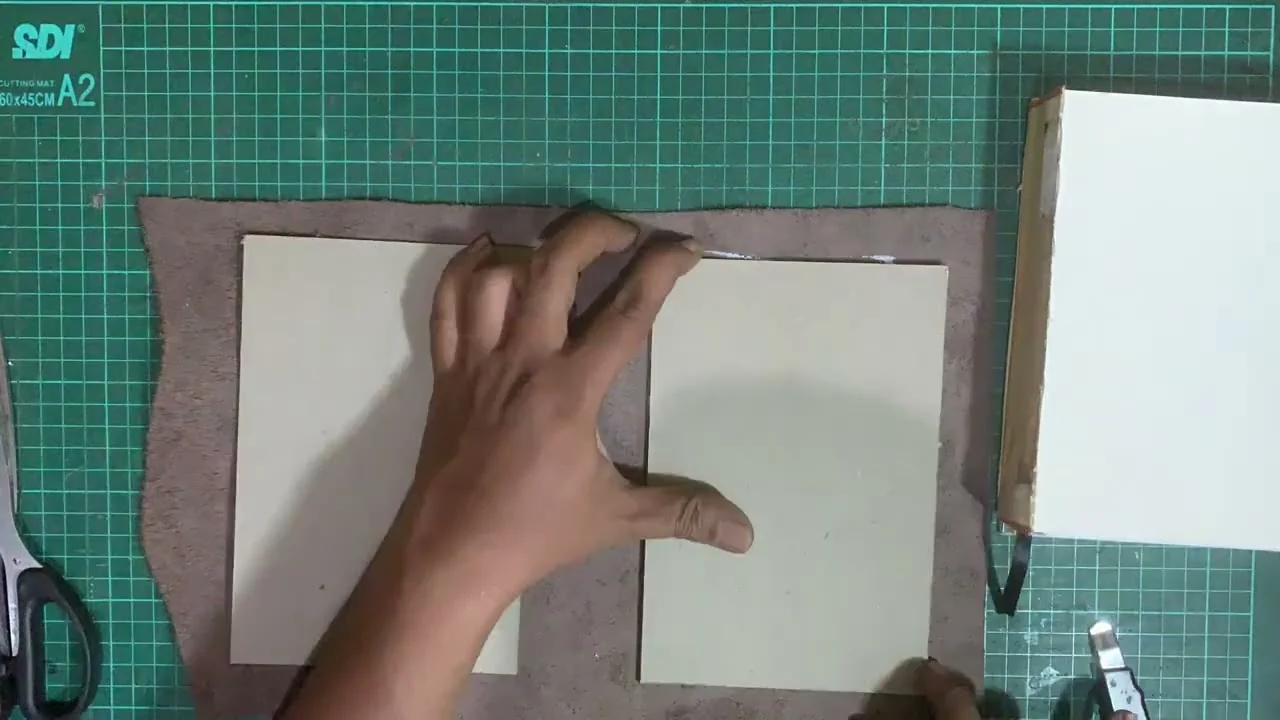 Timelapse: gluing the cover boardsOne small stage of the binding process, sped up.
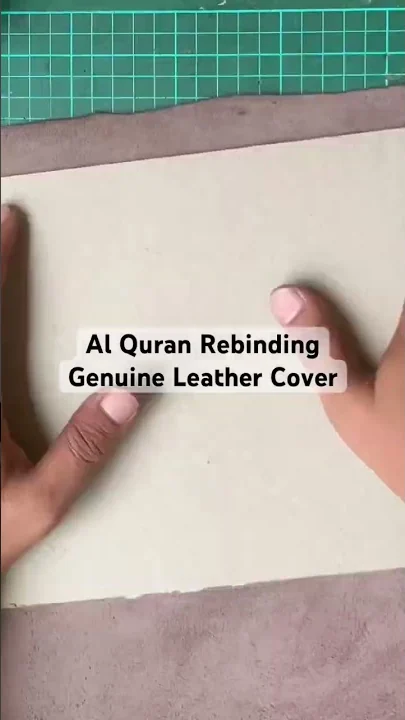 Rebinding and recovering a Qur’anGenuine leather, resewn.
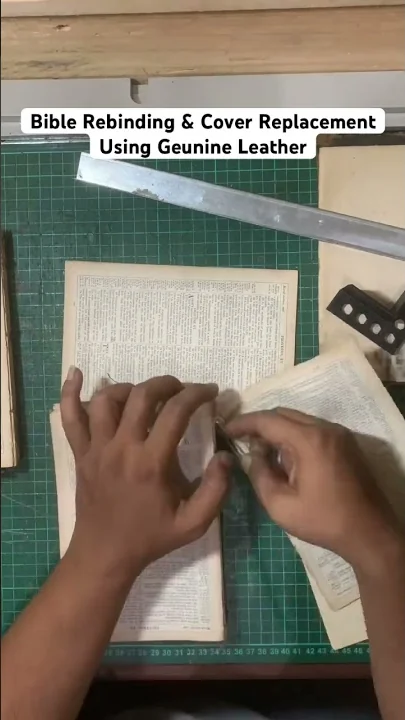 Bible repair: rebinding and a new coverFrom a detached cover to a book that opens again.
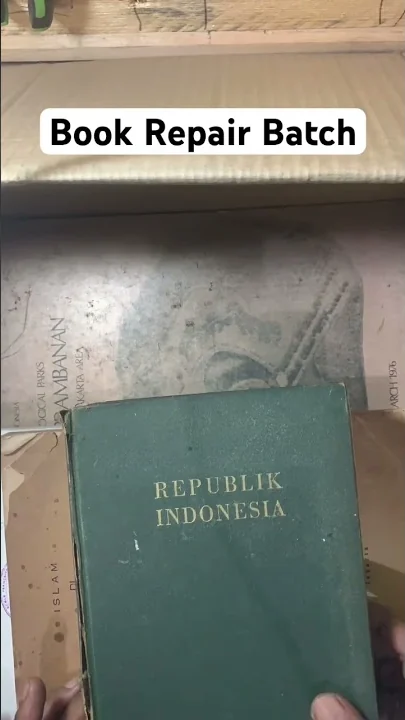 Batch inspection of a library collectionEvery book is examined one by one before any work starts.
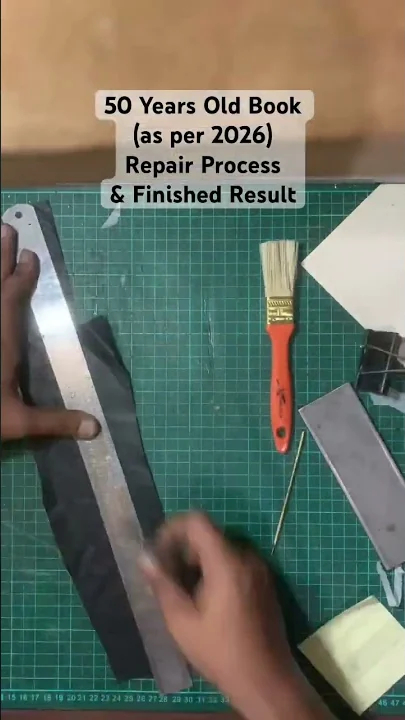 Library book repairA 50-year-old book, the process and the result.
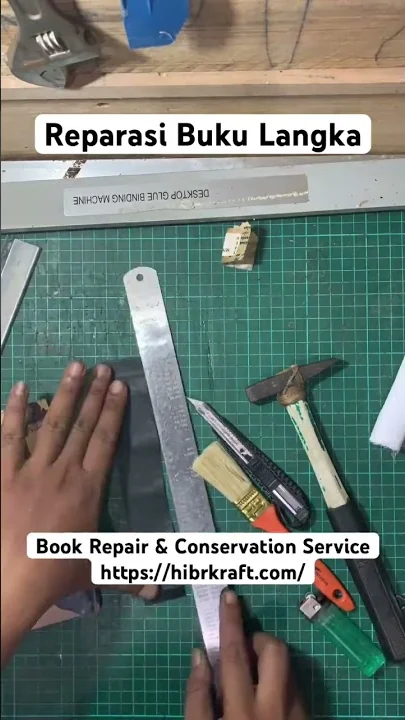 Rare book repair, to conservation standardReversible materials, every step recorded.
Real work
Books that have come through this workshop
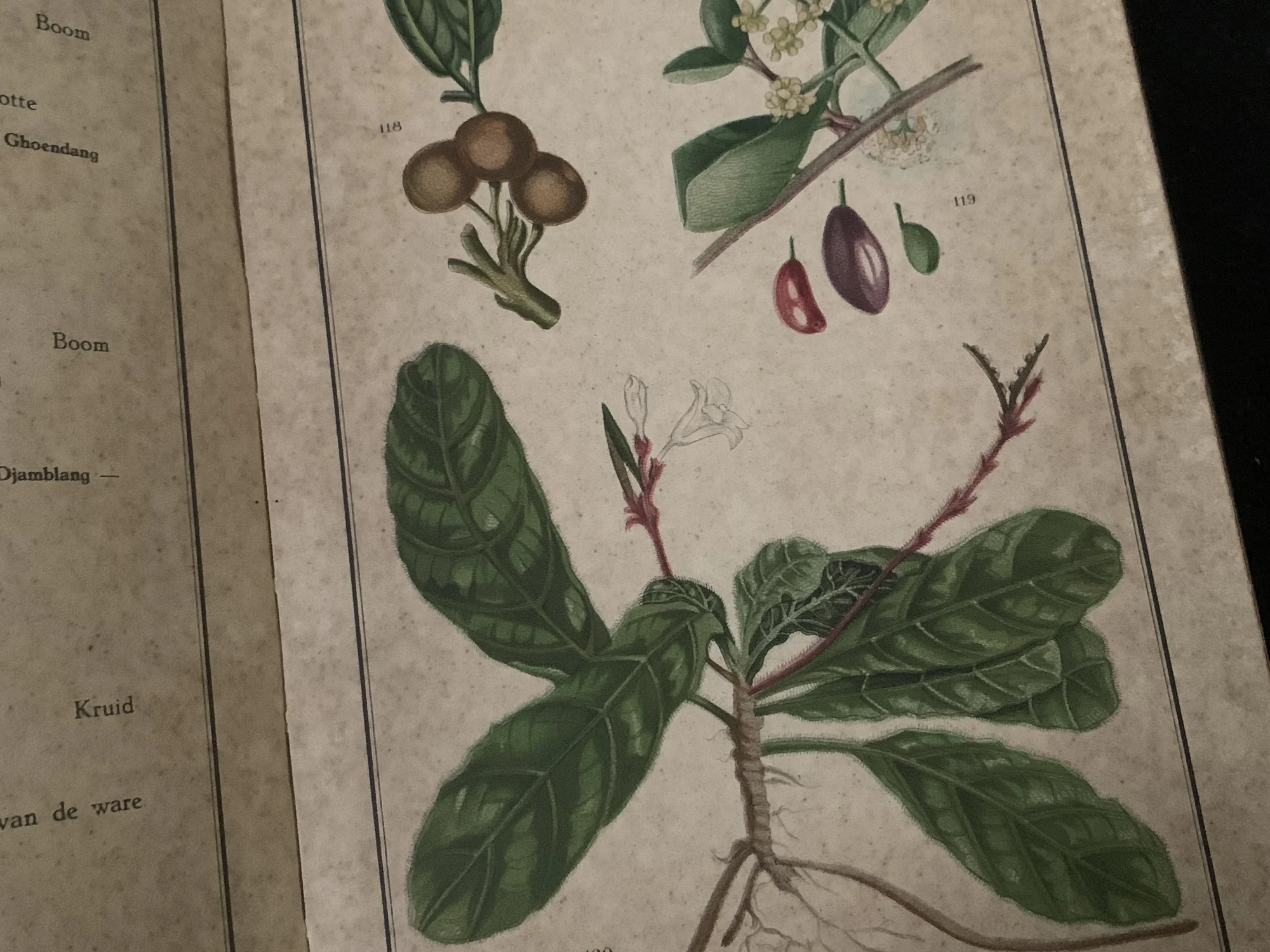
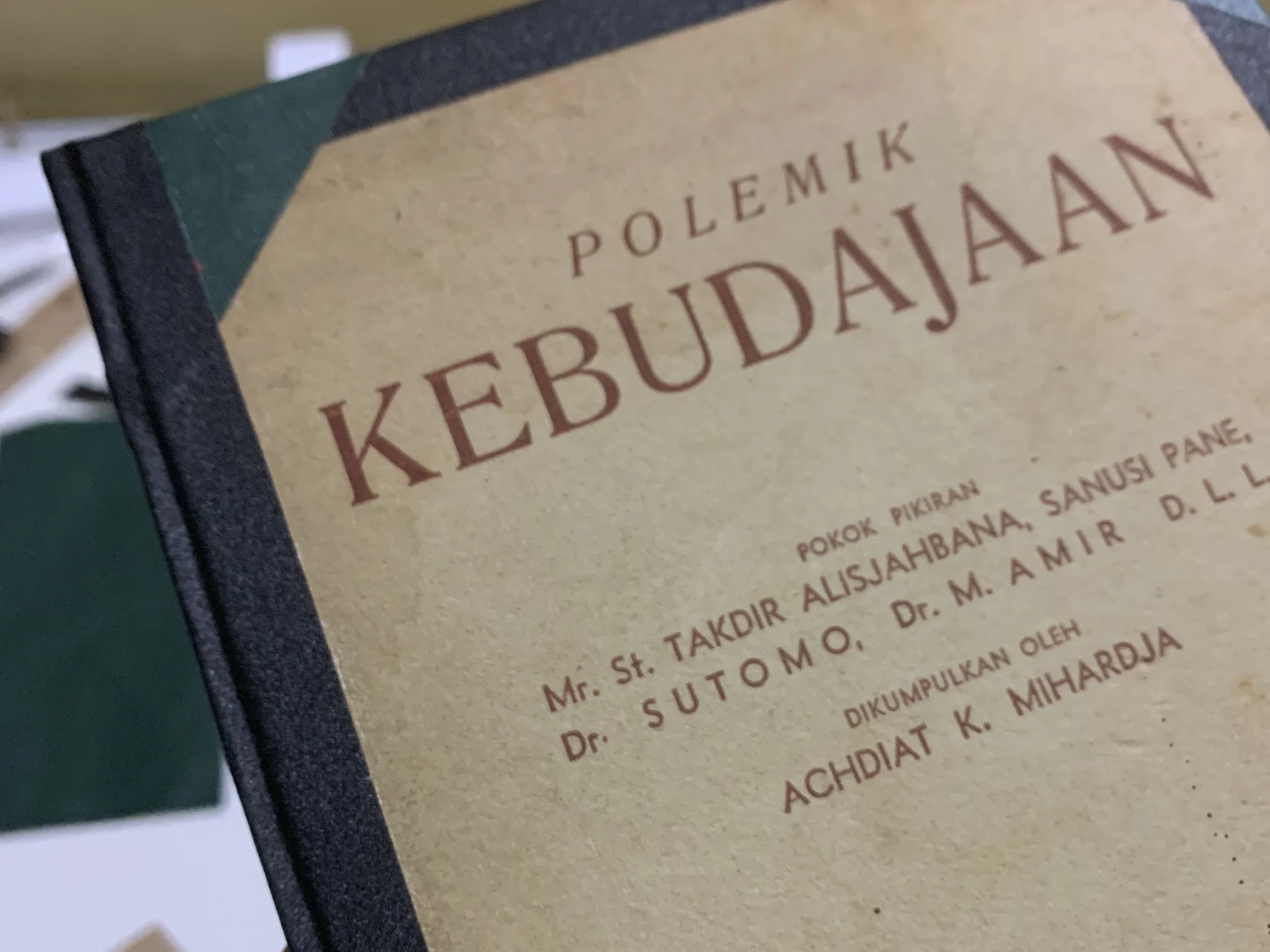
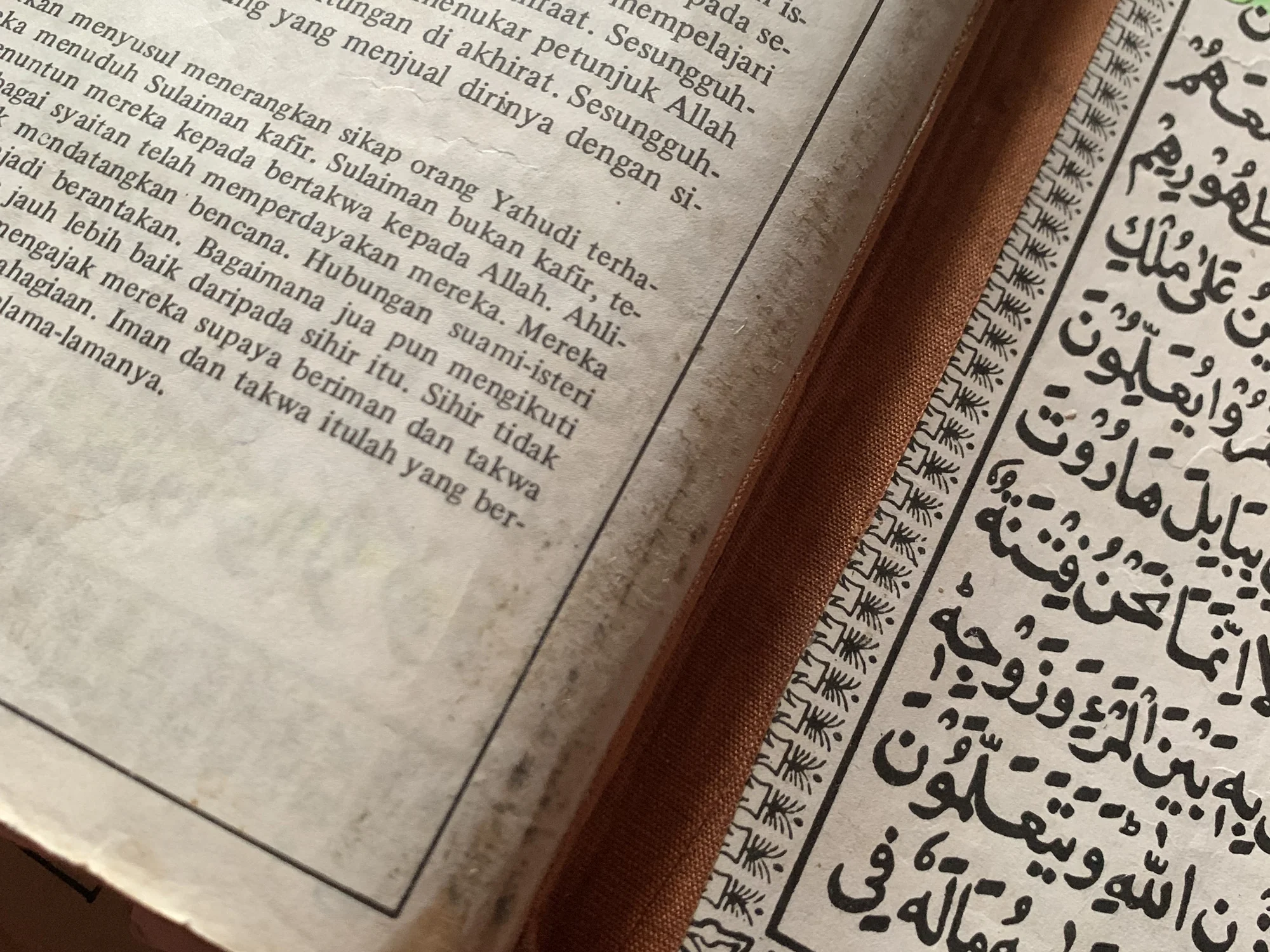
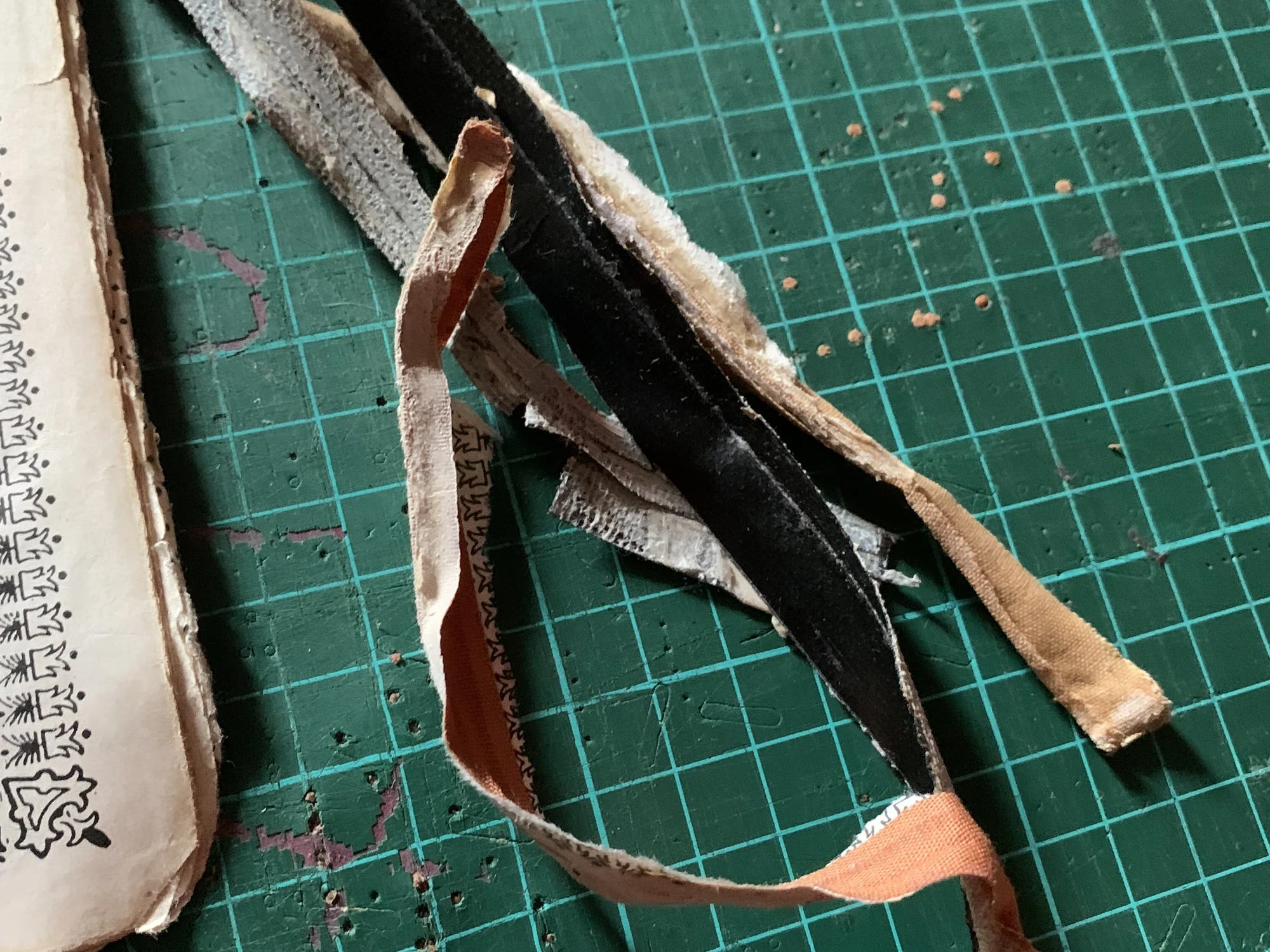
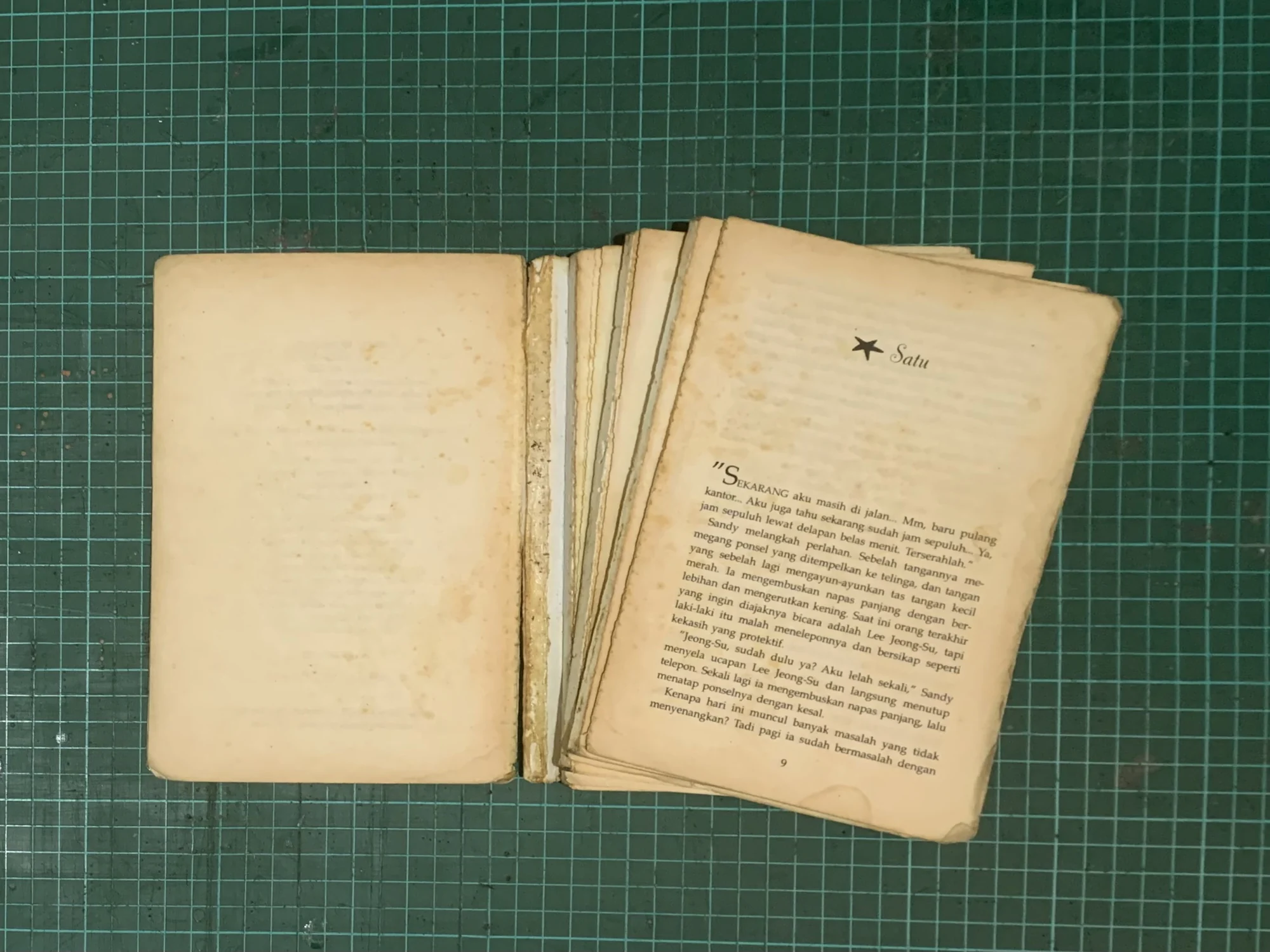
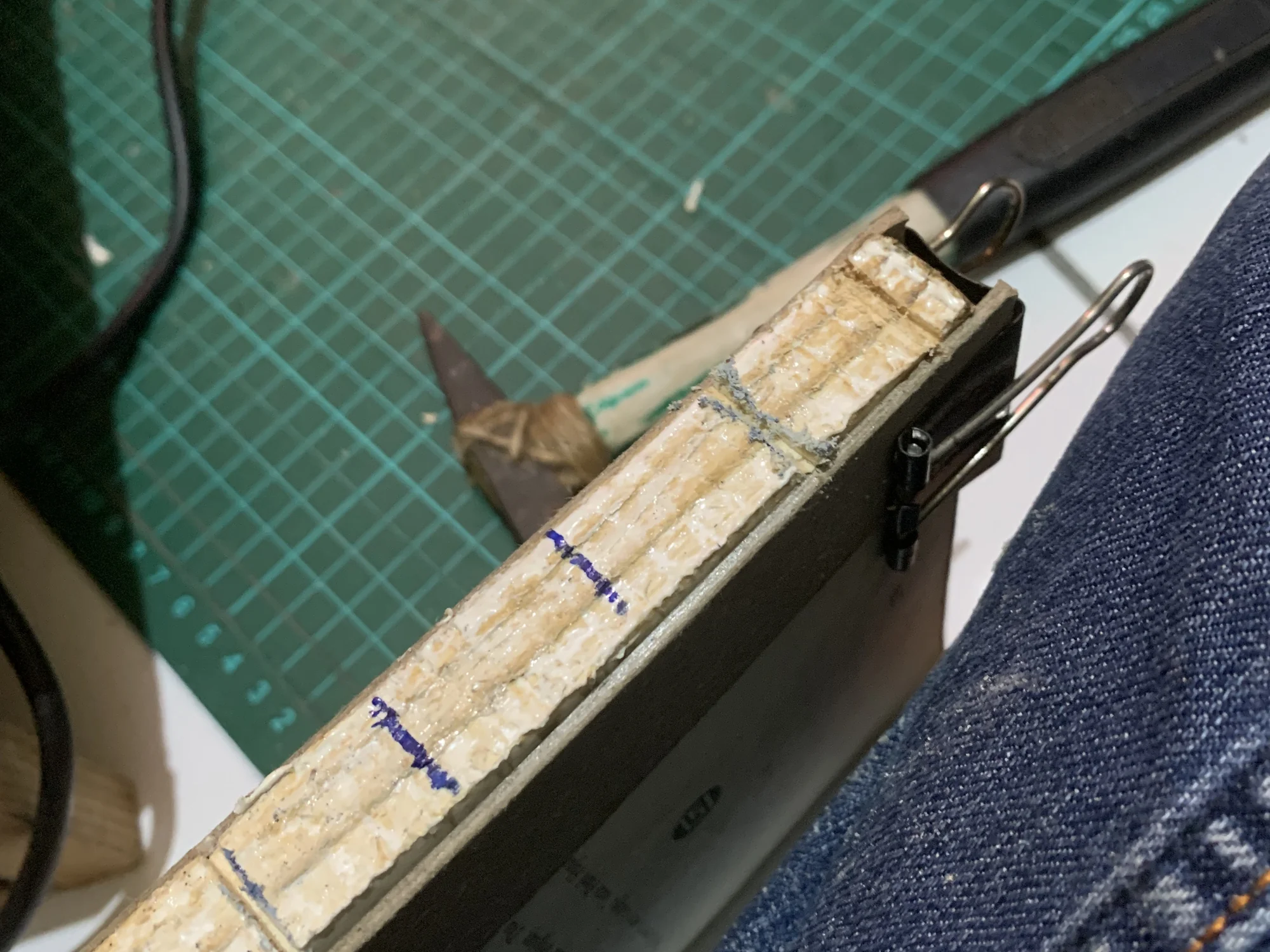
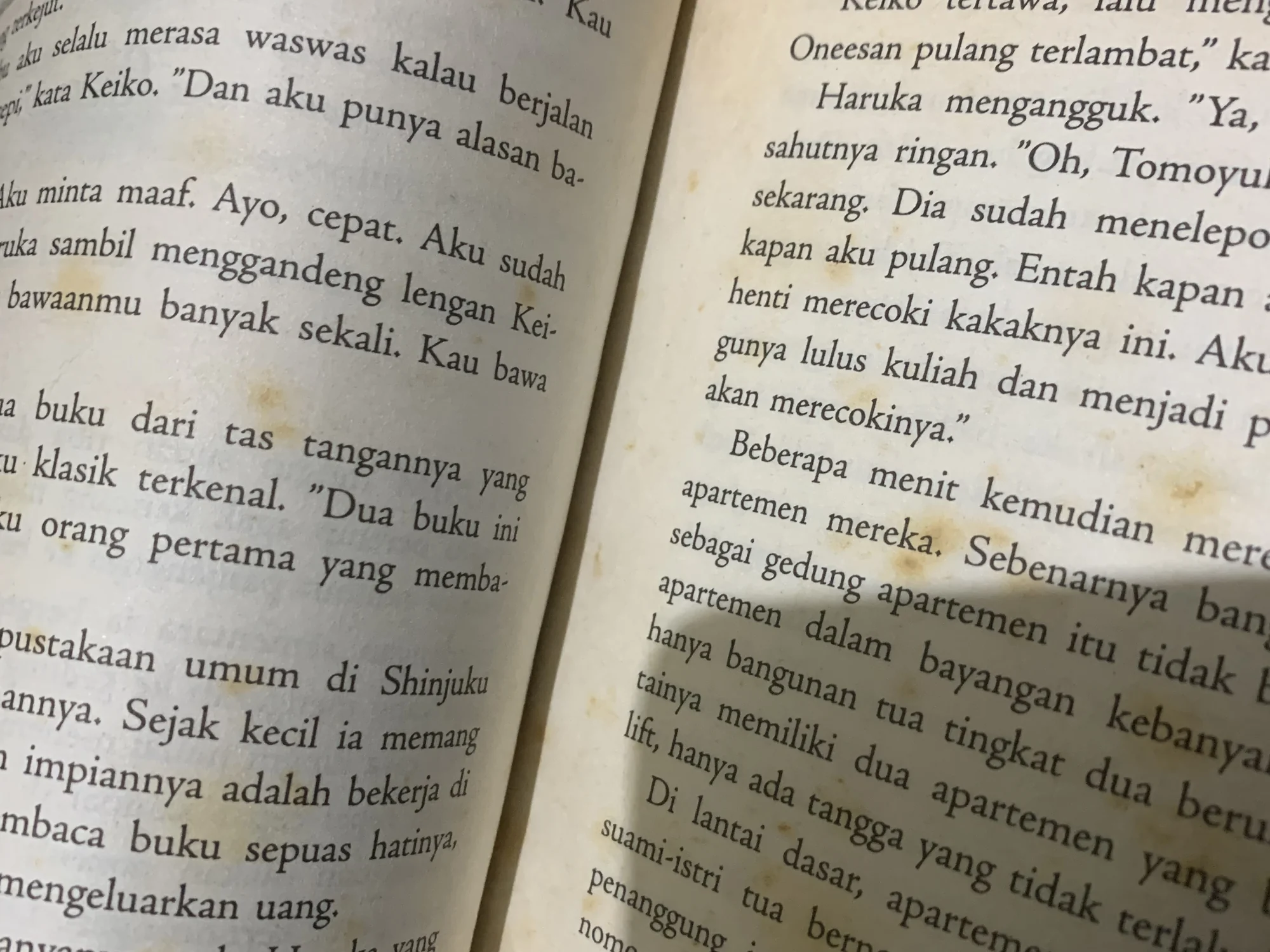
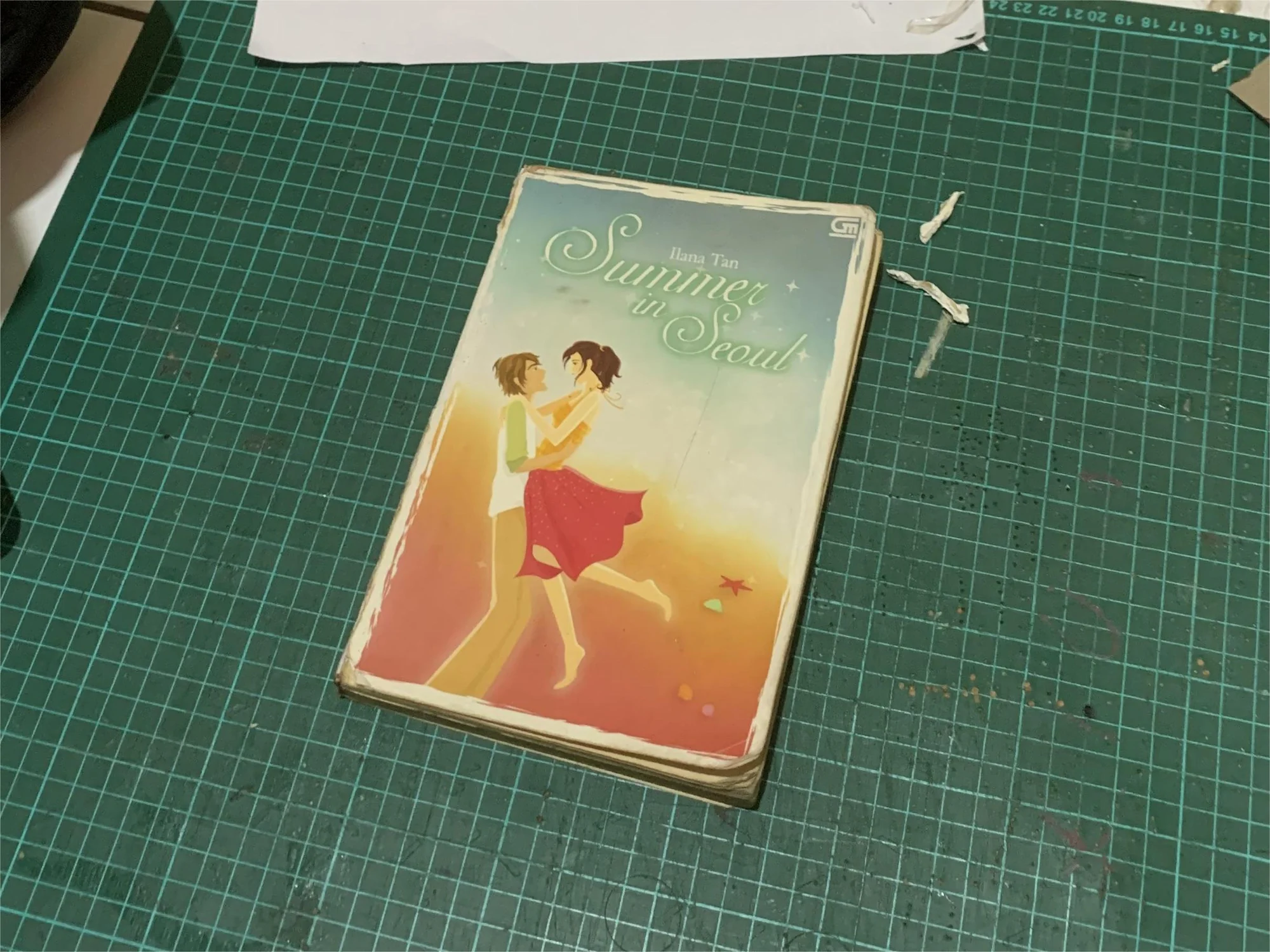
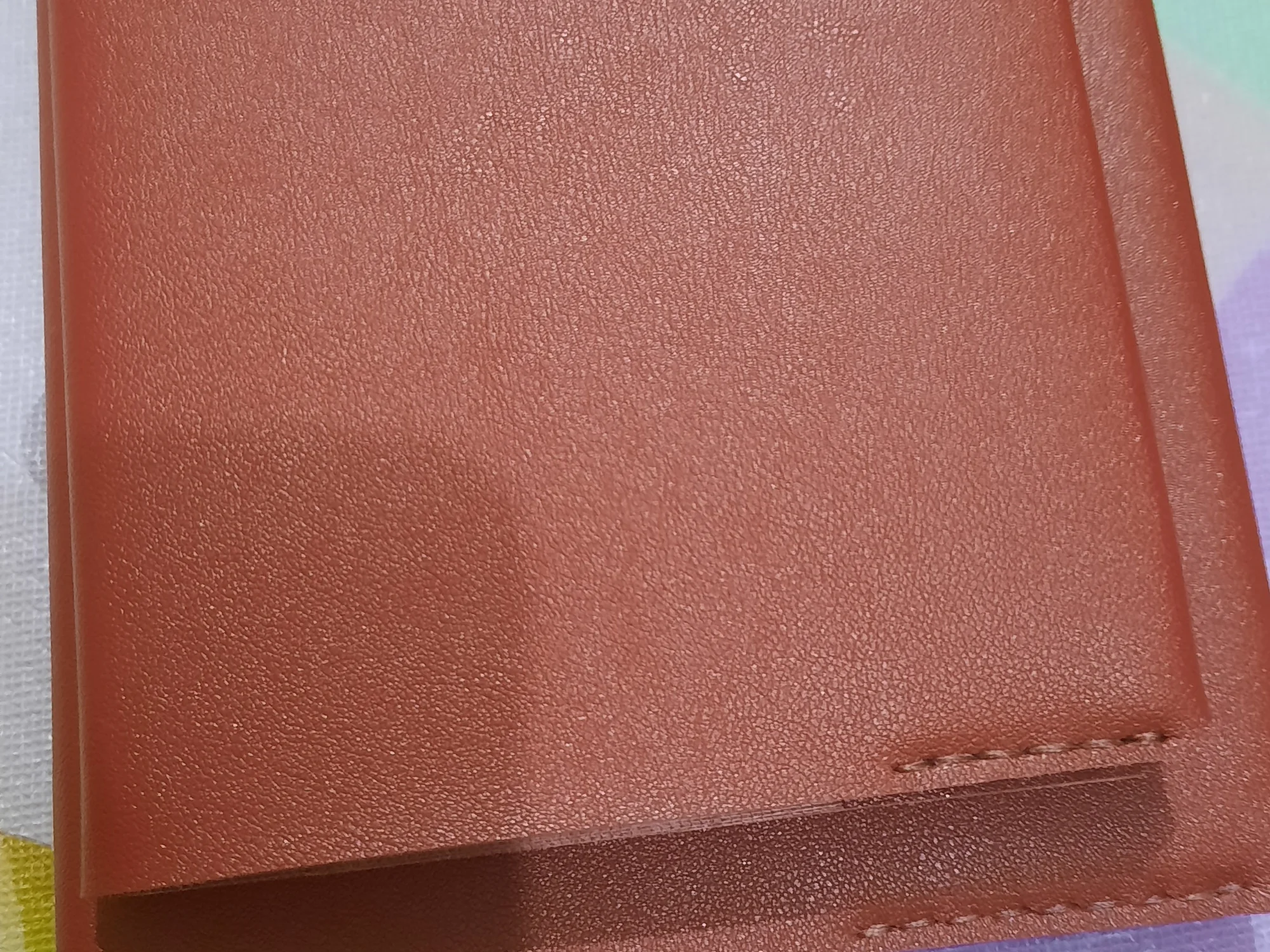
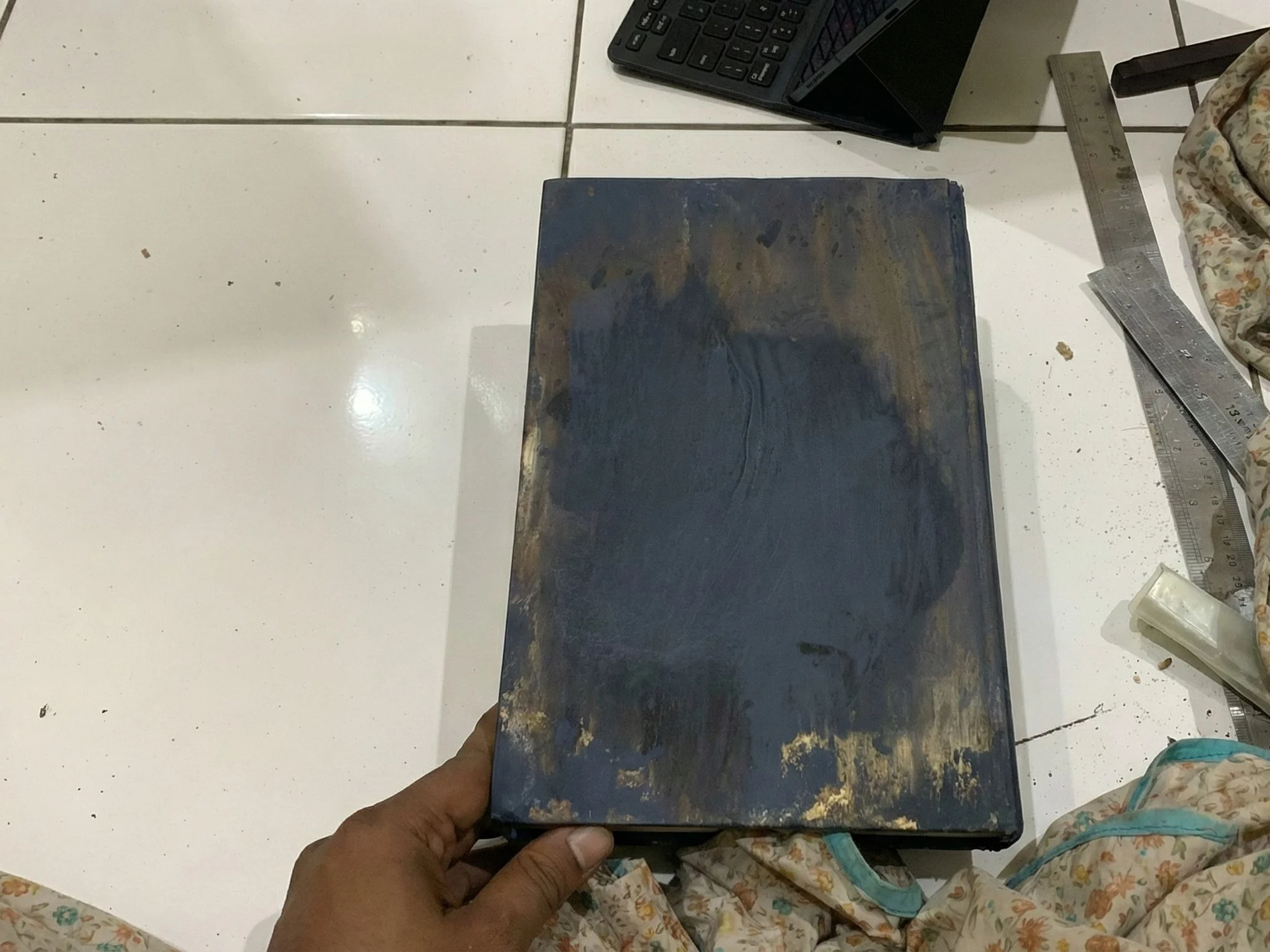
One job
The Al-Huda mushaf, before and after
The film comes from our own bench and our own server, not from YouTube — this page contacts nobody to play it, and downloads nothing until you press play.
One book, filmed twice: the day it arrived, and the day it was finished. What happened in between needs no words.
What you see in those final seconds is the measure we hold every binding to — the book lies flat, and stays where it was opened. A mushaf that still has to be held down with both hands every time it is read is, to our mind, not finished.
If your book is in a similar state, the two questions in the first assessment will tell you the tier and the starting price before you contact anybody.
The standard
Conservation follows different rules
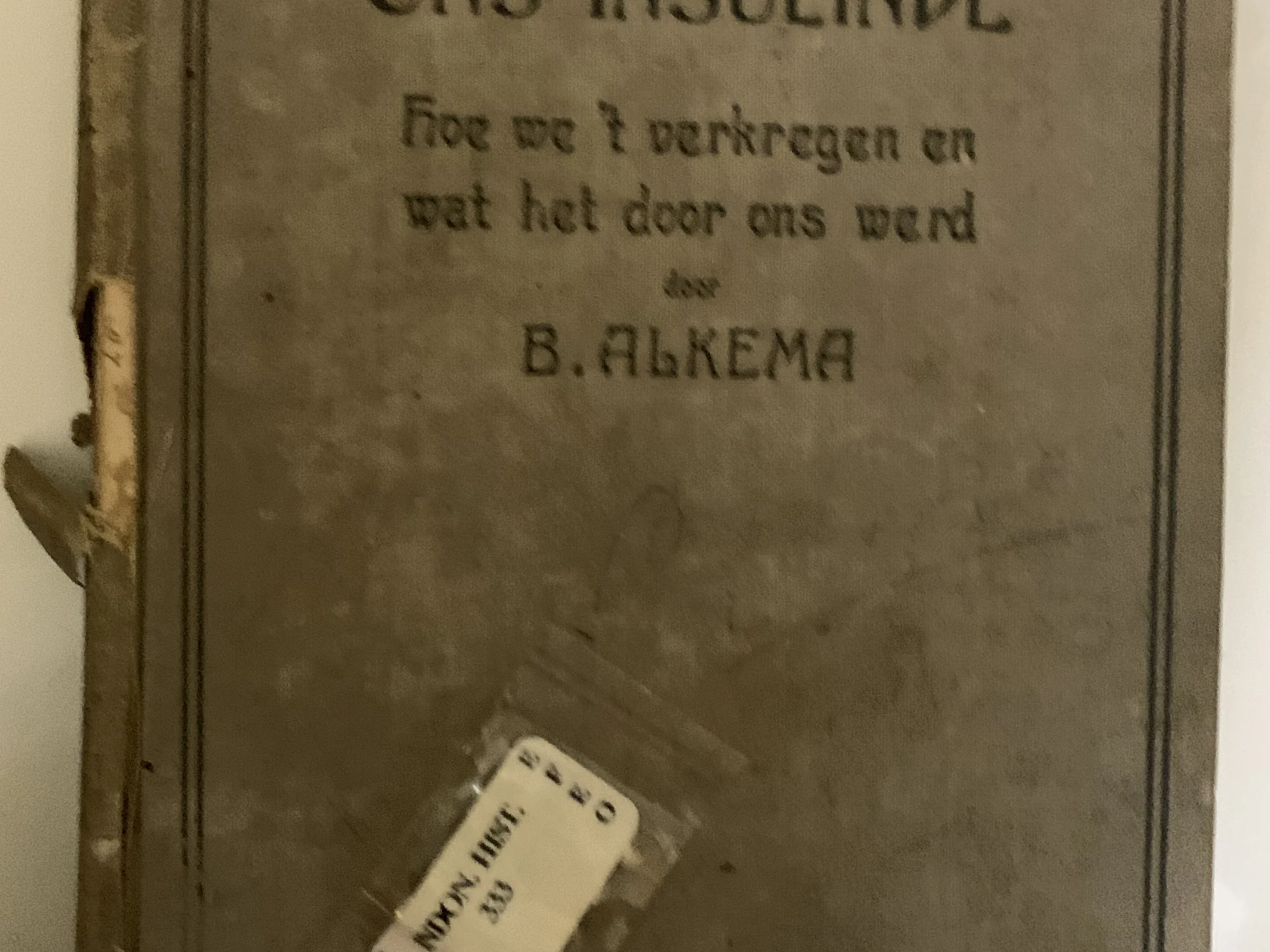
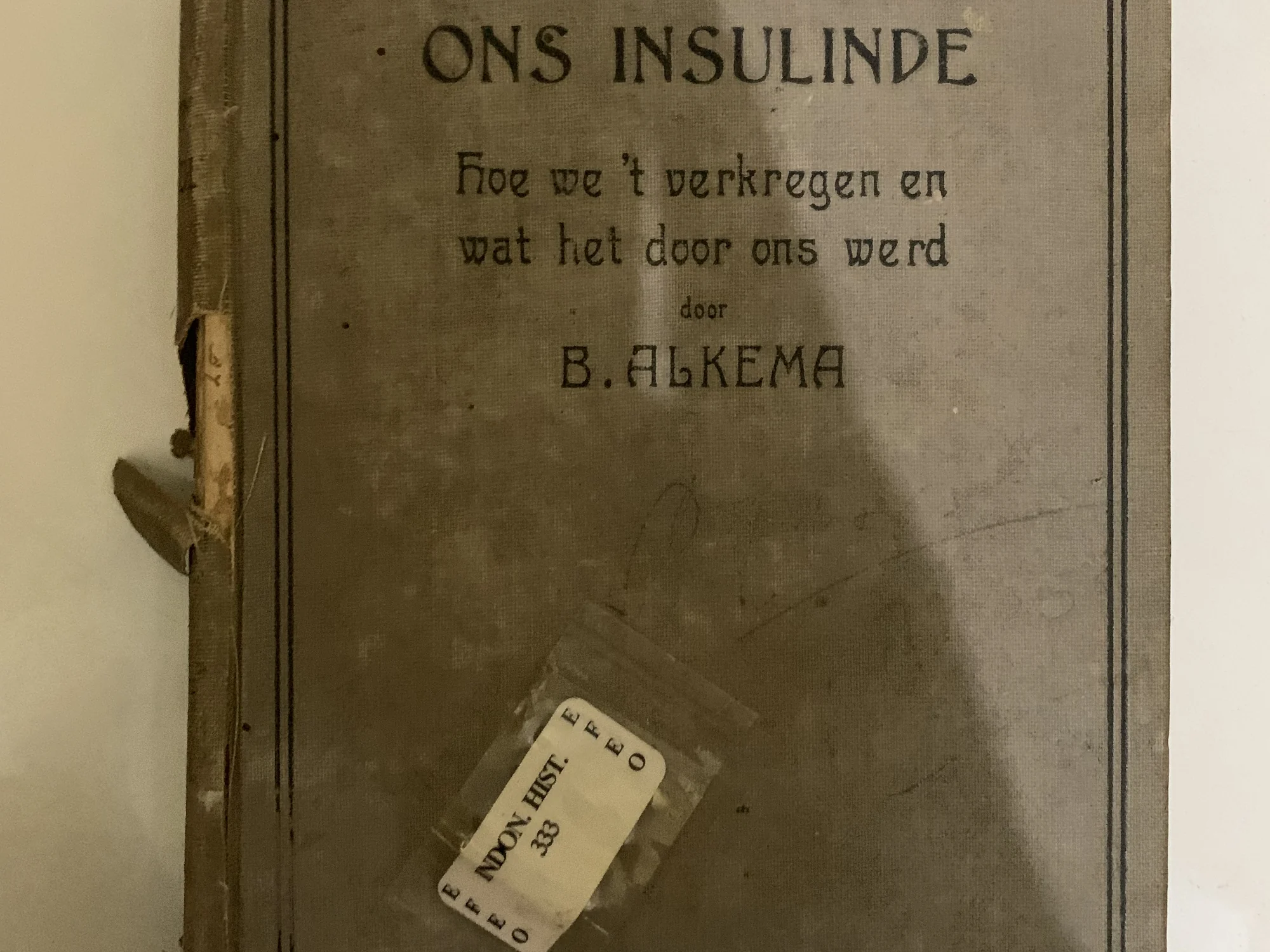
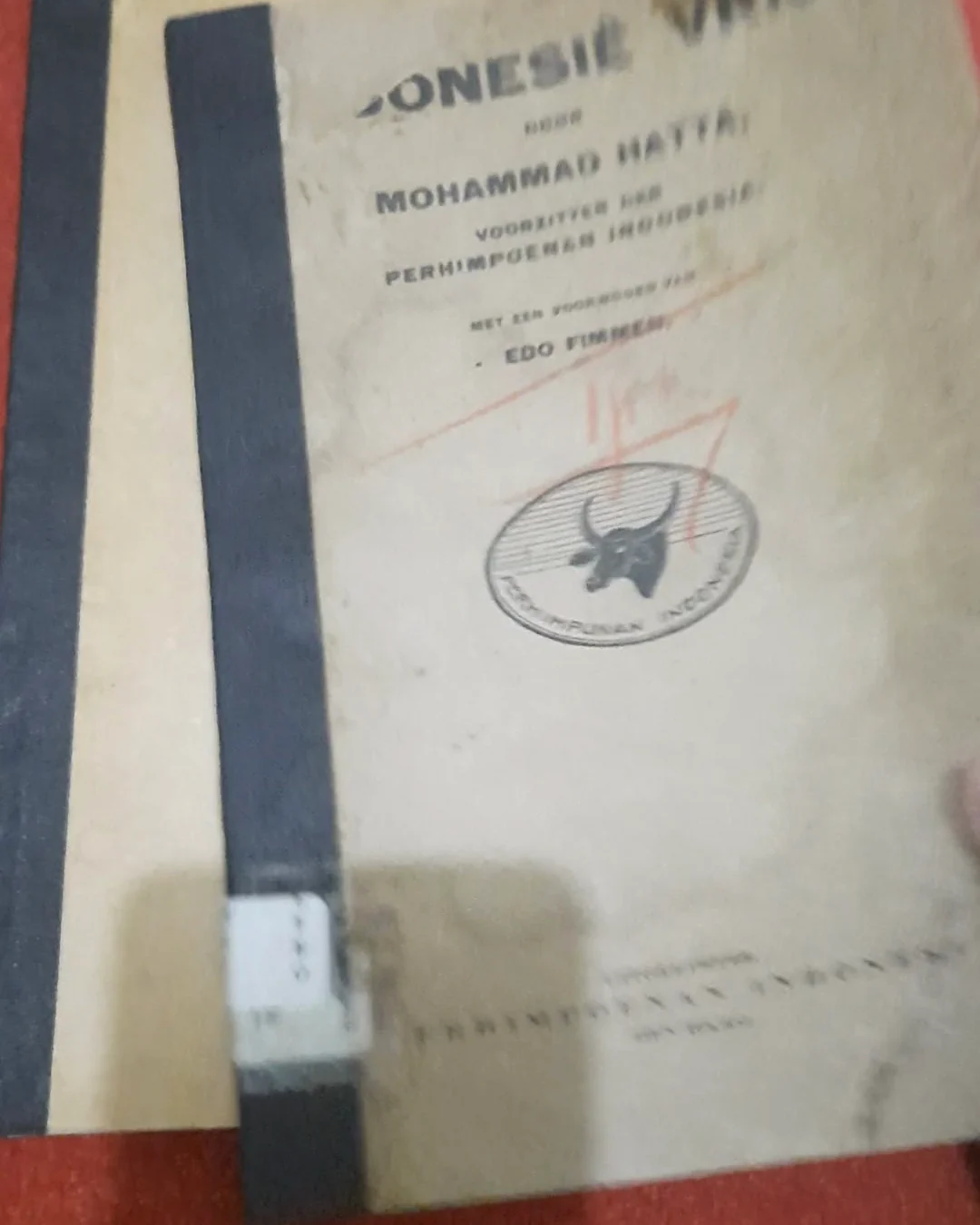
This book belongs to EFEO Indonesia — Mohammad Hatta’s 1928 defence speech. For a collection like this the materials must be reversible, nothing may be discarded, and every step is recorded.
We are members of the International Institute for Conservation of Historic and Artistic Works. For a book that cannot be replaced, that is the standard.
Why us
Four reasons people send their books here
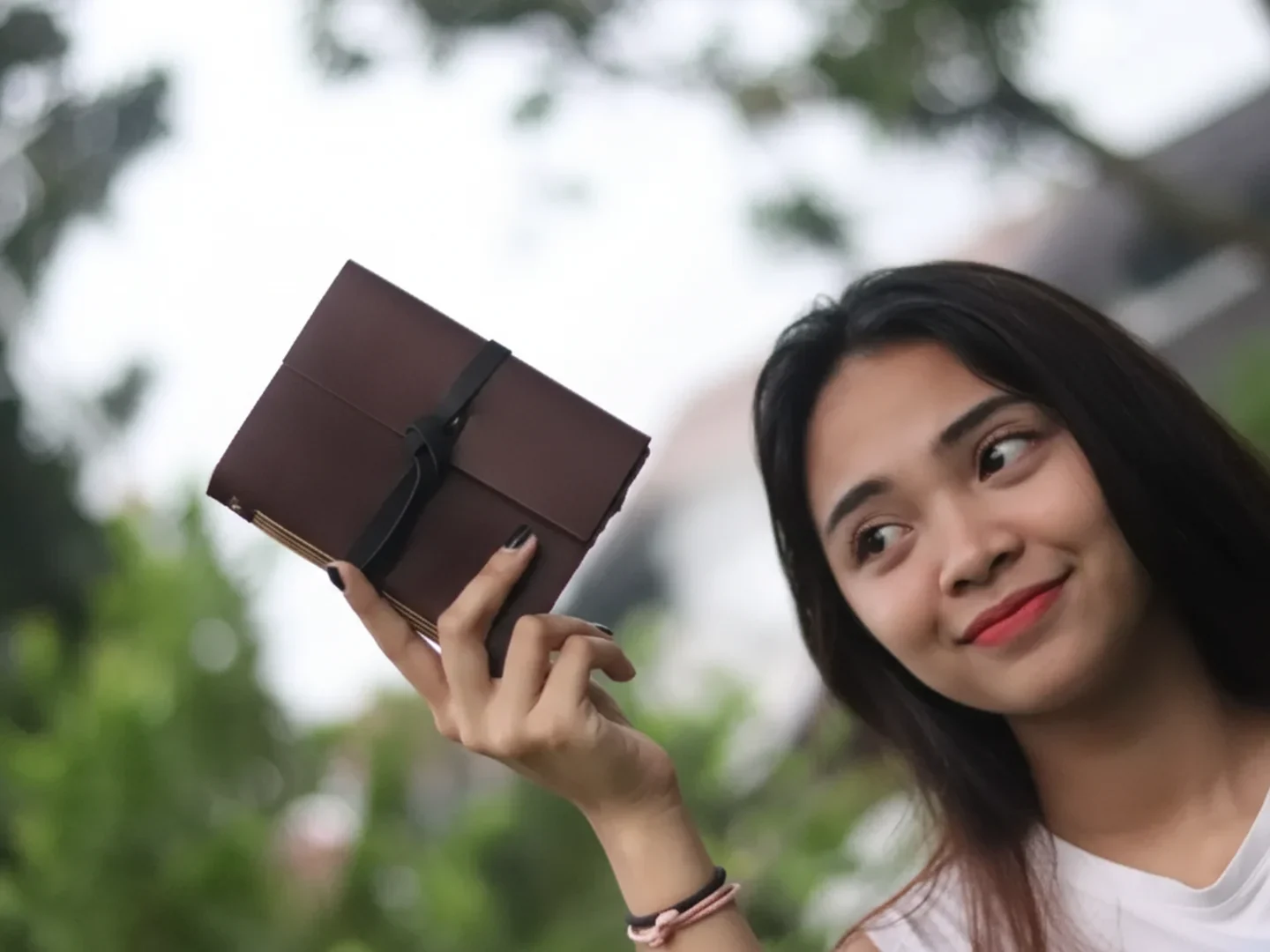
Deep expertise, and an international standard
Our team are full members of the IIC (International Institute for Conservation). We work to the same conservation standard as world-class museums and libraries. Every treatment uses archive-grade materials and reversible technique.
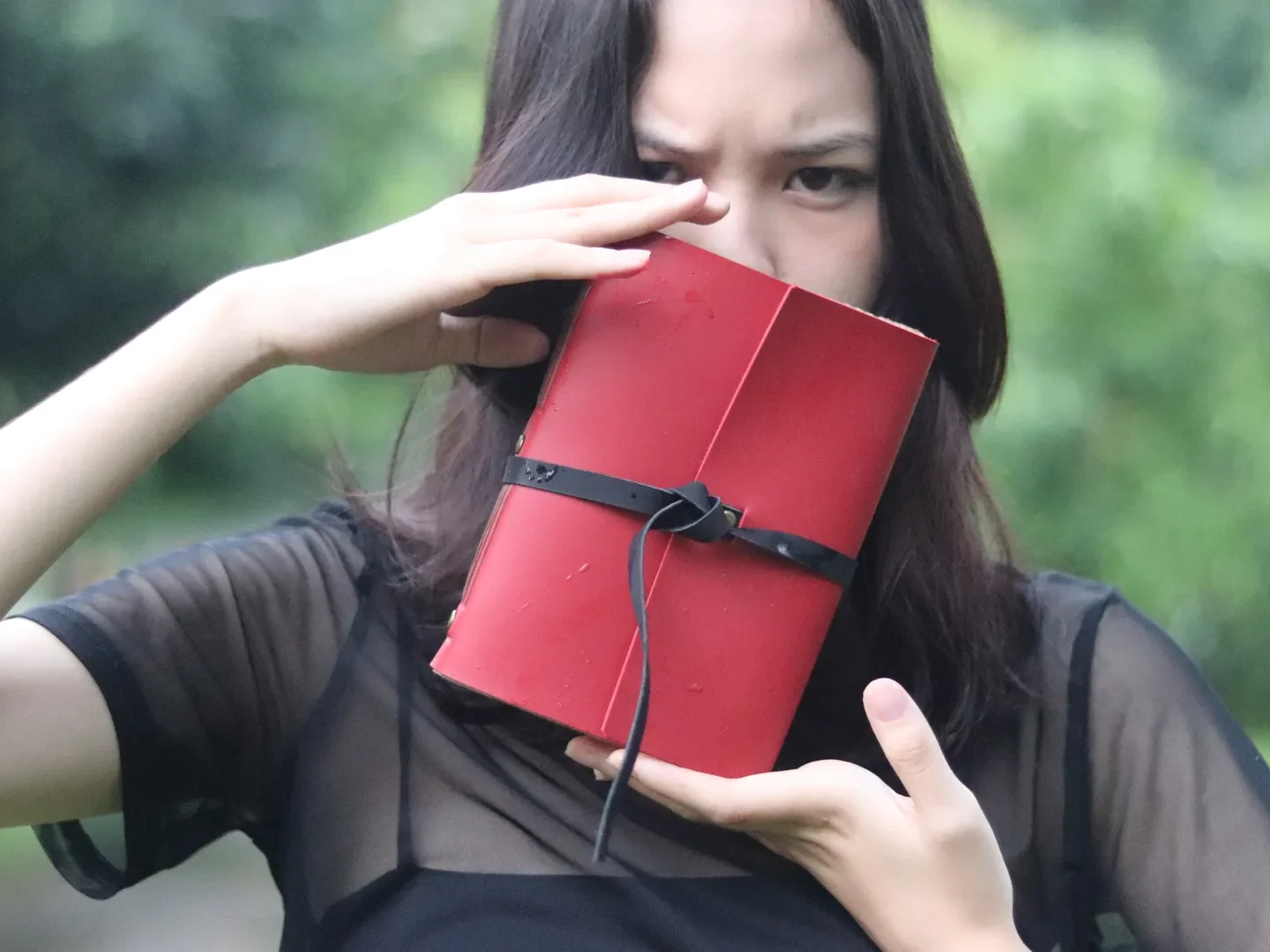
We are fond of every book
To us a book is not merely an object. Every book that arrives at the workshop carries a story, a memory, and a value nothing can replace. We treat your book as though it were our own — with respect, with care, and with full attention.
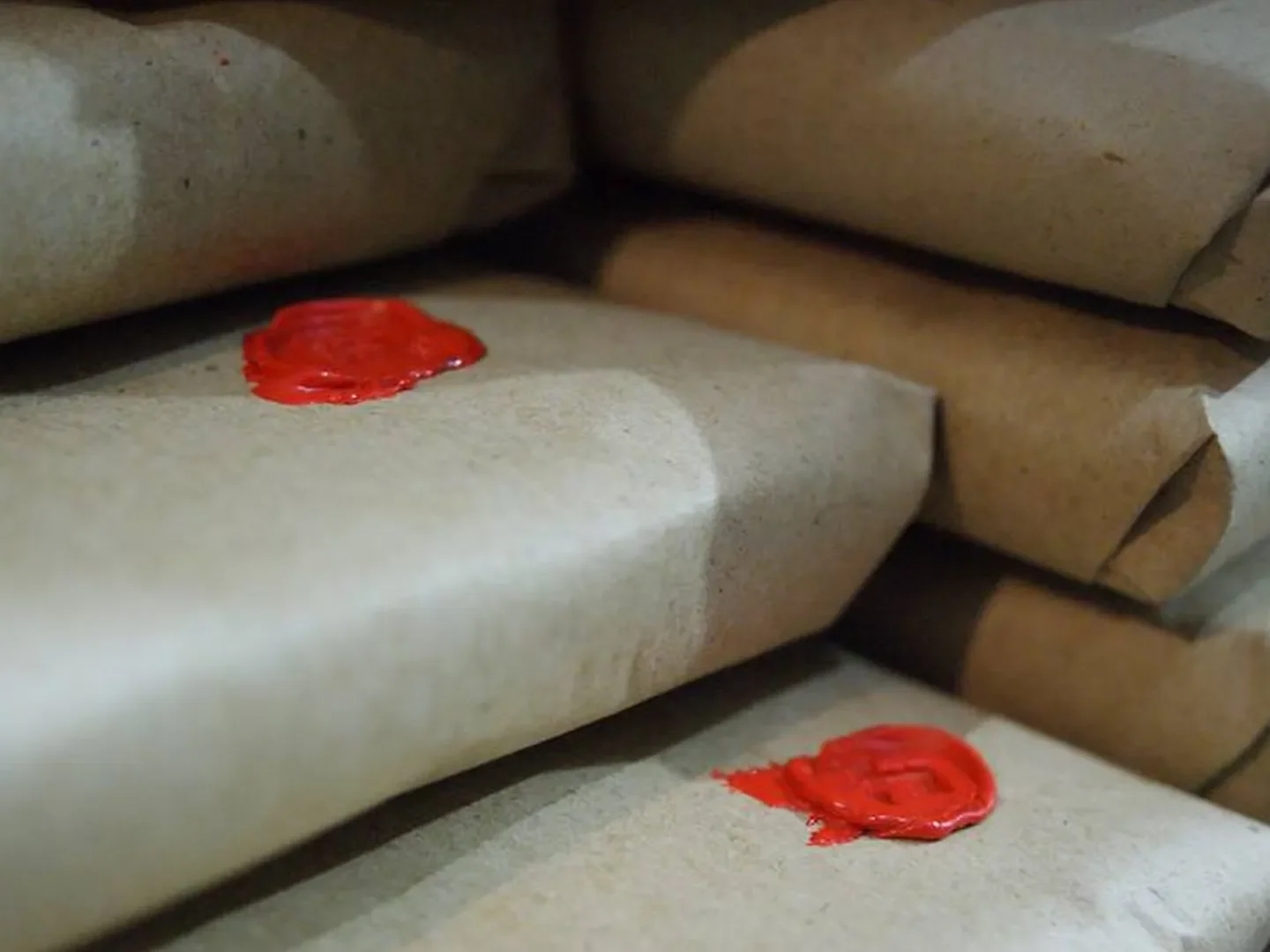
An open process, serving the whole country
From the first consultation to the final despatch, we keep the communication clear and open. You get regular updates on how the repair is progressing. We serve the whole of Indonesia, with shipping that is safe and insured.
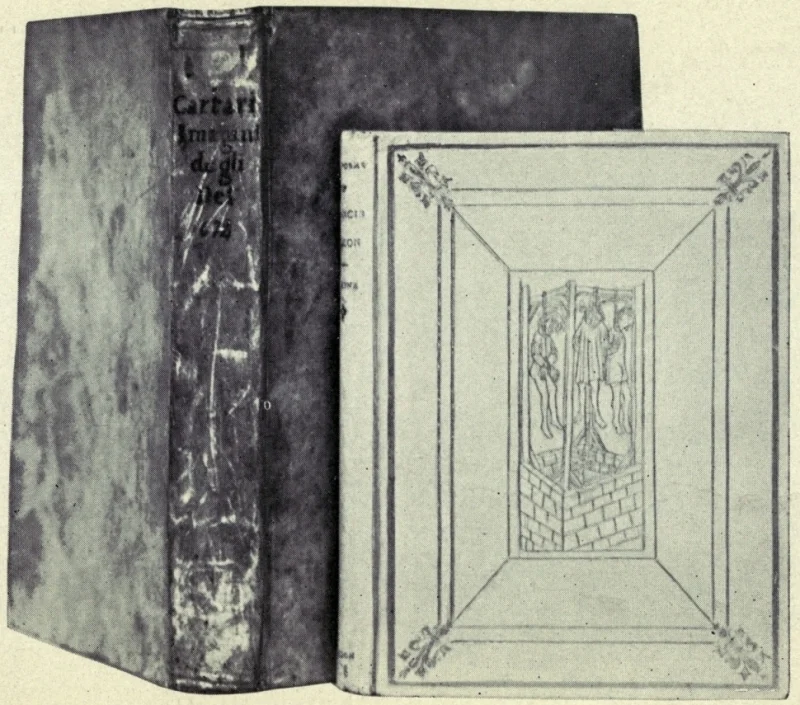
Keeping the value, respecting the history
We undertake not only to repair the physical damage but to preserve the emotional value, the history and the usefulness of your book for the generations after you. Every treatment decision is weighed against long-term preservation.
Who does the work
The hands that will hold your book
Conservation-tier work is done directly by Ibrahim Anwar, the founder of Hibrkraft, who bound his first book in 2011.
More than 1,000 books
Since 2011 more than a thousand books have passed across this bench. Most belong to private owners — books in daily use, and books that cannot be replaced.
Institutions among them
ANRI (the National Archives of the Republic of Indonesia) and EFEO (École française d’Extrême-Orient) have both sent work here, as have several libraries and one children’s library. Institutions usually send many books at once.
Including Hatta’s 1928 speech
One of the EFEO items worked on at this bench is Indonesië Vrij — the text of Mohammad Hatta’s defence speech before the court at The Hague in 1928. Done by hand here, under the same conservation rules: starch paste, nothing discarded, every step recorded. See the work done for EFEO
Not delegated
At Conservation tier no part of the work is handed to anybody else. First-hand experience cannot be borrowed — and a rare book does not offer a second chance.
One more job
Conservation work for EFEO
The film comes from our own server, as the one above does — nothing is downloaded until you press play.
EFEO — École française d’Extrême-Orient — is a research institute that sends work to this workshop. This footage is from one of those jobs.
Conservation-tier work uses a starch-based paste rather than PVA, so that a joint can be opened again without harming the original paper. Every step is recorded.
Materials and method
What we actually use
Not a shopping list, but the reason each material was chosen — and why the Conservation tier does not use the same materials as the tiers below it.
The adhesive differs by tier
Repair and Reconditioning use PVA glue — strong, quick, and right for a book in daily use. Conservation does not. At that tier the adhesive is a starch-based paste, so a joint can be opened again without harming the original paper. That is what “reversible” means on this page, and it is why the two tiers cannot stand in for one another.
Paper and thread
Japanese tissue for mending tears and strengthening folds; linen and cotton thread for sewing; kraftliner and linen paper wherever the material has to bear load. Chosen because they will still be defensible ten years from now, not because they are the cheapest.
Fragile paper is humidified first
Brittle paper snaps if it is flattened straight away. So it is humidified first in an enclosed space — a sealed bag for a single book, a sealed box for a few, and a sealed room of its own once there are more than ten. The humidity is raised slowly until the paper fibres will move again.
Every step is recorded
At Conservation tier, what was done and what was used is written down. So that whoever comes next — perhaps decades from now — knows exactly what has been done to that book, and can undo it if they need to.
Limits
What we will not take on
Four kinds of job we turn down, and why. Refusing work saves more books than accepting it does.
A sound binding with a few scuffs
We will not pull apart a library-standard binding that is merely a little knocked about. Taking a healthy binding apart shortens its life rather than extending it. All we offer is protection — we will make a cover for it, not a new binding.
Books carrying the marks of war
Four books bearing war damage were once sent here. We returned them unrepaired. That damage is not a fault to be erased — it is part of the book’s own history. Restoring it to smoothness would mean destroying evidence.
Water damage that has fused the pages
Once water has stuck the pages together into a single block, we do not take the job. Forcing them apart lifts the surface the text sits on. It is more honest to say it cannot be done than to hand back a book reduced to fragments.
Mould that is still mild
If the mould has not got far, we usually decline the work. We tell you what can be done at home and how to go about it carefully. The book needs to go nowhere, and you need pay nobody.
If something goes wrong
What we take responsibility for
The three worries we hear most, answered before you send anything.
If it turns out it cannot be repaired
We tell you at the consultation stage if the book is likely to be beyond saving — with photographs of its condition and the alternatives, such as minimal stabilisation for storage. If you decide not to go ahead, the book is returned at no charge.
If the cost overruns the estimate
The first estimate is worked out from photographs, and the real condition is sometimes different. Where the gap is under 20% we hold the original price. Where it is significant we come back to you for approval first — you are free to cancel, and the book returns with no treatment charge.
If the work does not hold
Sewing or binding that comes away within 6 months of normal use we repair free of charge. A workmanship fault that got past our checks we also put right at no cost. We always send photographs of the finished work before despatch — if it is not what you expected, we revise it.
Convinced enough?
Send photographs of the book now. What follows below is about how the process runs.
Comparison
What the difference actually is
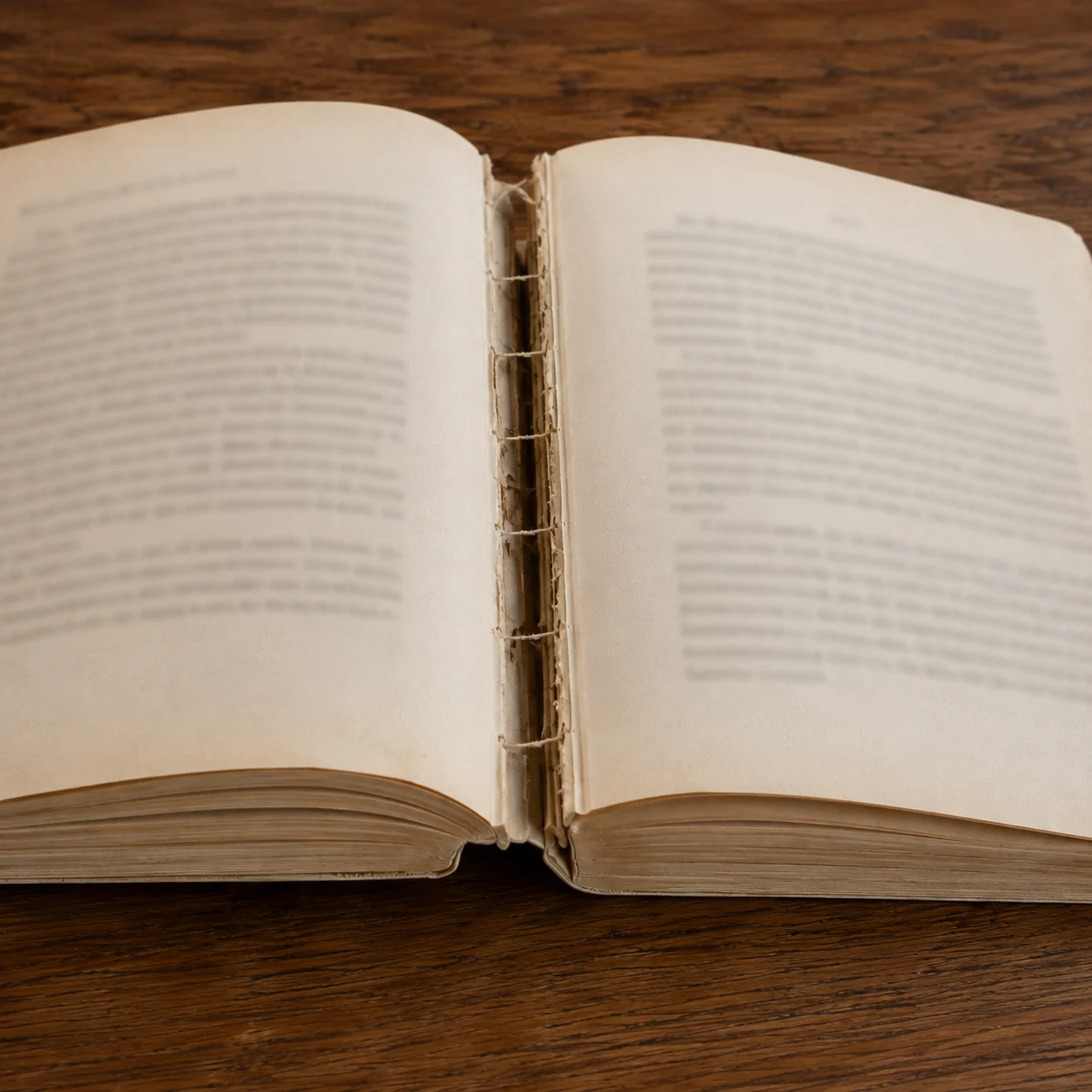
Book Repair
For light damage that gets in the way of reading. Repair is the most basic of the services, and none the less important for that. Its whole aim is to make the book usable again without irritation.
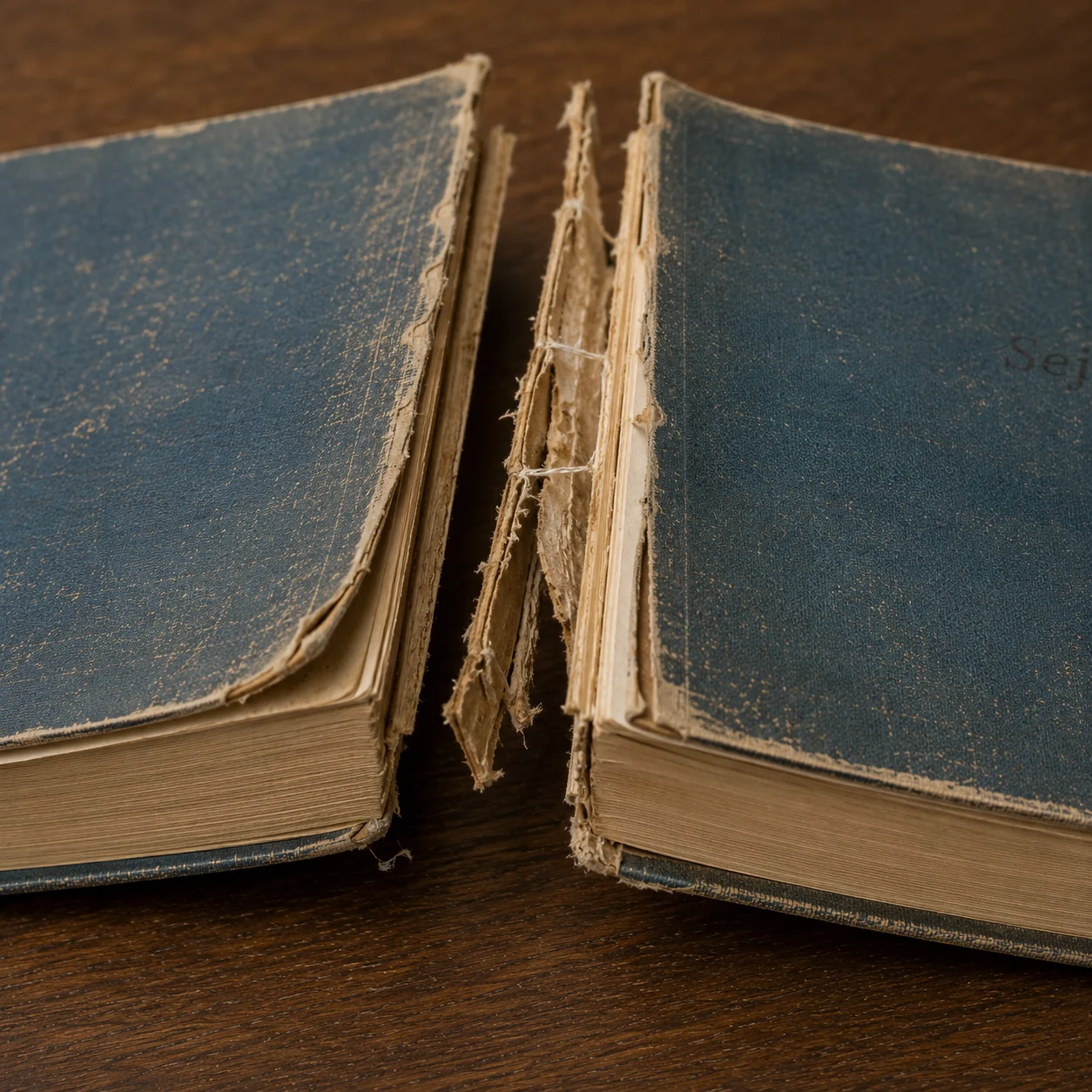
Book Reconditioning
For a book going dull that you still want to read comfortably. Reconditioning aims to bring it back to its best reading condition without drastically altering its original form.
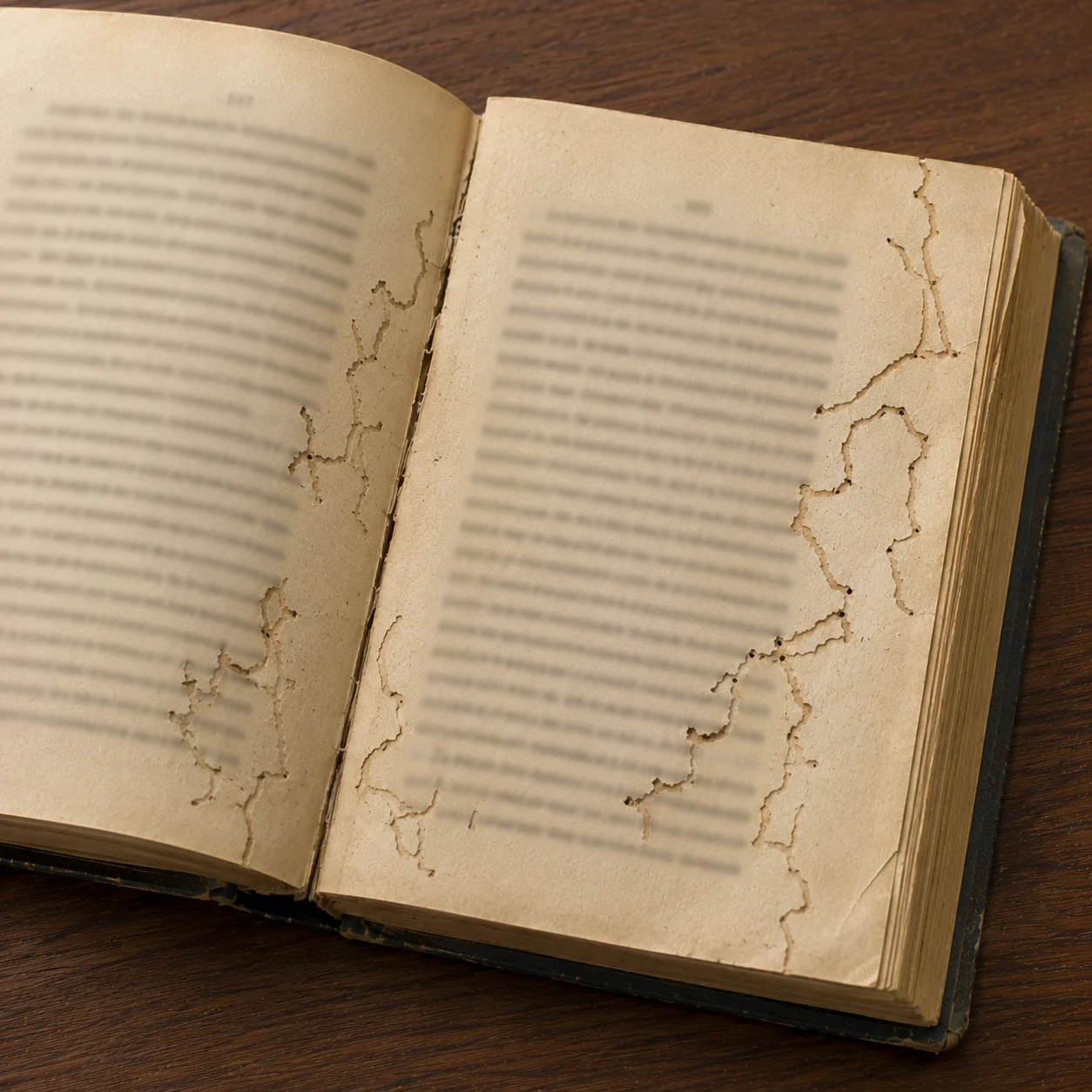
Book Restoration
For a thorough renewal that leaves the book looking new. Restoration is the service for a book you want “brought back to life”, in appearance and in function alike.
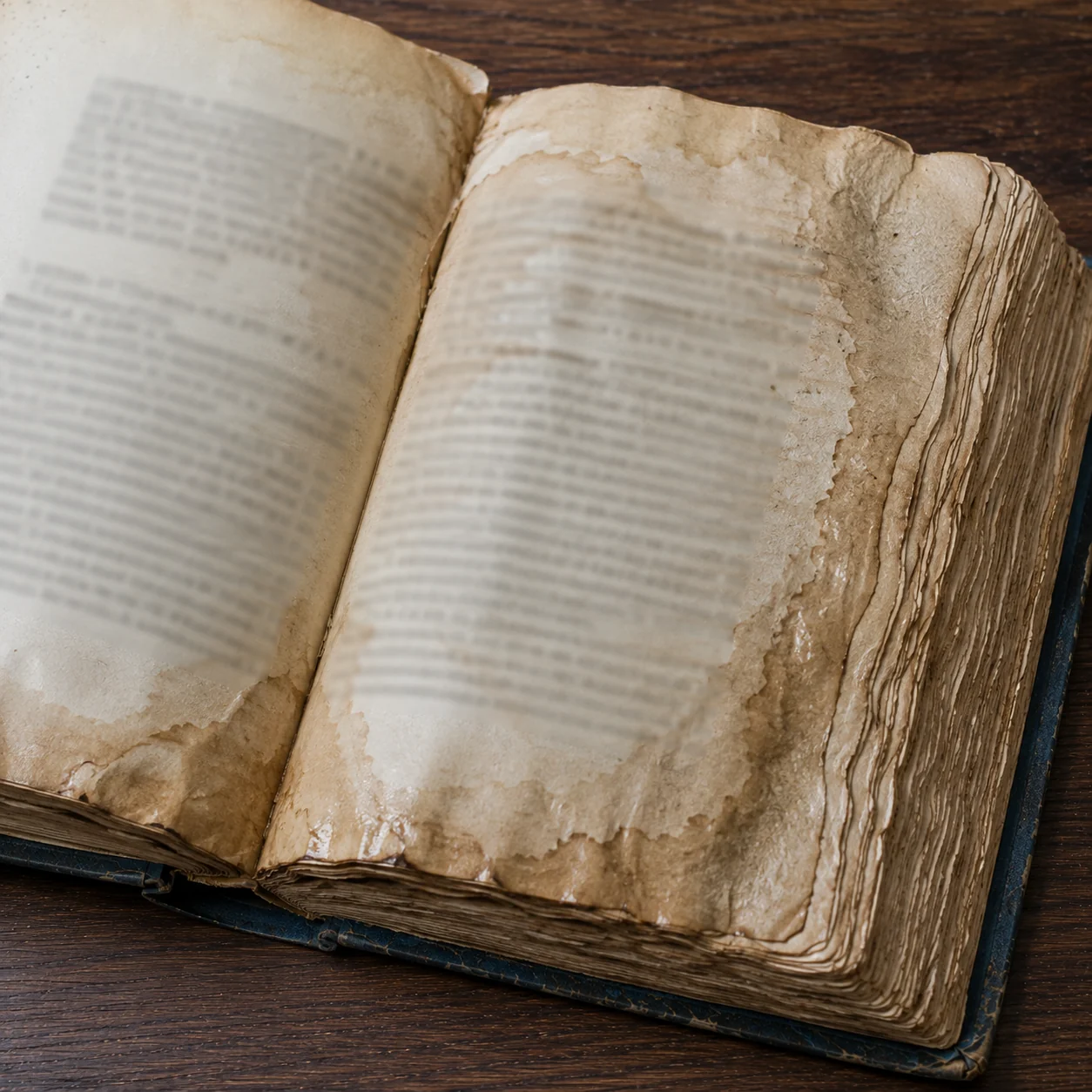
Book Conservation
For the preservation of a historic or high-value book. Conservation goes deepest of all. Its purpose is not merely to repair but to keep the book’s physical and historical integrity intact for the generations after us.
The process
From a photograph to the book coming home
- 01First consultation (FREE)Message us on WhatsApp at +62 815 1119 0336. Tell us the condition of your book and what you would like brought back. Send a few photographs for a first assessment. Our team replies in hours, not days.
- 02Assessment and cost estimate (FREE)Working from the photographs you send, our team will:
- Assess the extent of the damage.
- Decide the right service — repair, reconditioning, restoration or conservation.
- Give an estimated cost and working time before you commit.
- 03Sending the book to the workshopOnce you have approved the estimate, send your book to our workshop address. We will give you the right packing guidance to protect it in transit, particularly if it has already grown fragile.
- 04Confirming arrivalWhen the book arrives, we will:
- Send unboxing photographs and video, so its condition on arrival is on record.
- Examine the book directly and check it against the initial assessment.
- Tell you if anything we find changes the earlier estimate.
- 05The treatment itselfThe book is handled by experienced artisans and conservators. We use only:
- pH-neutral, reversible adhesive; starch-based paste for conservation.
- Acid-free paper and Japanese tissue for mending.
- Linen or cotton thread, bookcloth, and genuine leather for covers.
- 06Regular updatesWe keep you posted on how the treatment is going — the stage the work has reached, when it should finish, and the moment the book is ready. On complex projects we send work-in-progress photographs.
- 07Quality control and photographs of the resultBefore despatch the book goes through a strict quality check. We send photographs of the finished result for your approval before anything is posted.
- 08Payment and despatchAfter approval, payment is made by bank transfer. The book is packed with extra protection and sent to your address with a tracking number.
Shipping
Your book in transit
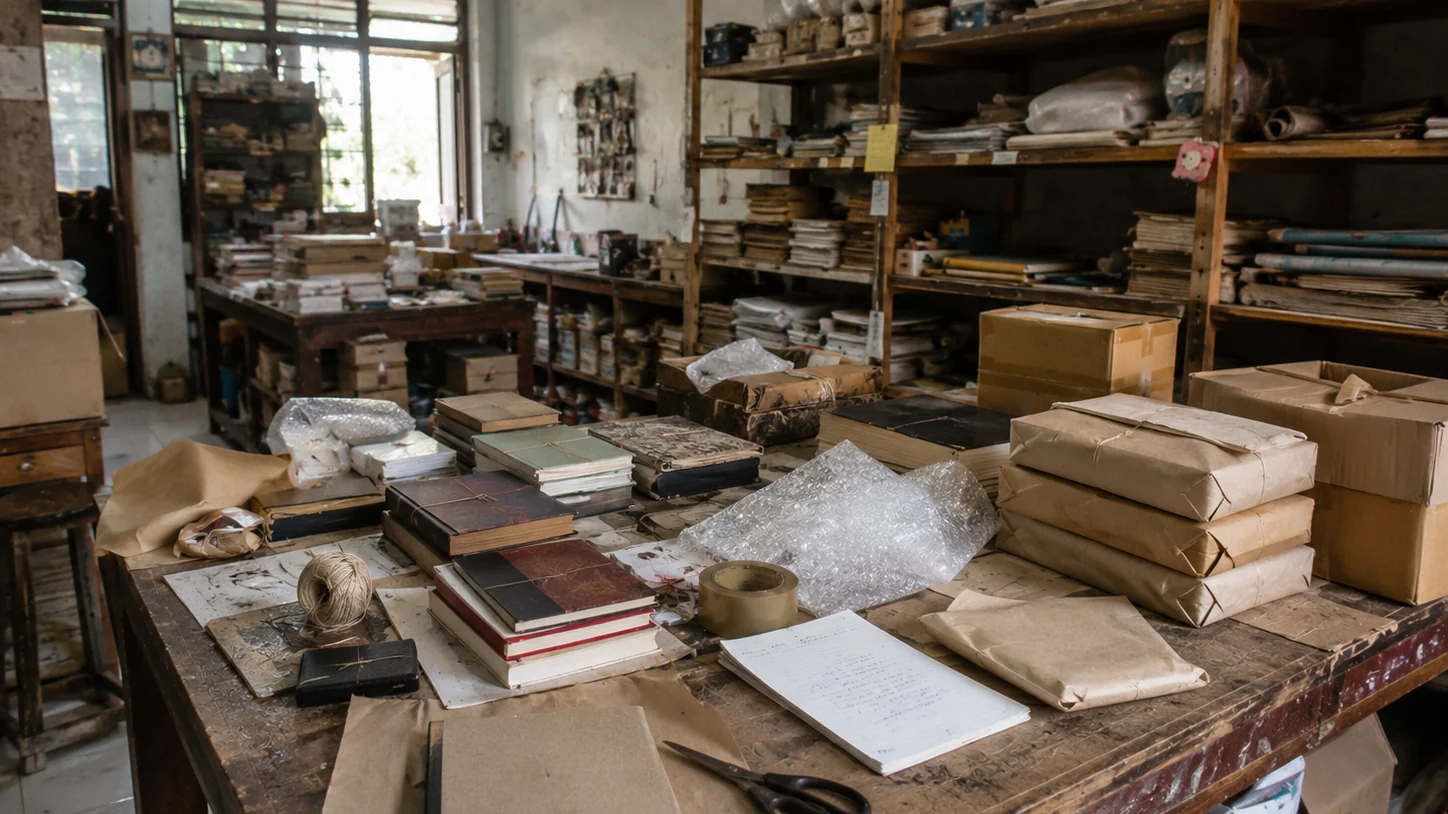
Confirmation photographs
We send photographs and an unboxing video the moment your book reaches the workshop. You know exactly what condition it arrived in.
Purpose-made packing
Packing guidance for fragile books. The return journey is double-protected and labelled FRAGILE.
Insurance if you want it
Shipping insurance is available for high-value books. Extra cover, for your own peace of mind.
Couriers we trust
We work with JNE, J&T, SiCepat and Paxel to make sure delivery is safe anywhere in Indonesia.
Materials
What we use
- Adhesive
- pH neutral, acid-free, reversible — removable without damage.
- Paper
- Acid-free, for joining and lining.
- Thread
- Linen thread, or thread made specifically for bookbinding.
- Cloth
- Good bookcloth for covers.
- Leather
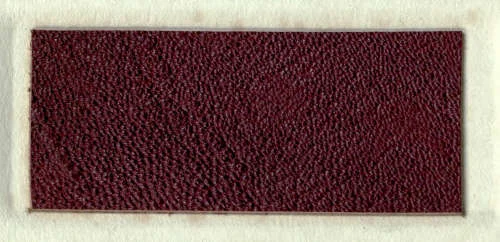
- Genuine leather, for restoring leather-bound books.
- Protection
- Archival-grade boxes for conservation storage.
Scope
What we accept
- Scripture
- The Qur’an, the Bible, the Torah, the Vedas and others.
- Family books
- Photograph albums, diaries, recipe books, inherited notebooks.
- Collectors’ books
- Rare novels, vintage comics, art books.
- Academic books
- Schoolbooks, lecture notes, theses.
- Antique books
- Manuscripts, old texts, historic volumes.
- Important documents
- Marriage books, certificates issued in book form.
Libraries, museums, archives
When it is not one book but fifty
Institutional projects run differently: assessed by collection, priced by volume, and documented copy by copy.
Who usually asks
University and school libraries, museums and archives, religious institutions — mosques, churches, temples — and companies that keep archive collections.
What we offer
On-site assessment in some areas, special pricing for large volumes, and a condition report with full documentation for every copy.
What has been done already
Conservation of the EFEO Indonesia collection, including an item published in 1928. Reversible materials, nothing discarded, every step recorded.
Diagnosis
312 terms for book damage and bookbinding
Two parts. First a damage diagnosis in Indonesian, grouped by the tier of treatment it calls for. Then a bookbinding dictionary, quoted exactly as it stands from public-domain glossaries.
Repair
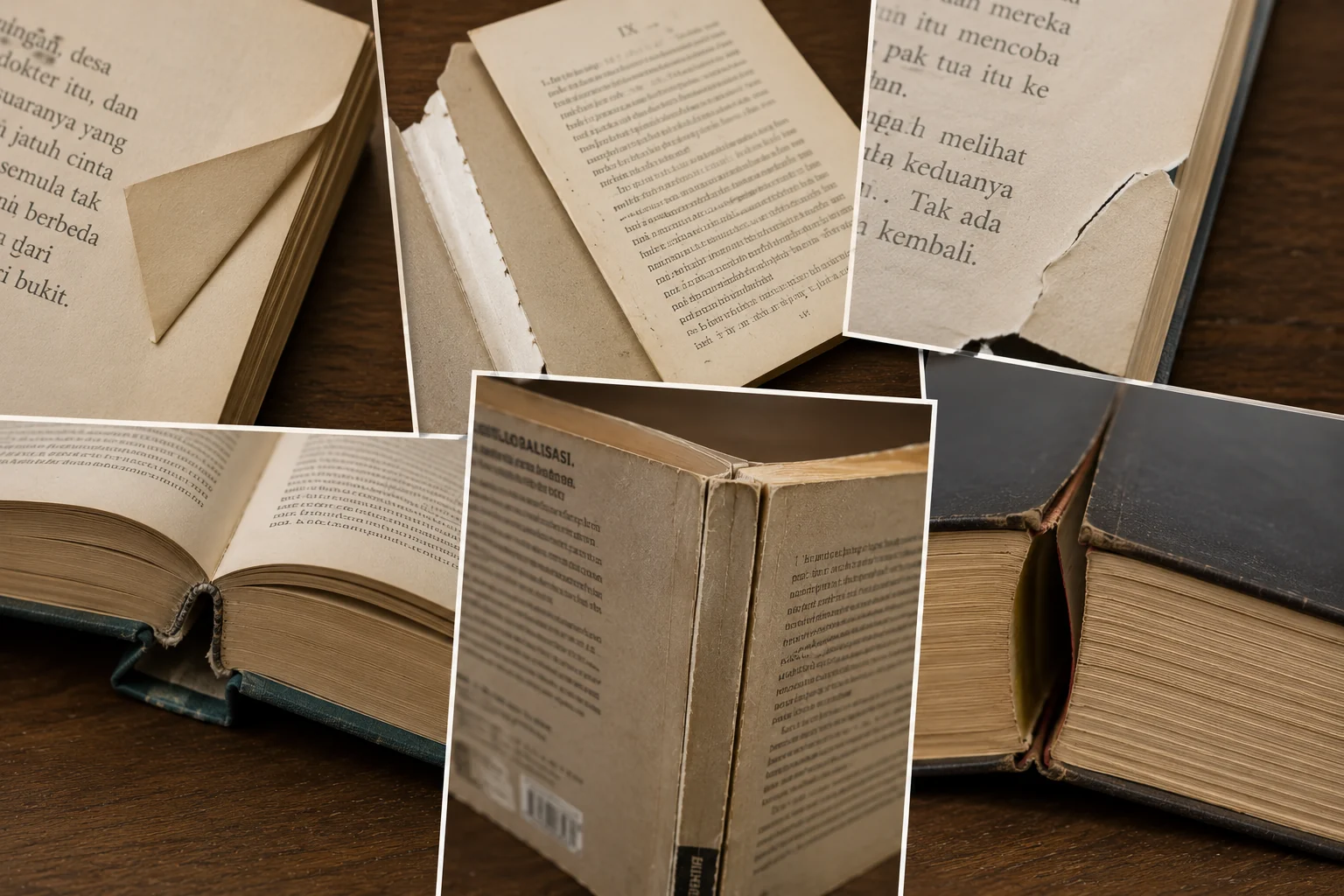
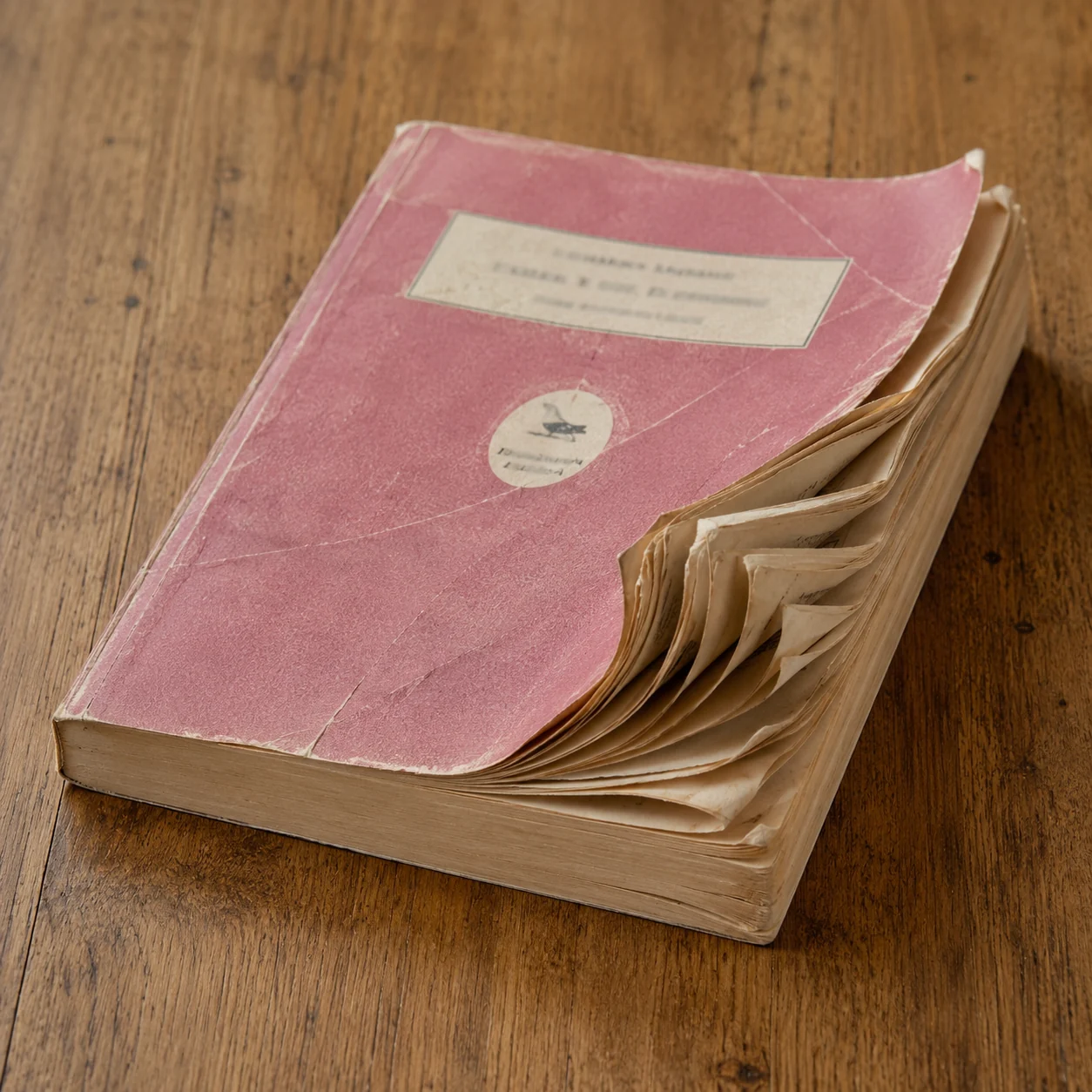
Dog-eared pages Sudut halaman tertekuk
Creases at the corner of a page that need flattening back out.AIC BPG Glossary: Dog-eared
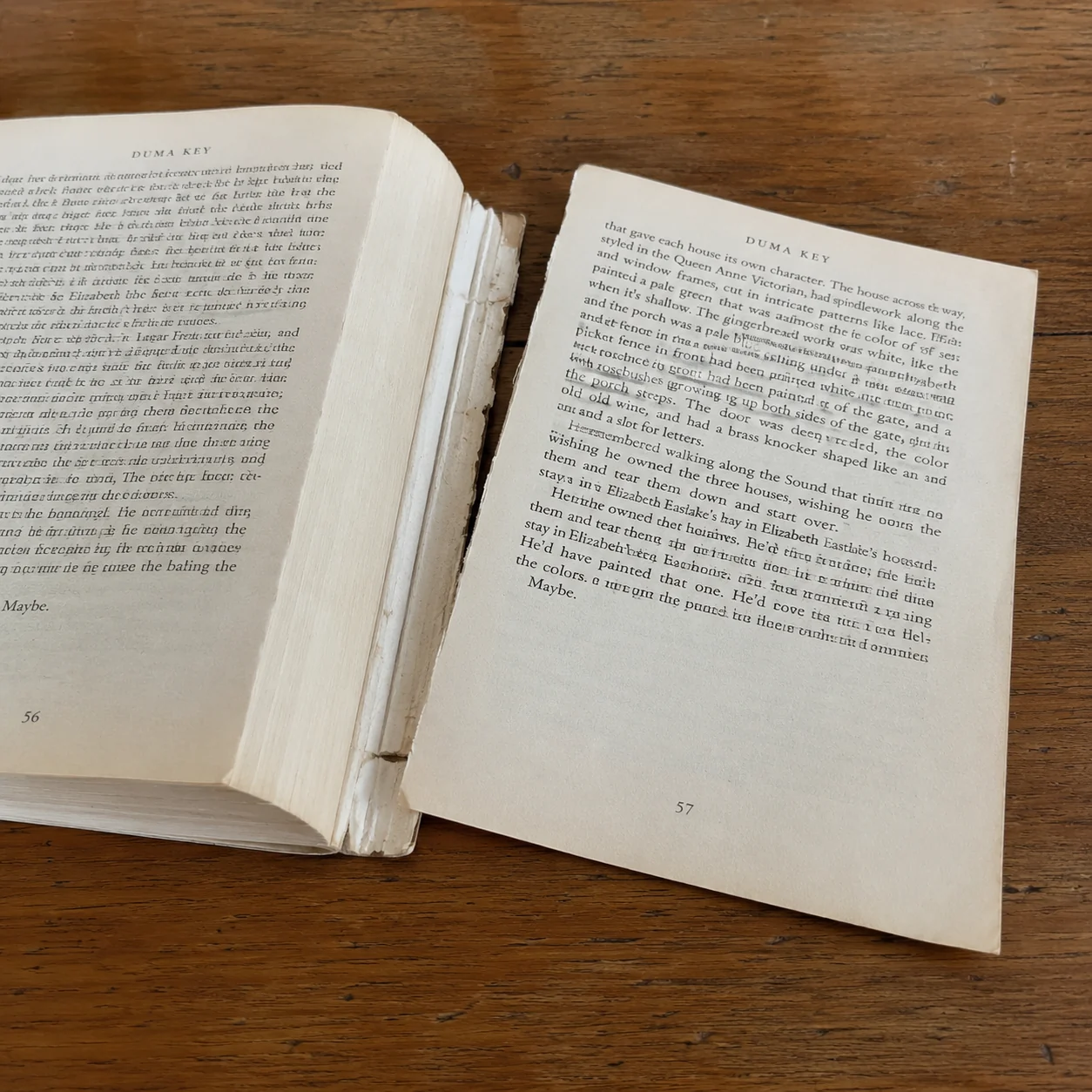
Detached page Halaman lepas
One or more leaves have come away from the binding, though the paper itself is still sound.AIC BPG Glossary: Loss
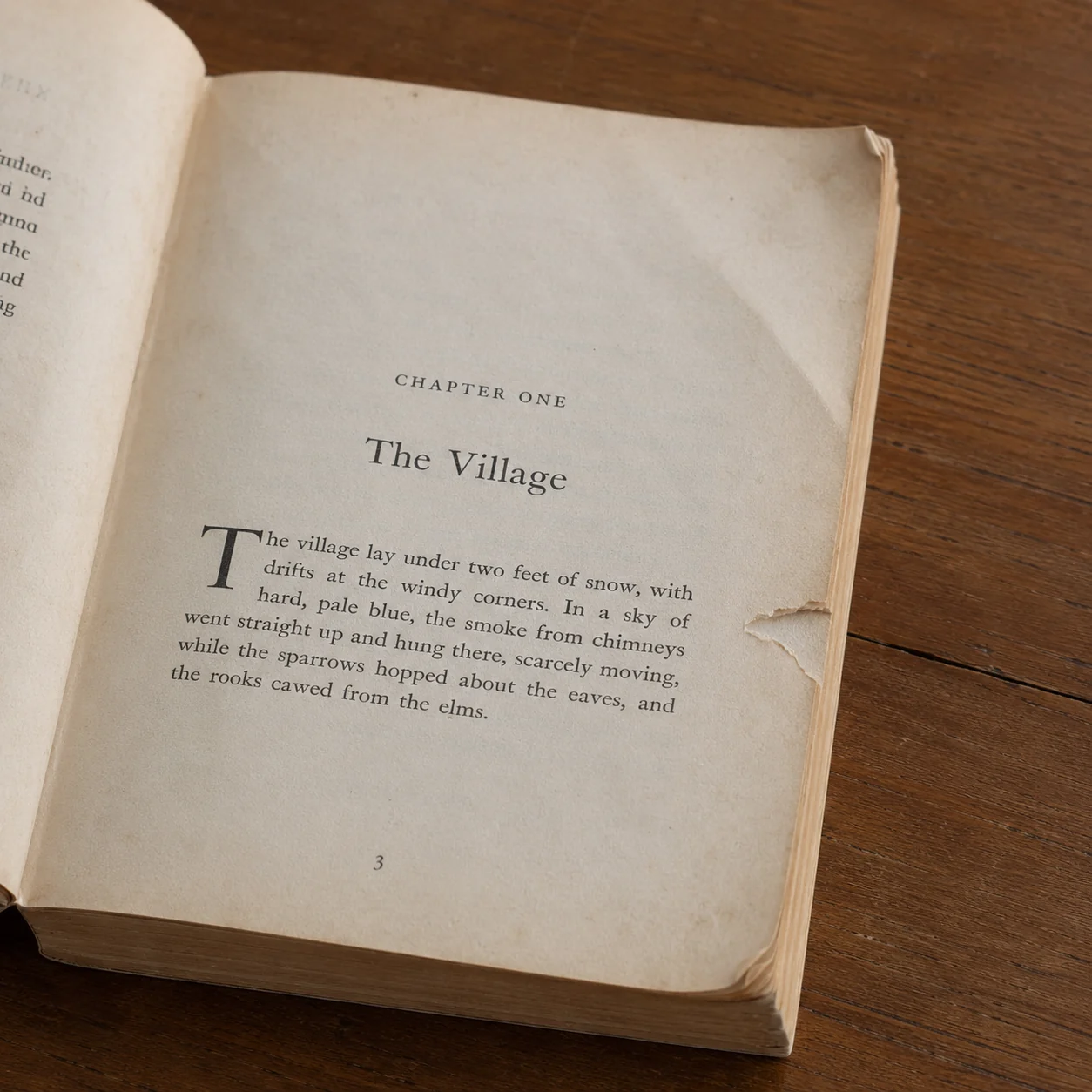
Minor tears Sobekan kecil
Tears under 2 cm at the edge of a page or cover, mendable with Japanese tissue.AIC BPG Glossary: Tear
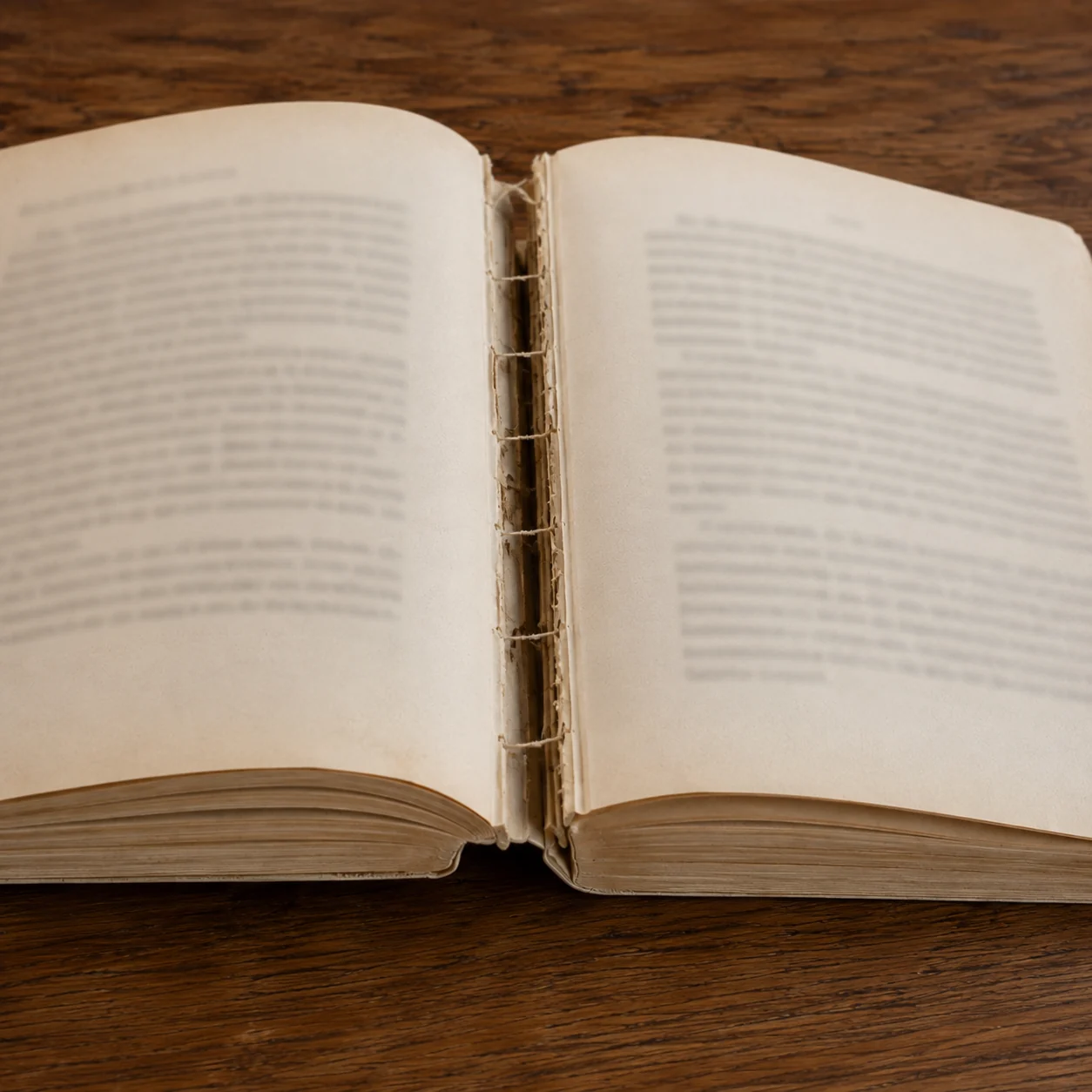
Loose binding Binding longgar
The binding structure moves when the book is opened, though the thread or glue has not given way entirely.Ligatus LoB: spine linings
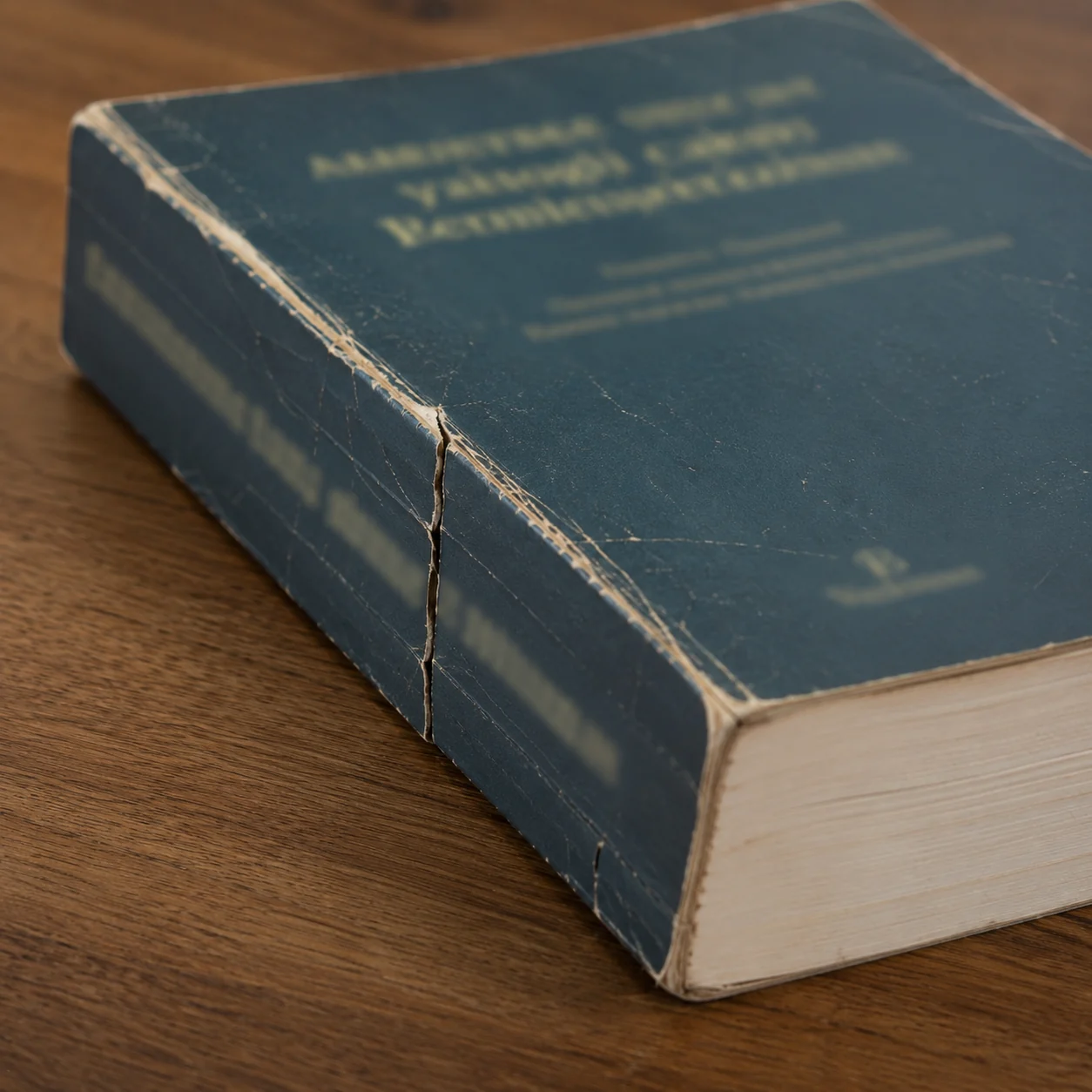
Spine crack Retak punggung
A vertical crack along the spine, common on thick softcover books.AIC BPG Glossary: Split
Reconditioning
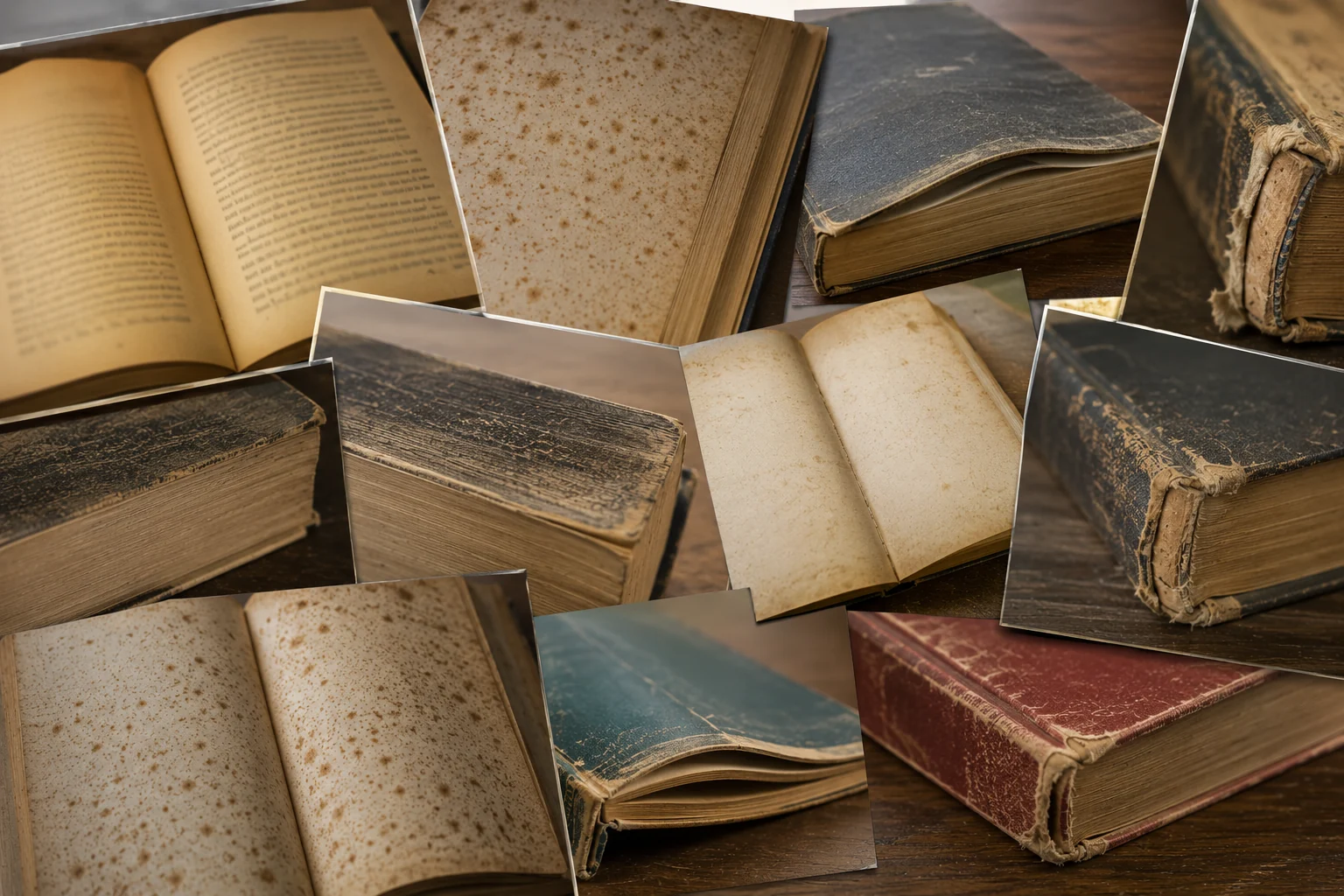
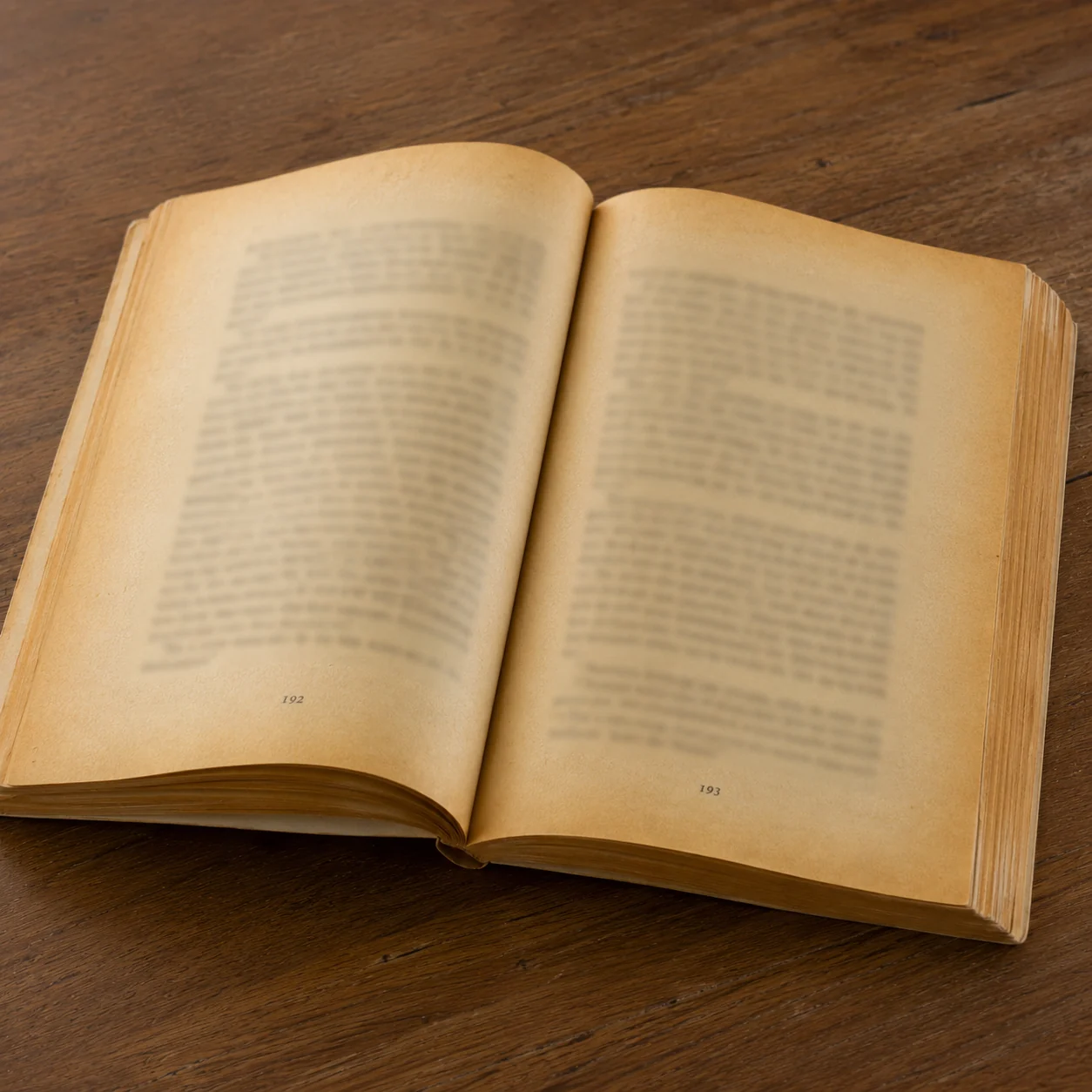
Yellowing Kertas menguning
Natural oxidation of the paper, or UV exposure, turning it yellow.AIC BPG Glossary: Discoloration
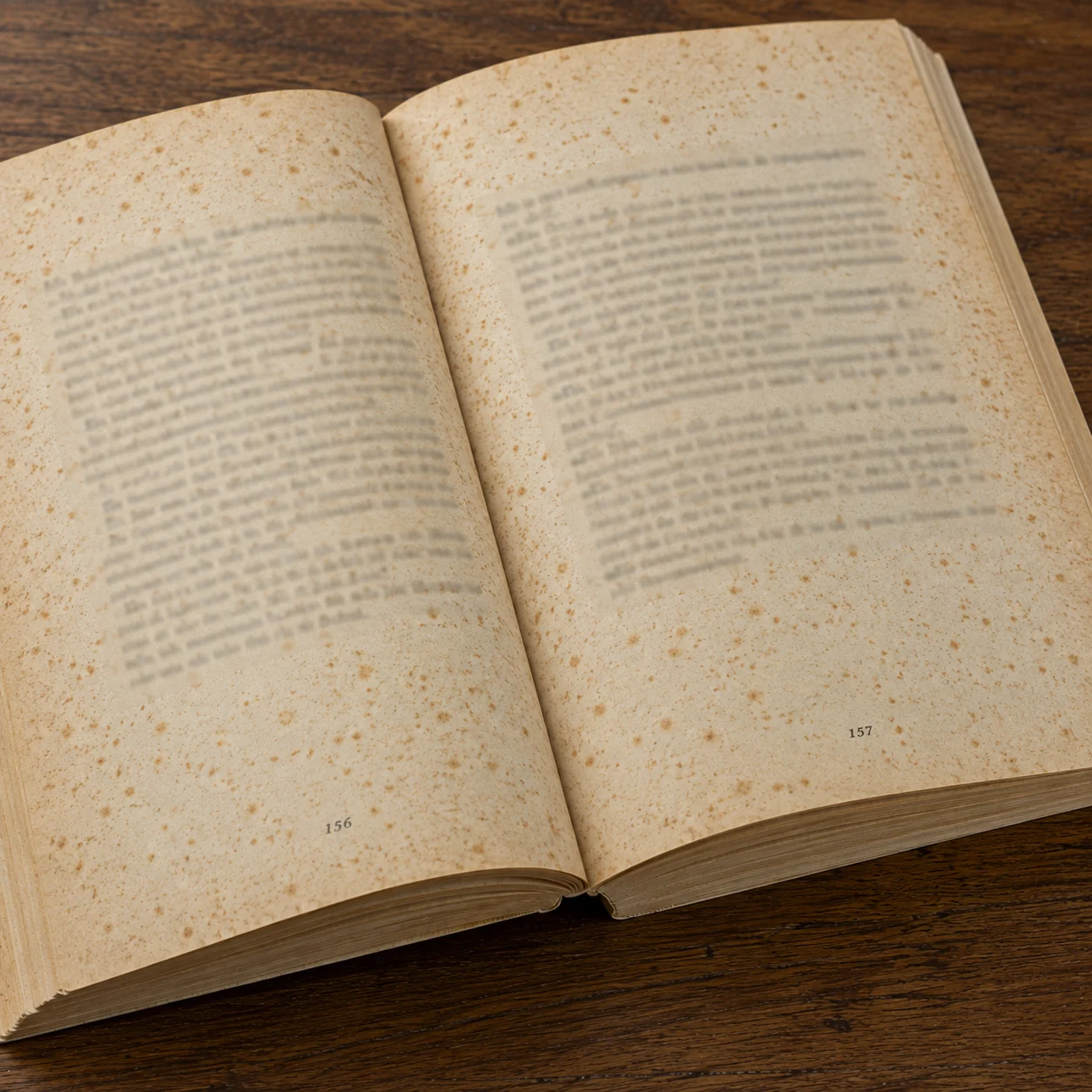
Foxing Bercak coklat
Reddish-brown spotting caused by a chemical reaction with metal in the paper, or by dormant fungal activity.AIC BPG Glossary: Foxing
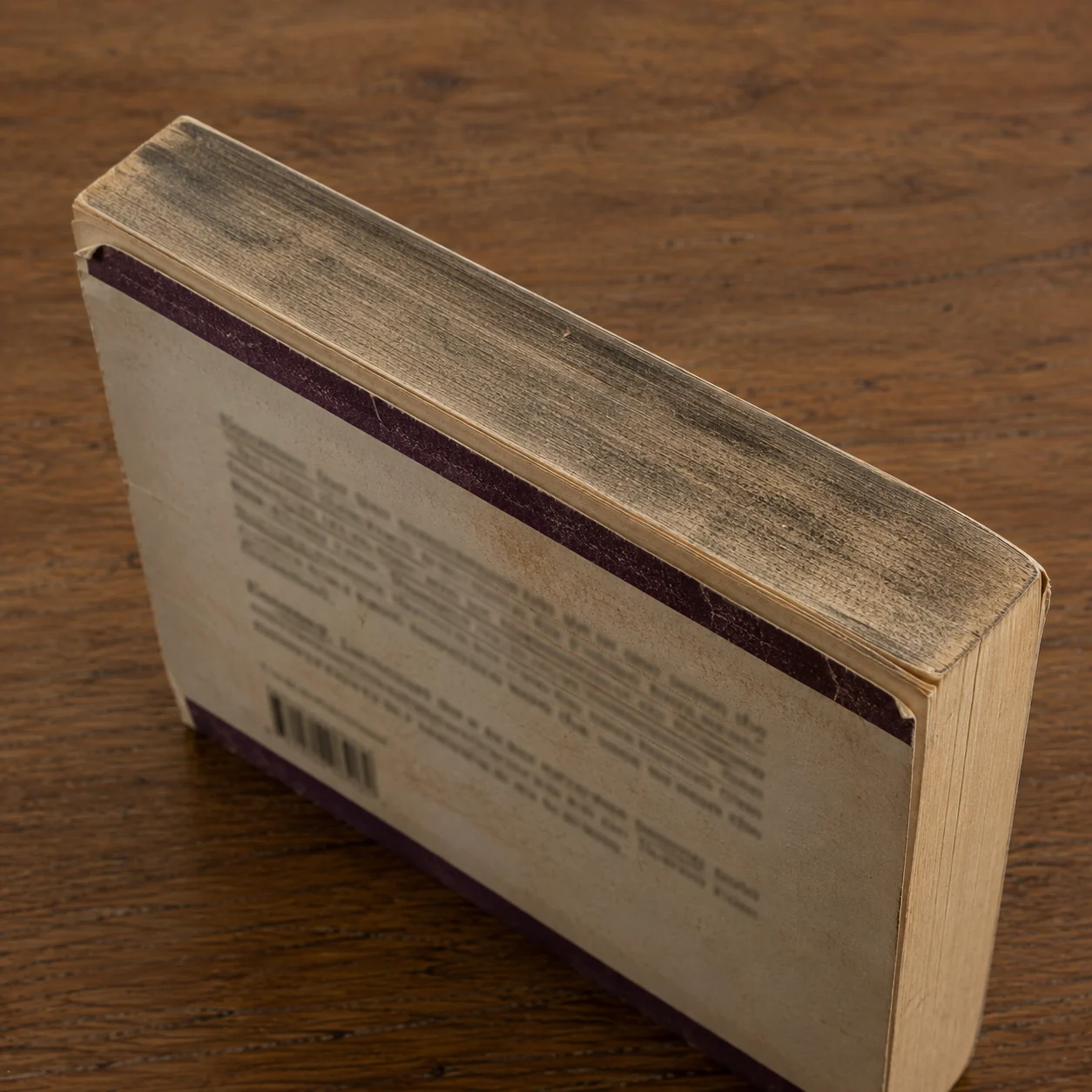
Dust soiling Kotoran debu
A build-up of dust darkening the top edge or the cover.AIC BPG Glossary: Grime
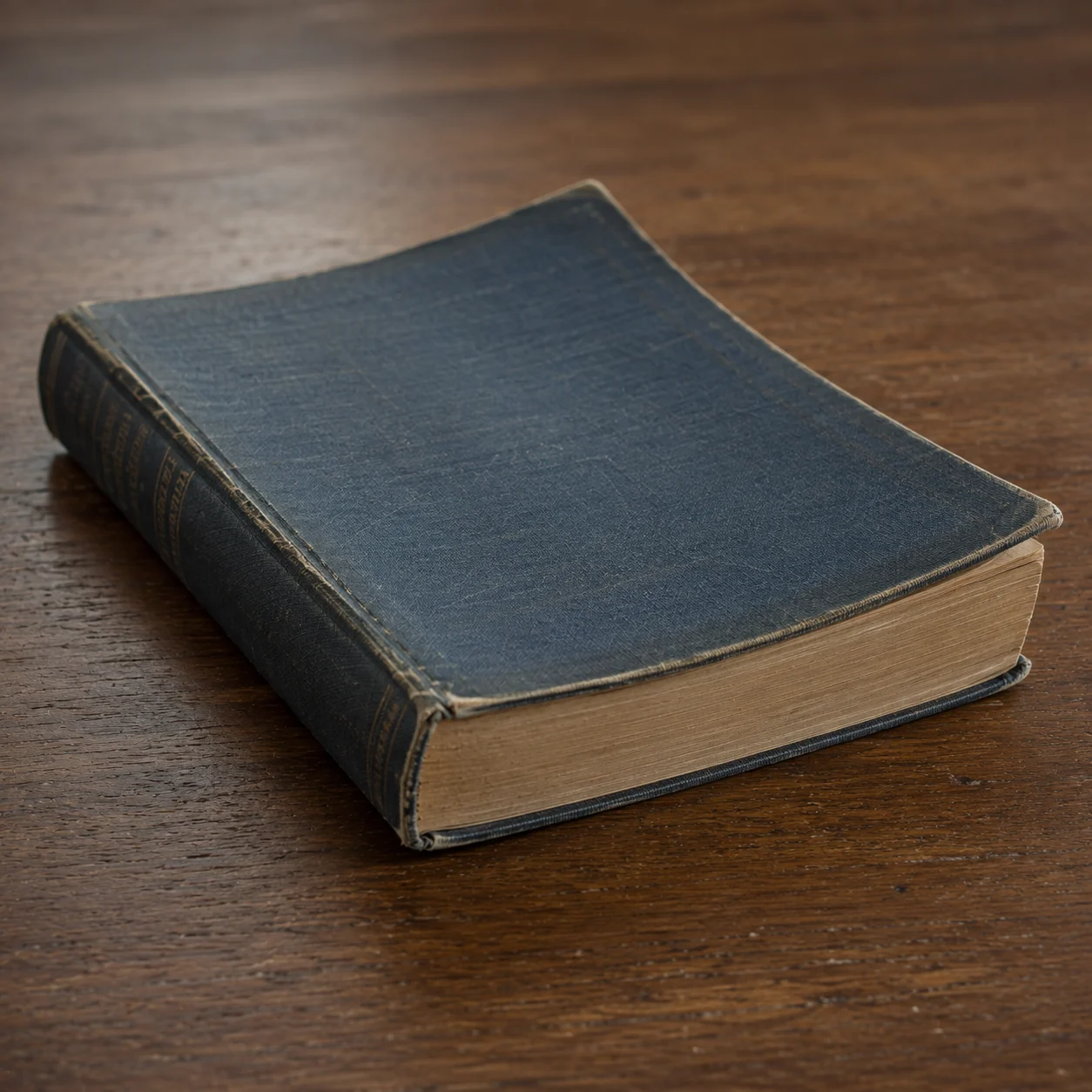
Warped boards Cover melengkung
Hardcover boards bowed convex or concave by a sharp change in humidity.Ligatus LoB: boards
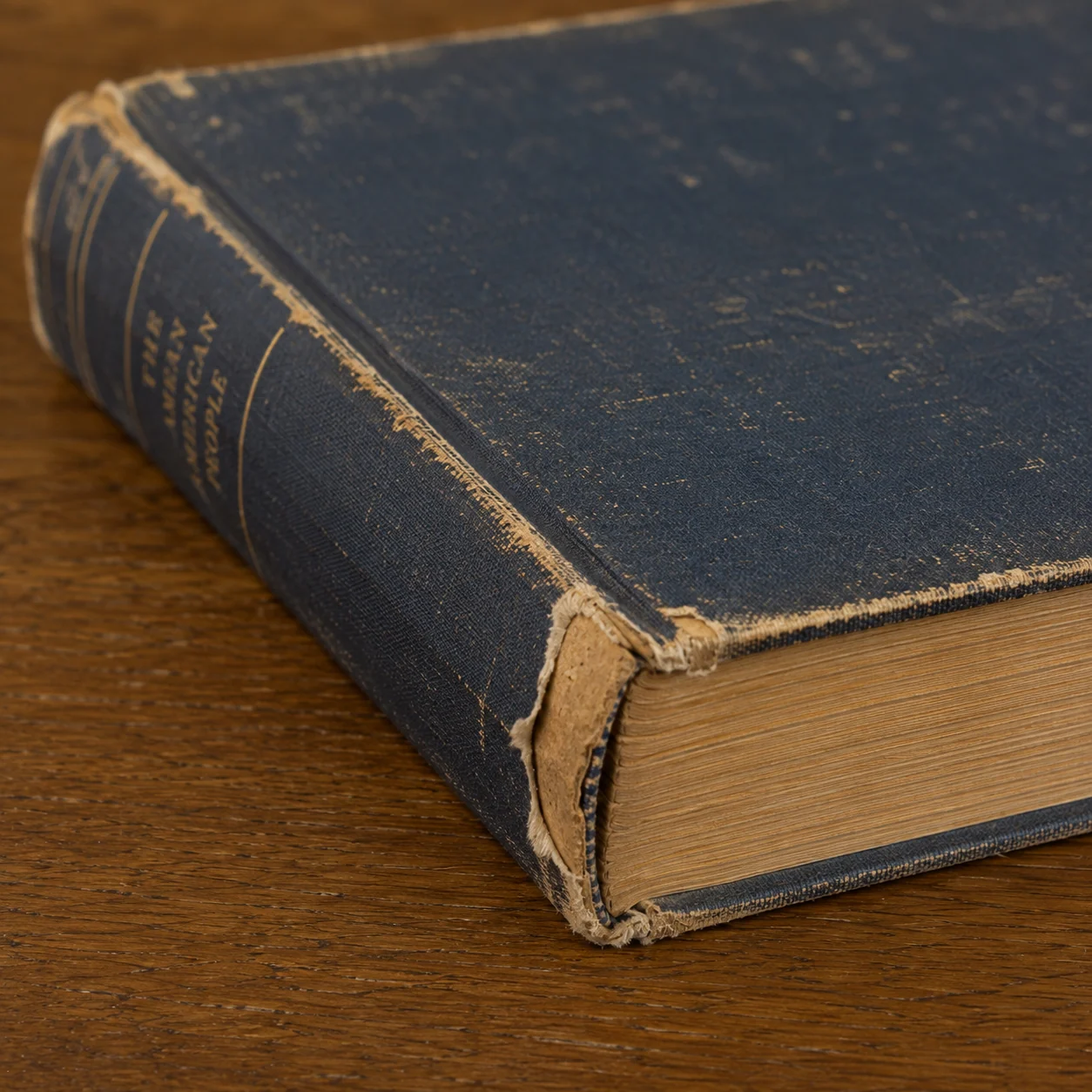
Worn edges Tepi aus
The cloth or paper at the cover corners rubbed away until the board beneath shows through.AIC BPG Glossary: Abrasion
Restoration
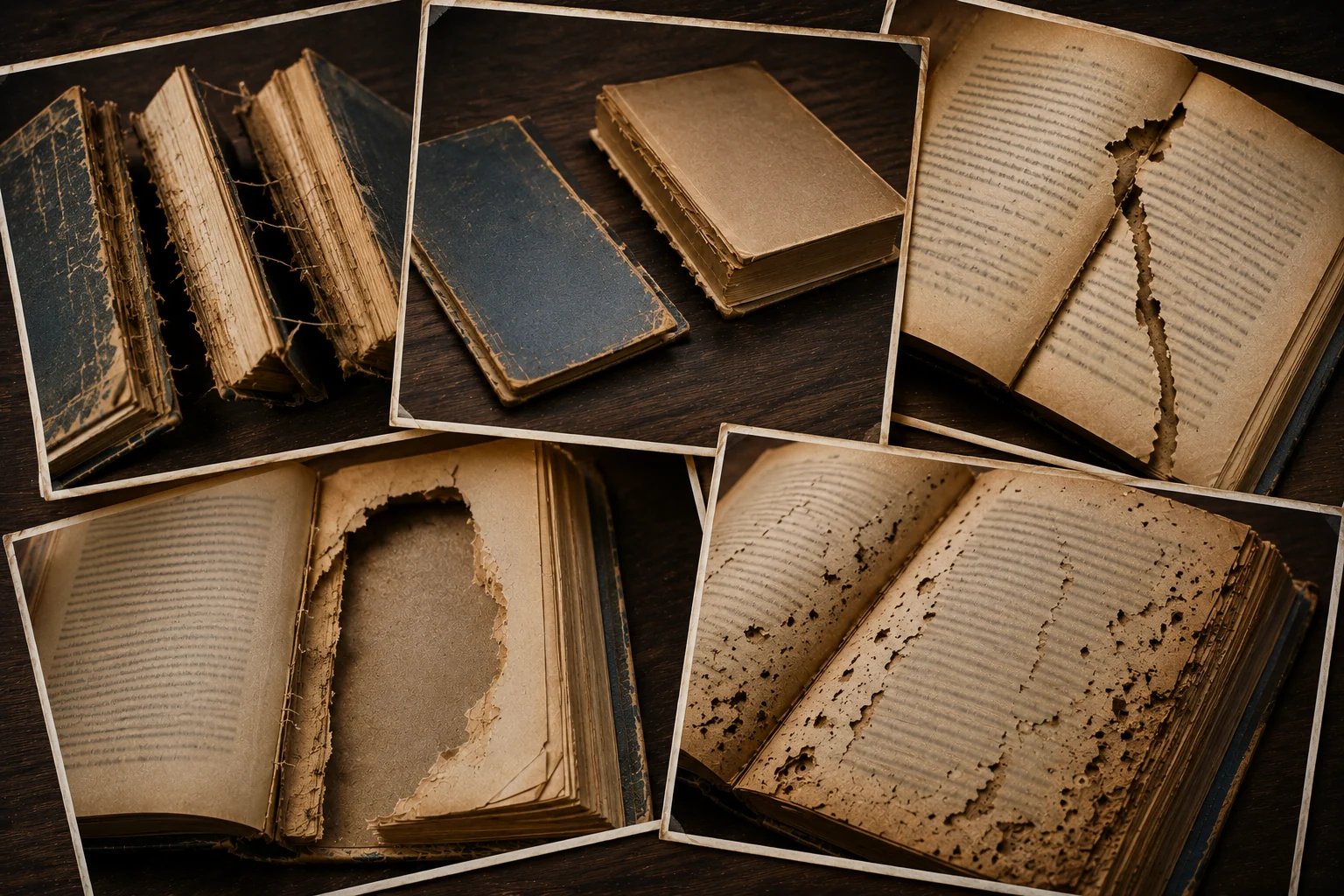
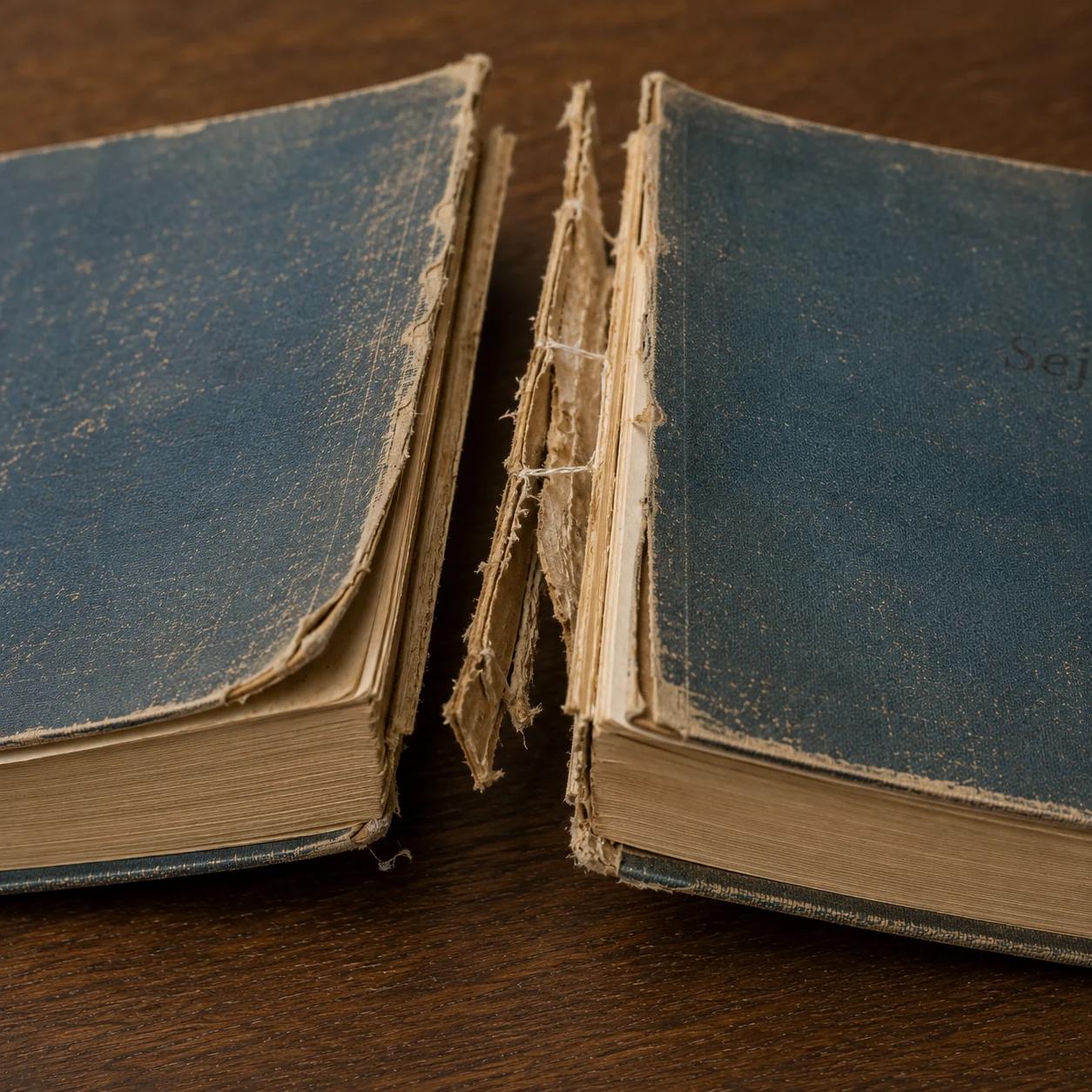
Broken spine Punggung patah
The spine has snapped in two, and the text block has usually separated into several large pieces.AIC BPG Glossary: Split
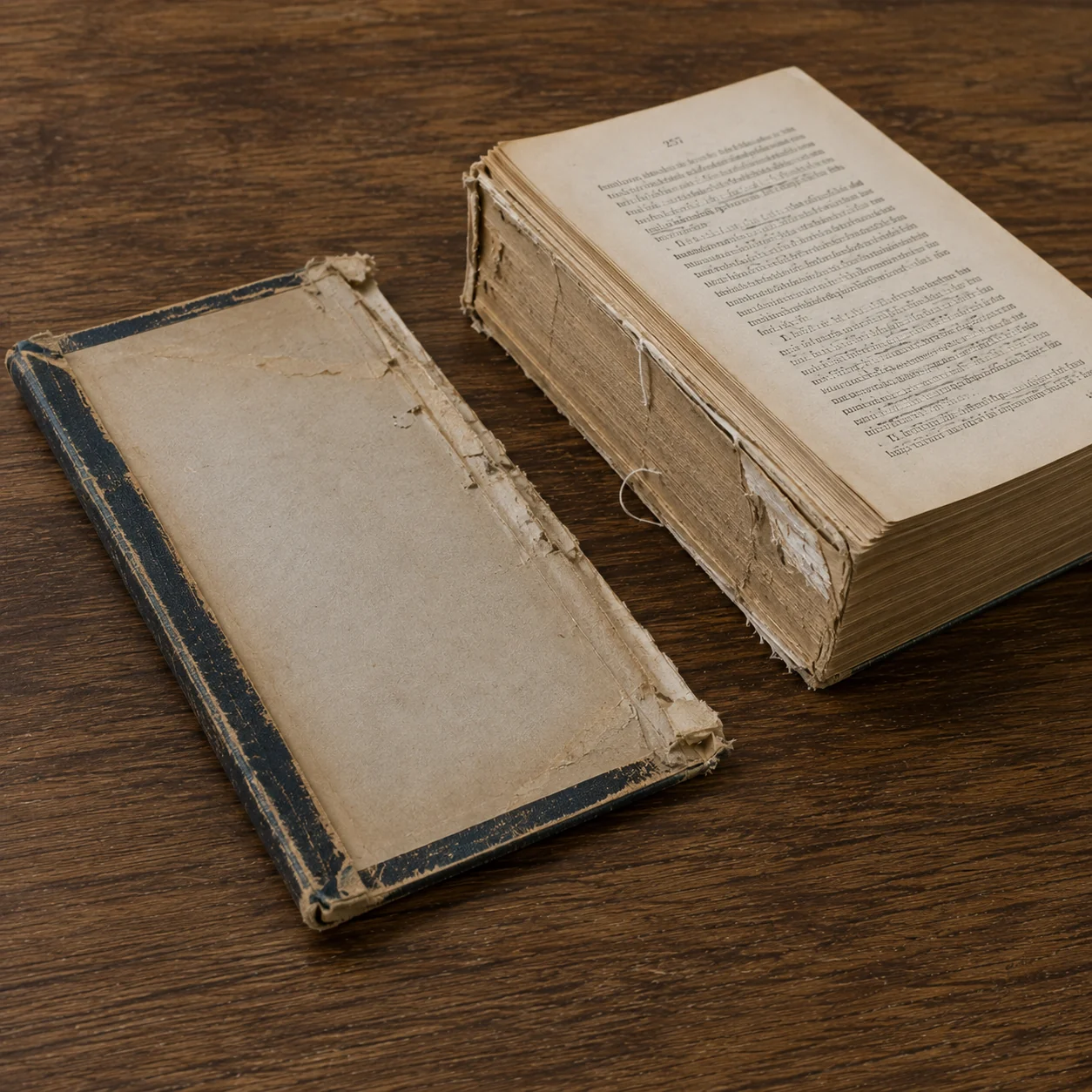
Detached cover Cover lepas total
The hardcover has come away from the text block completely.Ligatus LoB: covers
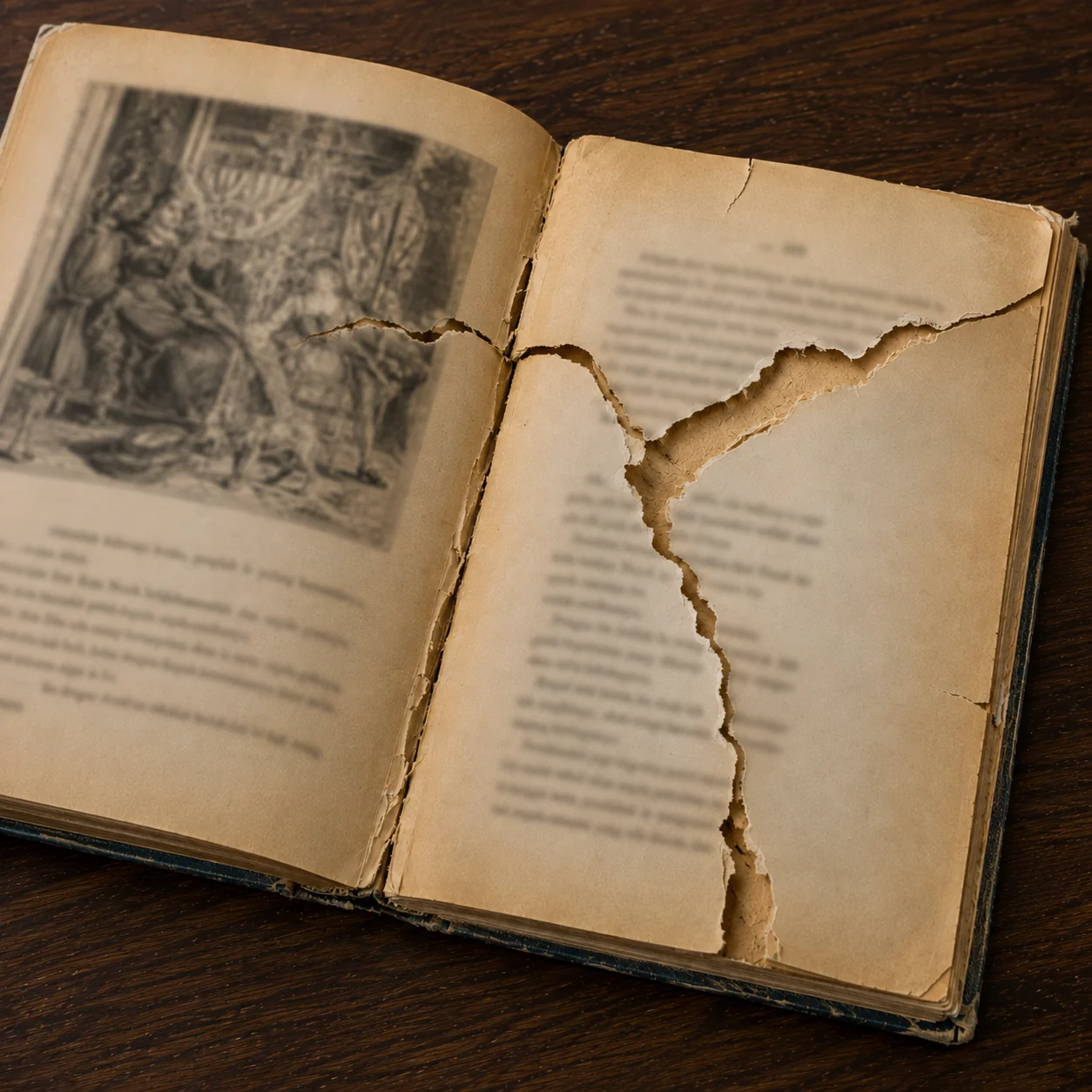
Major tears Sobekan besar
Tears running across text or an important image, needing the paper fibres to be rejoined.AIC BPG Glossary: Tear
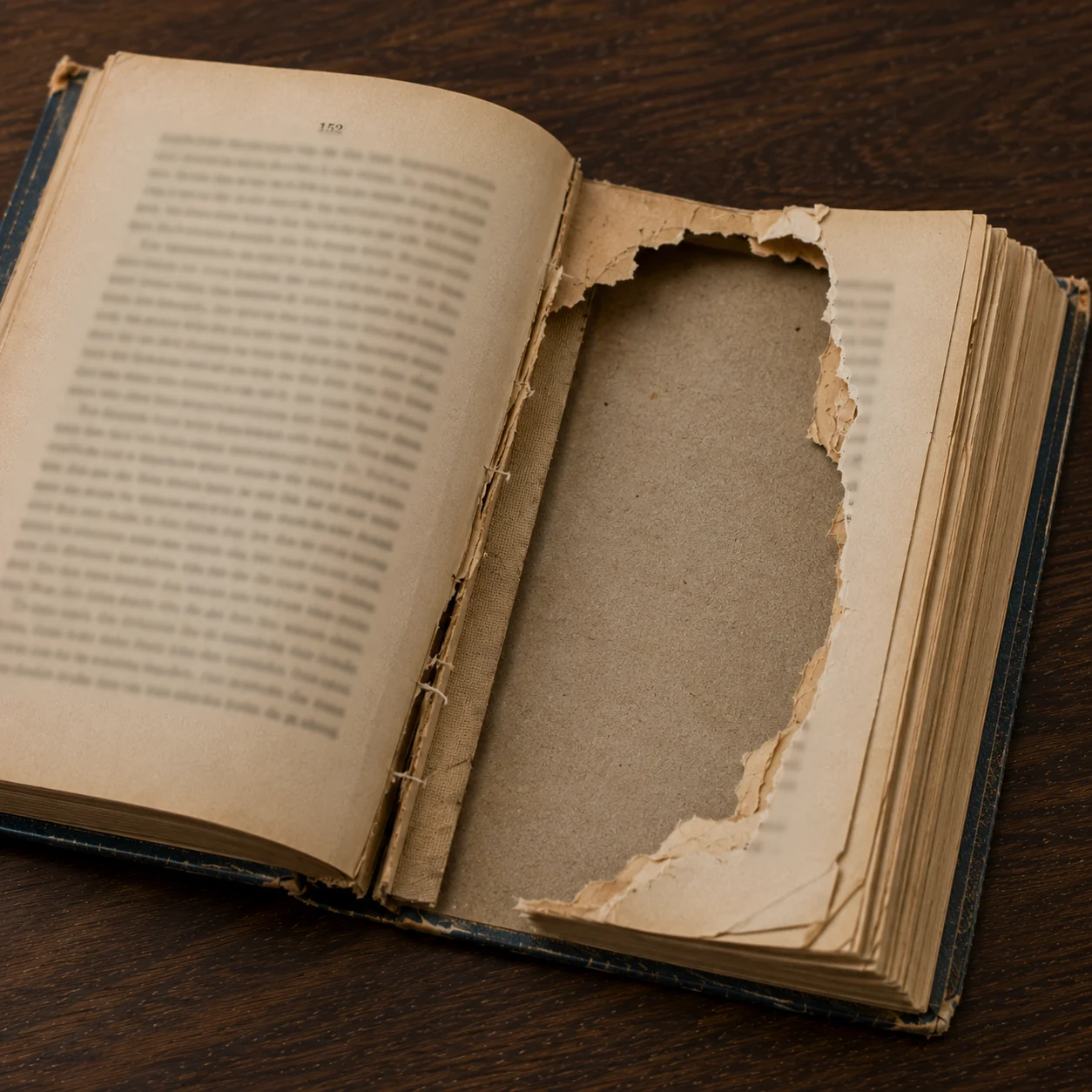
Missing pages Halaman hilang
Pages lost, needing facsimile reproduction and rebinding.AIC BPG Glossary: Loss
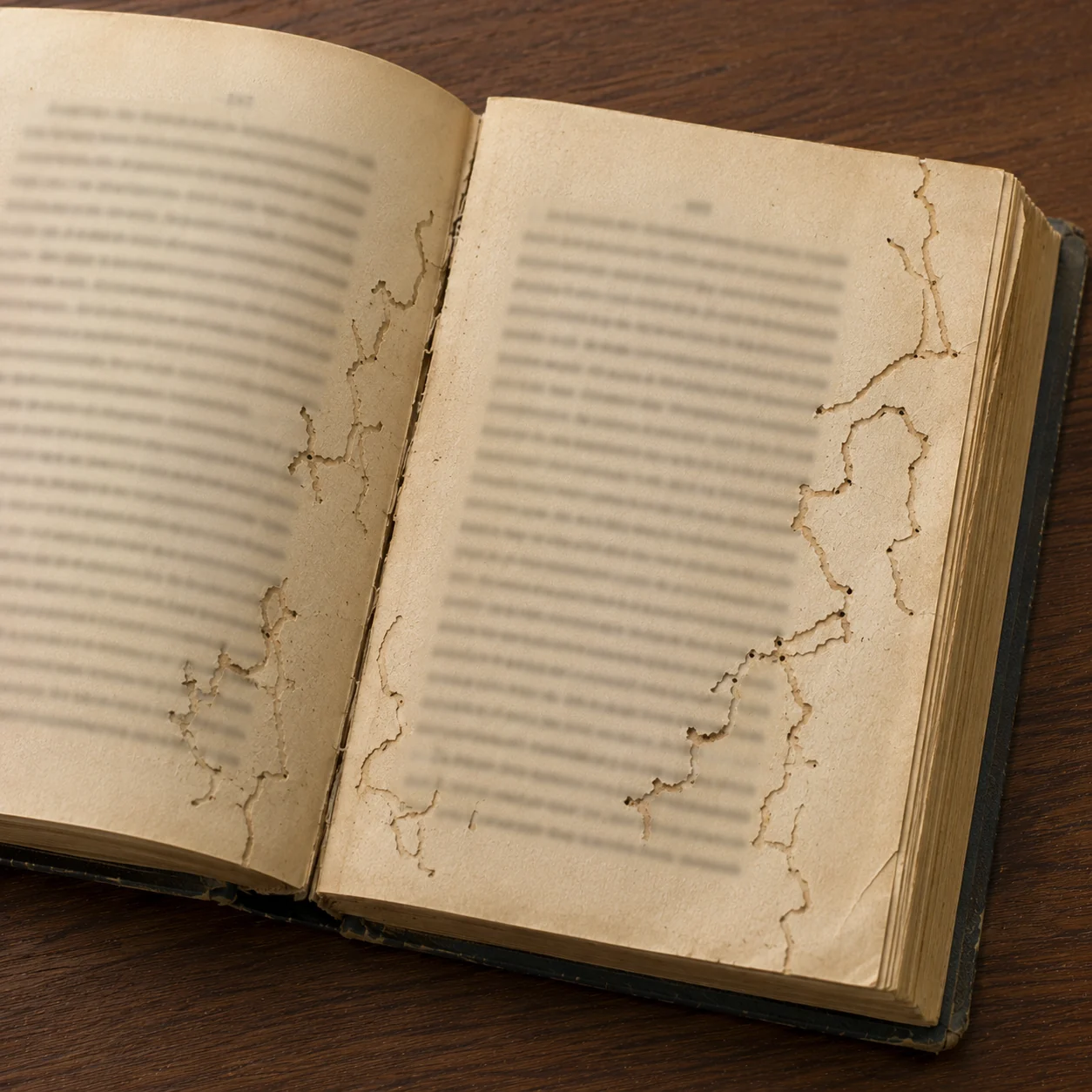
Rodent/Insect damage Kerusakan hama
Rodent bite holes, or termite tunnelling through the paper and cover.AIC BPG Glossary: Insect damage
Conservation
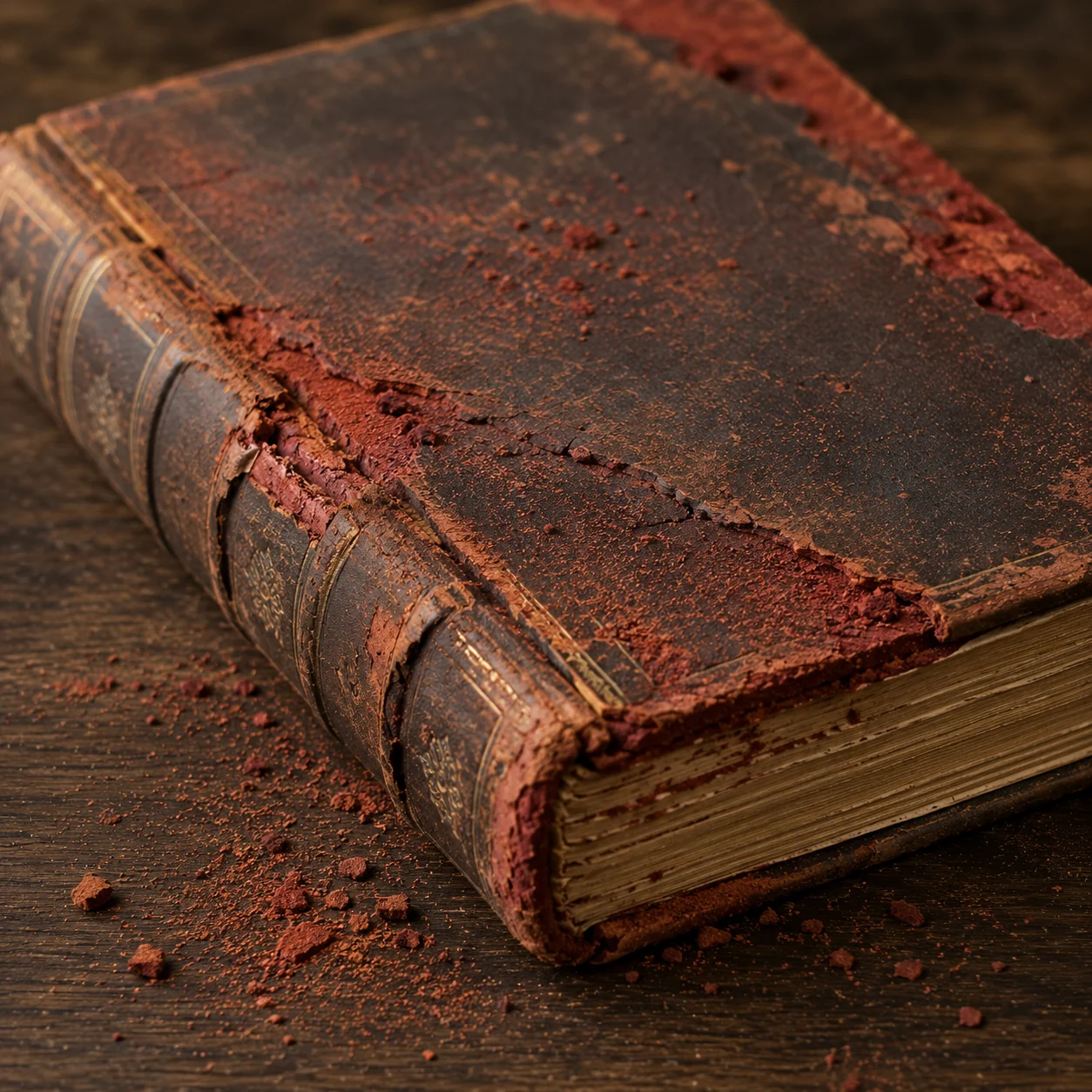
Red rot Pembusukan kulit
Chemical degradation of a genuine leather cover, leaving it so friable it turns to red powder at a touch.AIC BPG: Animal Skin and Leather, Red Rot
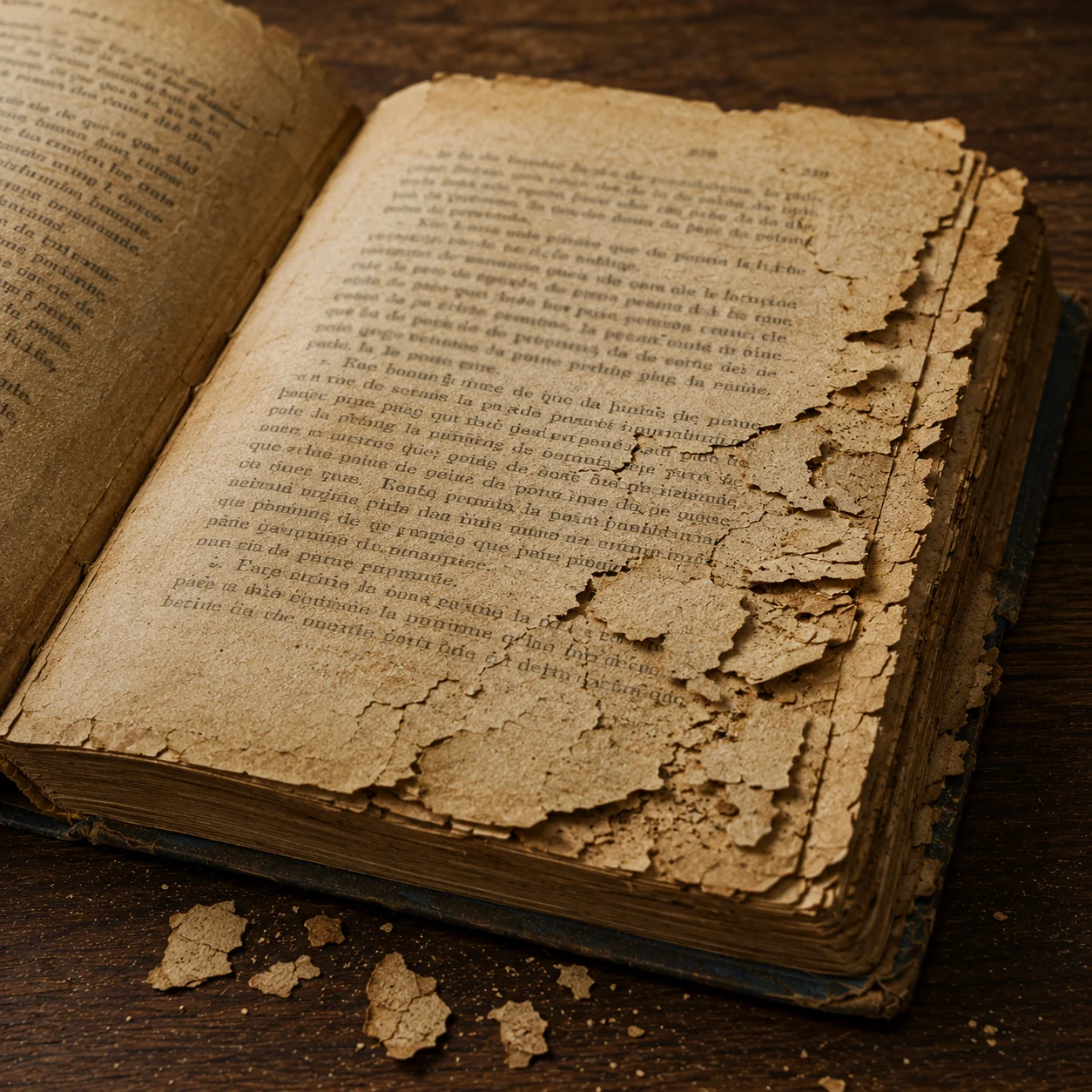
Acidic deterioration Rapuh asam
Paper gone brittle and easily crumbled through high acid content.AIC BPG Glossary: Acidic
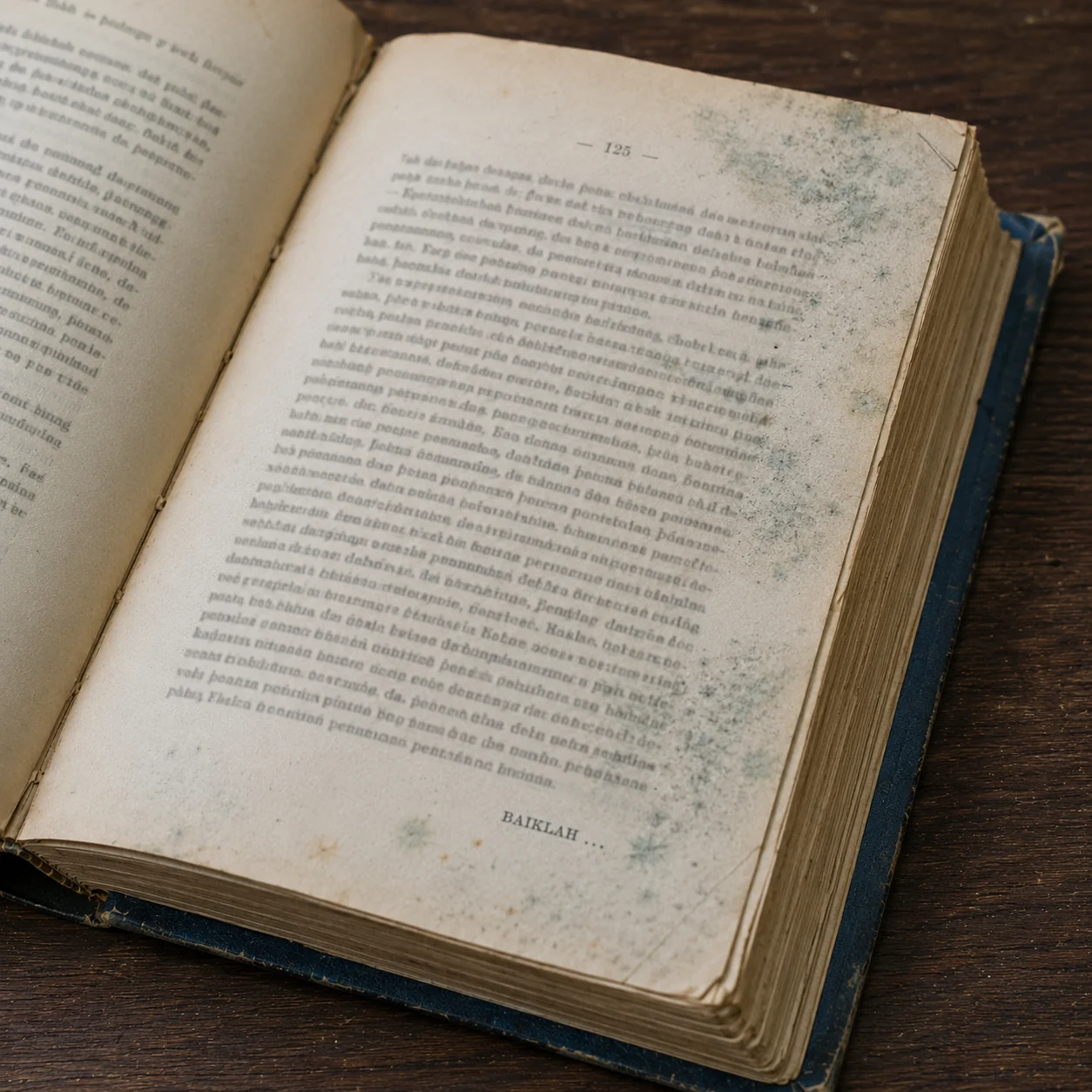
Active Mold Jamur aktif
Live fungal growth, still sporing — a risk both to other books and to human health.AIC BPG Glossary: Mold
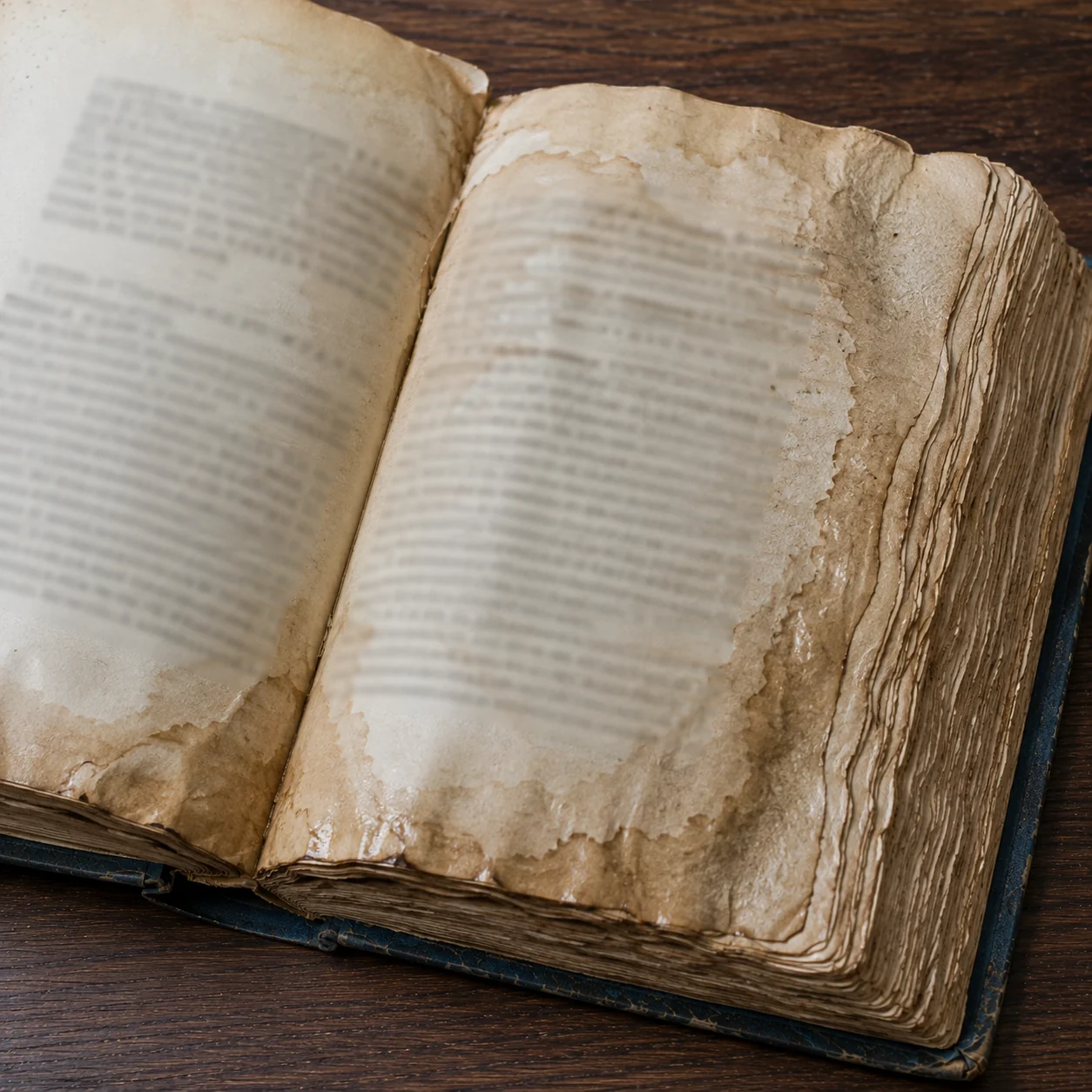
Water damage Kerusakan air
A swollen text block, pages stuck together (blocking), and heavy water staining.AIC BPG Glossary: Liquid stain
General terms — 293 words
The vocabulary of bookbinding and book care. Entries marked with a year are quoted exactly as they stand from public-domain glossaries — Zaehnsdorf (1890) and Coutts & Stephen (1911); the definitions are those authors’ own words.
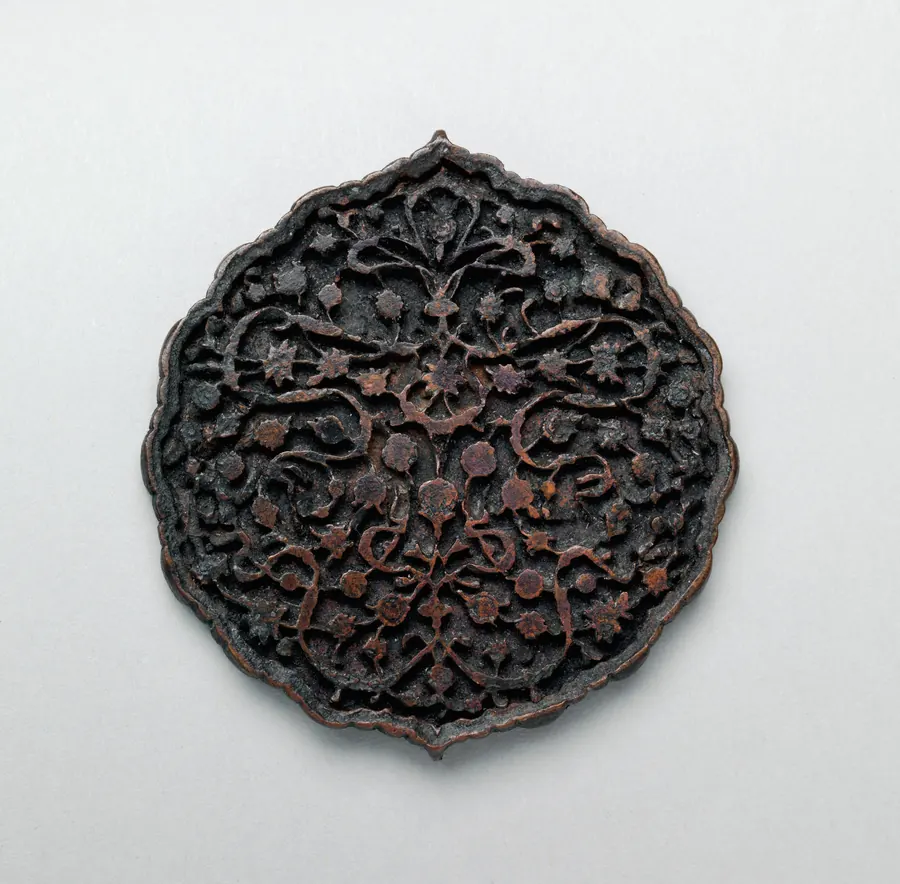
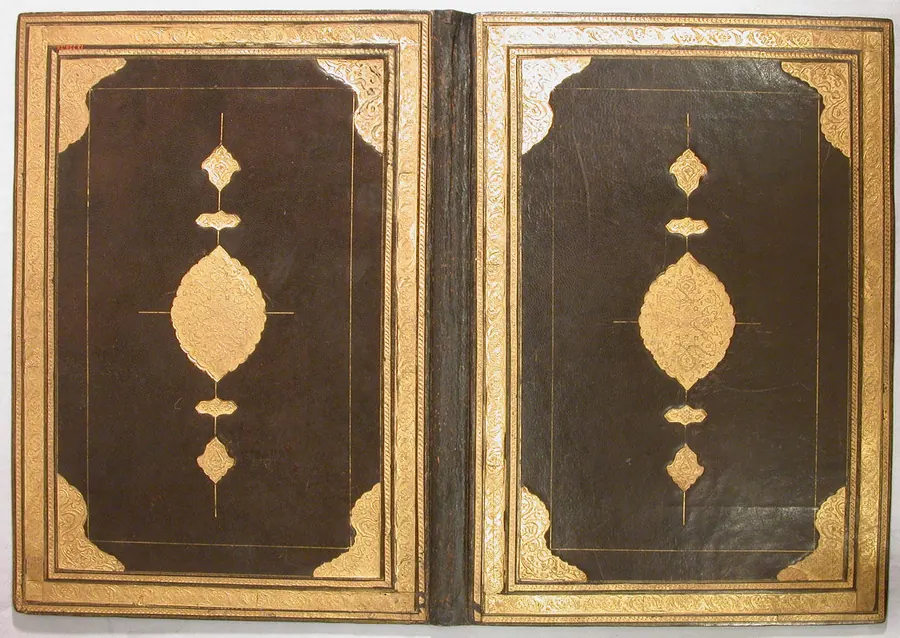
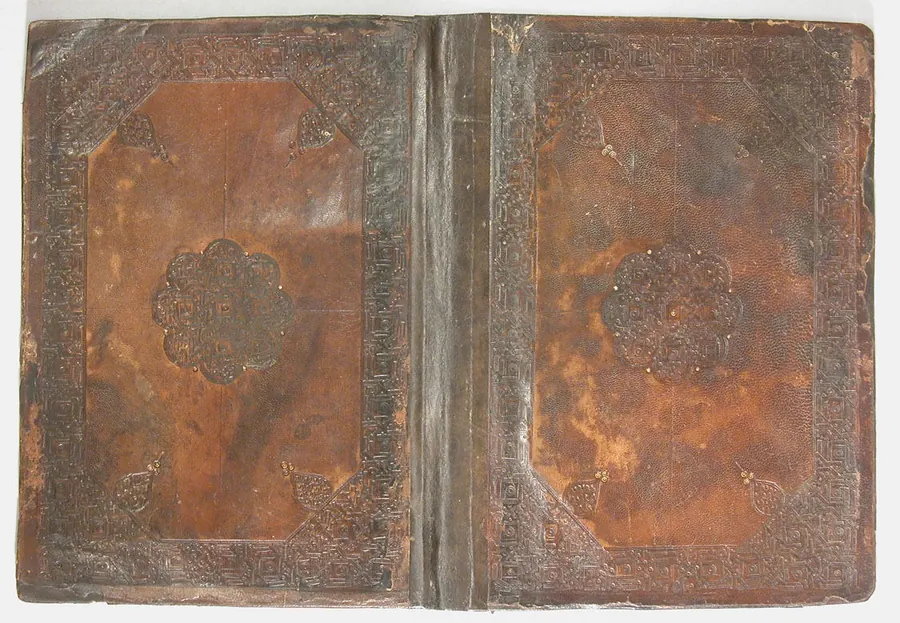
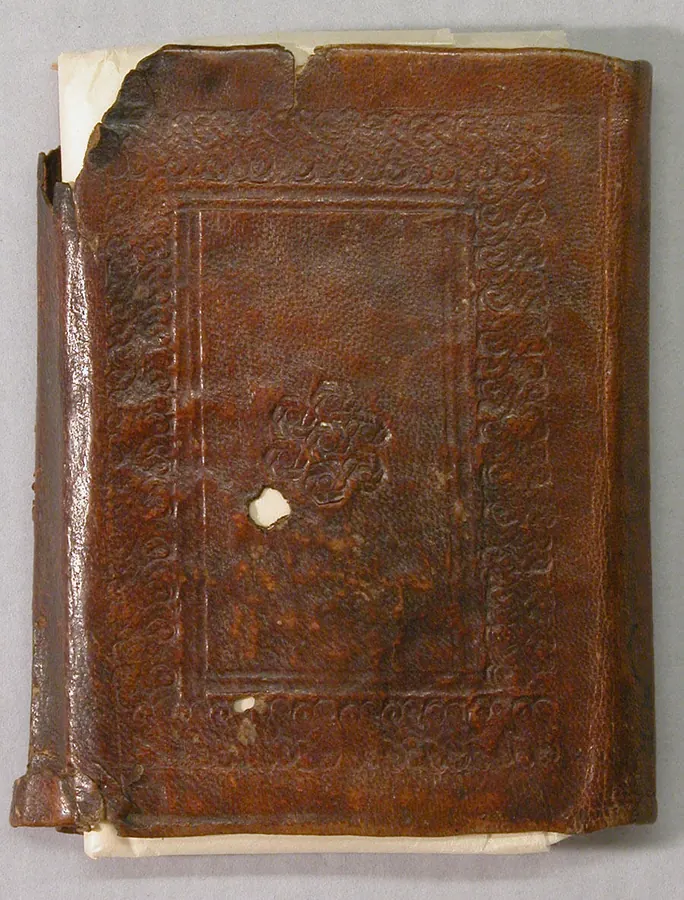
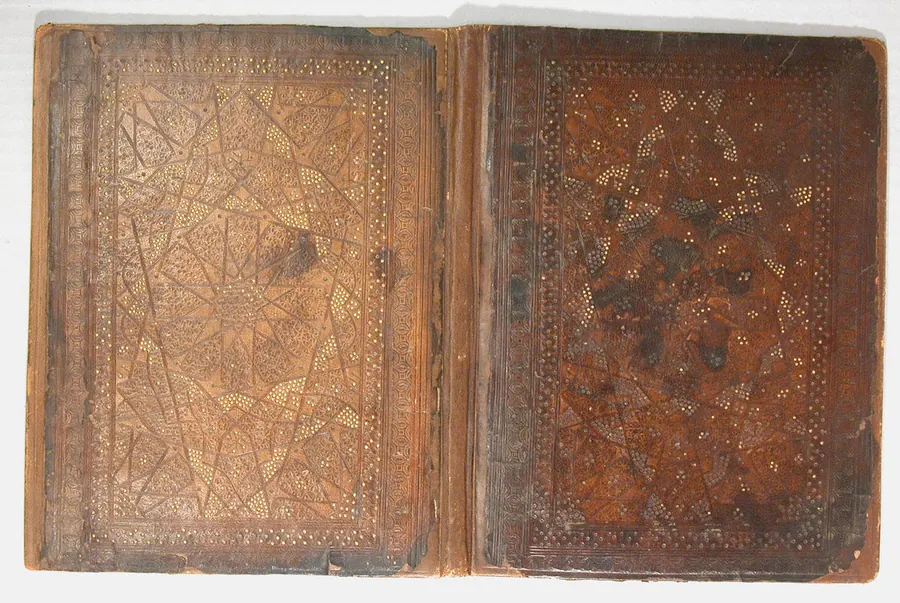
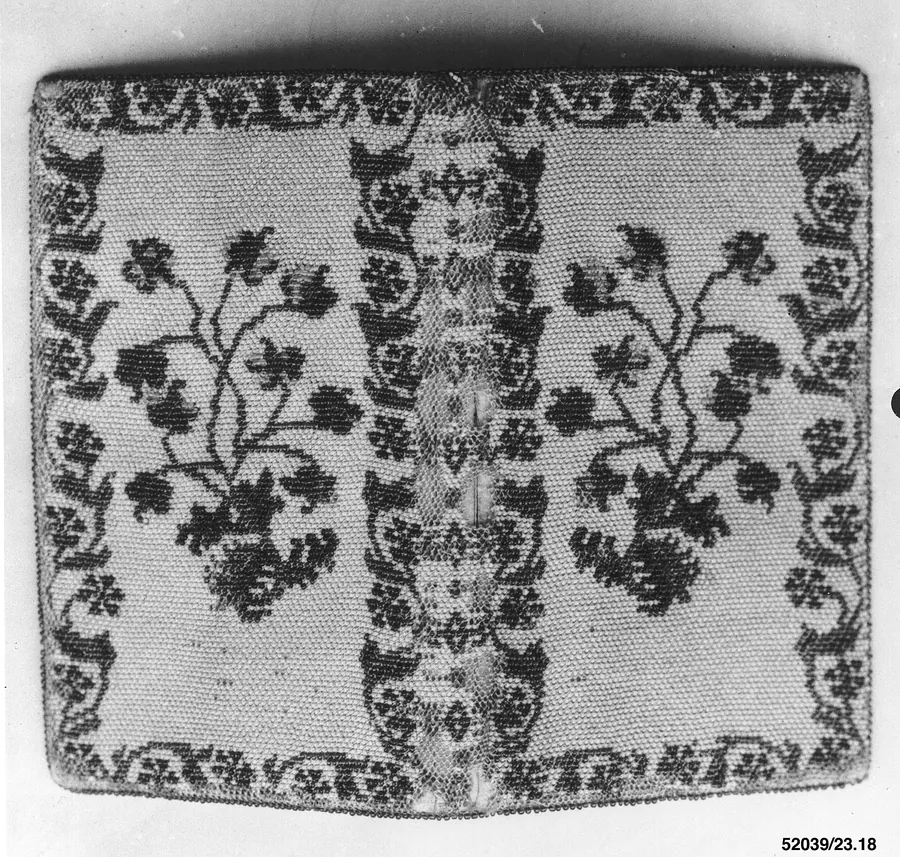
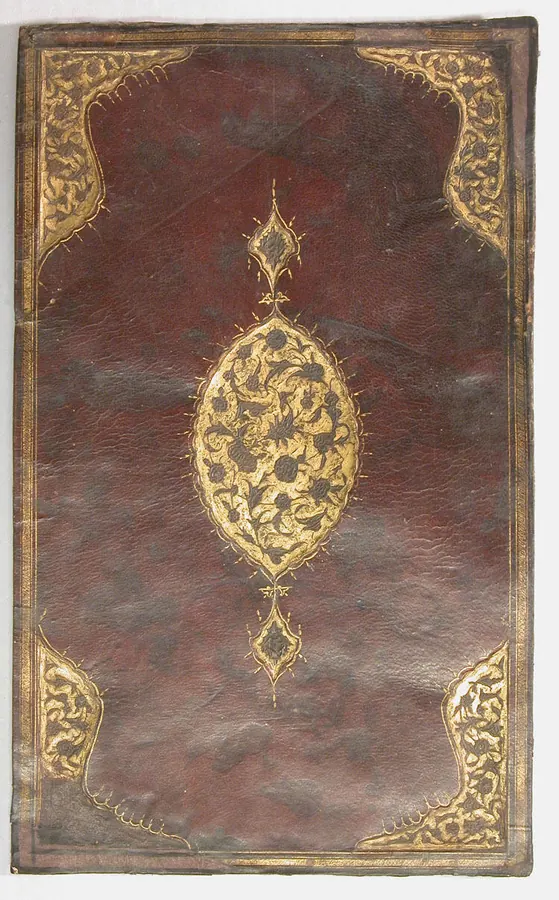
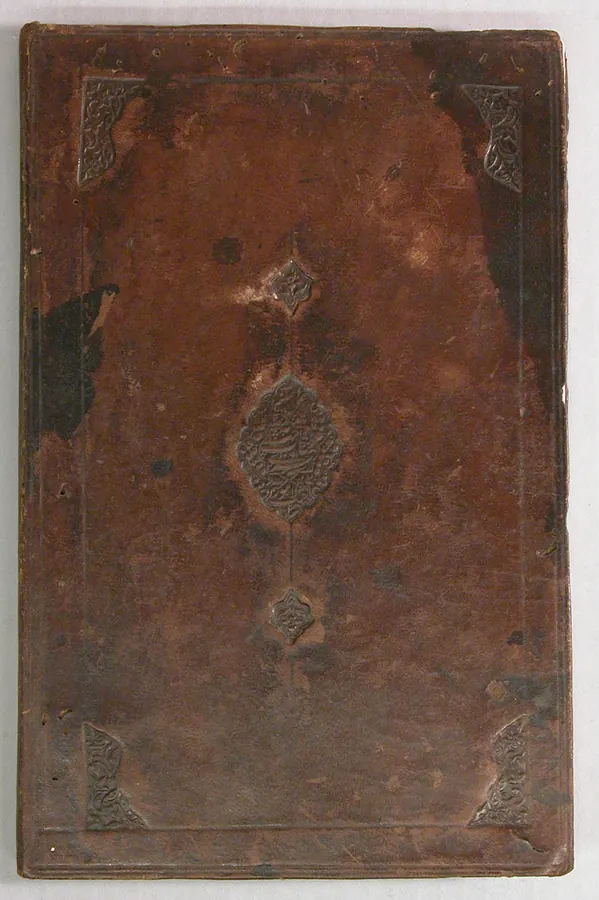
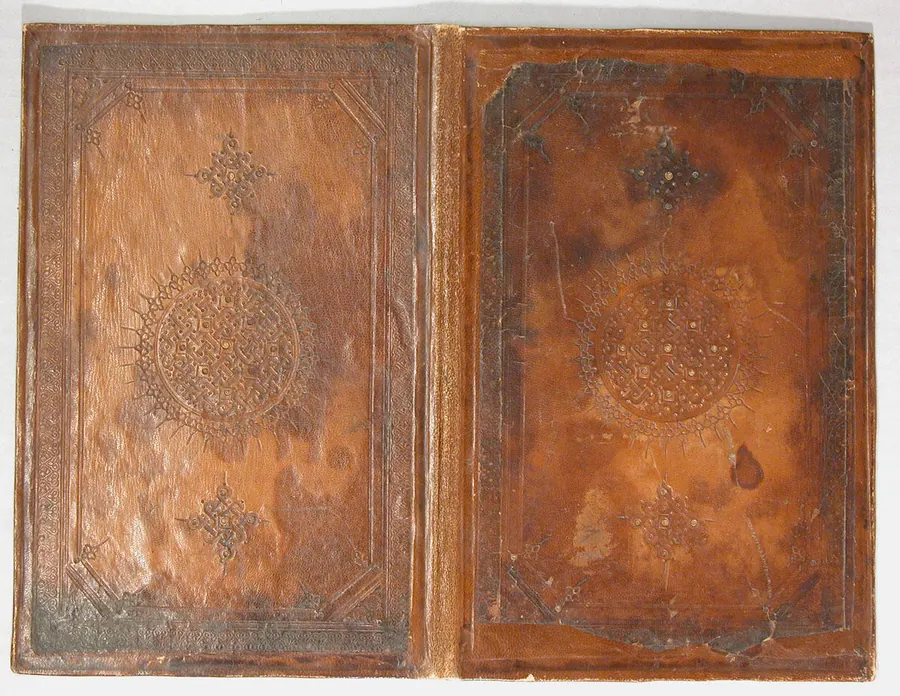
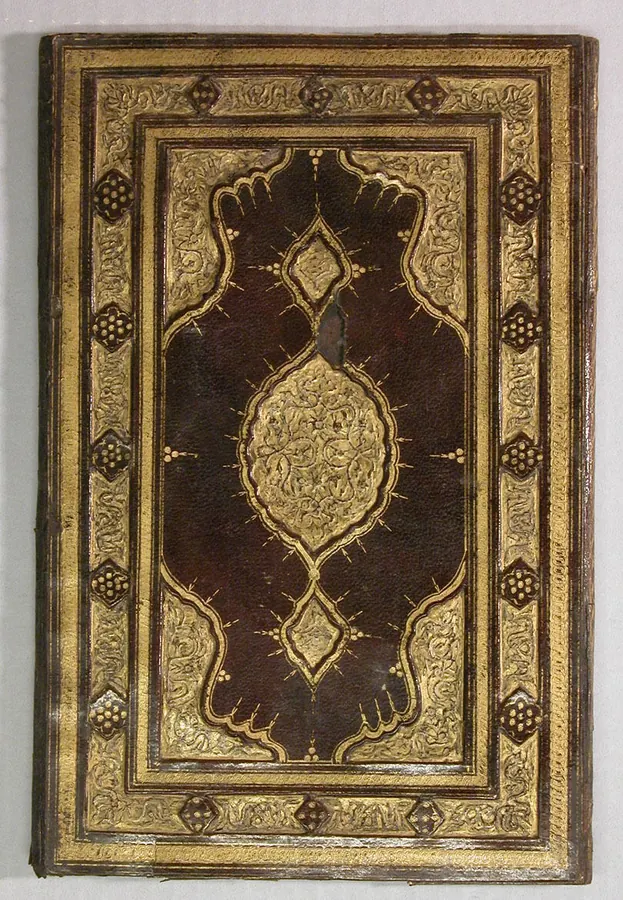
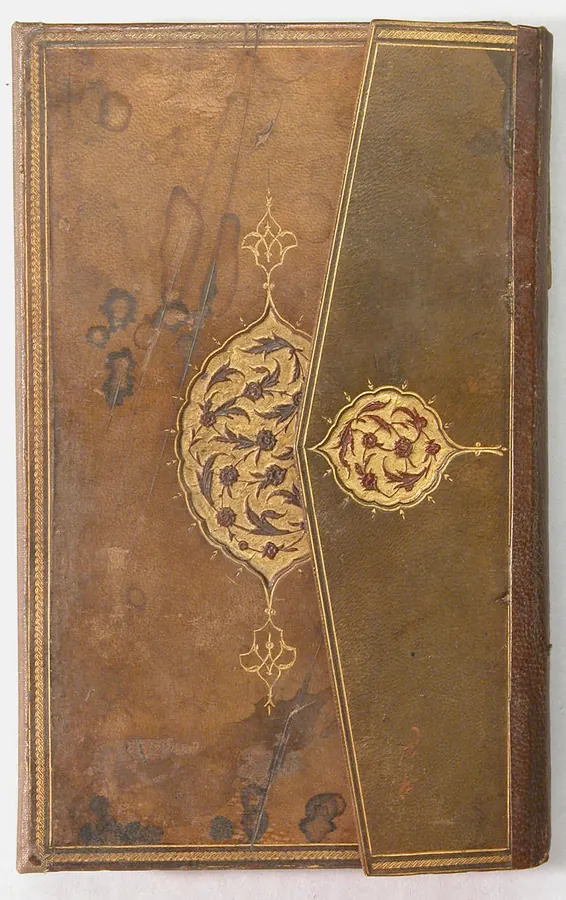
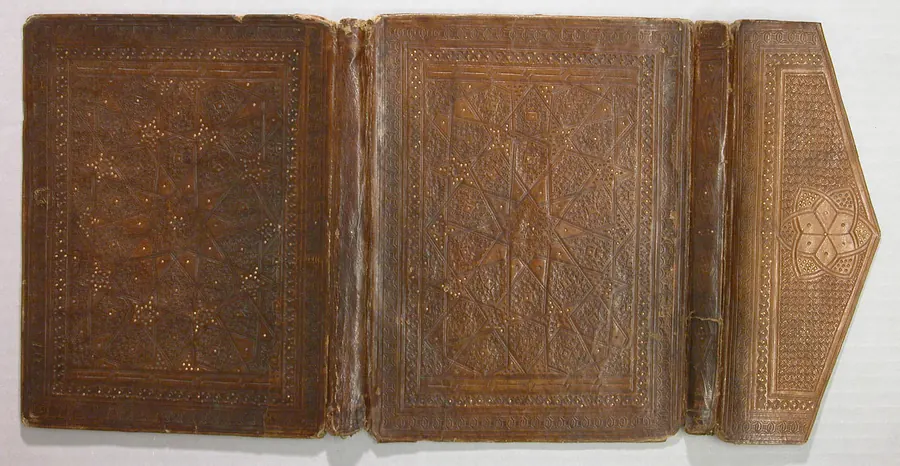
Twelve historic bindings from the open-access collection of The Metropolitan Museum of Art, released CC0.
Sources
The definitions above were written by Hibrkraft. The terms follow standard international conservation vocabulary, and every entry links to its source so that you can check it yourself. The bookbinding dictionary is quoted in full from the works listed below.
Checked 1 September 2026: all seven sources above are still live and still carry the entries we quote. For the three running web sources — AIC BPG and Ligatus — we have also noted their Wayback archives, so these quotations stay checkable if the original addresses change. The public-domain book sources have been in the archive from the outset.
- BPG Animal Skin and Leather — American Institute for Conservation — Book and Paper Group (AIC Wiki). free to read online
- BPG Glossary of Terms — American Institute for Conservation — Book and Paper Group (AIC Wiki). free to read online
- Book repair and restoration: a manual of practical suggestions for bibliophiles — Mitchell Buck (1918), Nicholas L. Brown, Philadelphia. full text, free
- Language of Bindings Thesaurus — Ligatus, University of the Arts London / University of Edinburgh. free to read online
- Manual of Library Bookbinding, practical and historical (Glossary of terms used in bookbinding and allied industries) — Henry T. Coutts and George A. Stephen (1911), Libraco, London.
- Procedures for salvage of water-damaged library materials — Peter Waters (1975), Library of Congress. free to borrow
- The Art of Bookbinding: a practical treatise — Joseph W. Zaehnsdorf (1890), George Bell and Sons, London.
Questions
The 12 questions we are asked most
- Do I have to come to Cileungsi in person, or can I send the book from another city?
- You do not need to come in person. Hibrkraft serves the whole of Indonesia, from Sabang to Merauke. The process:
- Send photographs of the book over WhatsApp — assessment and estimate are free.
- We reply with the service level, an estimated cost and a working time.
- The book is shipped to the workshop. We send unboxing photographs and video the moment it arrives.
- When the work is done it is shipped back with double protection and a FRAGILE label.
The full sequence is in From photograph to finished book.
- What is the difference between Repair, Reconditioning, Restoration and Conservation?
- The difference lies in the extent of the damage and in what the work is for:
- Repair — light damage: tears, a loose binding, detached pages. From Rp 35,000, 3–5 working days.
- Reconditioning — readable but dull or dirty. Appearance restored without erasing the book's character. From Rp 45,000, 5–7 working days.
- Restoration — heavier damage on an ordinary book. Components are replaced and the structure may change. From Rp 85,000, 7–10 working days.
- Conservation — rare or historical material. Every material is reversible and every step is recorded. From Rp 125,000, 10–20 working days.
- How do I find out what repairing my book will cost? Is the consultation chargeable?
- Consultation and cost estimates at Hibrkraft are 100% FREE and carry no obligation. How it works:
- Message us on WhatsApp at +62 815 1119 0336.
- Describe the book's condition and send a few photographs — cover, spine, and the damaged area.
- We reply with the right service level, an estimated cost and a working time. Usually within hours, not days.
- What if my book turns out to be beyond repair?
- We will tell you at the consultation stage if the book is likely to be beyond repair. In our experience, though, nearly every book can be saved to some degree.
- What if the final cost comes to more than the first estimate?
- Our first estimate is based on the photographs you send. The real condition is sometimes different once the book has been examined in the hand.
- Is it safe to send a valuable book by courier?
- We understand the worry. Here is what we guarantee:
- Confirmation photographs — we send unboxing photographs and video as soon as the book arrives, so you know exactly what condition it reached us in.
- Packing guidance for fragile books before you send them.
- Return shipping with double protection and a FRAGILE label.
- Optional insurance for books of high value.
- How long does repairing a book take?
- The working time depends on the service:
- Repair — 3–5 working days.
- Reconditioning — 5–7 working days.
- Restoration — 7–10 working days.
- Conservation — 10–20 working days.
Shipping time is separate. Larger projects are scheduled with you.
- What kinds of book can Hibrkraft repair?
- We take on many kinds of book:
- Scripture — Qur'an, Bible, Torah, Vedas and others.
- Family books — photo albums, diaries, recipe books, inherited records.
- Collectors' books — rare novels, vintage comics, art books.
- Academic books — textbooks, lecture notes, theses.
- Antiquarian books — manuscripts, old texts, historical volumes.
- Important documents — marriage books, certificates in book form.
- Does Hibrkraft handle bulk repair for libraries or institutions?
- Yes — we have experience with institutional projects:
- EFEO Indonesia — conservation of archive books, including Indonesië Vrij, the text of Mohammad Hatta's 1928 defence speech.
- ANRI — the National Archives of the Republic of Indonesia.
- Libraries, schools and private collections, worked through in batches so the collection is not out of use for long.
For institutional needs, start at the corporate page.
- What materials does Hibrkraft use for book repair?
- We use only high-quality materials meeting international conservation standards:
- Adhesive — pH neutral, acid-free, reversible. For conservation we use a starch-based paste.
- Paper — acid-free, for mending and lining. Japanese tissue included.
- Thread — linen or cotton, purpose-made for bookbinding.
- Cloth — bookcloth for covers.
- Leather — genuine leather for restoring leather bindings.
- Protection — archival-grade boxes for conservation storage.
- What is the IIC, and why does it matter?
- The IIC (International Institute for Conservation of Historic and Artistic Works) is the international body for conservation professionals. Membership of the IIC indicates that we follow its literature and working standards — reversible materials, nothing discarded, every step recorded. One thing should be clear: this membership is held by the company, and is not an accreditation of a conservator in one person's name. The two are often taken to be the same, and they are not. This membership and every other public record about us is listed on the badges page, each with the strength of its evidence.
- Is there a guarantee on the finished repair?
- Yes — we guarantee every job we do:
- 12 months against production defects — stitching and binding, detached pages, a binder structure that has skewed or torn.
- Free during the warranty period, and we cover return shipping on a valid claim.
- Not covered: damage in use, normal wear, or repairs made outside Hibrkraft.
- After the warranty period repair is still possible — at a cost we tell you first.
Library
Three books to read before you decide
Most books that reach our bench are worse off than they were when their owner first noticed something was wrong — usually because the wrong kind of help was applied. These three explain how to recognise the damage, how to hold it steady for now, and how to choose the tier of repair. Readable straight in your browser, free.
A visual atlas
Atlas Kerusakan Buku
Recognising damage by sight, before touching anything. Foxing, mould, brittle paper, loose pages — what each is called, what causes it, and what makes it worse.
Read the PDF
Before you send it
Merawat, Mengemas, Mengirim
Holding it steady, photographing it, packing it, and knowing when to stop touching it. What damages books most often is mistaken first aid.
Read the PDF
Telling the tiers apart
Empat Tingkat Perbaikan Buku
Repair, reconditioning, restoration, conservation — and what is given up at each tier. Settling the tier first makes both the price and the result predictable.
Read the PDFThe file opens in your browser rather than downloading straight to storage. All three are written in Indonesian, A5 in size, and may be printed for your own use.
Reading before you decide
All writing
Send photographs of the book
The first assessment is free. We reply with the tier that fits, an estimate of the cost, and how long the work will take.
Last updated