Saddle Stitch Binding
by Ibrahim Anwar · July 31, 2025
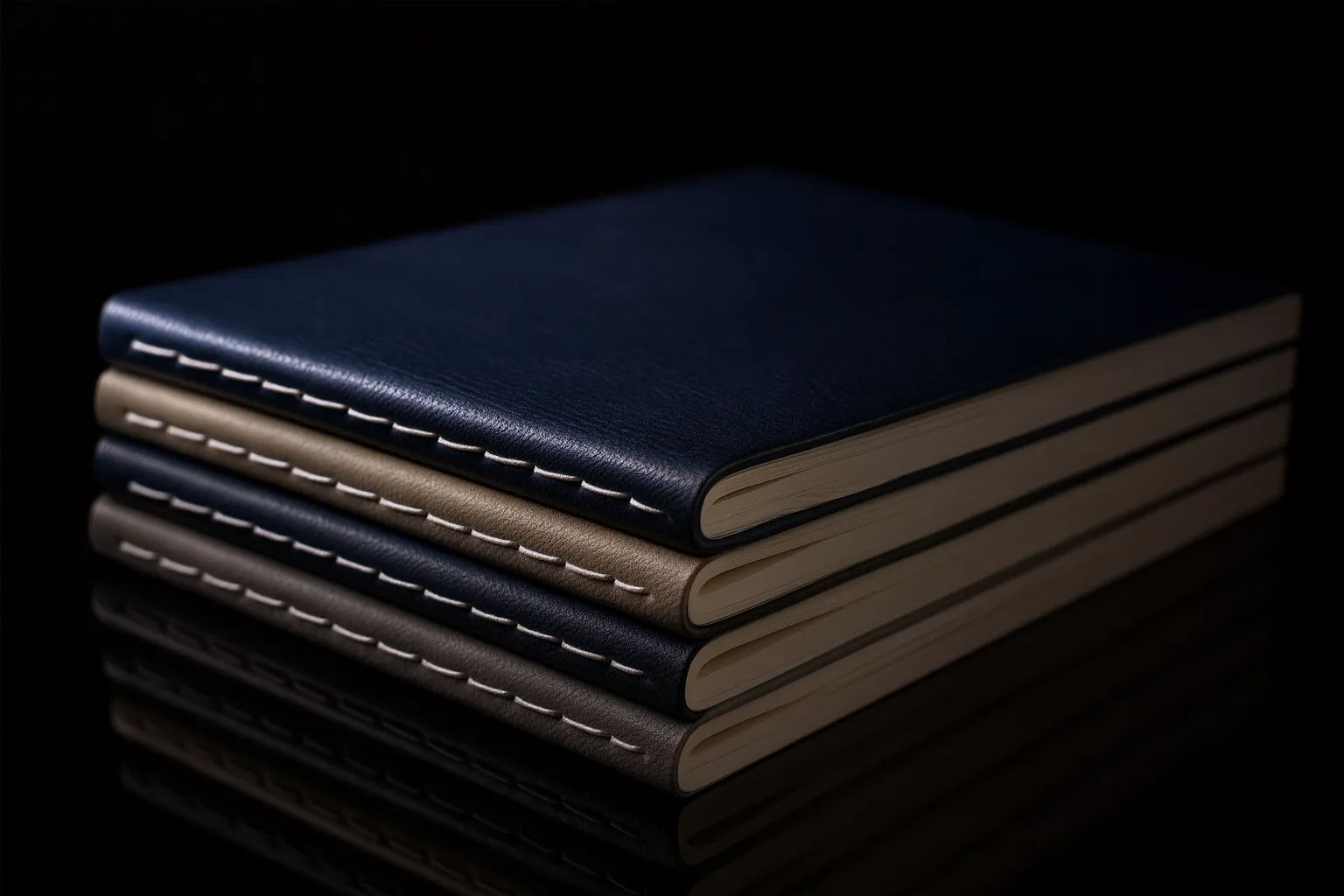
Saddle stitch binding — in Indonesian often called jilid sadel, jilid pelana or jilid staples tengah — is a binding method in which folded sheets are gathered into one group (a signature) and then stapled or sewn along the centre fold. The name comes from the process: the stack of paper is laid over a support shaped like a horse's saddle before it is bound. Although staples are common, in handmade work the method uses thread sewn by hand, which gives a more personal and more expressive result.
Hearing “stapled binding”, what comes to mind is probably something simple and quick, the sort of thing a copy shop does to make a thin booklet or a proposal. That impression is not wrong, but it is not the whole truth either. In bookbinding, saddle stitch is a world of its own, full of nuance, history, and technique that separates mass production from handmade work. It is among the oldest and most fundamental binding methods, and the doorway through which many bookbinders begin. But as practitioners often say, simplicity frequently hides an unexpected level of difficulty. To produce a saddle-stitched book that is neat, precise and durable takes a deep understanding of paper, of thread tension, and of precision in every hole and every pull of the needle.
This article works through saddle stitch binding from the most basic definition to the significant difference between its commercial and its handmade forms. We will look at why a method this apparently simple is so loved for independent publishing — zines, menus, minimal journals — while also understanding why the craftsmen at Hibrkraft value the technique as the foundation of more complex binding. We will also settle one of the most common misconceptions: the crucial difference between “saddle stitch” in bookbinding and “saddle stitch” in leather craft. They share a name but are entirely different techniques with entirely different purposes.
The anatomy of saddle stitch: from the name to the function
To understand a technique properly, it helps to start with where its name came from. The term “saddle stitch” is very descriptive. Picture a horse's saddle. When a bookbinder is about to bind by this method, they take a gathered group of folded sheets — the signatures — and lay them straddling a support or a machine shaped like a saddle. That position keeps every page straight and aligned along the spine, ready to be pierced exactly at the centre fold. Whether with a high-powered industrial stapler or with a needle and thread in a craftsman's hand, the principle is the same: securing the pages from the outside in, through the spine of the book.
There are two main variants of saddle stitch worth distinguishing:
- Commercial saddle stitch (with staples): the method we meet most often. It is used for mass-produced magazines, catalogues, manuals, menus and promotional booklets. The process is fast and automated. Sheets are printed, gathered, laid over the machine's “saddle”, stapled with wire from the outside, then folded and trimmed precisely on three sides. Its advantages are low cost and high production speed.
- Manual saddle stitch (with thread): the domain of craftsmen, book artists and DIY enthusiasts. Also known as pamphlet stitch, this method replaces the staples with thread. It demands more care. The binder must mark the hole positions along the fold precisely, punch them one by one with an awl, then sew with needle and thread — often waxed thread, which is stronger and less prone to tangling. The result is a book with a warm personal quality, with the stitching visible as a decorative element, and with far more freedom in the choice of materials. This is what a craftsman usually means when calling the technique “difficult”, because the evenness of the stitching, the right thread tension and the neatness of the knot all determine the final quality of the book.
The main visual characteristic of a saddle-stitched book is easy to recognise. Open it at the centre spread and you will see two or three metal staples, or a line of stitching, running from top to bottom along the fold. Its greatest functional advantage is that it opens very flat (lay-flat), which makes it ideal for designs that run across two pages (spreads) without any information being lost in the gutter.
One of the biggest misunderstandings is equating saddle stitch in bookbinding with saddle stitch in leather craft. They are completely different techniques. In a book, it binds the pages at the centre fold. In leather, it is a very strong two-needle hand stitch that joins two pieces of leather edge to edge.
A short history, and why it still matters
Saddle stitch in its sewn form — the pamphlet stitch — is one of the oldest and most basic binding techniques there is. Long before modern printing and staples, pamphlets, political tracts and thin manuscripts were held together by sewing them through the centre. The method became popular because it is efficient. With a single length of thread, a manuscript becomes a working book.
In the modern era, the revival of zine culture — self-published independent magazines — in the late twentieth century made saddle stitch popular again. Artists and writers found that with a photocopier and a long-reach stapler they could produce their own publications quickly and cheaply. That DIY spirit made saddle stitch a symbol of free expression and of resistance to mainstream publishing.
To this day, saddle stitch remains the first choice for projects with a limited page count. As a rule it is most effective for books under 64 pages, although some printers can push it to 80 or even 100 depending on the thickness of the paper. Beyond that you meet a problem called “creep”: after folding and trimming, the inner pages protrude further than the outer ones, which makes the page margins inconsistent. That technical limit is what makes it unsuitable for a thick novel or a textbook, and perfect for a travel journal, a thin notebook, a book of poems or a compact portfolio.
When to choose saddle stitch: a practical guide
Choosing the right binding is a decision that affects a book's function, its look and its cost. Saddle stitch, with all its strengths and weaknesses, has its own place. So when should you choose it?
Advantages
- Cost-effective: particularly the commercial stapled version, this is among the cheapest binding methods there is. A minimal, automated process keeps production costs down significantly.
- It lies flat: the main advantage. The book opens a full 180 degrees without damaging the spine, which is perfect for showing images, maps or graphic designs that run across two pages.
- Light and thin: with no glue and no thick cover, a saddle-stitched book is very light and takes little space, which makes it ideal for posting or for travelling with.
- Quick to produce: a fast binding process allows a project to be finished in a short time, which suits urgent work such as event material or a limited promotion.
- Clean and professional: simple though it is, the result looks neat and professional, particularly when done precisely.
Disadvantages
- A limit on page count: the biggest weakness. The method does not suit thick books. The more pages, the greater the risk of “creep” and the harder it is for the book to stay properly closed. The general rule is under 64–80 pages.
- Less durable: compared with thread-sewn bindings such as Smyth sewn or Coptic stitch, saddle stitch — particularly the stapled version — is less hard-wearing over long and heavy use. Staples can rust over time, and the spine can tear if handled carelessly.
- No spine for a title: because the spine is only a sharp fold, there is no flat area on which to print a title, an author's name or anything else. That can be a drawback once the book is on a shelf.
Saddle stitch against other binding methods
For a clearer picture, here is saddle stitch set against some popular alternatives:
- vs. perfect binding (hot glue): perfect binding, normally used for novels or thick magazines, stacks the pages and glues them to the cover with strong hot glue. It can take hundreds of pages and gives a flat spine for a title. But a book bound this way cannot open completely flat. Choose saddle stitch for a thin booklet that lies flat; choose perfect binding for a thick book with a bookshop look.
- vs. Smyth sewn: a high-quality method in which the signatures are sewn together before being attached to the cover. The result is very strong, very durable, and opens relatively flat. It is the gold standard for hardcovers. Choose saddle stitch for a simple, economical project; choose Smyth sewn for an archival book, a collector's edition, or a book that will be used constantly.
- vs. spiral / Wire-O binding: this uses a wire or plastic spiral threaded through holes along the edge of the pages. Its advantage is that it opens a full 360 degrees and stays flat. But its look is often judged less formal, or too “corporate”. Choose saddle stitch for a clean, traditional book; choose spiral for a notebook, a manual or a presentation that needs to fold right back.
The Hibrkraft view: a foundation we respect
At Hibrkraft we concentrate on making leather journals and custom books designed to last a lifetime. Our main binding techniques are therefore the more complex and stronger ones — Coptic stitch, longstitch, French link stitch — which give a book a handsome exposed spine and remarkable strength. But we regard saddle stitch, and particularly its hand-sewn pamphlet stitch form, with real respect.
For us, pamphlet stitch is the fundamental exercise in the art of binding. It teaches the most basic things: how to feel the character of a paper, how to punch a hole precisely, and above all how to control thread tension — the skill at the heart of every more complicated book-sewing technique. Sometimes we use it to make an insert or a companion notebook for one of our main leather journals. A substantial leather journal may well hold several saddle-stitched booklets inside it, each for a different purpose.
Understanding saddle stitch helps our customers appreciate the complexity behind a handmade book. When you see a simple line of stitching down the centre of a book, you begin to understand that behind every stitch there is a choice, a skill, and a story. It is a reminder that even in its simplest form, a book is an object of both engineering and art.
FAQ
What is the difference between saddle stitch and ordinary stapling?
Essentially, commercial saddle stitch is a kind of stapling. But the term “saddle stitch” is more specific: it refers to stapling exactly along the centre fold of a book, the spine. “Ordinary stapling” can also mean a staple in the top left corner, as on a stack of papers, whose job is only to hold loose sheets together rather than to make a booklet. So all commercial saddle stitching is stapling, but not all stapling is saddle stitching.
What is the maximum page count for saddle stitch?
The ideal page count depends greatly on the thickness of the paper. As a general rule the safe limit is 64 pages. Some printers can manage 80 or even 100 with very thin paper. Beyond that you get significant “creep”, where the inner pages protrude, and the book becomes hard to keep closed or bulges at the spine.
Is saddle stitch in bookbinding the same as saddle stitch in leather craft?
No, and this is an important point. They are entirely different techniques that happen to share a name.
- Saddle stitch (bookbinding): sewing or stapling folded sheets along the centre fold to make a booklet.
- Saddle stitch (leather craft): a very strong hand-sewing technique using two needles at once on a single thread. The stitch creates a lock inside every hole, and is used to join two or more pieces of leather edge to edge. It is known for exceptional strength and durability, and is common on luxury leather goods.
The shared name causes frequent confusion, but the function and the process are quite different.
References
- PrintingForLess. “What is Saddle Stitch Binding?”.
- LDD. “Saddle Stitching vs Perfect Binding: Which one to choose?”. (the original link is dead; the reference is kept without it)
- BookWeb. “A Brief History of Saddle-Stitching”. (the original link is dead; the reference is kept without it)
- Company Folders. “Saddle Stitching vs. Perfect Binding: Which is Better?”. (the original link is dead; the reference is kept without it)

A personal custom notebook
From the most fundamental stitch to an intricate design, make a journal that is genuinely yours. Handmade in real leather, with quality that lasts.
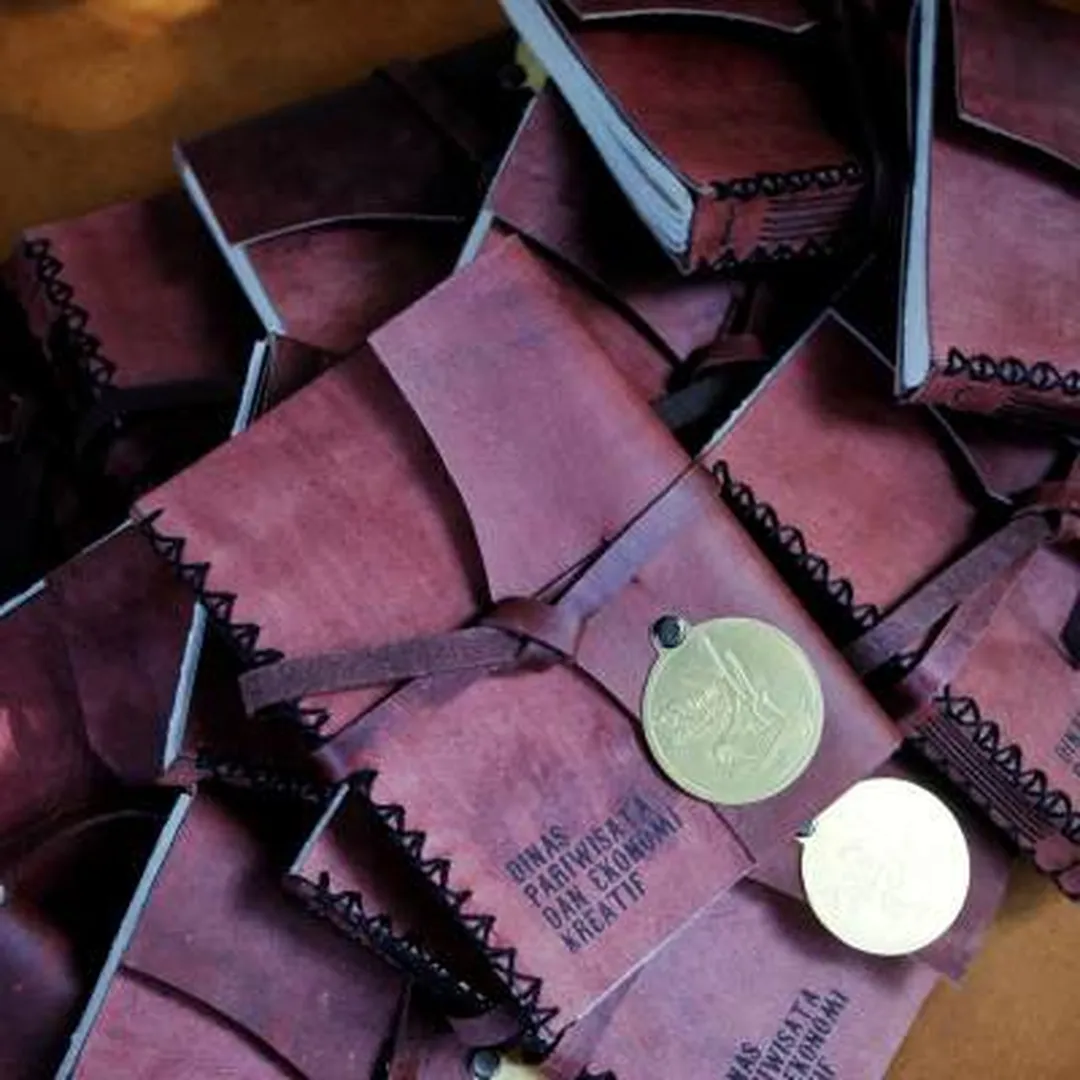
Business & white label solutions
Lift your brand with premium diaries and notebooks, from saddle-stitched booklets to fine leather journals, all under your own label.
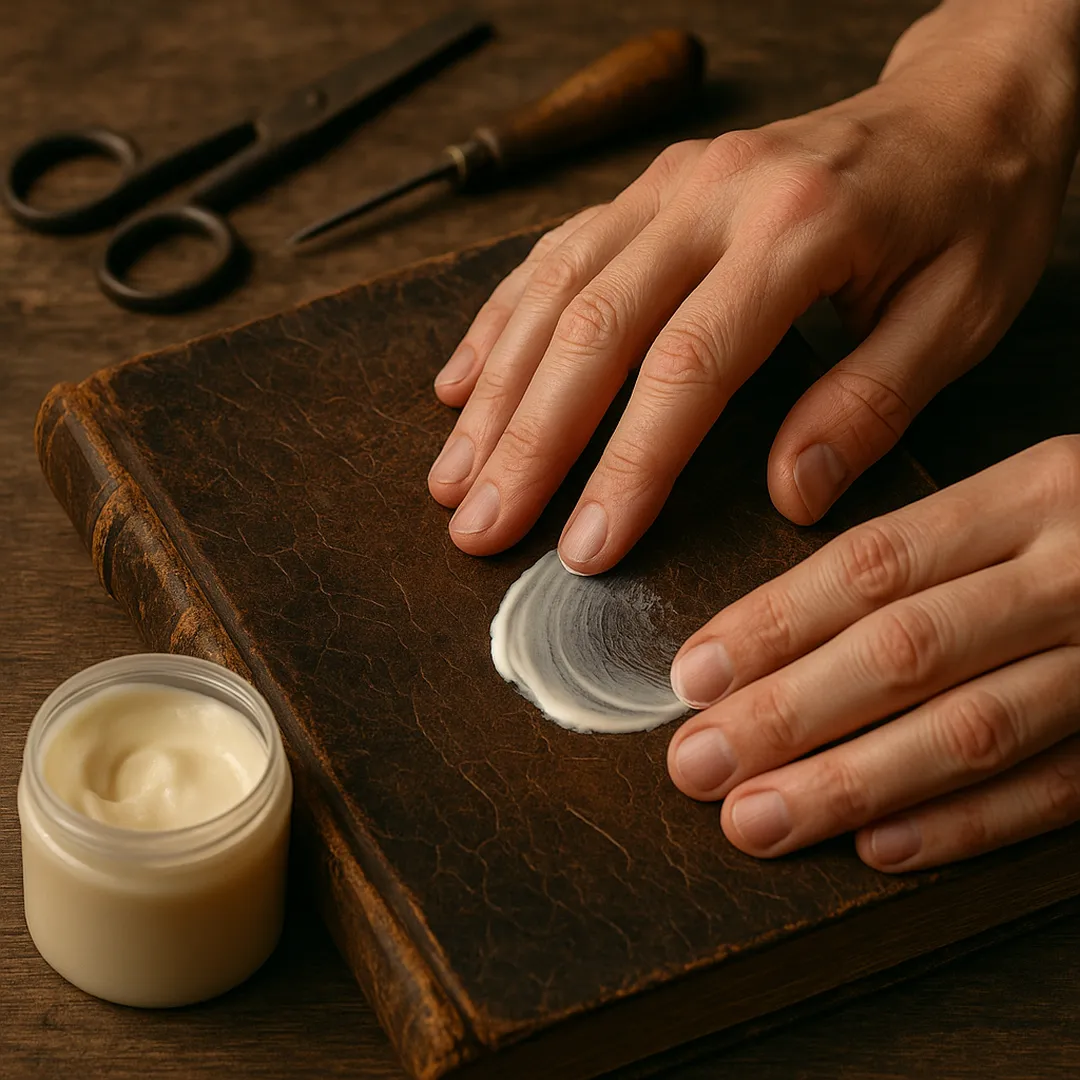
Book repair & conservation
Restore a book you value, from a simply bound novel to an heirloom volume. We care for it with archival technique, for the generations after.