
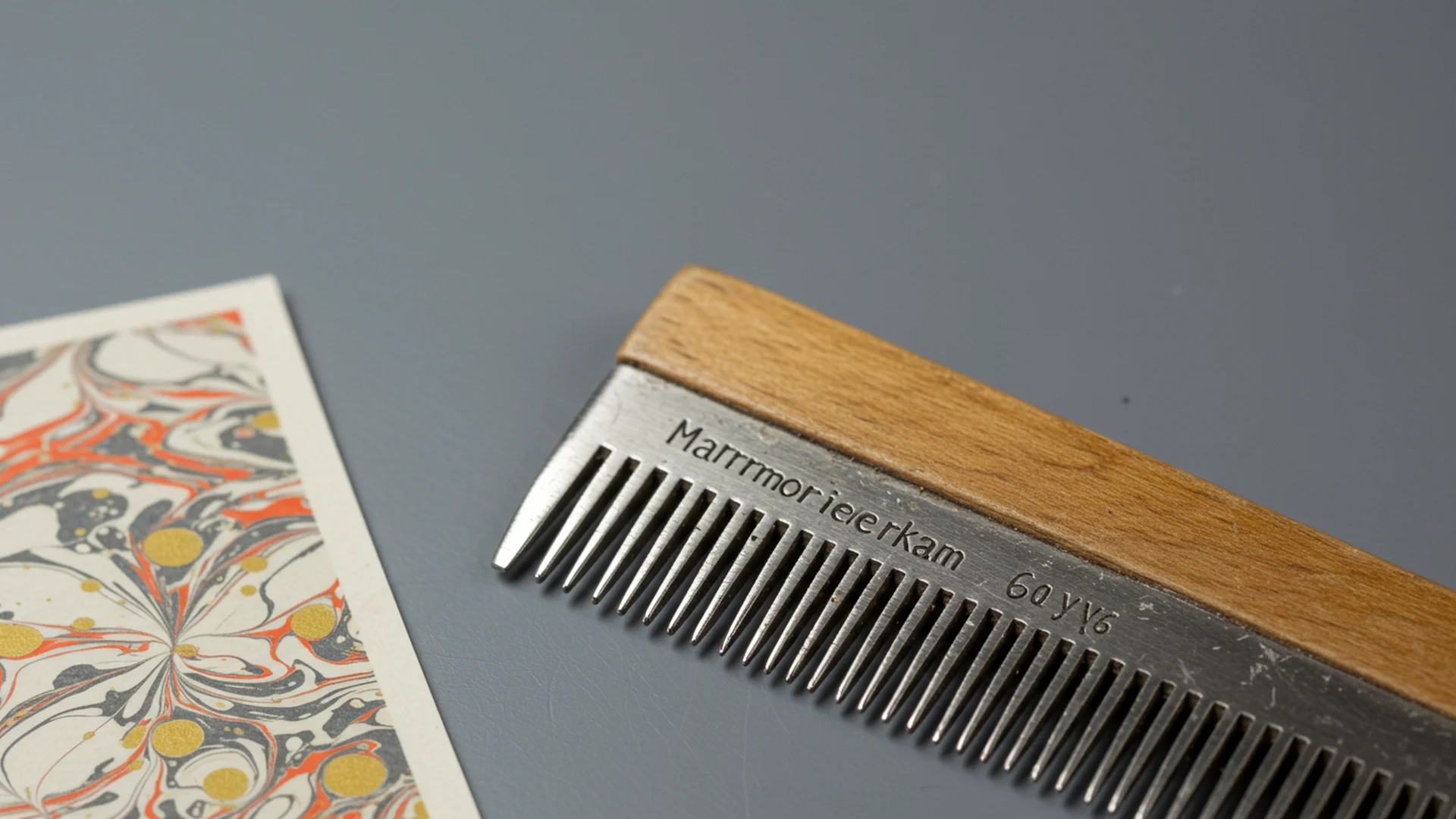
Marmorierkamm
by Ibrahim Anwar · August 9, 2025
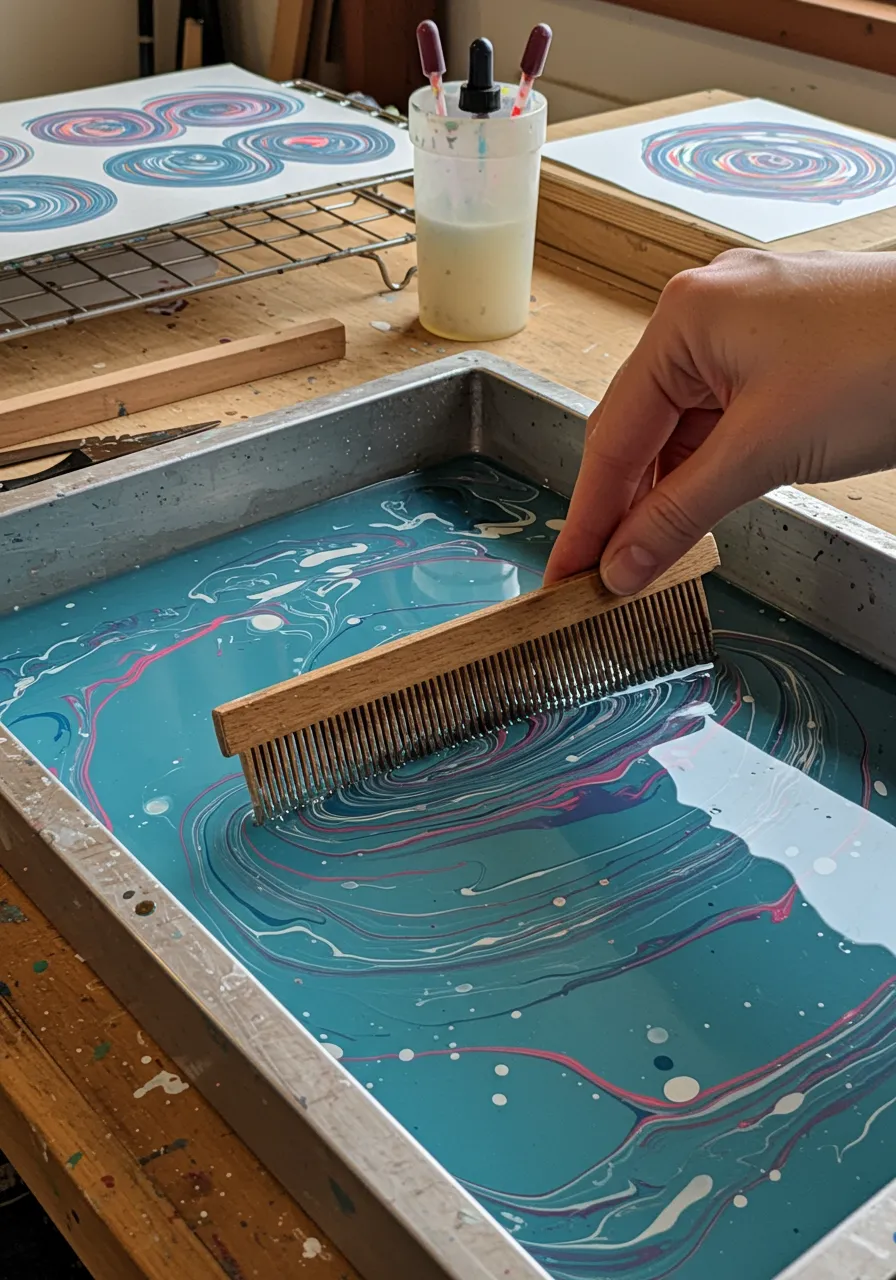
In the studio of a paper marbler the air is full of the smell of paint and of a medium made from seaweed. Over a tray of thickened liquid the colours float like miniature galaxies. Among all the tools there is one that takes the director’s part: the Marmorierkamm. If the stylus and the rake are the pen that draws the first sketch, this comb is the brush that lays down the decisive final stroke. With one steady, measured pass it turns liquid chaos into cosmic order, drawing lines of colour into precise formations. To understand the Marmorierkamm is not merely to know a tool; it is to appreciate the instrument that allows an artist to dance with fluid physics and create wonders on water.
Definition and Function: More Than an Ordinary Comb
At the heart of every handcraft there are tools so fundamental that without them the art form itself would not exist in the shape we know. For the art of paper marbling, the Marmorierkamm is one of those tools. It is the bridge between artistic intent and physical execution, a device designed for a single purpose: to order floating colour with mathematical precision. Its German name captures the essence of its function perfectly.
Etymology and Meaning: Unpacking the German Name
The term “Marmorierkamm” is a compound word, beautiful and efficient in the way distinctive of German. It has two parts: “Marmorier” and “Kamm”.
- Marmorier: From the verb “marmorieren”, meaning “to marble”, or “to make a pattern like marble”. It refers to the whole process of marbling: creating a pattern on the surface of a liquid and then transferring it to paper or cloth, a pattern that often resembles the veining of natural marble.
- Kamm: Literally, “comb”. It refers to the physical form of the tool, which does resemble a comb: a row of “teeth” or “pins” (known as tines) fixed into a bar.
So Marmorierkamm can be translated, literally and poetically, as “a comb for the art of marbling”. The name describes not only the tool but its purpose, packing the whole concept into one compact word.
The Main Function: Controlled Manipulation
The main function of the Marmorierkamm is to give control and structure to a marbled pattern. Once the paint has been dropped onto the surface of the size (the thickened medium) it spreads at random. Earlier tools such as a stylus or a rake can be used to pull those colours into looser first patterns such as Get-Gel or Feather. But creating the regular classic patterns, such as Nonpareil or Chevron, requires a higher degree of precision. That is where the Marmorierkamm comes in.
By drawing a comb with evenly spaced teeth across the tray, a maker pulls hundreds of lines of colour at once and turns them into perfect parallel ranks. Each tooth creates its own “lane”, splitting and dragging the paint it passes through. It is the act that turns the unlimited possibility of a liquid into a defined design. Without the Marmorierkamm, the comb patterns that are the distinctive mark of European marbling would not be possible. It is the tool that brings order into a world of liquid randomness.
The Marmorierkamm is the conductor’s baton in the maker’s hand, turning a liquid symphony of colour into an ordered and harmonious visual score.
A Range of Forms: The Marbler’s Arsenal
No single Marmorierkamm can do everything. A serious marbler usually keeps a collection of self-made combs and rakes, each designed for a particular purpose. The variety lies in the spacing, the length and the grouping of the teeth.
- Rake or Stylus: The most basic manipulation tools. A rake may have a few very widely spaced teeth, while a stylus has only a single point. They are used for the first movements, such as creating a Feather or Get-Gel pattern by drawing the paint back and forth. They serve to “stir” rather than to “comb”.
- Standard Comb (Nonpareil Comb): The most fundamental of them. It has a single row of straight teeth at even spacing (every 5mm or 1cm, for example). Its purpose is to create the Nonpareil pattern—the base pattern from which all the other comb patterns are built, made of neat parallel lines of colour. The comb is usually a little narrower than the marbling tray.
- Grouped Comb (Bouquet or Arch Comb): Instead of evenly spaced teeth, this kind has its teeth gathered into clusters with wide gaps between the clusters. Drawn through an existing pattern, it creates a beautiful arch or bouquet effect, because the paint flows in to fill the wide gaps between the groups of teeth.
- Custom & Complex Combs: Many makers build their own combs in order to create a distinctive pattern. That can mean a comb with two rows of teeth (a double comb) to make a net-like pattern, or a comb with wavy teeth to create a wave effect. The possibilities are almost unlimited, bounded only by the maker’s imagination and engineering skill.
A maker’s collection of Marmorierkamm is like a painter’s palette of brushes; each tool offers a different stroke and makes countless visual effects possible.
The Marmorierkamm in Action: Technique, Art and Construction
Owning the right Marmorierkamm is only half the battle. Using it well is an art that takes practice, feel and a deep understanding of fluid dynamics. The maker’s movement must be steady, confident and consistent, because every small tremor or hesitation will be reflected in the finished pattern. Building the tool, on the other hand, is a precision craft of its own that comes before the art of marbling.
Its Part in Creating the Classic Patterns
Many of the most iconic marbled patterns are the result of using several combs in sequence, a layered process that builds complexity by stages. Here is how the Marmorierkamm is used to create a few well-known patterns:
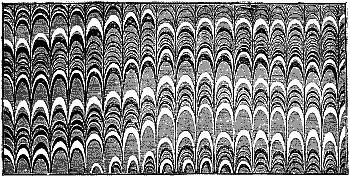
- Nonpareil: A one-step comb pattern. Once the colours have been dropped and perhaps moved a little with a stylus, the Nonpareil comb is drawn straight from one end of the tray to the other. The result is a beautiful rank of straight lines. It is the foundation of many other patterns.
- Chevron: To make this pattern the maker starts from a finished Nonpareil. A rake with a few widely spaced teeth is then used. It is moved rhythmically back and forth as it is drawn across the Nonpareil, usually at right angles to it. That “going and coming” movement (Git-Gel in Turkish) breaks the straight lines into a series of sharp “V” shapes.
- Entwined Comb: This very intricate pattern also begins from a Nonpareil base. But instead of a sharp back-and-forth, a second comb is drawn across the tray with a gentle side-to-side oscillation or tremble. That undulating movement makes the straight Nonpareil lines curve and appear to weave through one another, creating a mesmerising visual illusion of depth and interlacing.
The process shows how the Marmorierkamm and tools like it are used in a planned choreography to build up the layers of a design, where every step depends on the one before it.
Material and Construction: From DIY to Professional
The beauty of the Marmorierkamm is that it can be made from relatively simple materials, and yet its construction demands high precision. A professional comb is usually built with great care.
- Shaft: The main bar that holds the teeth is usually made from a stable wood that does not warp easily, such as oak or mahogany. On more modern combs, acrylic or a rigid plastic may be used instead.
- Tines: The most crucial part. The teeth must be strong, straight and rust-proof. Traditionally brass pins or stainless steel wire are the first choice. Sewing needles or even small nails can serve on a home-made version.
- Construction: The greatest difficulty in making a Marmorierkamm is making sure every tine is set at exactly uniform spacing and to the same depth. The smallest inconsistency shows plainly in the finished pattern. Makers often build a jig or a purpose-made template so the holes can be drilled with high precision. Once the tines are in, they are usually secured with epoxy so that none of them can work loose.
Making your own Marmorierkamm is a rite of passage for many marblers, an exercise in patience and precision that mirrors the skill the art of marbling itself demands.
Hibrkraft’s Take on It: The Beauty of a Tool Made for One Purpose
At Hibrkraft we have a deep admiration for tools designed and built for one specific purpose. The Marmorierkamm is a prime example of that philosophy. It is not a general-purpose tool; it is an instrument tuned perfectly to do a single job with remarkable excellence. It is a reminder that in true handcraft there are no shortcuts. Using the right tool for the right job is fundamental to reaching a high-quality result.
That spirit is reflected in the way we approach our own work. Just as a marbler would never use a hair comb to make a Nonpareil, we would never use low-grade leather to make an heirloom journal. We understand that every component and every tool plays an important part. The story of the Marmorierkamm—a tool the maker often builds to meet their own artistic vision—also chimes with our ethos of customisation. It shows the power of creating something that fits, designed specifically for a unique need. Whether it is a comb built for one particular pattern or a journal built for one person’s story, the beauty lies in a design that has a purpose and is made with full attention.
FAQ
What is a Marmorierkamm?
Marmorierkamm is the German term for a “marbling comb”. It is a specialised comb-shaped tool with a row of precise teeth or pins, used in paper marbling to manipulate the paint floating on a liquid and to create structured, repeatable patterns.
What is the difference between a Marmorierkamm and a rake?
The difference lies in function and design. A rake usually has fewer teeth, spaced more widely, and is used for the rough first movements that break up the colour. A Marmorierkamm, by contrast, has more teeth, closely and regularly spaced, and is used for the precise final movement that creates a structured pattern such as straight lines (Nonpareil) or waves.
Which well-known marbled patterns are made with a Marmorierkamm?
Many of the best-known classic marbled patterns are made with a Marmorierkamm. Among them are Nonpareil (parallel straight lines), Chevron (a V or fishbone pattern) and Entwined Comb (a woven or interlaced pattern). Each of these usually calls for one or more combs used in sequence.
Can I make a Marmorierkamm myself?
Yes — many marblers make their own combs (DIY). The materials are simple: a bar of wood or plastic for the handle, and stainless steel wire or brass pins for the teeth. The main difficulty is making the spacing between the teeth genuinely precise and uniform, because the smallest inconsistency will show in the finished pattern.
References
- Kremer Pigmente. (n.d.). Marbling Combs (Marmorierkamm). (the original link is dead; the reference is kept without a link)
- Eden Workshops. (n.d.). A Glossary of Marbled Paper Patterns. (the original link is dead; the reference is kept without a link)
- iBookBinding. (2018). Paper Marbling: A Brief Overview of the Craft. (the original link is dead; the reference is kept without a link)
- John Neal Books. (n.d.). Marbling Combs and Rakes. (the original link is dead; the reference is kept without a link)
- Schleiper. (2018). Marbling with Jemma Lewis – The Comb Patterns.
- Chenna Carr. (n.d.). Marbling Glossary. (the original link is dead; the reference is kept without a link)
- Dictum. (n.d.). Marbling Equipment. (the original link is dead; the reference is kept without a link)
- Victoria and Albert Museum. (n.d.). Paper marbling. (the original link is dead; the reference is kept without a link)
- TALAS. (n.d.). Marbling Supplies.
- Etherington & Roberts. (1982). Marbled papers – Bookbinding and the Conservation of Books.
- Mai Kolofane. (n.d.). Marbling Combs and Tools. (the original link is dead; the reference is kept without a link)

Custom Notebook
Craft your unique story with a custom notebook, adorned with mesmerizing marbled patterns. Let our artistry inspire your creativity, making every journal a one-of-a-kind masterpiece.
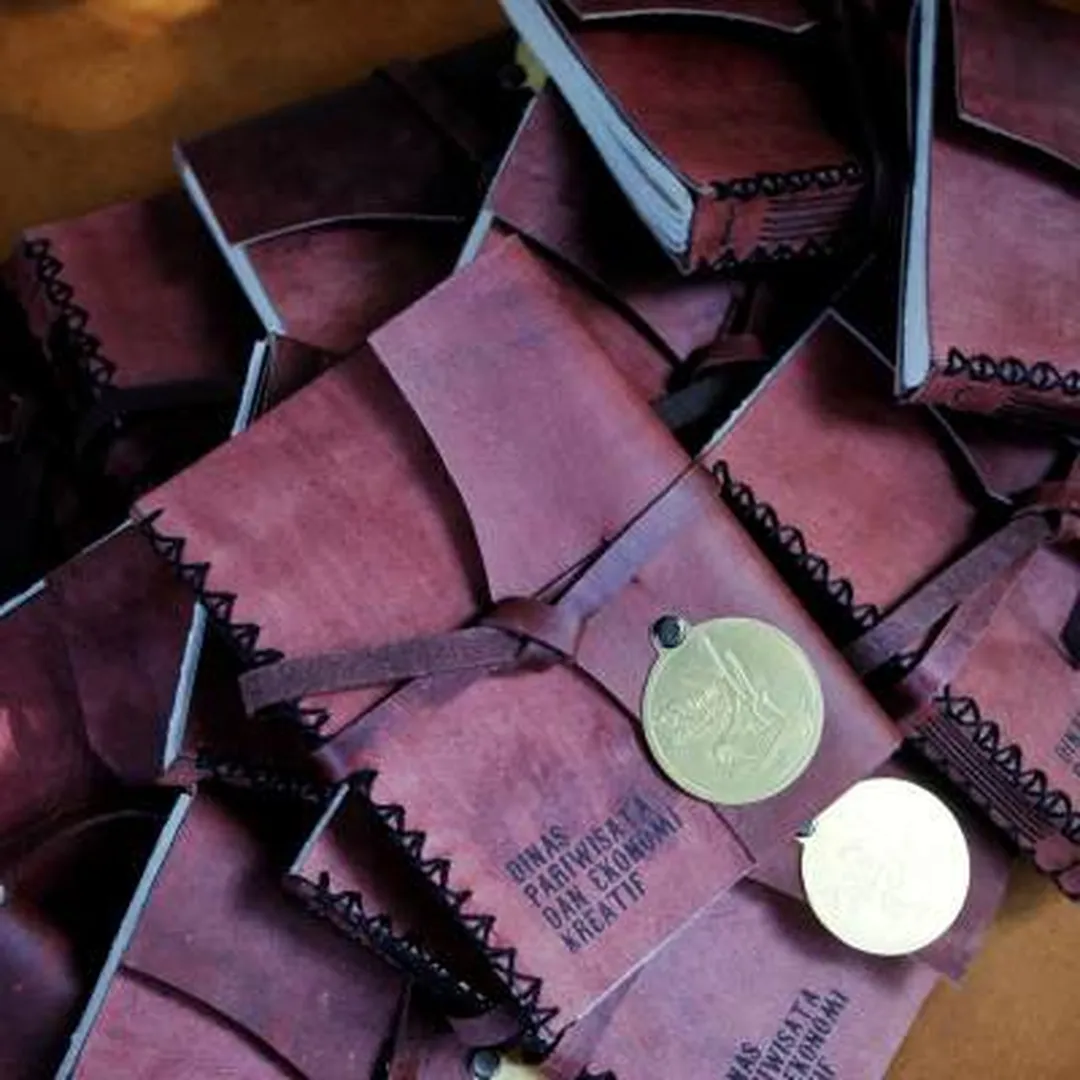
Business & Whitelabel
Make your brand unforgettable with custom corporate journals featuring sophisticated marbled designs. These premium notebooks offer a distinctive edge, showcasing your brand’s unique artistry and commitment to quality.
Book Repair & Conservation
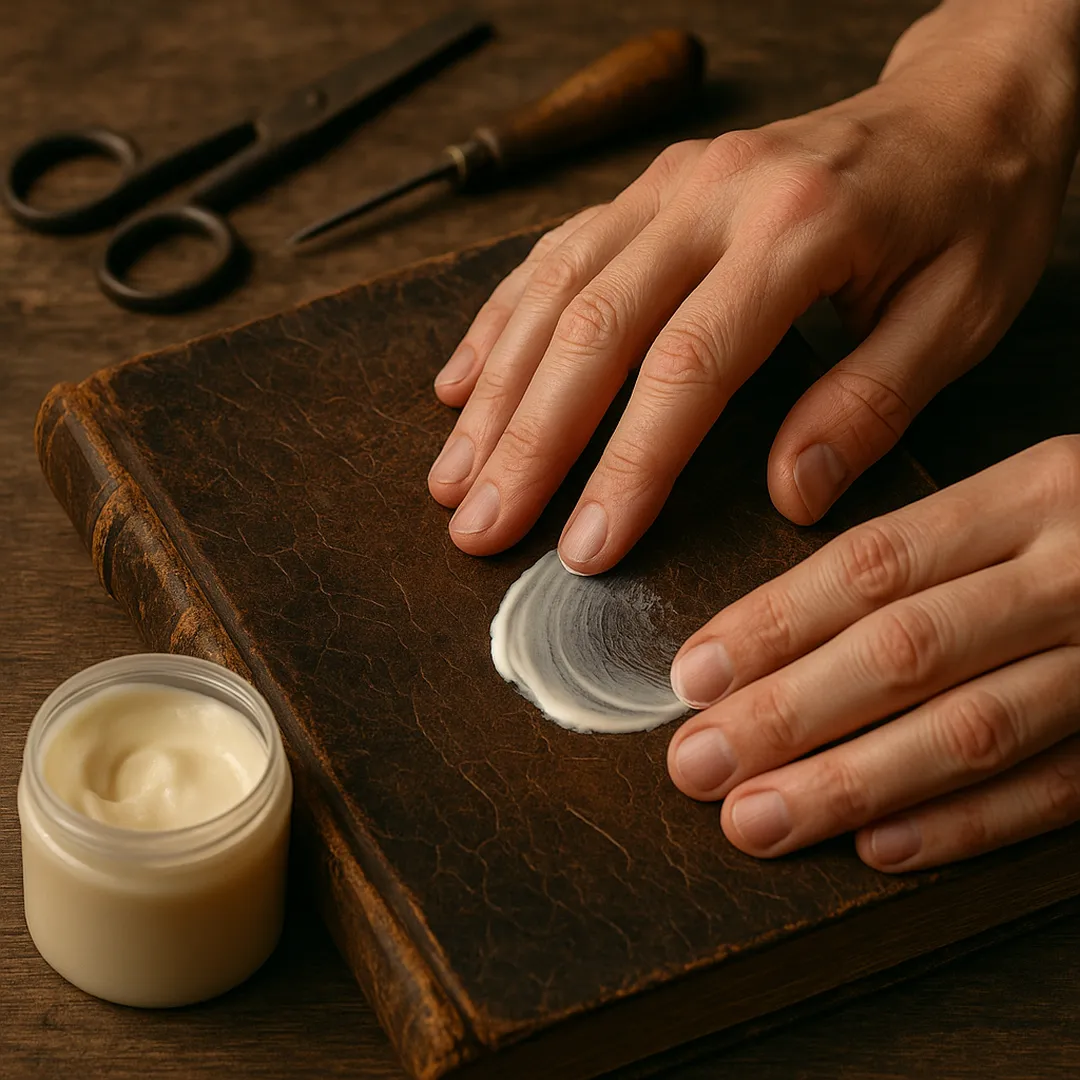
Preserve the legacy of fine books. Our expert restoration brings delicate marbled patterns back to life, ensuring the timeless beauty and intricate craftsmanship of your cherished volumes are protected for eternity.