
Jacobean Corner Stamp
by Ibrahim Anwar · July 27, 2025
In the world of antiquarian bookbinding and leather craft, a small detail often holds a large story about its age, its technology and its artistic taste. One such detail is the Jacobean corner stamp, a decorative element that not only makes a book cover more beautiful but also marks out an important era in English history. Understanding this tool takes us back to the early seventeenth century, a period of cultural and artistic transition reflected strongly in every hand-bound book.
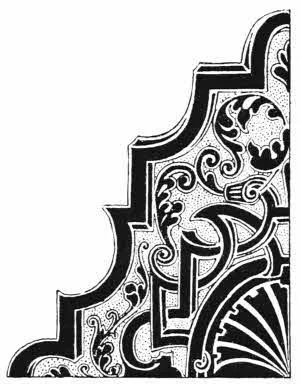
The corner stamp is more than an ornament. It is an integral part of the cover layout that was popular at the time, known as the “centre- and corner-piece design”. In this scheme a large ornament (the centrepiece) decorates the middle of the cover while four identical corner stamps are placed in each corner, creating visual harmony and balance. The corner stamps give the design structure, frame the cover and draw the eye to its centre. They are evidence of the skill of the binders of that period, who were able to bring every element into line with extraordinary precision.
Etymology and Historical Context: The Jacobean Era
To understand why this corner stamp matters, we must first understand its context. The name “Jacobean” comes from Jacobus, the Latin form of the name James. The Jacobean era refers to the reign of King James I in England, from 1603 to 1625. It follows the Elizabethan era and precedes the Caroline, marking a new chapter in art, in architecture and, of course, in craft in England. Jacobean decorative art is known for a style that is rich, often massive, and at times a little “heavy” beside the elegance of the era before it. A strong Renaissance influence carries on, but with a distinctly English interpretation.
In bookbinding, the era saw a shift away from the stiffer Tudor style. While influence from the European continent, particularly France and the Netherlands, was still felt, English binders began to develop an identity of their own. Designs became more structured, and the centre- and corner-piece layout became very popular, especially for devotional books or for important works intended as gifts. The Jacobean corner stamp was the principal tool for achieving this aesthetic.
The Jacobean corner stamp is not merely a tool but a marker of time, freezing the artistic taste of a kingdom in a metal impression on leather.
Visual Characteristics and Distinctive Motifs
What makes the Jacobean corner stamp so special is how distinctive its motifs are. The designs are often intricate and dense, reflecting the period’s taste for rich ornamentation. Among the most commonly found motifs are:
- Strapwork: This is the most iconic motif, made up of a pattern of bands or straps that interlace and fold over one another, as though cut from leather or flat metal. The pattern creates a complex, geometric three-dimensional effect.
- Stylised Floral Motifs: Flowers such as the tulip, the carnation and the rose appear often, but not in naturalistic form. They are drawn in a stylised way, frequently symmetrical and integrated into the strapwork design.
- Acorns: The acorn motif is one of the features found most often on English bindings of this period and is one of the strongest identifying clues.
- Geometric Forms: Abstract and geometric patterns are often the basis of the design, giving the ornament a strong structure.
The stamps are usually fairly large, filling a substantial part of the corner. Impressed into leather, whether by blind tooling (without gold) or gold tooling (with a layer of gold leaf), the result is a decoration that is grand and commanding. The quality of the engraving on the tool itself varied a great deal, reflecting the skill of the metal engraver (the tool cutter) and the standing of the binding workshop that owned it. These tools were valuable assets and were often handed down from one generation of binders to the next.
The Technique and Skill Behind the Application
Using a Jacobean corner stamp calls for skill and high precision. The tool, made of brass or bronze, must first be heated to the right temperature. Too hot and it burns the leather. Too cool and the impression is neither crisp nor permanent. The binder relies on experience and on feel to judge the right heat.
The process itself is known as finishing, the last stage of binding, in which the decoration is applied to the cover. For blind tooling, the heated stamp is pressed straight onto slightly damp leather, creating a dark, glossy recess. For gold tooling the process is more involved. First the area to be stamped is brushed with a special adhesive (often made from egg white, and called glaire). A thin sheet of gold leaf is then laid over it. Finally the heated stamp is pressed firmly down on the gold leaf. Heat and pressure make the gold adhere permanently to the leather where it is wanted, while the loose gold that has not adhered can be brushed clean away.
The skill of a Jacobean binder was measured by the ability to bring all four corner stamps into line with perfect precision, creating a symmetry that indulges the eye.
The greatest challenge is making sure that all four corner impressions are truly symmetrical and aligned. The slightest error in placement spoils the look of the whole cover. Binders often used simple aids such as a rule and a pair of dividers to mark the placement points before the stamping began. This is work that demands patience, a sharp eye and a steady hand. That so many books from this period survive with near-perfect decoration is evidence of the extraordinary level of skill of the craftsmen of the past.
How to Identify One, and Why It Matters Today
For book collectors, historians and conservators, recognising a Jacobean binding is an important skill. Here are some clues for identifying one:
- Period: Focus on books published in England between 1603 and 1625.
- Layout: Look for the centre- and corner-piece design. The presence of four identical corner ornaments is the main characteristic.
- Motif: Look for strapwork, acorns and stylised flora. Compare them with the styles of other periods such as the Tudor (which often used large panel stamps with figurative images or royal arms) or the Restoration (which tends towards a denser all-over design).
- Material: The cover is usually made of calfskin or goatskin in dark brown or black.
Today the Jacobean corner stamp has a relevance that reaches beyond its historical value. For modern makers such as those at Hibrkraft, the style is a rich source of inspiration. Although we may not use replicas of the antique tools, its design principles—symmetry, a decorative frame, and a focus on the corner ornament—can be adapted to create a custom leather journal with a classic and stately character. That same spirit of handcraft, which values precision and beauty in the detail, is at the heart of what we do.
Ordering a journal with corner ornament inspired by the Jacobean style is a way to bring a piece of historical grandeur into an everyday object. It is a statement of appreciation for tradition, for beauty, and for handcraft that time does not wear away.
A Comparison with Other Corner Styles
To appreciate the uniqueness of the Jacobean corner stamp more fully, it is worth comparing it with corner decoration from other periods and regions. French binding of the same period, for example, may have preferred the semis style (a repeating pattern of small stamps covering the whole cover) or *à la fanfare* (an intricate geometric compartment design). German binding may have carried on using large panel stamps engraved with biblical scenes or portraits. The “Cottage Roof” style, meanwhile, which appeared in England in the late seventeenth century, has a very different corner form, resembling the gable roof of a cottage. Set against these, the distinctive strapwork and floral forms of the Jacobean stamp become all the clearer and easier to recognise.
What exactly is meant by the ‘Jacobean era’ in the context of bookbinding?
The Jacobean era in bookbinding refers to the period in England during the reign of King James I, from 1603 to 1625. The binding style of this time is marked by the use of dark leather, by the symmetrical decorative layout known as the ‘centre- and corner-piece’, and by the use of decorative stamps with distinctive motifs such as ‘strapwork’ (a pattern of interlaced bands) and stylised flora.
How do you tell a Jacobean corner stamp apart from corner decoration of other periods?
A Jacobean corner stamp can be told apart by its very specific motifs, above all ‘strapwork’ (a pattern of interwoven bands), the acorn, and stylised flowers. The stamps tend to be large and to form a strong frame. This differs from the earlier Tudor style, which often used large panels, and from the later ‘Cottage Roof’ style, which has a roof-like form.
Is this technique still used by modern book craftsmen?
Although the original antique tools (the stamps) are rarely used, the principles and the aesthetic of Jacobean design are still very influential. Modern makers, Hibrkraft among them, often draw inspiration from the ‘centre- and corner-piece’ layout and its classic motifs to create custom designs on leather journals. The technique itself, ‘gold tooling’ or ‘blind tooling’ with a heated tool, is a fundamental skill in luxury bookbinding and is still practised today.
What material is a Jacobean corner stamp usually made from?
A Jacobean corner stamp, like most ‘finishing tools’ of the period, is almost always made from a hard metal able to withstand heat and pressure again and again. The most commonly used materials are brass and bronze alloy. The tools were engraved by hand by a specialist craftsman called a ‘tool cutter’.
References
- Peachey, Jeff. “17th century bookbinding tools.” Peachey Conservation, 2018. (the original link is dead; the reference is kept without a link)
- University of Glasgow Library. “British Bookbindings.” Special Collections Virtual Exhibitions.
- Medieval and Renaissance Manuscripts, The University of Iowa Libraries. “Seventeenth-Century English Bindings I.” MCRS Rare Books Blog, 2011. (the original link is dead and there is no archive of it; we keep this reference without a link)
- Wells-Cole, Anthony. “Art and Decoration in Elizabethan and Jacobean England. The Influence of Continental Prints, 1558-1625.” Yale University Press, 1997. (the original link is dead; the reference is kept without a link)
- National Diet Library, Japan. “Chapter 4: Bookbinding and Decoration.” Incunabula.

Custom Notebook
Bring the book you have imagined to life with a historical touch. Your cover design drawn from the grandeur of the Jacobean era, handmade in genuine leather.
Business & Whitelabel
Elevate your brand with the prestige of classic design. Exclusive agendas featuring timeless, historically-inspired ornamentation.
Book Repair & Conservation
Restore your treasured heirlooms. We specialize in conserving historical bindings, including those with delicate Jacobean tooling.