
Envelopes
by Ibrahim Anwar · July 25, 2025
Simple, everywhere, and often taken for granted. That is the envelope. Since childhood we have known it as the wrapper for a letter or the packet for gift money at the holidays. Behind its simplicity, though, the envelope holds a long history of communication, privacy and innovation. More than that, for bookbinders and journal writers the envelope is a blank canvas full of potential. It is the bridge between the world outside and the private world inside a journal, a secret compartment waiting to be filled with fragments of a life.
This article will take you past the common understanding of the envelope. We will trace its journey from a clay tablet in Babylon to an interactive feature in a modern leather journal. We will take apart its anatomy, explore the range of its forms, and find how this simple object can enrich your journaling, turning an ordinary notebook into a dynamic personal archive full of memories.
The History of the Envelope: From Guarding Secret Messages to Mass Production
The need to protect a message goes back thousands of years. The earliest form of the envelope was found in Babylon around 3500 BC. An important message written on a clay tablet was wrapped in a second layer of clay, which was then baked. To read the message inside, this clay “envelope” had to be broken. It was the first security system, making sure the message was not read by anyone unauthorised along the way.
In ancient China, where paper was first invented, paper envelopes called “chih poh” were used to give money to government officials. In time the practice of wrapping letters spread across the world. In medieval Europe a letter was often no more than a sheet of paper folded in an intricate way and closed with a wax seal. That seal, frequently stamped with a signet ring, served as a mark of authenticity and of security.
An envelope is not merely a wrapper. It is a keeper of secrets, a bearer of good news, and the silent witness to thousands of stories crossing space and time.
The real revolution for the envelope came in the nineteenth century. Before it, postage was charged by the number of sheets of paper, so an envelope counted as an expensive extravagance. The postal reform led by Rowland Hill in England in 1837, which went on to produce the world’s first postage stamp, the “Penny Black”, changed everything. Postal rates became standardised and affordable, setting off an explosion in demand for correspondence and, of course, for envelopes.
At first envelopes were made by hand, cut one at a time from a diamond- or rhombus-shaped die. The process was slow and inefficient. In 1845 Edwin Hill and Warren De La Rue patented the first envelope-making machine, an innovation that changed the industry for good. Mass production began from that point, and the envelope became the commodity we know today, complete with innovations such as pre-gummed adhesive and the window envelope, patented in 1901.
The Anatomy and Varieties of the Envelope
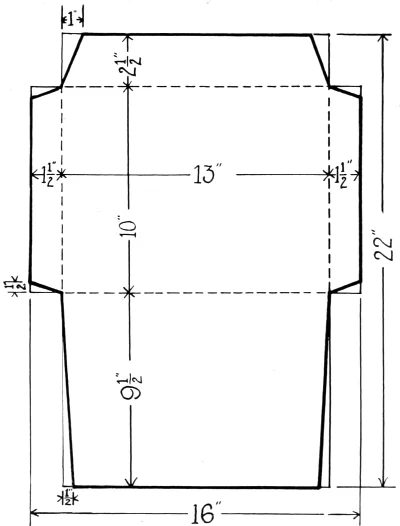
Simple as it looks, the envelope has a fairly rich anatomy and a fair range of variation. Understanding it helps us choose or make the right envelope for a given need, whether for posting or for a craft project.
- The Main Body: The face and the back panel, formed from the side and bottom folds.
- Flap: The part folded over to close the envelope. Its shape varies widely — the elegant pointed/baronial flap for invitations, the standard commercial flap for business, or the modern square flap.
- Types of Closure: There are several ways to seal an envelope. The most traditional is gummed (it needs moistening). There is also peel-and-seal (with a protective strip that is pulled away) and self-seal (two latex layers that stick to one another). For repeated use there is the classic string-and-washer closure.
- Styles: By the orientation of the opening and the position of the seams, there is the “Banker” style (opening on the long side), common for personal letters, and “Pocket” or “Open End” (opening on the short side), often used for documents or catalogues.
The Envelope Reborn in Journaling and Bookbinding
In the digital age the envelope’s main function as a carrier of letters may have shrunk. In craft, though, it has found a new life, more creative and more personal. For bookbinders, journal writers and scrapbook enthusiasts, the envelope is a versatile component that adds dimension, interactivity and storage capacity to a book.
Inside a journal the envelope turns from merely a container into a space. A space to keep memories, to hide a surprise, and to create a personal reading experience.
Pockets and Tuck Spots
This is the most common and most useful application of the envelope inside a journal. Glue an envelope in a well-chosen place on the inside of the cover or on a page of the book and you instantly create extra storage. An envelope can be pasted down on three sides to make a simple pocket, or on only two of them (the bottom and one side) to create a corner tuck.
This pocket is perfect for holding:
- Ephemera: Cinema tickets, travel tickets, leaflets, postcards, and other scraps of paper that hold a memory.
- Photographs: The extra photographs you do not want to paste permanently onto a page.
- Letters and Notes: A precious letter or a small note you want to read again.
- Stickers and Paper Cut-outs: A place to keep stickers or other decorative cut-outs to be used inside the journal.
Interactive Pages and Envelope Journals
Creativity does not stop at the pocket. An envelope can be the main interactive element in a book. Some makers even create a book made entirely of envelopes joined to one another. This technique, known as envelope binding, creates a book in which every “page” is in fact a pocket.
Imagine a travel journal in which each envelope stands for one city visited. Inside each envelope you can keep a map, a museum ticket, and your notes from that city. It creates a multi-layered experience far richer than pasting everything flat on a page. Several envelopes joined with the hinging technique (using a paper strip or washi tape as the hinge) can form an appealing waterfall page.
How Hibrkraft Adopts the Philosophy of the Envelope
At Hibrkraft we believe a leather journal should be a container that is both personal and useful. We understand how much it matters to have room for the small fragments of your life’s journey. That is why we have adopted the “philosophy of the envelope” in our designs.
When you order a Custom Notebook from Hibrkraft, you have the option of adding pockets built into the inside of the front or the back cover. These leather pockets, hand-stitched by our makers, work exactly like a premium envelope. They are sturdy, secure, and designed to sit seamlessly within the aesthetic of your journal. It is how we translate the classic function of the envelope into the luxury and durability of leather craft.
You can ask for a pocket for business cards, a tuck spot for an important scrap of note paper, or a larger pocket to hold a passport or a few photographs. That personalisation turns your journal from a writing book into an elegant personal filing system.
Frequently Asked Questions (FAQ)
- What is the best material for making a pocket inside a journal?
- Besides paper, you can use thin card, vellum for an elegant translucent effect, or even cloth. For maximum durability and a premium look, a pocket made from thin leather, of the kind we offer at Hibrkraft, is the best choice.
- What is the easiest way to make a pocket from a used envelope?
- Take a used envelope (from unimportant post, ideally). Cut or tear its front panel away neatly. You now have a pocket open on one side. You can decorate it with scrap paper or stickers, then paste its back and both of its side edges onto your journal page.
- What is a “junk journal”? And what part does the envelope play in it?
- A junk journal is a handmade book made from all manner of recycled material and paper “rubbish” (old letters, leaflets, pages from old books, and envelopes). The envelope is a key component in a junk journal, serving as a page, as a pocket, and as an interactive element for holding more paper “treasure”.
References
- History of Envelopes – More Than A Wrapper (the original link is dead; the reference is kept without a link): An article reviewing the history of the envelope from ancient times to the modern day.
- JAM Paper – The History of Envelopes (the original link is dead; the reference is kept without a link): Gives a chronology of the envelope’s evolution, from clay tablet to paper.
- All Color Envelopes – Envelope Flap Types: A visual guide to the various types and styles of envelope flap.
- Creative ArtnSoul – How to make Envelope Pockets for Junk Journals (the original link is dead; the reference is kept without a link): A tutorial and inspiration for using envelopes in junk journaling.
- YouTube – Envelope Journal TUTORIAL by Johanna Clough: A step-by-step video tutorial for making a journal out of envelopes.

Custom Notebook
A handmade leather notebook you can design yourself — for a gift, for a memory, or for plans still to come.
Business & Whitelabel
Business and corporate gift solutions in the form of exclusive agendas carrying your company’s logo.
Book Repair & Conservation
Repair and conservation for antique books, family heirlooms, and private collections of historical value.