Entwined Comb Marble
by Ibrahim Anwar · August 9, 2025
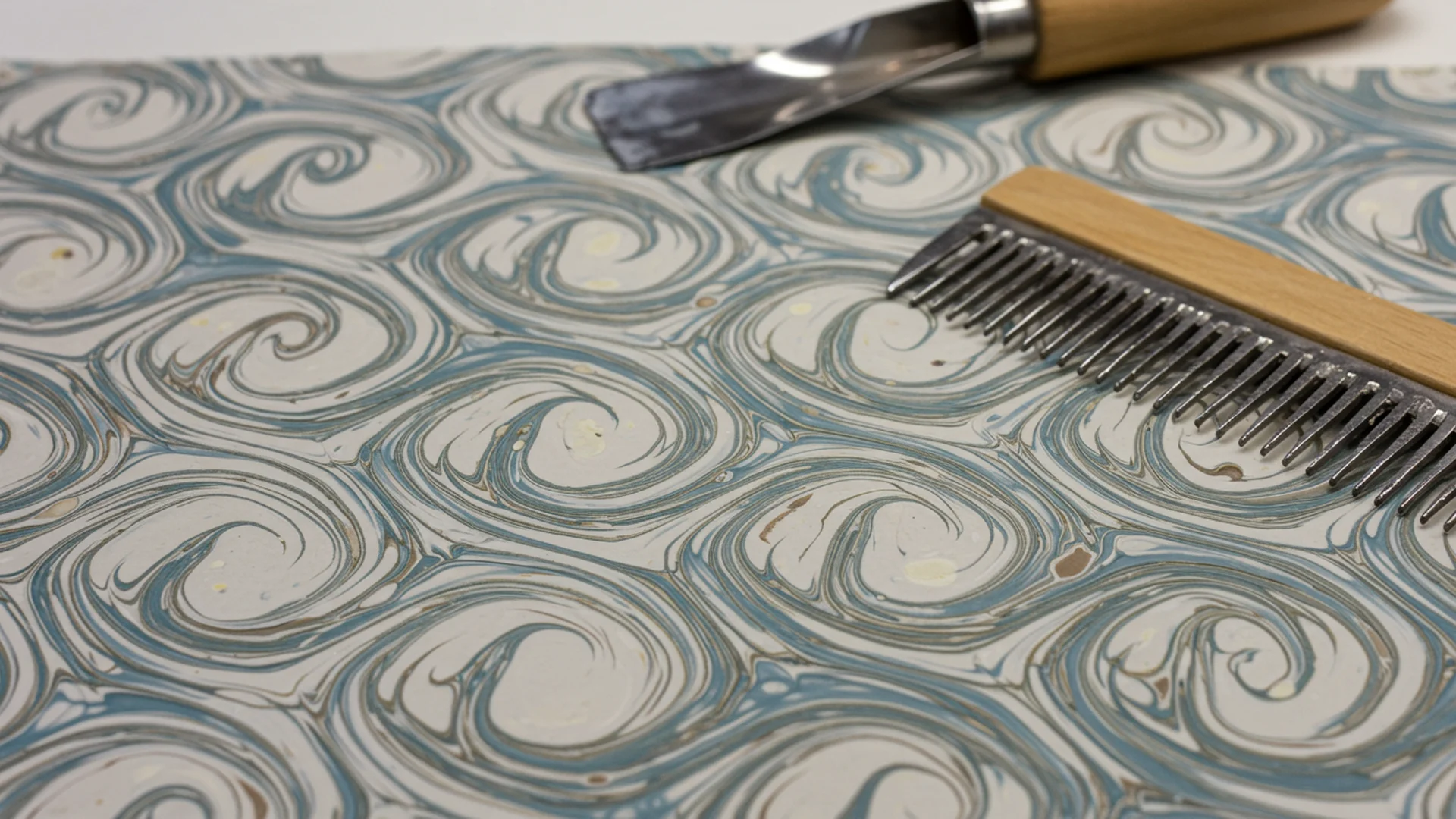
Imagine a dance on water. Drops of coloured paint float, and then a stylus draws them out into fine lines. A large comb passes across next, turning those lines into orderly parallel rows, a pattern known as Nonpareil. But the dance is not finished. A second comb, with a more complex movement—advancing while trembling gently—crosses the surface again, unsettling that order in a measured way. The rows that were straight now curve and interlace, creating a living woven pattern full of rhythm. That is the essence of how Entwined Comb Marble is made. It is not merely a pattern but the summit of control and chance, a precise choreography that produces one of the most prized decorative papers in the history of bookbinding.
Unpicking the Dance of the Comb: The Anatomy of the Entwined Comb Marble Pattern
In the colourful, free-form world of paper marbling, the combed patterns represent the summit of order and technical skill. Among them, Entwined Comb stands as one of the most sophisticated. To value it properly we need to understand its place in the family of combed patterns, to take apart the dance-like process that creates it, and to learn to identify its unique and unmistakable visual character.
Origins and Place in the Combed Marble Family
The art of paper marbling has two main branches: the Eastern styles, such as the Japanese Suminagashi, which is more meditative and more free, and the Turkish/Persian style, Ebru, which is denser and became the forerunner of European marbling. The combed patterns are an evolution developed extensively by artisans in Europe, particularly in France, Italy and Germany, after the Ebru technique was introduced there around the 17th century. These European artisans were looking for ways to create designs that were more regular and could be reproduced, which led to the development of various kinds of combs and rakes.
The family of combed patterns has several basic members. The most fundamental is Nonpareil, which consists only of straight parallel lines drawn with a comb. It is from the Nonpareil base that many other patterns are born. By changing the movement of the comb, an artisan can create a Chevron (a V pattern) or a Peacock (a peacock-eye pattern). Entwined Comb is one of the more complex derivatives. It begins with the Nonpareil pattern as its foundation, but then adds a second layer of movement that turns that linear structure into a dynamic woven one. This places it at a higher level of technical difficulty and visual beauty than the basic combed patterns.
The Process of Creation: A Choreography in Two Directions
Making an Entwined Comb Marble pattern is a process that demands patience, precision and a deep understanding of how the colours interact on the medium (known as the size, usually a viscous solution of carrageenan or methyl cellulose). The process can be set out as follows:
- Initial Preparation: The artisan begins with a tray of size. Special marbling colours, thinned to exactly the right consistency, are dropped one by one onto the surface of the size. Each drop spreads out into a circle of colour.
- Creating the Foundation: Often the artisan will first move a rake or stylus through the floating colours to create a base pattern called Get-Gel or Feather, which breaks the circles of colour up into a finer web.
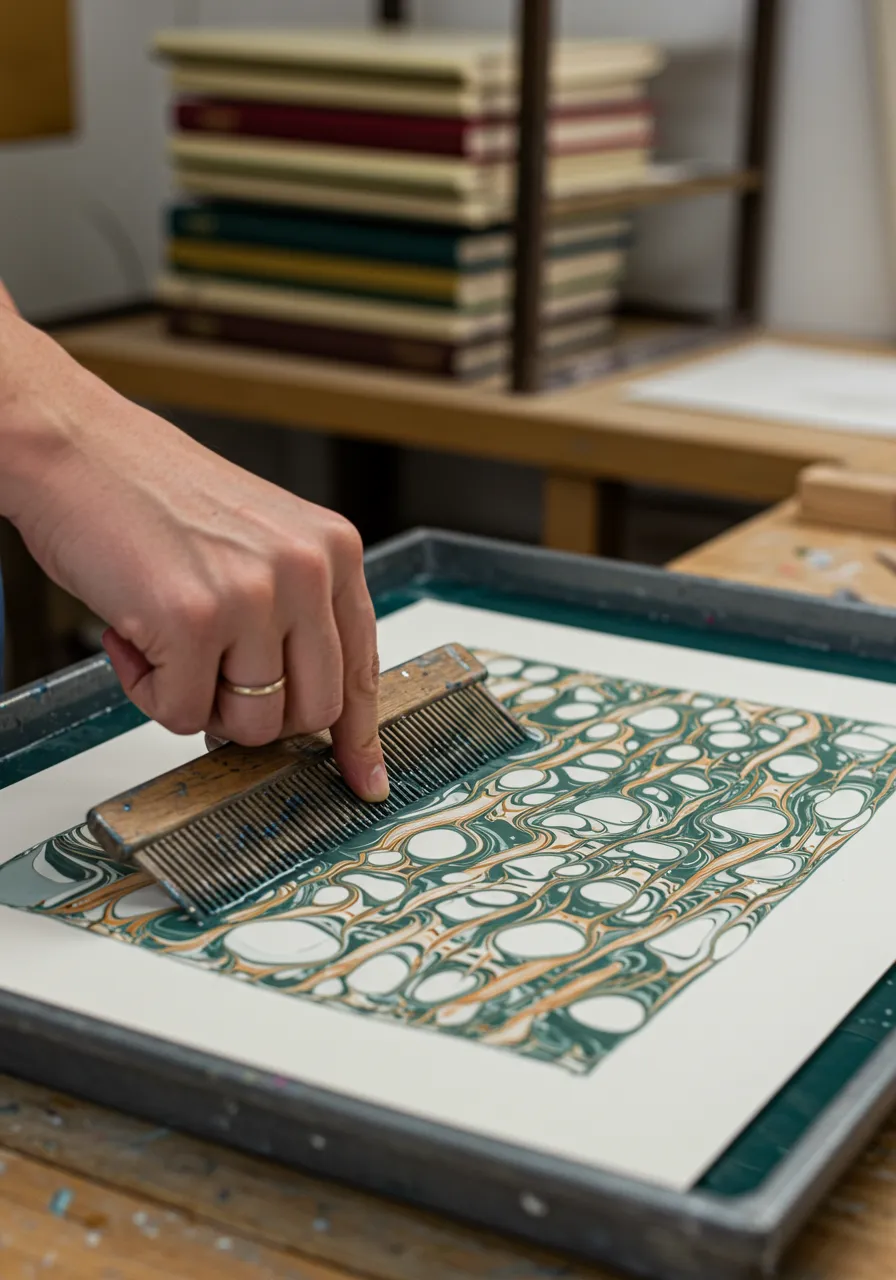
- The First Combing (Creating the Nonpareil): A large comb with evenly spaced teeth (known as a Nonpareil comb) is drawn carefully across the whole surface of the tray in a single straight movement. This action pulls the colours into a series of neat parallel lines, creating the classic Nonpareil pattern. It is the canvas for the next step.
- The Second Combing (Creating the Interlace): This is where the magic happens. The artisan takes a second comb, which may have the same tooth spacing or a different one. This comb is then drawn back across the Nonpareil pattern, usually in a direction perpendicular to the first combing. But instead of being pulled straight, it is moved with an oscillating motion, a gentle side-to-side tremble. It is this advancing-while-swaying movement that “disturbs” the straight Nonpareil lines, making them curve and pass over one another, creating the optical illusion of an interlace or a weave.
- Printing the Paper: Once the desired pattern has been reached, a sheet of paper treated with alum is laid carefully onto the surface of the size. The floating pattern of colour transfers to the paper at once. The paper is then lifted, rinsed gently to wash off the remaining size, and hung up to dry.
Every step in this process has to be carried out quickly and confidently, because the pattern on the size is fluid and will change if it is left too long.
The Entwined Comb pattern is a dialogue between the order of the straight line and the freedom of the curve, evidence that the highest beauty is often found in controlled disorder.
Visual Character: Identifying the Distinctive Interlace
A trained eye can recognise the Entwined Comb pattern easily. Its chief feature is a structure resembling latticework or a net. Unlike the straight lines of the Nonpareil or the V shapes of the Chevron, Entwined Comb shows lines of colour that appear to curve and wind, as though they had been woven. There is a clear rhythm to the pattern, the result of the consistent oscillating movement during the second combing. The effect can vary a great deal depending on several factors: the spacing of the comb teeth, the amplitude of the oscillation, and the palette of colours used. Some Entwined Comb patterns have a tight, fine interlace, while others may be more open and bolder. But the chief characteristic is always the same: an illusion of depth and movement, in which some colours appear to lie in front and others behind, like the threads in a piece of intricately woven cloth.
More Than a Pattern: Entwined Comb in the Context of the Craft
The presence of a sheet of Entwined Comb Marble inside a book is not merely a decorative choice. It is a statement about quality, about tradition, and about a deep appreciation of handwork. Understanding its historical and functional context lets us value this pattern not only as ornament but as an integral part of the art of bookbinding itself.
Significance in Bookbinding
Historically, marbled paper was a marker of luxury and quality. The fact that it could be produced only by hand, and the level of skill it demanded, made it expensive and sought after. In bookbinding, marbled paper, and especially an intricate pattern such as Entwined Comb, is most often used as endpapers, or flyleaves. Endpapers are the leaves pasted to the inside of the front and back covers of a book, serving as a bridge between the binding and the text block.
Using marbled paper for this purpose serves several functions. Aesthetically, it gives a burst of colour and beautiful pattern the first time the book is opened, creating a satisfying visual experience before the reader reaches the title page. It is a kind of decorative “gateway”. Functionally, strong endpapers also help to reinforce the structure of the book, covering the less beautiful parts of its construction such as the leather turn-ins or the ends of the reinforcing tapes. The dense, dynamic Entwined Comb pattern is very effective at disguising these structural elements, creating a smooth and elegant transition from cover to page.
A Comparison with the Other Combed Patterns
To understand properly what makes Entwined Comb unique, it helps to compare it directly with its closest relatives in the family of combed patterns:
- vs. Nonpareil: Nonpareil is the mother of every straight combed pattern. Picture a neat rank of soldiers. Entwined Comb takes that rank of soldiers and sets them dancing a synchronised wave. If you see perfectly straight lines, it is Nonpareil. If those lines look interlaced and wavy, it is most likely Entwined Comb.
- vs. Chevron / Git-Gel: The Chevron pattern, often also called Git-Gel (from the Turkish for “go-come”), also starts from a Nonpareil base. But instead of a smooth oscillation, the comb is moved sharply back and forth as it is drawn across the tray. This breaks the straight lines into a series of “V” shapes, or herringbone. The result is a spiky, angular pattern, very different from the gentle curves of Entwined Comb.
- vs. Bouquet: The Bouquet, or Arch, pattern is another interesting variation. It is often made by combing in one direction and then using a comb with grouped teeth to create shapes like arches or bunches of flowers. This creates a pattern that is more organic and less uniform than the regular rhythm of Entwined Comb.
Every pattern has its own character and its own visual “voice”, and the choice between them often depends on the overall style the binder wants for the book.
Hibrkraft’s Take on It: Valuing Intricacy in a Single Sheet of Paper
At Hibrkraft we are captivated by handwork that takes time, skill and a human touch. The art of paper marbling, and the Entwined Comb pattern in particular, is a perfect embodiment of that philosophy. Every sheet is a unique work of art that cannot be replicated exactly. There are subtle imperfections and variations, and those are precisely the evidence that it was made by hand. It is the antithesis of sterile, identical mass digital printing.
Using a sheet of Entwined Comb Marble as the endpaper in one of our custom leather journals is a way of adding a hidden layer of luxury and story. It is a detail perhaps only the owner will notice, a beautiful surprise as the book is opened. It sends the message that quality has been attended to down to the smallest detail. For us, choosing a paper like this is not only a matter of decoration; it is about honouring another craft tradition and bringing its beauty into our own work. It is a celebration of process, of patience, and of the unique beauty that can only be born of human hands.
FAQ
What is the 'Entwined Comb' marble pattern?
Entwined Comb is a highly decorative and intricate paper-marbling pattern. Its distinctive feature is a woven or interlaced appearance, in which the lines of colour seem to curve over and under one another. The pattern is made by a double combing of the colours on a viscous medium.
How do you tell Entwined Comb apart from other combed marble patterns such as Nonpareil or Chevron?
The easiest way is to look at the movement of the lines. Nonpareil has perfect, parallel straight lines. Chevron has a sharp “V” or herringbone pattern. Entwined Comb, meanwhile, has curving, wavy lines that appear to weave into one another, creating the effect of woven cloth or a net.
Why is marbled paper so often used as the endpaper in a book?
Marbled paper is used as an endpaper for two main reasons. First, aesthetically, it gives a beautiful and luxurious visual transition from the cover to the body of the book. Second, functionally, it helps to reinforce the structure of the book and cleverly covers construction elements such as the leather or cloth turn-ins, creating a neat and professional finish.
Is the Entwined Comb pattern made by hand?
Yes, exclusively. Every sheet of Entwined Comb Marble is a piece of handwork. The pattern is created by an artisan who drops and manipulates the colours by hand on a tray of liquid. Because the process is fluid and dynamic by nature, no two sheets of marbled paper are ever truly identical, which makes each one a unique work of art.
References
- Eden Workshops. (n.d.). A Glossary of Marbled Paper Patterns. (the original link is dead; the reference is kept without a link)
- iBookBinding. (2018). Paper Marbling: A Brief Overview of the Craft. (the original link is dead; the reference is kept without a link)
- Jemma Lewis Marbling. (n.d.). The History of Marbling. (the original link is dead; the reference is kept without a link)
- Chenna Carr. (n.d.). Marbling Glossary. (the original link is dead; the reference is kept without a link)
- Peabody Essex Museum. (2020). A Quick Dip into the Art of Paper Marbling. (the original link is dead; the reference is kept without a link)
- University of Washington Libraries. (n.d.). Paper Marbling Collection.
- The Guardian. (2022). Marbling: the ancient art that’s making a comeback. (the original link is dead; the reference is kept without a link)
- Victoria and Albert Museum. (n.d.). Paper marbling. (the original link is dead; the reference is kept without a link)
- Schleiper. (2018). Marbling with Jemma Lewis – The Comb Patterns.
- John Neal Books. (n.d.). Marbling Combs and Rakes. (the original link is dead; the reference is kept without a link)
- Etherington & Roberts. (1982). Marbled papers – Bookbinding and the Conservation of Books.
Custom Notebook
Weave your own narrative into a custom notebook decorated with the intricate interlaced design inspired by Entwined Comb Marble. Create a journal as unique and as creative as the ancient art of bookbinding.
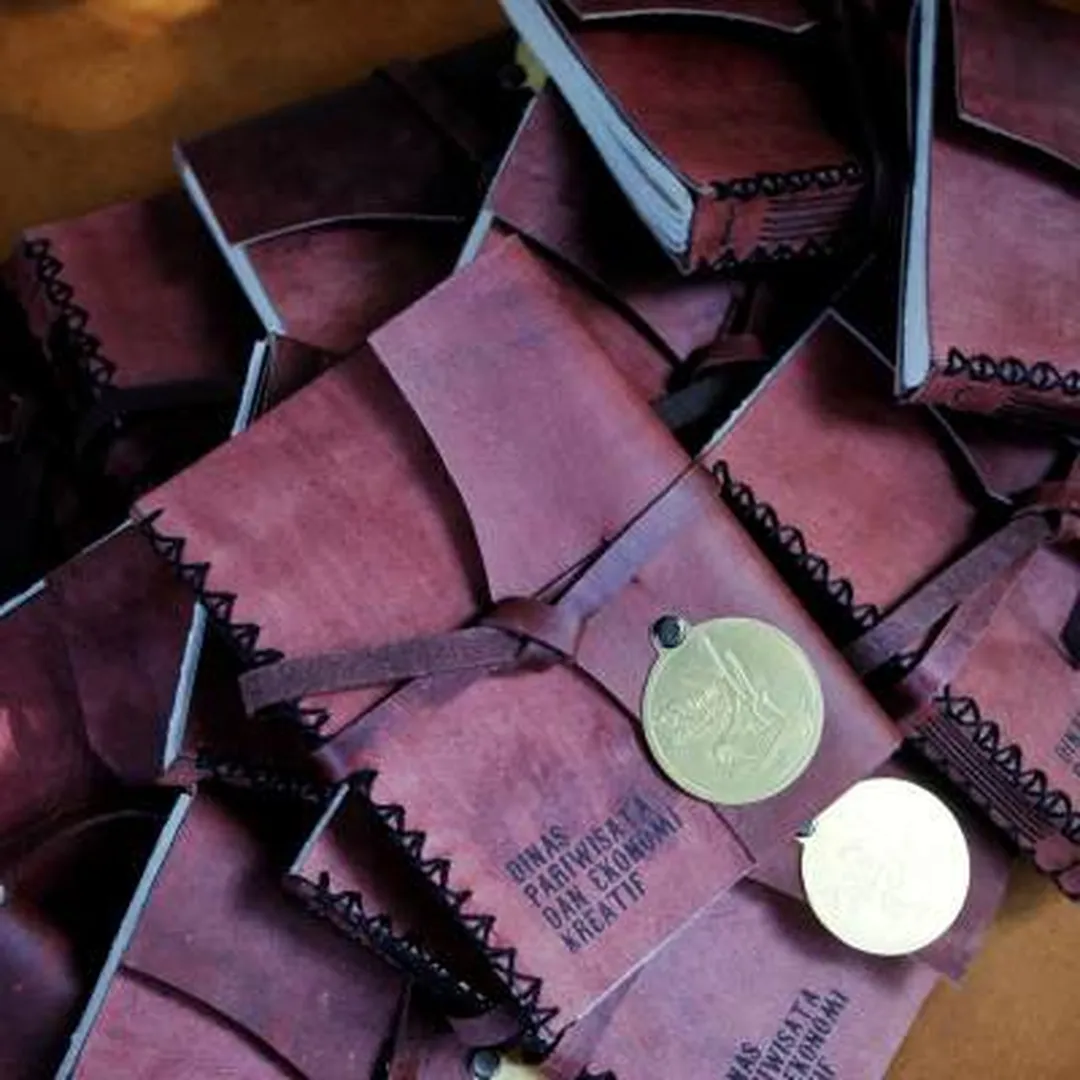
Business & Whitelabel
Raise your brand’s presentation with custom corporate journals carrying the sophisticated Entwined Comb Marble pattern. Offer clients a special artistic touch and a lasting elegance that reflects true quality.
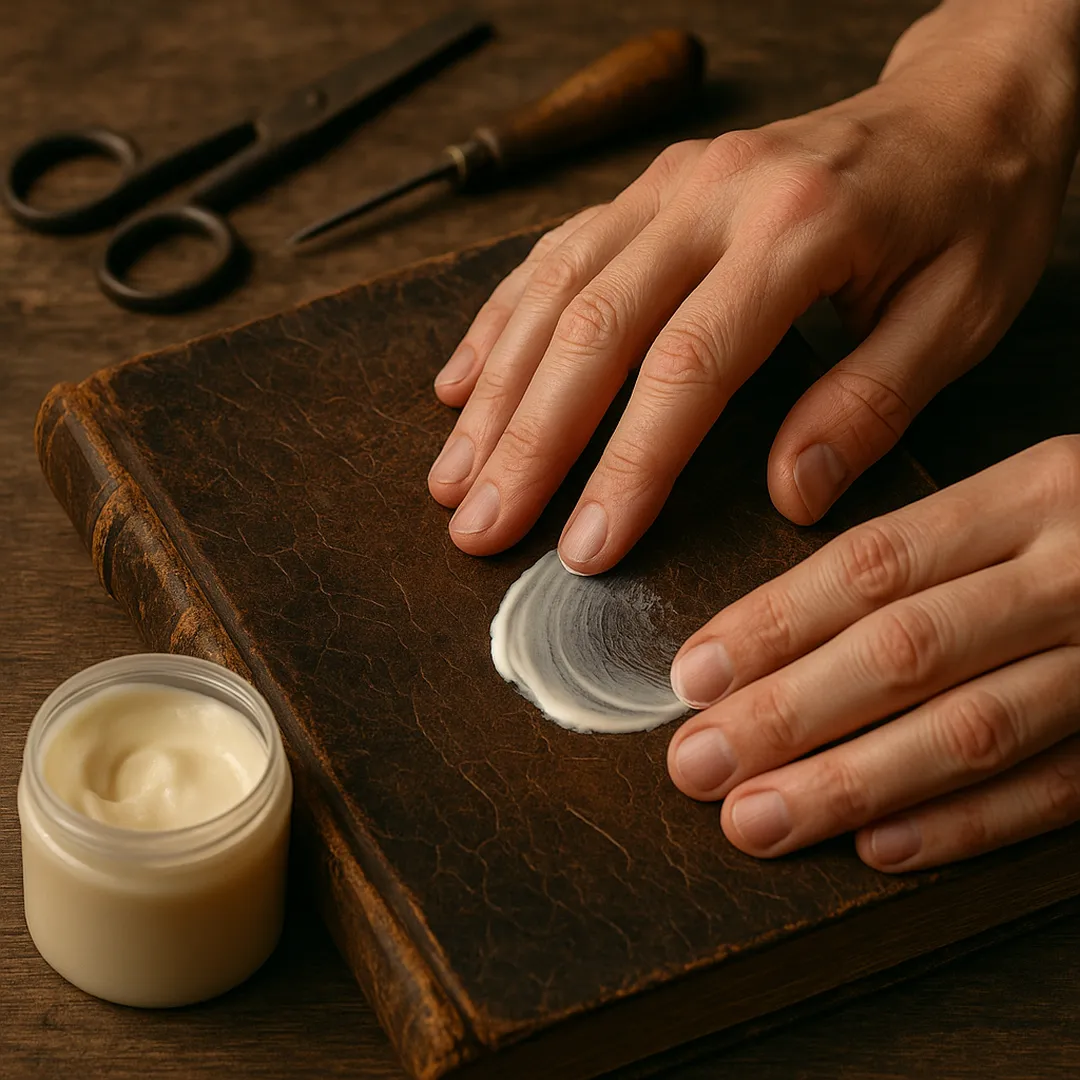
Book Repair & Conservation
Restore the extraordinary beauty of a book you treasure. Our expert conservation techniques carefully replicate delicate patterns such as Entwined Comb Marble, preserving the historical craftsmanship and the intricate charm of your volumes.