Durchgehenden in Bookbinding: An Illustration Technique
by Ibrahim Anwar · August 11, 2025

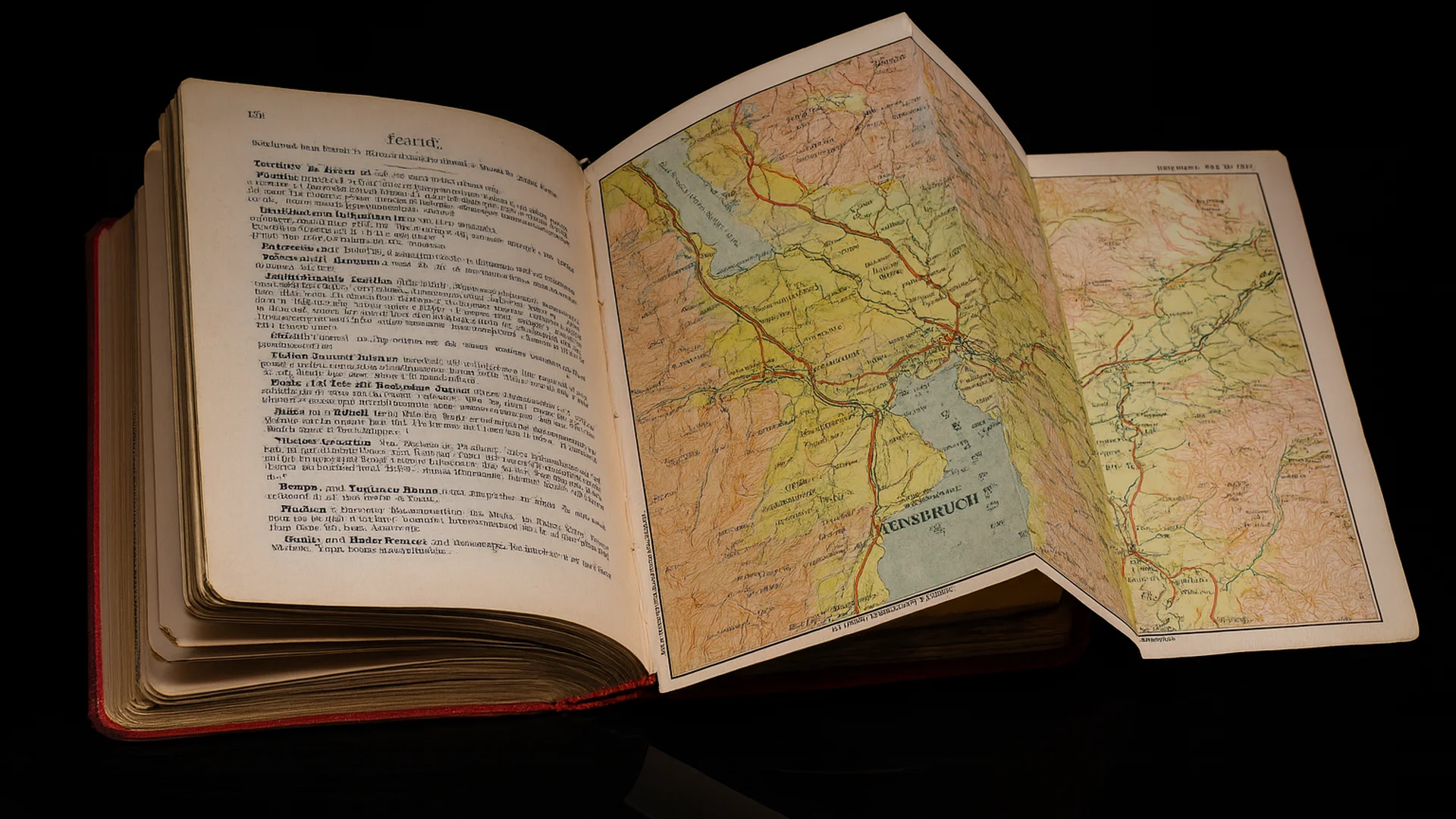
Have you ever opened an old book — an antique atlas, perhaps, or an anatomy textbook — and found a page that opens out wider still, revealing a magnificent map of the world or an intricate diagram of the human body? The sensation of unfolding that hidden leaf, uncovering an image far larger than you had expected, is an unforgettable experience. That is the magic of the durchgehenden technique. It is not merely a way of fitting a large image into a small book; it is a deliberate design decision, an invitation to the reader to pause, to handle the book physically, and to explore detail that could not possibly be presented within the bounds of an ordinary page. It is a blend of art, paper engineering and visual storytelling.
A Window That Folds: The Concept and History Behind Durchgehenden
Behind a German term that sounds technical lies an elegant concept and a clever solution to a fundamental problem in book design: how do you present broad visual information in a limited format? Durchgehenden is the answer to that question. Understanding it means going into the history of printing, of exploration, and of the human need to map the world — both the world outside us and the world within. It is evidence of the ingenuity of the bookbinders and publishers of the past in pushing the limits of what a book could do.
Etymology and Meaning: Crossing the Limits of the Page
The German word durchgehenden comes from the verb “durchgehen,” meaning “to go through,” “to pass across,” or “to continue without a break.” Applied to an image (Abbildung), “durchgehende Abbildung” refers to an illustration that is “continuous” or that “runs across” the normal boundary of the page. It captures the essence of the fold-out perfectly: an image whose flow is not interrupted by the edge of the page or by the gutter of the book. It runs on, hidden inside neat folds, waiting for the reader to reveal it.
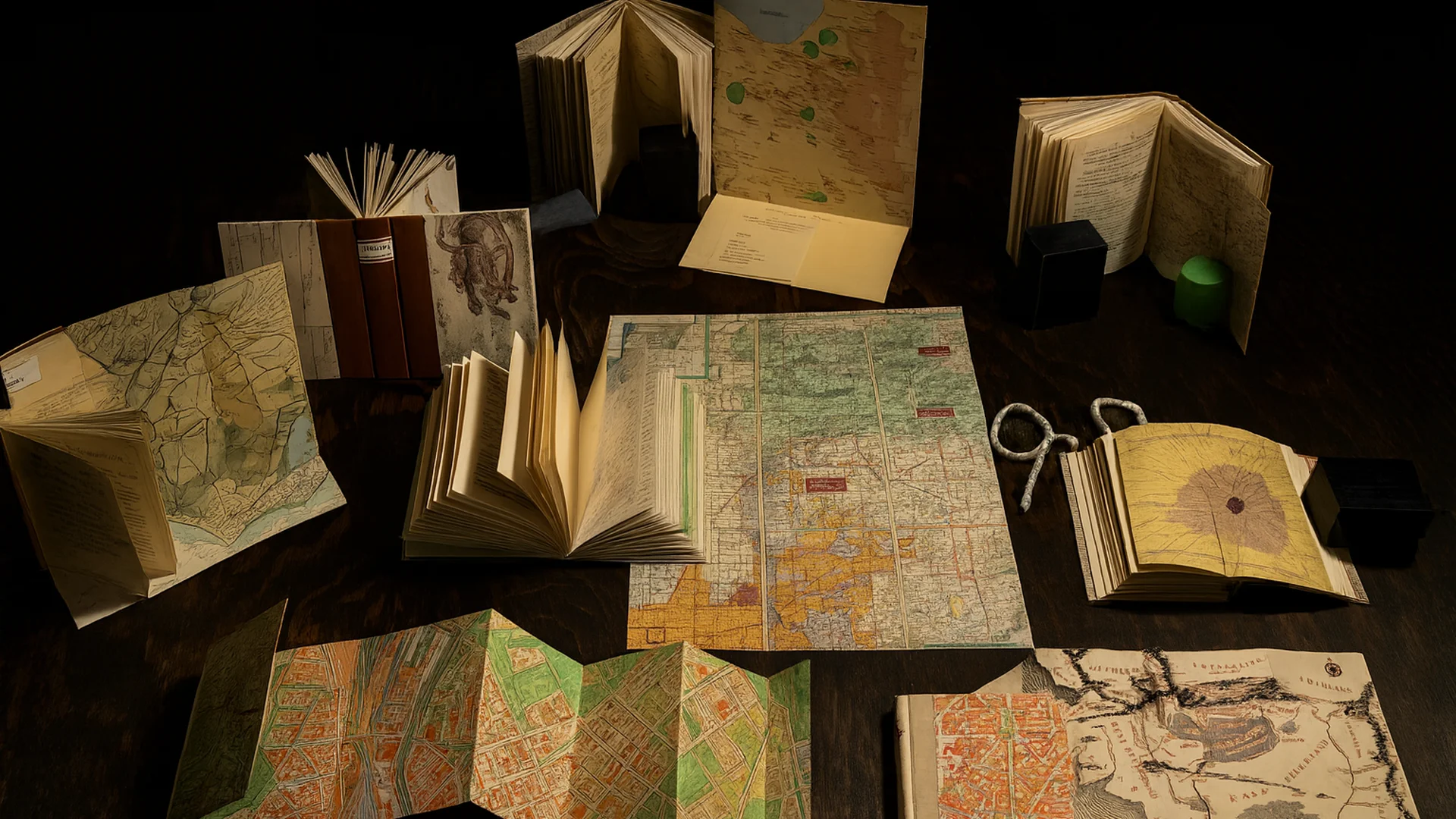
In practice this can mean many things. It might be a large map folded several times over and tucked into one section of the book. It might be a pair of “gates” at the centre of the book that open to reveal a dramatic panorama (known as a gatefold). Or it might be a long technical diagram folded like a concertina. Whatever the form, the underlying principle stays the same: the visual content is deliberately made larger than the trim size of the book, and it demands a specialised binding technique to fit it in neatly and functionally.
Historical Traces: From Explorers’ Maps to Anatomical Diagrams
The need for the durchgehenden page grew alongside the explosion of knowledge and exploration during the Renaissance and the Enlightenment. Before the technique was common, a large map or a complicated diagram often had to be printed separately and sold in a roll or a portfolio. That was impractical, and it kept the information apart from the text that explained it. Bookbinders and publishers began to experiment with ways of integrating these large sheets directly into the book.

In the sixteenth and seventeenth centuries the magnificent atlases produced by Dutch cartographers such as Ortelius and Blaeu became famous for their hand-coloured folding maps. These maps let a reader take in a whole country or continent at a single glance. At the same time, scientific books adopted the technique. Anatomical works such as “De humani corporis fabrica” by Vesalius used fold-outs to show extremely detailed illustrations of the human body, in which the layers of the organs could be “peeled away” by opening further folds. Architectural books used the gatefold to show wide building façades, and botanical books showed illustrations of plants at their original size. The durchgehenden technique became synonymous with books that were serious, informative and of high quality.
A Durchgehenden page turns the book from a two-dimensional object into an interactive three-dimensional experience, a surprise that enriches the narrative.
Why It Matters: Visual and Functional Impact
The importance of the technique rests on two main aspects: visual impact and functionality. Visually, a fold-out creates a “wow” moment. It breaks the monotonous rhythm of turning pages and presents something unexpected and striking. The moment of physical interaction—opening the fold carefully—leaves the reader more engaged with the content and more likely to remember it. The larger scale allows finer detail, more precise lines and more legible annotation, all of which matter greatly for maps and technical diagrams.
Functionally, durchgehenden is the most efficient solution for presenting a large image whole. Cutting a large map across several pages destroys its geographical continuity and makes it hard for the reader to grasp spatial relationships. In the same way, a complex diagram of a machine loses its context if its parts are separated. Keeping the image on a single integrated sheet of paper keeps the integrity of the information intact. It is a design choice that respects both the content and the reader, ensuring the information is presented in the clearest and most useful way.
The Art Behind the Fold: Technique and Craft Considerations
Fitting a large sheet of paper into a smaller book is no trivial task. It demands careful planning, precision and a deep understanding of the structure of a book. The smallest error in folding, trimming or gluing can damage the book or leave the fold-out unusable. The process is a true test of a bookbinder’s skill, where paper engineering meets the traditional art of binding.
Methods of Attachment: Tipping-in, Guards and Sewing-in
There are several main ways of attaching a durchgehenden page into the text block of a book, depending on the weight of the paper, the size of the fold and the quality of binding wanted.
- Tipping-in: This is the commonest method for a single fold-out. The fold-out is printed with an extra narrow margin on one side. Once it has been folded neatly, a thin line of archival adhesive (PVA or wheat paste, for instance) is applied to that margin, and the leaf is then attached carefully into the gutter between two pages, or alongside a single page of the text block. Precision is essential to ensure the leaf sits straight and does not protrude from the book when it is closed.
- Using Guards or Stubs: If the fold-out is made of thick, heavy paper (the sort used for antique maps, say), attaching it directly to a page of the book can put too much strain on that page and tear it. The solution is to use a “guard” or “stub”. This is a folded strip of thin paper or linen. One side of the guard is sewn in with the signatures of the book, while the fold-out is attached to the other side of the guard. The guard serves as a strong, flexible hinge, absorbing most of the strain as the fold-out is opened and closed.
- Sewing-in: For the strongest integration, the fold-out can be designed as part of a signature itself. A large sheet is folded so that one of its folds lines up with the centre fold of the signature. The leaf is then sewn directly into the spine along with the rest of the pages. This is the most durable method, and it is often used for books of very high quality.
Critical Considerations: Paper Grain, Folding and Trimming
The success of a durchgehenden page depends on a few crucial technical details.
- Paper Grain: This is probably the single most important factor. Paper has a grain direction, and it folds far more easily and neatly when the fold runs with that grain. A fold made against the grain will crack, sit weakly and run unevenly. On a fold-out, every main fold must run with the grain of the paper to ensure durability and a clean appearance.
- Scoring: Before folding, and especially on thicker paper, it is essential to score the sheet. This is the process of making a faint crease along the fold line with a blunt tool (a bone folder, for instance). Scoring creates a predetermined path for the fold, keeping it sharp and straight and stopping the paper fibres from breaking.
- Trimming: A fold-out must be trimmed with absolute precision. Folded, it must sit slightly smaller than the text block so that it does not protrude beyond the edge of the book, where it would be damaged. Careful calculation is needed to make sure every fold is stored neatly within the bounds of the book when it is closed.
Preservation and Care: A Beautiful Fragility
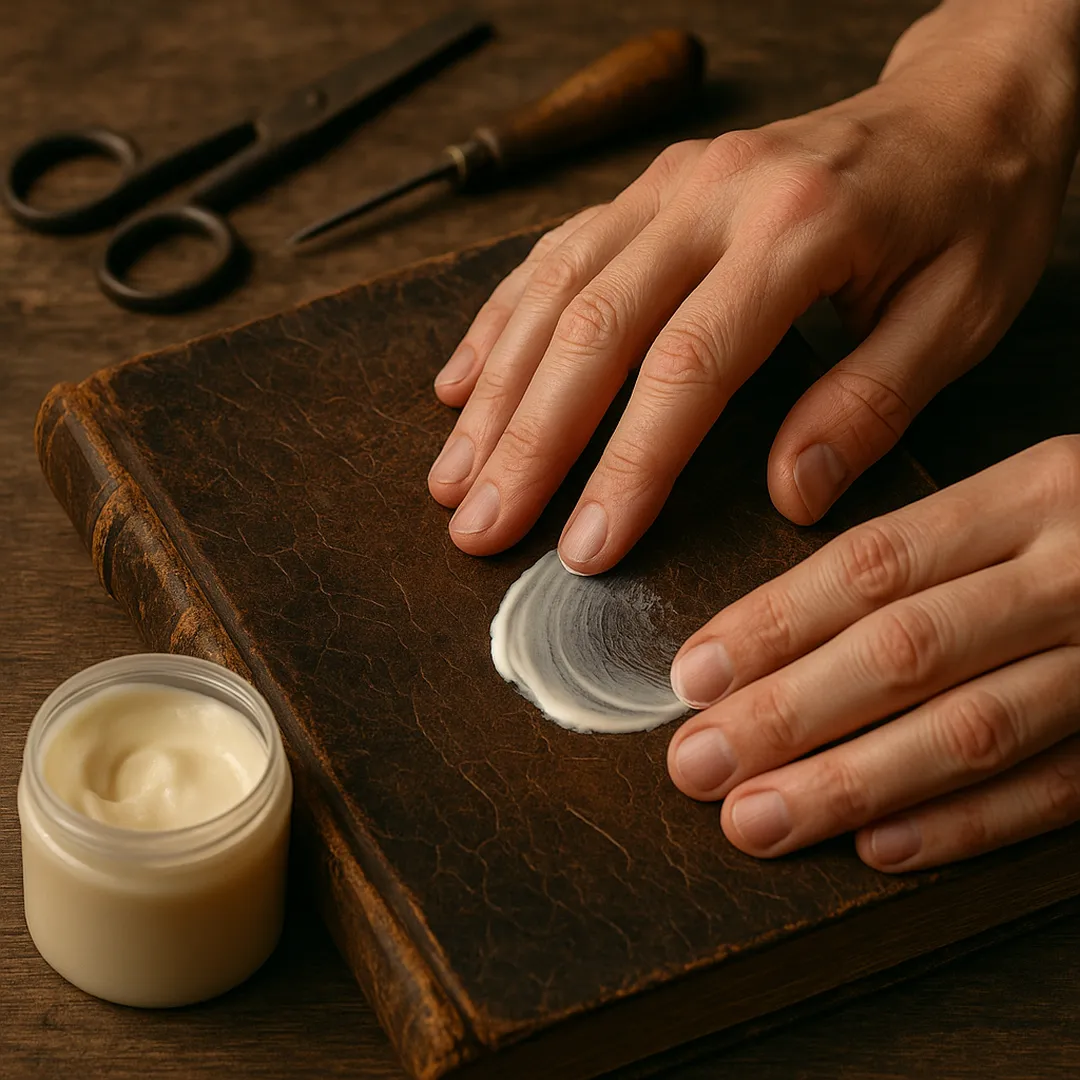
Beautiful though it is, the fold-out is one of the most vulnerable parts of a book. The folds themselves are weak points, liable to tear after being opened repeatedly. A careless reader can refold one the wrong way, creating unwanted new creases or even tearing the paper. Books with durchgehenden pages therefore need extra care in handling. Open one slowly, and support the weight of the paper. On closing, make sure every fold has returned neatly to its original position before the book is shut. For collectors and librarians, examining the condition of the fold-outs is an important part of assessing the condition of a book.
Hibrkraft’s Take on It: Adding a Dimension of Surprise to a Custom Order
At Hibrkraft we see the durchgehenden technique as a fantastic way of raising a custom book from merely an object to an experience. It is a feature that can add remarkable functional and emotional value. Imagine a custom travel journal you commission to remember the adventure of a lifetime. Inside it we could insert a large folding map of your route, complete with annotations and small photographs. Or a family heritage book, in which an intricate family tree opens out wide to show the connections between generations that could never be shown on a single page.
When you order a custom book from us, do not hesitate to think beyond the edge of the page. If you have visual content—a project timeline, an architectural blueprint, even a work of art—that would shine in a larger format, talk to us. Our team understands the technical detail of mounting a fold-out. We can help you choose the right paper, plan the folds, and integrate them seamlessly into your custom leather journal. It is a way of adding a welcome element of surprise, a sophisticated detail that shows a depth of personalisation and attention to your project.
FAQ
What does the term 'durchgehenden' mean in bookbinding?
Durchgehenden is a German term meaning “running across” or “continuous”. In bookbinding it refers to a leaf (a map or an illustration, for instance) larger than the book’s normal page and folded inwards. In English it is usually called a fold-out or a gatefold.
What is the difference between a 'fold-out' (durchgehenden) page and a 'double-page spread'?
A double-page spread is an image printed across two facing pages. That image is divided down the middle by the sewing of the book. A fold-out or durchgehenden page, by contrast, is a single whole sheet of larger paper, folded and mounted into the book, so that when it is opened the image appears unbroken by the gutter.
How is a fold-out page mounted into a book?
There are several ways, including: 1) Tipping-in, where the narrow margin of the fold-out is glued into the gutter of the book. 2) Using a guard, a strip of paper or linen sewn to the book as a strong hinge to carry a heavy fold-out. 3) Sewing it directly into one of the book’s signatures for maximum strength.
Why is the fold-out so often the part of a book most easily damaged?
A fold-out is vulnerable for several reasons. The crease in the paper is itself a structural weak point that can tear over time. Opening and refolding it repeatedly puts strain on the paper. If a reader does not refold it correctly, a wrong new crease can form, or the paper can be caught and torn as the book is closed.
References
- Etherington & Roberts. (1982). Bookbinding and the Conservation of Books: A Dictionary of Descriptive Terminology – Throw out.
- Antiquarian Booksellers’ Association of America. (n.d.). Glossary: Fold-out. (the original link is dead; the reference is kept without a link)
- iBookBinding. (2018). How to Tip-in a Page or an Image Into a Book. (the original link is dead; the reference is kept without a link)
- Trillium Bookbinding. (n.d.). Glossary of Bookbinding Terms (Gatefold, Guarding). (the original link is dead; the reference is kept without a link)
- Folger Shakespeare Library. (2018). Folded sheets in early modern books. (the original link is dead; the reference is kept without a link)
- British Library. (n.d.). Database of Bookbindings (Gate-fold).
- Save Your Books. (2018). Hinging in a Fold-out Map.
- Stanford University Libraries. (2018). Latest acquisitions: maps with many folds. (the original link is dead; the reference is kept without a link)
- RBMS (Rare Books and Manuscripts Section). (n.d.). Binding Terms: Gatefold. (the original link is dead; the reference is kept without a link)
- Northeast Document Conservation Center. (n.d.). 7.2 How to Do Simple Repairs on Books (Tipping-in). (the original link is dead; the reference is kept without a link)