Caxton’s Myrrour of the Worlde
by Ibrahim Anwar · July 27, 2025
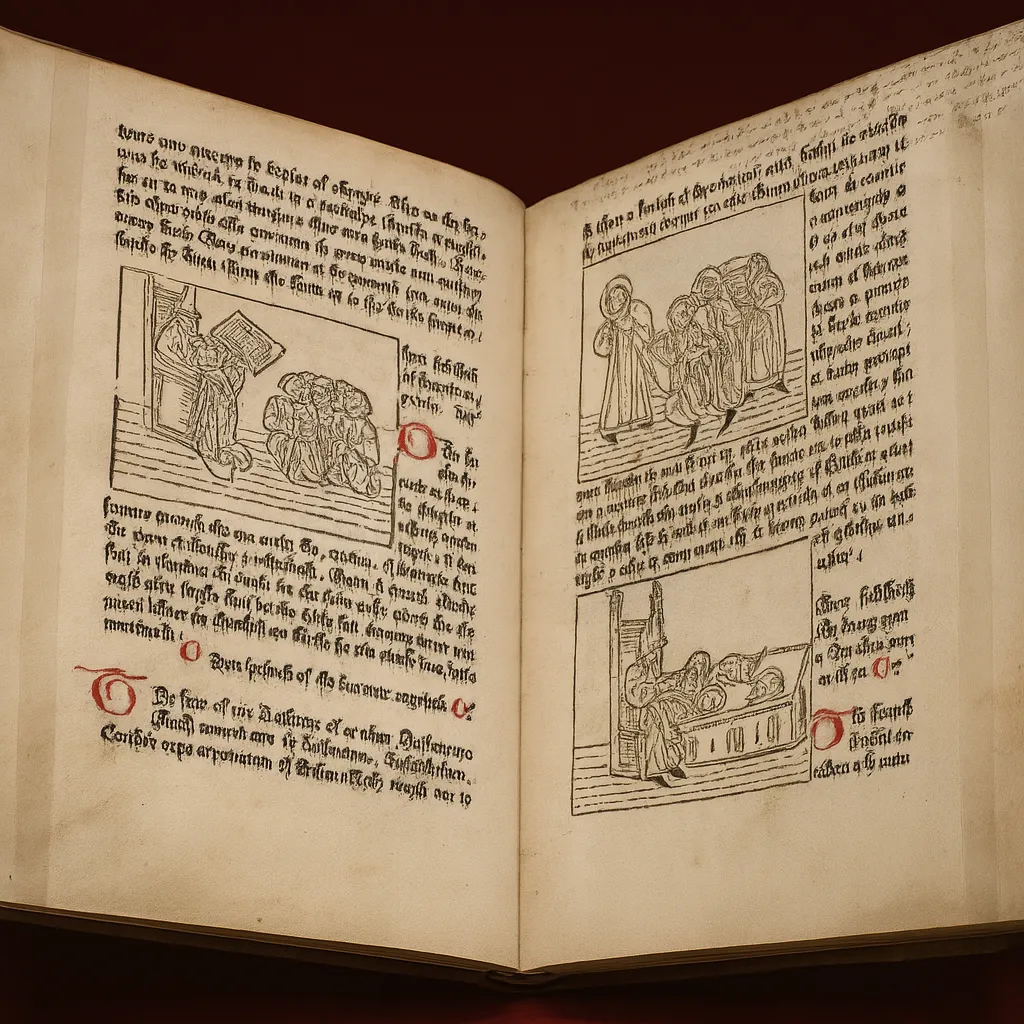
In the long history of the book there are moments that become turning points, changing for good the way people share knowledge and stories. One of the most important moments in the history of English printing is the birth of The Myrrour of the Worlde in 1481. Printed by William Caxton, the pioneer of printing in England, this book is not merely a collection of texts. It is the first work printed on English soil that deliberately brought words and images together, an innovation whose effect is still felt today in every book, every magazine, and even every web page we read. To understand the significance of this work is to understand the foundation of modern graphic design and the importance of visualisation in the spread of knowledge.
This work is more than a historical artefact. It is a mirror, as its name says, reflecting the knowledge and the beliefs of medieval society. At the same time it is a window onto the future of book production, in which the image is no longer the exclusive ornament of an expensive manuscript but an integral part of a reading experience open to far more people. Let us look deeper into the world of William Caxton and this simple yet revolutionary masterwork.
Historical Background: William Caxton and the Printing Revolution in England
To appreciate the achievement of the Myrrour of the Worlde, we must first know the figure behind it: William Caxton (c. 1422 – c. 1492). Caxton was not an academic or an artist but a successful wool merchant, diplomat and writer. Over the years he lived and worked in Bruges, Belgium, one of the commercial and cultural centres of Europe, he was exposed to the most transformative technological innovation of the fifteenth century: the movable type printing press invented by Johannes Gutenberg around 1440.
Recognising the extraordinary potential of this technology, Caxton learned the art of printing in Cologne, Germany. In 1473 he printed the first book in the English language, Recuyell of the Historyes of Troye, at Bruges. A few years later, in 1476, he returned to England and set up the first printing press in the country, within the precincts of Westminster Abbey. This was a monumental step. Before Caxton, every book in England was a manuscript copied by hand, a process that was very slow, expensive and prone to error. The arrival of Caxton’s press began a new era of book production that was faster, cheaper and more consistent.
Read the article on Caxton’s book here.
“Myrrour of the Worlde”: A Mirror of Medieval Knowledge
The Myrrour of the Worlde is the English translation Caxton made of a very popular French work, L’Image du Monde (The Image of the World), a thirteenth-century encyclopaedia written by Gossuin of Metz. The book is a summary of the general knowledge of its day, covering the various subjects an educated person was thought to need to understand.
Its contents are divided into several parts, dealing with topics such as:
- Theology and Creation: Explaining the creation of the world from a Christian perspective.
- Geography: Describing Europe, Africa and Asia with the T-O map distinctive of the Middle Ages (depicting the world as a disc with Jerusalem at its centre).
- Astronomy: Discussing the heavenly bodies, the planets, and the Ptolemaic cosmology that placed the Earth at the centre of the universe.
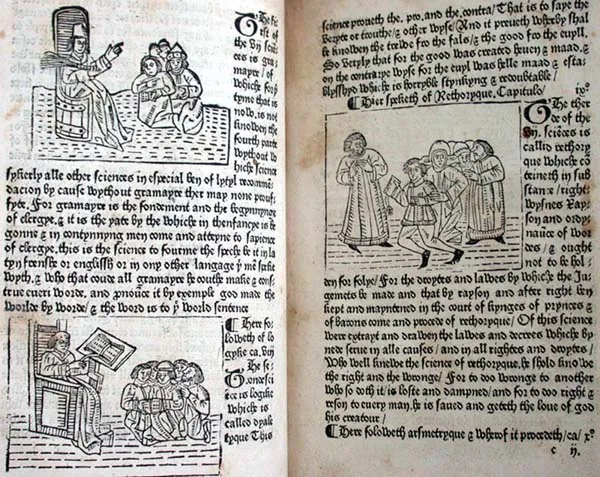
- The Seven Liberal Arts: Explaining the pillars of classical education, made up of the Trivium (Grammar, Logic, Rhetoric) and the Quadrivium (Arithmetic, Geometry, Music, Astronomy).
In essence, this book was the “Google” or the “Wikipedia” of fifteenth-century society. It presented a summary of the world’s knowledge in a single volume that was (relatively) easy to reach, aimed not at expert theologians but at wealthy and educated lay people, the nobles and merchants who were Caxton’s main market.
For the first time in England, printed words and engraved images lived side by side on the same page, an innovation that changed for good the way knowledge was spread and understood.
The Greatest Innovation: Integrating Text and Image
Before the Myrrour of the Worlde, Caxton’s printed books in England held text alone. On the other side stood the illuminated manuscript, thoroughly luxurious, decorated with beautiful images painted by hand. But such manuscripts were unique luxury objects, made one at a time for the highest nobility or for the church. What Caxton did was bridge these two worlds. He used the woodcut technique to make illustrations that could be reproduced in quantity alongside the text.
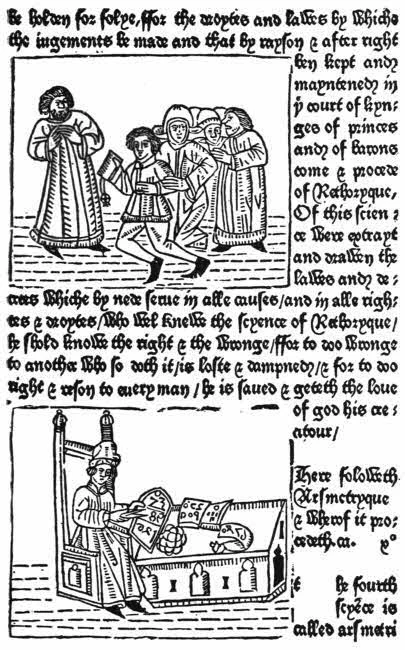
The book holds 27 woodcuts. Eleven of them are schematic diagrams explaining scientific and philosophical concepts, such as the diagram depicting the Seven Liberal Arts or the astronomical cycles. The rest are more narrative images, though still heavily stylised. The decision to include these images was thoroughly visionary. Caxton understood that a visual can help a reader grasp complicated concepts, above all in an encyclopaedic work. This is a fundamental shift from the book as a vessel of pure text to the book as a tool of multimedia communication.
Technique and Skill: The Art of the Fifteenth-Century Woodcut
The illustrations in the Myrrour of the Worlde were made using one of the oldest relief printing techniques, the wood engraving or woodcut. The process is conceptually simple but demands a high degree of hand skill:
- An artist draws the design directly onto the flat surface of a wooden block (usually a fruitwood such as pear or apple).
- A cutter (often a different person) then carefully cuts away the parts of the wood that will not print (the white areas of the finished image), leaving the lines and shapes of the design as a raised surface.
- The finished block is then inked.
- Finally, a sheet of paper is laid over the block and pressed, transferring the ink from the raised surface to the paper.
Set beside the woodcut work of Germany or Italy in the same period, the illustrations in Caxton’s book are often described as “coarse” or “simple”. The lines are thick, the detail is slight, and the perspective is often flat. This is likely because the art of the woodcut had not yet developed so far in England at that time. The artists and cutters who worked on it may not have held the same level of skill as their counterparts on the European continent. But this simplicity does not lessen the book’s historical importance. Its main purpose was usefulness: to clarify the text, not to stand alone as a beautiful work of art.
Caxton’s spirit—taking a new technology and using it to bring word and image together—is the DNA of every custom bookmaker working today, Hibrkraft included.
Why Does “Myrrour of the Worlde” Still Matter Today?
Although it is more than 500 years old, the inheritance of the Myrrour of the Worlde is still very relevant. Its influence can be seen in various aspects of modern literary and visual culture.
An Inheritance for Graphic Design and Publishing
This book is the direct ancestor of every illustrated textbook, graphic novel, infographic and magazine we enjoy today. The basic principle of page layout, balancing blocks of text against images to create an effective flow of information, begins with early experiments like this one. It proved that the combination of text and image is not mere ornament but a powerful tool for education and storytelling.
The Democratisation of Visual Knowledge
By producing illustrations in quantity, Caxton helped popularise visual knowledge. Before that, access to informative images was limited to those who could afford a manuscript painted by hand. The illustrated printed book allowed complex ideas in geography, astronomy and philosophy to be understood by a wider audience, growing the seeds of the visual literacy we take for granted today.
Inspiration for the Modern Maker
For bookmakers and artists such as those at Hibrkraft, the story of the Myrrour of the Worlde is a powerful reminder of the heart of our craft. Caxton’s spirit was not about technical perfection but about innovation and purpose. He used the tools available to him to create something new and meaningful. That same spirit drives us today. When we combine high-quality leather, chosen paper and ancient binding techniques with modern technology such as laser engraving or precision debossing, we continue the same tradition: bringing different elements together to create a unique and personal object.
The Hibrkraft Perspective: Caxton’s Echo in a Custom Leather Journal
Every time a customer comes to Hibrkraft asking us to make a custom journal, they are, without knowing it, channelling Caxton’s spirit. The request to add initials, a company logo, a favourite quotation or even a personal sketch to the cover of a leather journal is the modern manifestation of the wish to integrate text (the writing that will fill the journal) with the visual (the personal element on the cover).
This is the process of turning a book from a merely useful object into a personal artefact full of meaning. As Caxton translated an encyclopaedia to make it reachable, we at Hibrkraft help customers “translate” their ideas, memories and aspirations into real physical form. Whether it is a journal for travel, an agenda for business, or a gift for someone dear, every custom piece is a small “Mirror of the World” for its owner, reflecting their identity and their story through a blend of material, text and image.
FAQ
What makes 'Myrrour of the Worlde' so special in the history of the book?
This book is special because it is the first book printed in England to include woodcut illustrations alongside its text. Printed by William Caxton in 1481, the work marks an important milestone in the history of printing by integrating visual narrative into a book produced in quantity, a revolutionary step away from the pure text book and from the illuminated manuscript painted by hand.
Who was William Caxton and why does he matter?
William Caxton (c. 1422 – c. 1492) was the key figure who introduced the printing press to England in 1476. A merchant, diplomat and writer, he saw the great potential of printing technology while he was in Europe. By founding the first printing house in England he revolutionised book production, making it faster, cheaper and easier to reach. He did not only print books; he also translated many important works into English, which makes him a central figure in the standardisation of the English language and the spread of literature.
How were the illustrations in this book made, and what is their style?
The illustrations in “Myrrour of the Worlde” were made using the woodcut technique. The process involves cutting the image into a wooden block, leaving the lines of the design as a raised surface to be inked and printed onto paper. The style of the illustrations is considered simple or “coarse” by the European standards of the day, with thick lines and minimal detail. Their purpose was useful rather than purely aesthetic: to explain a concept.
Is 'Myrrour of the Worlde' the same as an illuminated manuscript?
No. Although both hold images, the two are very different in production and in purpose. An illuminated manuscript is a unique handwritten book, decorated with intricate hand painting and often using real gold. The process is very expensive and slow, which makes it a luxury object for the elite. The “Myrrour of the Worlde”, by contrast, is a printed book. Its woodcut illustrations and its text could be reproduced in quantity, which makes it a step towards the democratisation of the illustrated book.
References
- British Library – Caxton’s Myrrour of the Worlde – A description and digital images from the British Library collection.
- The Morgan Library & Museum – The Myrrour of the Worlde – Detailed information on the second edition of this book from The Morgan Library collection.
- National Trust UK – William Caxton, the first English printer – An article on the life and importance of William Caxton.
- Library of Congress – Myrrour of the Worlde – Resources and images from the Library of Congress collection.

Custom Notebook
A canvas for your story, where personal visuals and text unite, continuing a centuries-old legacy of innovation.
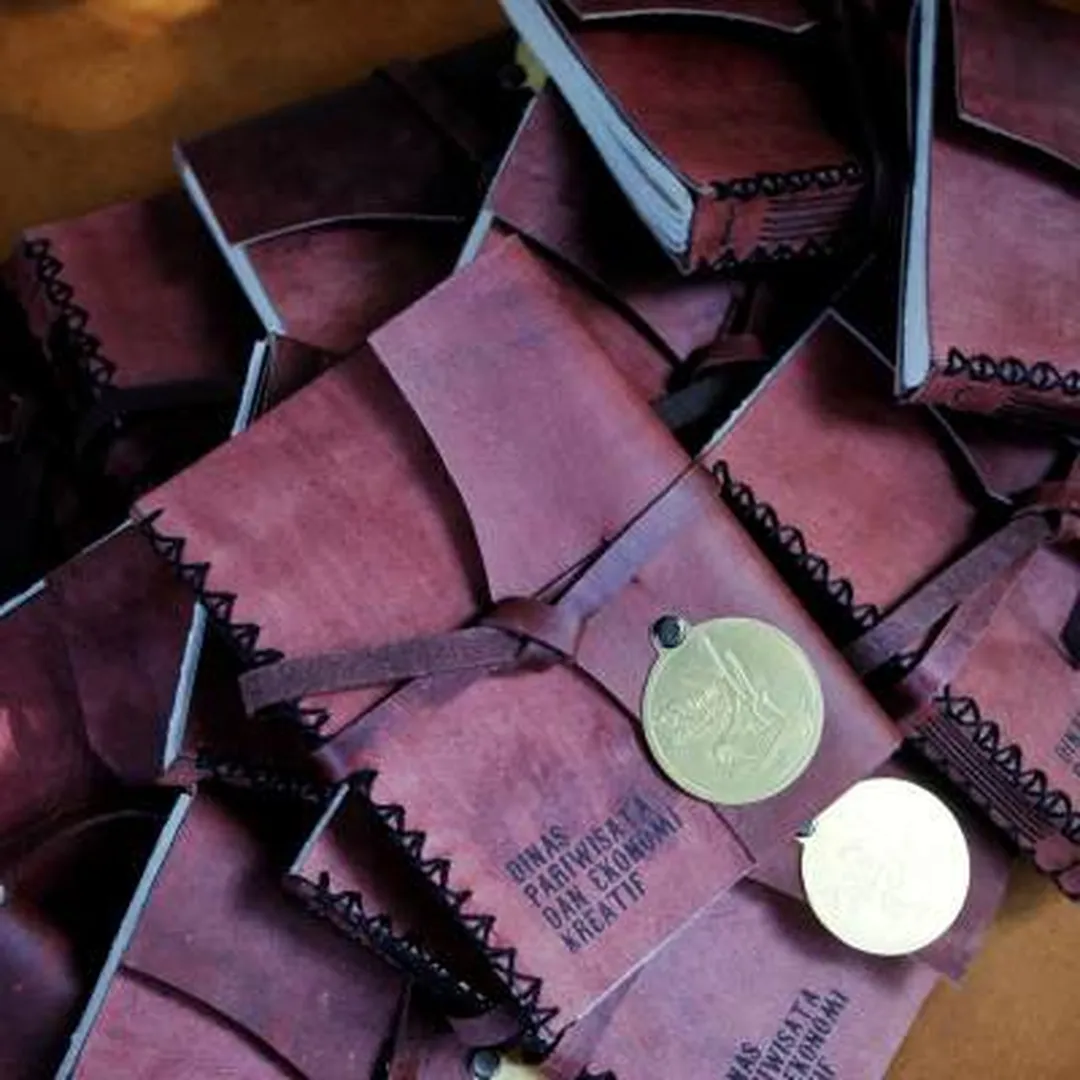
Business & Whitelabel
Elevate your brand with premium agendas. Like Caxton advanced printing, deliver exclusive branded products that make a lasting impression.
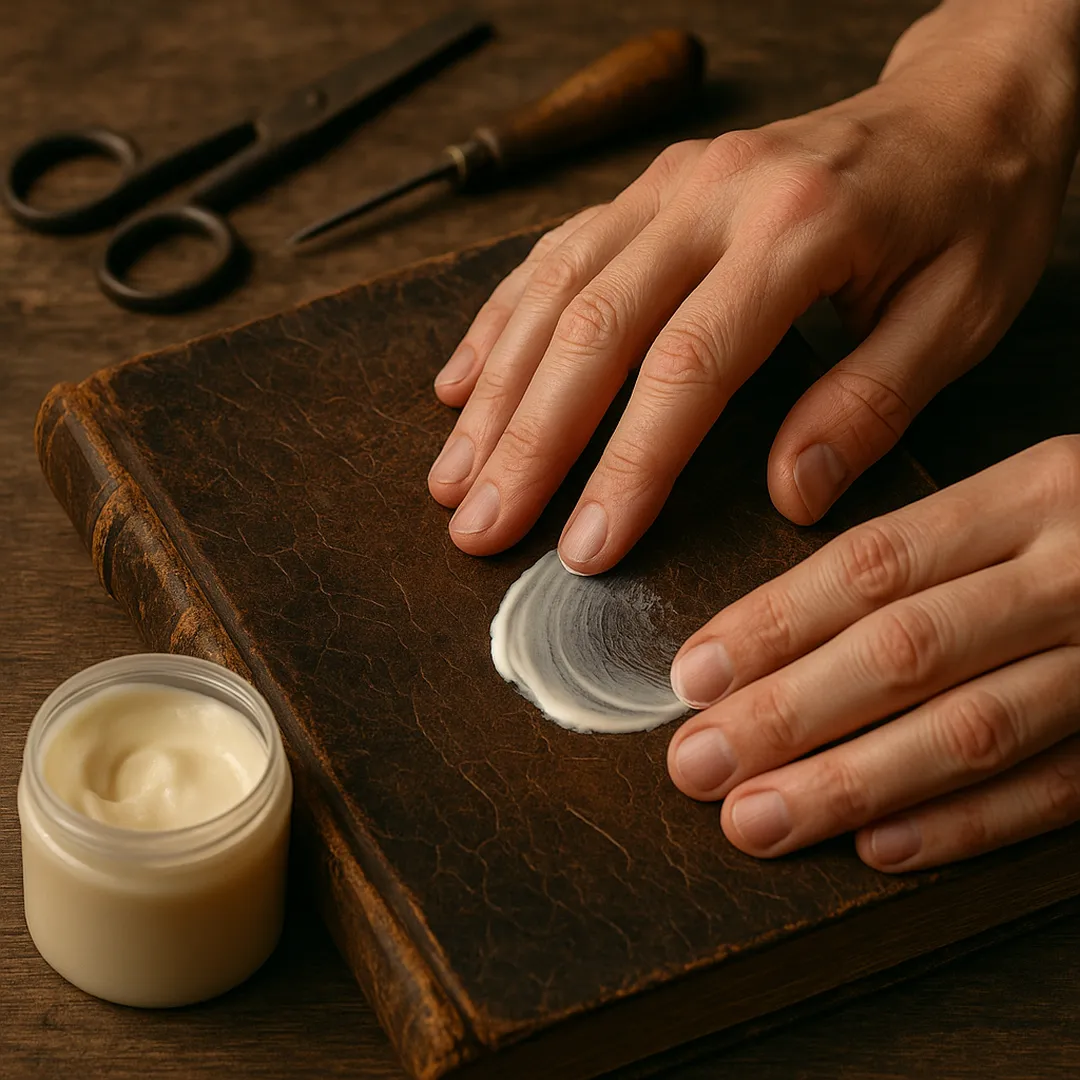
Book Repair & Conservation
Preserve treasured books, from heirlooms to historical collections, ensuring their stories survive for generations, just like the enduring ‘Myrrour of the Worlde’.