

1S. 6D./1 Shilling 6 Pence
by Ibrahim Anwar · August 1, 2025

Opening an old book often feels like travelling in time. The smell of ageing paper, the texture of a fragile binding, and the archaic letterforms all carry us into another era. Sometimes, though, the most interesting clue to that book’s past is not the words printed on its pages but a faint pencil mark on the first leaf or the inside cover. A notation such as “1s. 6d.” or “1/6” may look like a secret code to a modern eye. To anyone who can read it, though, that code is a key that opens a hidden story about a book’s value, its accessibility and its social context. This is not merely a price; it is an economic artefact that tells us how precious this book was to its first owner and to the society of the day.
Understanding 1s. 6d. is the first step towards becoming a “book archaeologist”. It lets us see a book not only as a vessel for a story but as an object that was once part of an everyday transaction. Was this a luxury item only a handful of people could buy, or a cheap edition made for the many to enjoy? The answer is often held in that short notation. For the makers at Hibrkraft, who are often entrusted with restoring these heirlooms, understanding every detail—including a scribbled price that looks trivial—is part of respecting and preserving an object’s complete history.
More Than a Number: Taking Apart the Complicated £sd System
To appreciate what 1s. 6d. really means, we have to go into the currency system that produced it: the system of Pound, Shilling and Pence, commonly known as £sd (pronounced L-S-D). It was used in Great Britain and across most of the British Empire for more than a thousand years before it was finally replaced by the decimal system in 1971. Unlike our modern decimal system, which is based on 10, £sd is a seemingly complicated system built on mixed bases.
The structure is as follows:
- 1 Pound (£) equals 20 Shillings (s)
- 1 Shilling (s) equals 12 Pence (d)
This means there were 240 pence in a pound (£1 = 20s x 12d). The system may look illogical to us now, but it has deep historical roots and served well for centuries. Denominations such as 1s. 6d. (one shilling and sixpence), or 18 pence, were very common. This value is equivalent to 1/8 of a pound at the time. Another fraction that appears often is the “half a crown”, worth 2s. 6d. (two shillings and sixpence).
Why “s” for Shilling and “d” for Pence?
One of the first things that confuses a beginner is why “shilling” is abbreviated “s” and “pence” is abbreviated “d”. The answer lies in the heritage of the Roman Empire. The name £sd comes from the Latin names of Roman coins:
- £ (Pound): From the word Libra, a Roman unit of weight. This is why the pound symbol is a stylised ‘L’.
- s (Shilling): From Solidus, a Roman gold coin.
- d (Pence): From Denarius, the most common Roman silver coin.
So when you look at 1s. 6d., you are really looking at an echo of a monetary system thousands of years old. It is a reminder that many aspects of our modern world, even something as small as a currency abbreviation, have far deeper roots than we suppose.
A pencilled price of ‘1s. 6d.’ in an old book is not merely a price label. It is a whisper from the past, telling the worth of a story in measures of shillings and pence.
Relevance in the World of Books and Leather Craft
For anyone involved with antiquarian books, this notation turns up everywhere and offers priceless insight. When a book conservator at Hibrkraft handles a Victorian novel, finding the notation “1/6” (another way of writing 1s. 6d.) inside it gives context at once.
1. Establishing Provenance: The price helps identify what kind of edition the book is. In the nineteenth century, for instance, a handsomely bound three-volume novel might cost a guinea and a half (£1 11s. 6d.), a very expensive price. A paper-covered book or “yellowback” sold at a railway station, by contrast, might cost only a shilling or two. A price of 1s. 6d. places the book between the two, probably as a reprint edition affordable to a growing middle class.
2. Understanding the Book Market: A price notation is data. Found across many books from the same period, it helps book historians track inflation, publishers’ pricing strategies and the purchasing power of the public. It tells the story of how literature became easier to reach over time.
3. Context for the Craft: In an old bookbinder’s notes or ledger, £sd notation itemises the cost of materials—the price of a skin of leather, a sheet of marbled paper, or a bottle of glue. Understanding these values helps us appreciate the economics of the craft at the time. If rebinding a book cost 5s., for example, we know that was a significant investment, equal to several days’ wages for some people.
In this way 1s. 6d. stops being an abstract number and becomes a rich data point, a fragment of information connecting the physical object in our hands to the lives and the economy of the people who made it and read it in the past.
The End of an Era: The Transition to Decimal Currency
The £sd system, which had lasted more than 1,200 years, finally met its end in the second half of the twentieth century. As the world grew more integrated and the decimal system came to dominate elsewhere, the distinctive British arrangement was judged increasingly impractical, above all for international trade and for computation. After years of debate and preparation, Great Britain formally moved to a decimal currency on 15 February 1971, a day that came to be known as “Decimal Day”.
Conversion and Chaos
On that day the old shillings and pence were abolished, and the pound was divided into 100 “new pence”, abbreviated “p”. The transition was an enormous logistical undertaking, involving a wide public information campaign, the minting of billions of new coins, and the adjustment of every till and vending machine in the country. For a time prices were often shown in both currencies to help people adapt.
So how was the value of 1s. 6d. converted? The process ran as follows:
- One shilling (1s. or 12d.) became the equivalent of 5 new pence (5p).
- Sixpence (6d.) became the equivalent of 2.5 new pence (2.5p).
So 1s. 6d. (or 18d.) was directly equivalent to 7.5 new pence (7.5p). The half new penny coin (½p) was introduced to handle odd conversions of this kind, though it was eventually withdrawn from circulation in 1984.
How to Read the Other Notations
Besides 1s. 6d., you may come across various other ways of writing a value in the £sd system. Understanding them is part of historical literacy.
- Three Components (£ s. d.): A full value is written as £2 10s. 6d. (two pounds, ten shillings and sixpence).
- Shillings and Pence Only: A value under a pound is often written with shillings and pence alone, such as 7s. 6d. This is also frequently written with a slash, or solidus, as in 7/6. In this notation, “1/6” means 1s. 6d.
- Pence Only: A value under a shilling is written in pence alone, such as 8d.
- A “-” for Nought: Sometimes, where there are no pence, a dash is used. 5/-, for example, means exactly five shillings.
Case Study: Book Repair and the Meaning Behind a Number
Imagine a customer bringing an Edwardian family Bible to Hibrkraft for repair. The binding is loose and several pages are torn. Examining the book, our maker finds a pencil inscription on the inside of the front cover: “To John, Christmas 1908. Price 4/6.”
That “4/6” (four shillings and sixpence) is more than a price. It is a story. A little research tells us that in 1908 the average wage of a skilled worker was around 30-40 shillings a week. So a Bible costing 4/6 represented a fairly significant outlay, perhaps the equivalent of half a day’s wages or more. This was not an impulse purchase. It was a carefully considered gift, bought at a sacrifice, and meant to be treasured. That understanding changes the way our makers approach the restoration. They are not only repairing a physical object; they are preserving evidence of love and sacrifice from the past. Knowing what 4/6 was worth gives their work its emotional weight, ensuring that every stitch and every leaf of repair paper is done with a deep respect for that book’s history.
This is why a term like 1s. 6d. matters so much in our work. It is the bridge between our technical expertise and the soul of the object in our care. It reminds us that every book has a biography, and that sometimes its most important clue is written in the language of shillings and pence.
FAQ
What does 1s. 6d. mean, and what was it worth in the old system?
1s. 6d. is short for one shilling and sixpence. In the British pre-decimal currency system (£sd), one shilling equalled 12 pence. So 1s. 6d. had a total value of 18 old pence. The notation is also frequently written as “1/6”.
Why is 'shilling' abbreviated 's' and 'pence' abbreviated 'd'?
The abbreviations come from the Latin names of ancient Roman coins. ‘s’ is from solidus (a gold coin) and ‘d’ is from denarius (a silver coin). The pound symbol (£) itself comes from libra. It is a legacy of Roman influence on the early European monetary system.
When did this currency stop being used in Britain?
The system of Pound, Shilling and Pence (£sd) was officially replaced by the decimal system on 15 February 1971, an event known as “Decimal Day”. After that date the pound was divided into 100 “new pence” (p).
Where am I most likely to find a notation like 1s. 6d. today?
You are most likely to find it inside antiquarian books (usually pencilled on the first leaf or the inside cover), in historical documents such as receipts, wills and accounting ledgers, and in old advertisements in newspapers or magazines from before 1971.
References
- The National Archives (UK) – Pre-decimal currency (the original link is dead; the reference is kept without a link)
- Project Britain – Old English Money (the original link is dead; the reference is kept without a link)
- The Royal Mint – The Story of Decimalisation
- RetroWow – Old money – a guide to pre-decimal currency (the original link is dead; the reference is kept without a link)
Price notations like this one appear in English binding ledgers of the period, and reading them correctly is part of dating a volume before it is touched — the question that always comes first in book repair and conservation.

Create Your Legacy
Begin your story today. Create a custom leather journal that will become a precious legacy in years to come, like the historic books we admire and preserve.
Value That Does Not Fade with Time
A corporate gift that goes beyond passing trends. A leather agenda is an investment in lasting quality, a message of class whose value time will never wear out.
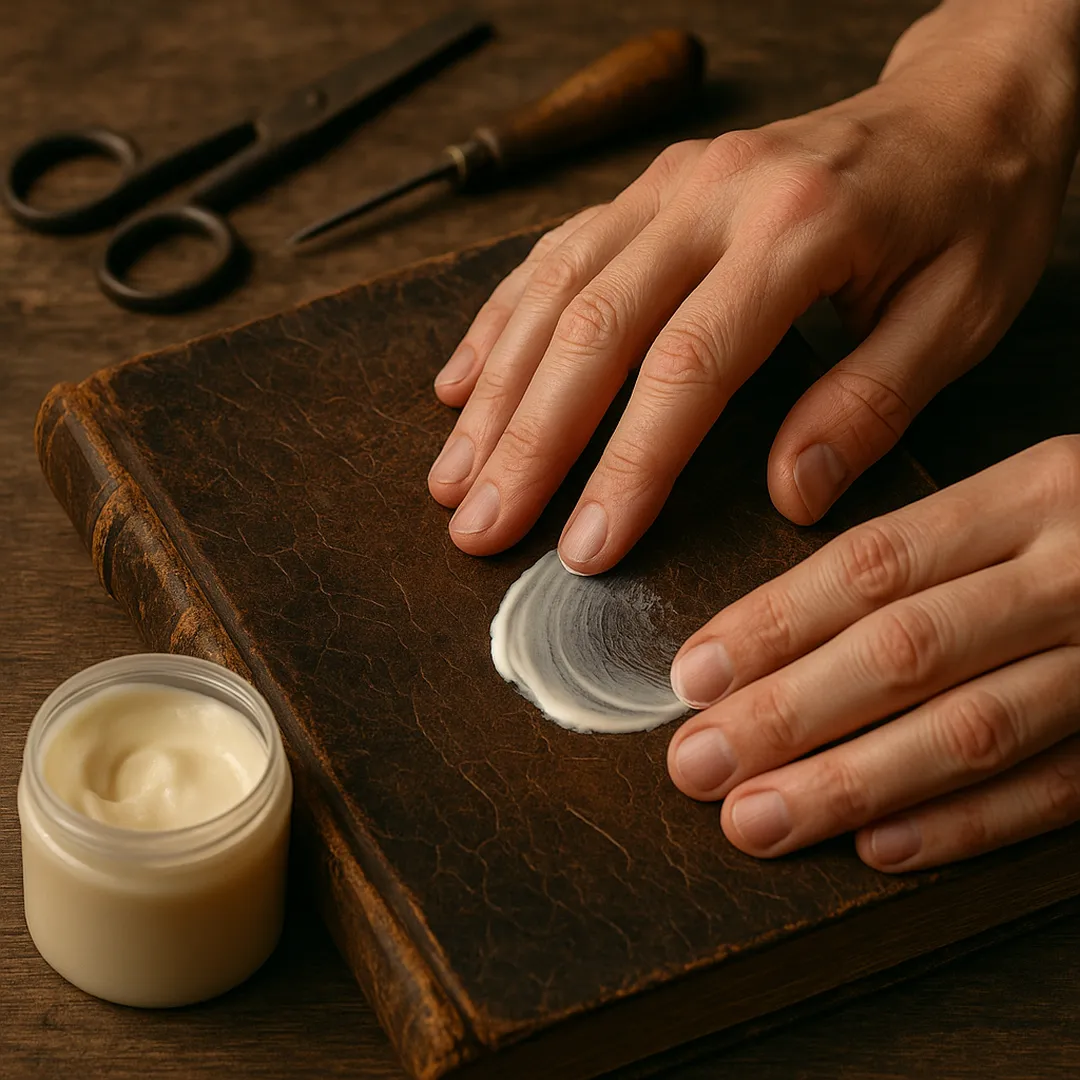
Preserve the Story Inside
Found a historical notation in your book? We do not only repair physical damage; we help preserve the story and the historical context of a book you treasure.