
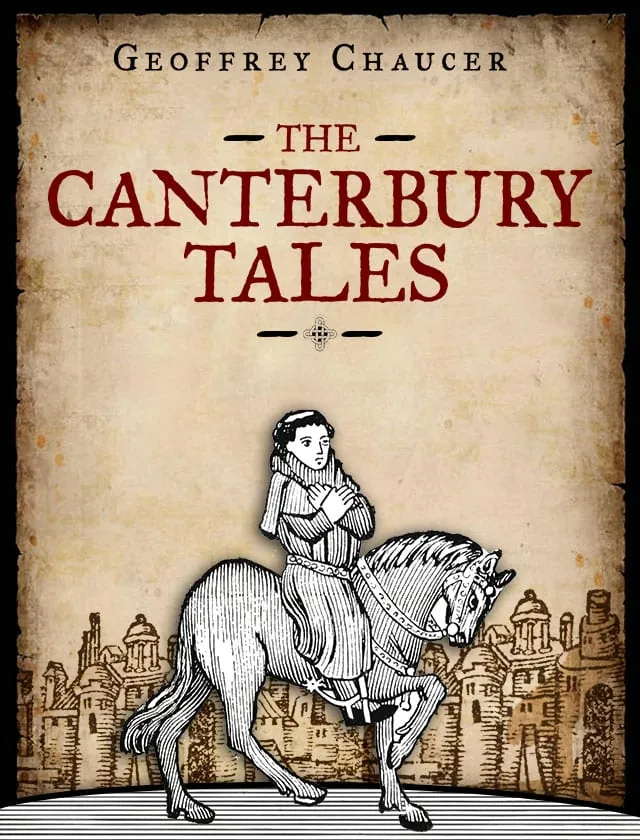
Canterbury Tales
by Ibrahim Anwar · July 25, 2025
Long before the novel or the pocket book, there was a group of pilgrims travelling to Canterbury Cathedral. They carried not only prayers but stories. From the gallant knight to the witty wife, from the pious monk to the drunken miller, every character in Geoffrey Chaucer’s “The Canterbury Tales” is a reflection of medieval English life. The work is a rich, funny and sometimes vulgar mosaic of stories that forms the foundation of English literature.
But the story of the work does not end with Chaucer’s pen. It carries on almost a century later in a printing workshop in London, in the hands of a man named William Caxton. This is where “The Canterbury Tales” was born again, transformed from a rare manuscript into a printed book. That journey, from handwritten text to a first printed edition decorated with woodcuts, is a story of innovation, of market demand, and of the birth of the book as we know it now. It is a story that speaks directly to anyone who loves books, not only as vessels for stories but as beautiful objects of craft.
Chaucer and His Vision: A Portrait of Society in Verse
Geoffrey Chaucer (c. 1340s – 1400) was a civil servant, a diplomat and a poet who lived through turbulent times. He wrote in the vernacular at a moment when Latin and French still dominated literature and government. By choosing to write “The Canterbury Tales” in Middle English, the language of ordinary people, Chaucer made a powerful statement: that English was worthy of great literature.
The work itself is arranged as a storytelling contest among a group of pilgrims drawn from every layer of society, travelling from London to the tomb of Saint Thomas Becket in Canterbury. The variety of those pilgrims is where Chaucer’s genius lies. Through their tales—ranging from chivalric romance and animal tales to moral fables and bawdy stories—Chaucer painted a portrait of English society unmatched in his own day. Sadly, Chaucer died before finishing his ambitious project; of the 120 tales he planned, he completed only 24.
The story of “The Canterbury Tales” is not only about the pilgrims but about the birth of the English book itself, a journey from exclusive manuscript to illustrated printed edition.
William Caxton and the Printing Revolution in England
For almost 75 years after Chaucer’s death, “The Canterbury Tales” existed only as manuscript. Every copy had to be written out by hand by scribes, a process that was expensive, time-consuming and prone to error. That changed dramatically with William Caxton (c. 1422 – c. 1492).
Caxton was a successful wool merchant who spent most of his life in Bruges and Cologne. It was there that he saw the revolutionary new technology out of Germany: the movable-type printing press invented by Johannes Gutenberg. Recognising its potential, Caxton learned the art of printing and then brought that technology back to England, setting up his first press at Westminster in 1476.
The First Edition (c. 1476): A Monumental Achievement
One of the first and most significant projects Caxton undertook was printing “The Canterbury Tales”. It was a shrewd and a bold choice. Chaucer’s work was already very popular among the nobility and the wealthy merchants who could afford a manuscript. By printing it, Caxton could reach a far wider audience and establish his reputation as the printer of important works in English.
That first edition was a marvel in its own day, but from a modern point of view it looks very plain. The book was printed with no title page, no page numbers and, most importantly of all, no illustrations whatsoever. It was pure text. Caxton had a problem, though: the manuscript he used as his source was not perfect, and carried a great many errors and omissions.
The Second Edition (c. 1483): A Response to the First “Customer Review”
This is where the story becomes both very interesting and very modern. According to the prologue Caxton wrote himself for the second edition, a “gentleman” came to him and complained. This customer said that the book he had just bought did not match the manuscript his father owned, which he believed to be the more accurate. He went so far as to say he would not buy Caxton’s edition unless it were printed correctly.
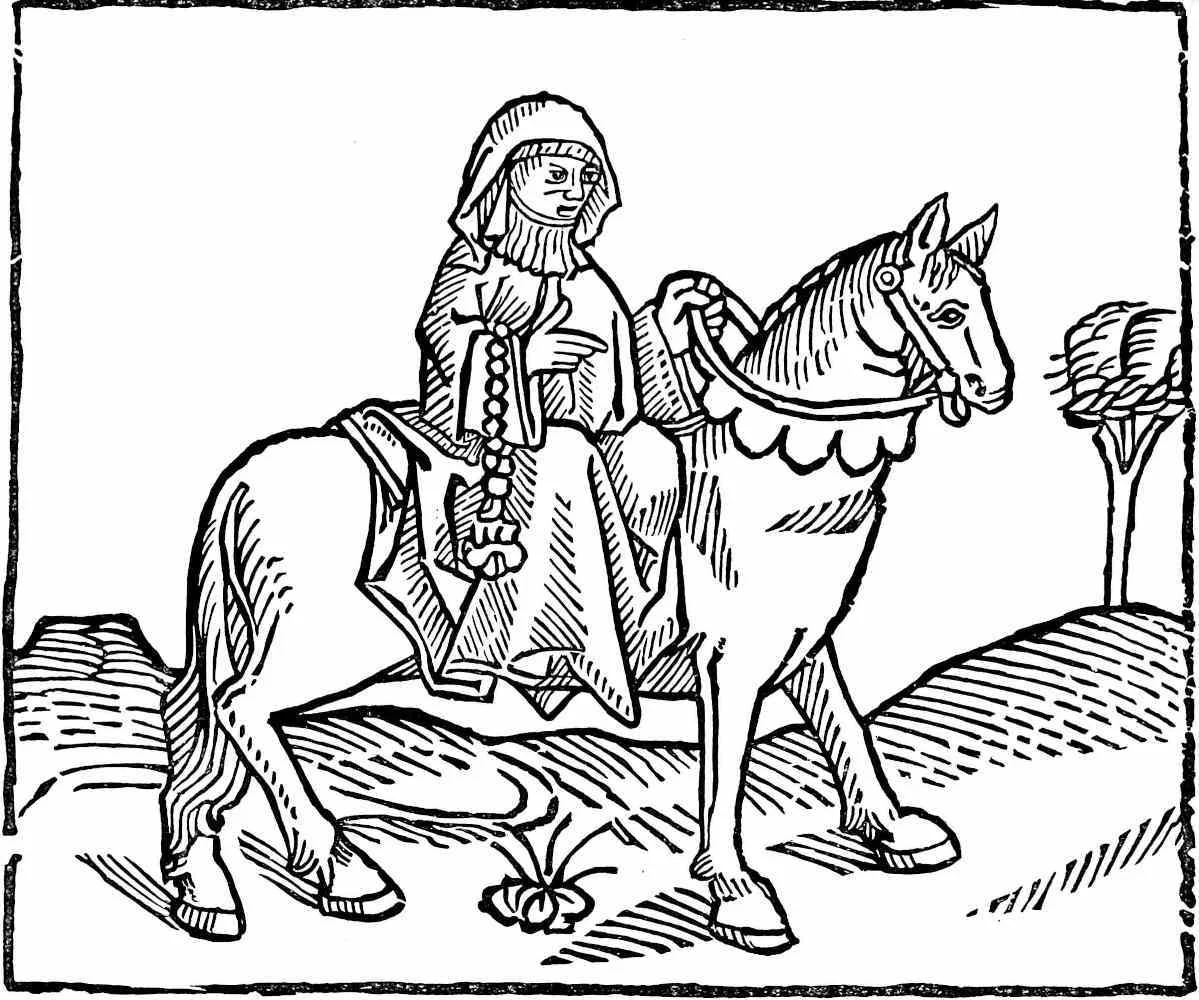
In a move that shows remarkable business sense, Caxton agreed. He asked the gentleman to lend him the better manuscript and, in return, promised to print a new corrected edition. More than that, to make this second edition more appealing, Caxton added a feature that was entirely new: 26 woodcuts, depicting most of the pilgrims. This was one of the first uses of narrative illustration in an English printed book, a major innovation that would shape the future of publishing.
Early Illustration and Caxton’s Successors
The woodcuts in Caxton’s second edition are often described as “crude” or “primitive” by later standards. They matter a great deal all the same. Made by cutting the image into a block of wood, they gave Chaucer’s characters a face for the first time before a wider audience. The image of the Knight on his horse, the Wife of Bath in her broad hat, all of them became visual icons.
Every early printed book is a statement. It does not only hold a story, it also tells one — about technology, about art, and about the ambition of its maker.
Richard Pynson and Wynkyn de Worde: The Next Generation
After Caxton’s death the business was carried on by his assistant, Wynkyn de Worde. Alongside de Worde, other printers such as Richard Pynson became important figures in the London printing trade. Both also published their own editions of “The Canterbury Tales”.
Richard Pynson, later appointed King’s Printer, published his first edition around 1492. He too included illustrations, many of them copied from Caxton’s second edition, though he added some new ones as well. The quality of Pynson’s illustrations is sometimes judged lower than that of other work he produced. This does not mean Pynson was a poor printer—quite the opposite, he was one of the best of his day. The judgement is comparative and contextual. Perhaps for a popular edition of the Tales he chose to use woodblocks that already existed, or ones cut quickly, to keep costs down, while for more prestigious commissions he used more skilled engravers.
In fact the competition and the collaboration between these early printers—copying woodblocks, correcting texts, adding new features—drove innovation in the publishing trade. All of them built on the foundation Caxton had laid.
The Legacy of “The Canterbury Tales” in Book Craft
The story of the early editions of “The Canterbury Tales” offers a lasting lesson to anyone who loves the book as a physical object.
- Quality matters: The first customer complaint to Caxton shows that from the very beginning readers wanted a book that not only held the right text but was also well made. That appetite for quality is at the heart of the art of bookbinding and of leathercraft.
- The power of illustration: Caxton’s decision to add pictures changed the way people engaged with the story. Illustration adds a layer of meaning and of enjoyment. At Hibrkraft we see the same thing when a customer asks us to engrave a personal image or symbol on their journal. It turns a notebook into a meaningful personal artefact.
- The book as a collaboration: From Chaucer (the author), the scribes (who copied the manuscripts), Caxton (the printer), the woodcutters (the illustrators), and even the customer who gave feedback, “The Canterbury Tales” is the product of many hands. It echoes the spirit of custom craft, where the customer’s vision and the maker’s skill come together to create something unique.
Hibrkraft: Telling Your Own Story
At Hibrkraft we are inspired by this legacy. Every time we make a custom leather journal, we feel part of a long tradition begun by pioneers like Caxton. We may not print Chaucer’s tales, but we do provide the blank canvas on which you write your own story.
The spirit of the customer who asked Caxton to make a better edition is the same spirit we see in our customers today. You do not only want a notebook, you want the right notebook—in the leather you like, with your name or logo engraved perfectly, with a pocket exactly where you need one. You want a book that is a reflection of yourself.
By ordering a Custom Notebook from Hibrkraft, you become Chaucer and that gentleman customer at once. You are the author of your story, and you are the art director of the book that will hold it. We are only the modern “printers”, using our own tools—not movable type, but leather cutters, sewing needles and laser machines—to bring your vision into being.
Frequently Asked Questions (FAQ)
- Why is “The Canterbury Tales” so important to the English language?
- The work proved that English—not only Latin or French—could be used to create literature that was complex, beautiful and profound. It helped standardise and popularise London English as the dominant dialect.
- What is a woodcut?
- A woodcut is a relief printing technique in which an artist cuts an image into the surface of a block of wood. The parts that are to print are left level with the surface, while the parts that are not to print are cut away. Ink is then applied to the surface, and the image is printed onto paper.
- Do Caxton’s original editions still exist?
- Yes. Though extremely rare, a few copies of Caxton’s first and second editions survive and are held in major libraries such as the British Library, the Bodleian Library at Oxford, and the Folger Shakespeare Library in Washington, D.C. They are among the most precious books in the world.
References
- British Library – “Caxton’s Chaucer” (the original link is dead; the reference is kept without a link): An excellent resource, with digital images of the early editions of “The Canterbury Tales”.
- Britannica – “William Caxton”: A comprehensive biography of England’s first printer and his contribution.
- Folger Shakespeare Library – “Chaucer’s Canterbury Tales” (the original link is dead; the reference is kept without a link): Insight into their collection of early editions and the importance of the work.
- University of Glasgow Special Collections – “Printing Chaucer”: A virtual exhibition on the history of printing Chaucer’s work.

Custom Notebook
Your story deserves a legendary book. Design a custom leather journal with us and continue a 500-year-old tradition of personalized literature.
Business & Whitelabel
Print your company’s legacy. We create premium branded leather goods that tell your brand’s story with quality and distinction.
Book Repair & Conservation
Some books are worth preserving. We restore treasured volumes, from family bibles to first editions, ensuring their stories survive.