Reference
An Encyclopaedia of Bookbinding and the Printing Trades
Three volumes, 1,046 pages, 4,790 entries. Every definition is reprinted verbatim from one of nine works on binding and printing published between 1683 and 1982, and closes with the siglum of the book it came from. The PDFs are free and the whole thing is also published as an open dataset. Nothing is gated and there is nothing to sign up for.
A bookbinder learning this trade in Indonesia has almost nothing to read. The vocabulary is English, the standard references are out of print or behind a library wall, and the terms that matter — oversewing, French joint, kettle stitch, rebacking — get translated differently by every person who tries. So we compiled the sources that are readable and put them in one alphabet.
This is not a book we wrote. It is nine books, set in one typeface, in one order, with the attributions kept. Where several authors defined the same term we kept all of them, which is why register and signature each appear eight times here, from 1841 through to 1982. Reading them in sequence is the closest thing there is to watching a craft argue with itself about what a word means.
The three volumes
B5, two columns, letter openers. Each PDF opens on its own bookmark panel — a letter opener for every letter, and beneath it a thumb index naming the first headword on a page roughly every five pages. Each also carries its full bibliographic record in its own metadata, and is linearized, so the first page paints before the rest has arrived.
-
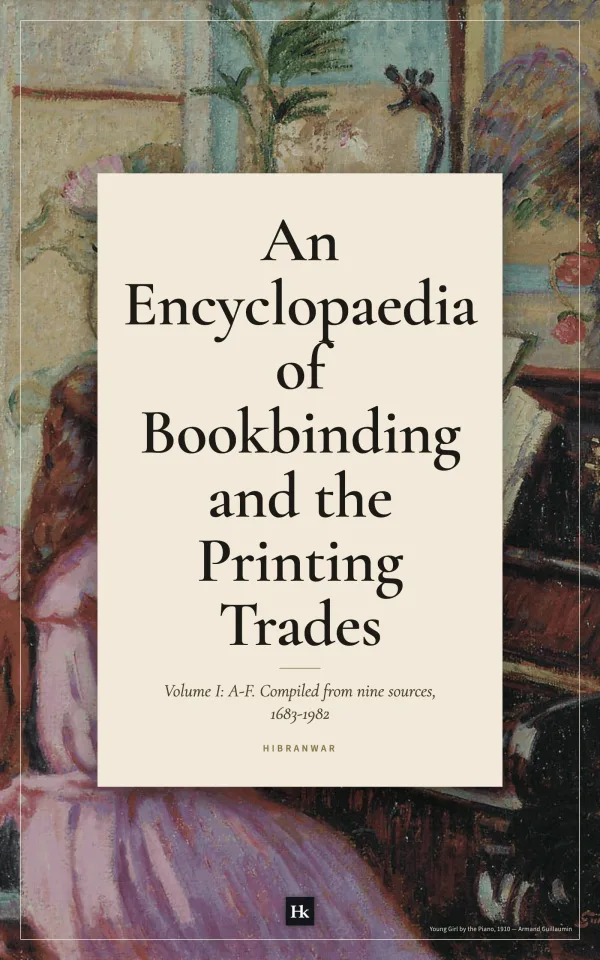 Volume I
A – F
361 pages · 1,845 entries · 253 figures
Letters A, B, C, D, E, F -
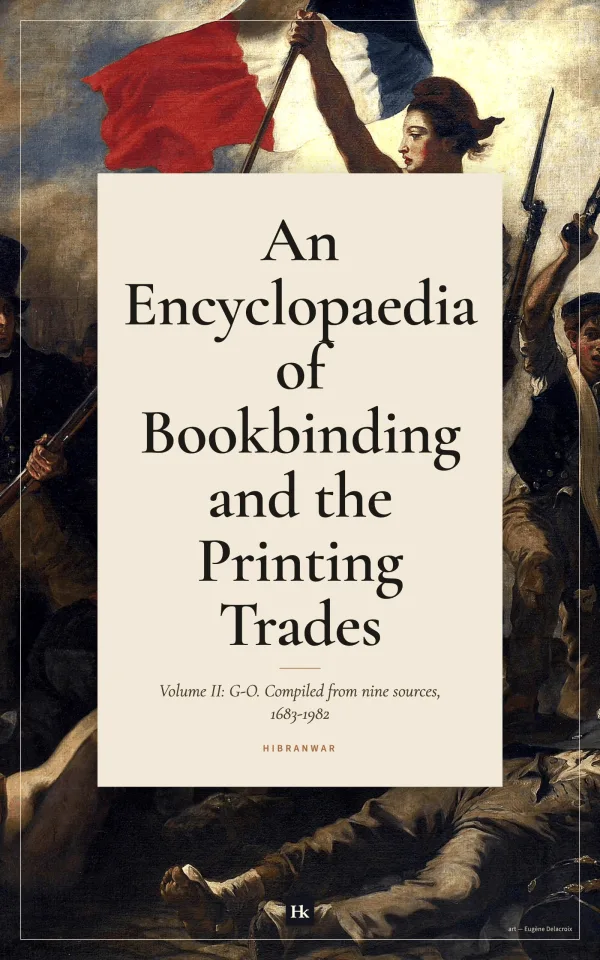 Volume II
G – O
321 pages · 1,187 entries · 162 figures
Letters G, H, I, J, K, L, M, N, O -
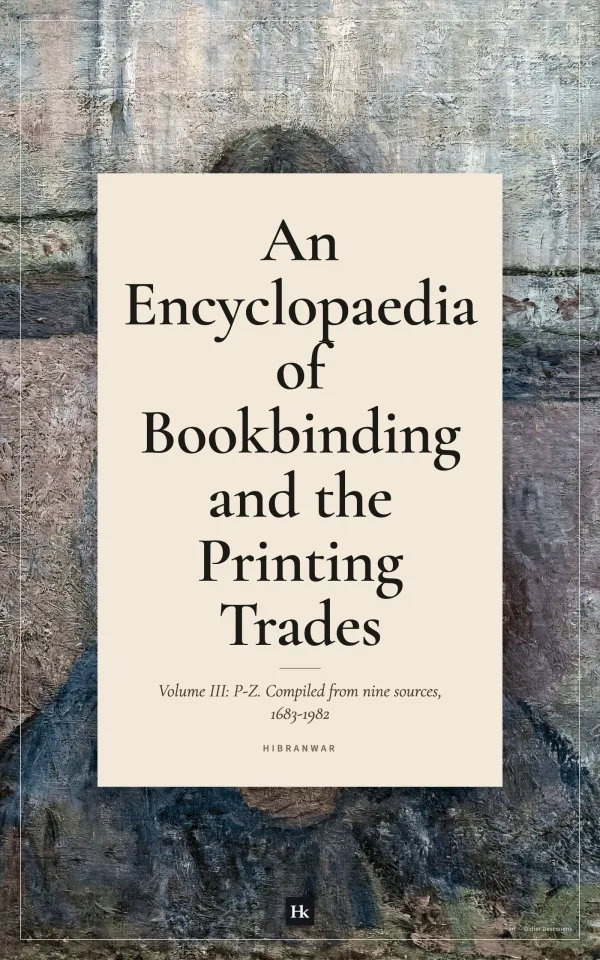 Volume III
P – Z
364 pages · 1,758 entries · 225 figures
Letters P through Z
Baca di layar, cetak sendiri, atau pesan yang sudah dijilid. Bebas. Kami ingin hidupmu lebih baik.
The nine sources
Every entry closes with a siglum naming the work it was taken from. Eight of the nine are pre-1930 imprints from Project Gutenberg. The ninth is not, and is marked here and in every record of the dataset.
| Siglum | Author | Work | Year | Entries |
|---|---|---|---|---|
| MOX | Joseph Moxon | Mechanick Exercises, Volume 2 | 1683 | 35 |
| DAP | William Savage | A Dictionary of the Art of Printing | 1841 | 753 |
| MAB | James B. Nicholson | A Manual of the Art of Bookbinding | 1856 | 106 |
| AMP | Thomas MacKellar | The American Printer: A Manual of Typography | 1866 | 215 |
| BIB | Joseph Sabin | Bib-li-op-e-gis-tic | 1889 | 39 |
| ABB | Joseph W. Zaehnsdorf | The Art of Bookbinding: A Practical Treatise | 1890 | 137 |
| BCB | Douglas Cockerell | Bookbinding, and the Care of Books | 1901 | 64 |
| NBL | Arthur L. Bailey | Notes on Bookbinding for Libraries | 1906 | 250 |
| RE | Matt T. Roberts and Don Etherington | Bookbinding and the Conservation of Books: A Dictionary of Descriptive Terminology See rights | 1982 | 3,861 |
Those entry counts are the dataset's, not the books'. The printed volumes carry 4,790 entries and the dataset carries 5,460. Of the 670 difference, 654 are repeat definitions — 414 terms were defined by more than one author, and the books print one where the dataset keeps them all. That leaves 4,806 distinct headwords in the dataset against 4,790 in the books: 16 the dataset has and the books do not print. We would rather show you the 16 than round them into the sentence above.
The same thing, for machines
All 5,460 entries as JSON Lines, one object per line, each carrying its source, that source's year, its rights status and its references already resolved against the 373-work bibliography. Published with an MLCommons Croissant descriptor and a Frictionless Data Package, so it can be read as a dataset rather than as a pile of files. Version 2.1.0, archived at Zenodo under DOI 10.5281/zenodo.22182080.
- entries.jsonl 8.5 MB
- entries.jsonl.gz 1.7 MB
- entries-public-domain.jsonl 3.1 MB
- bibliography.json 60 KB
- sources.json 3.5 KB
- bookbinding-encyclopedia-v2.json 7.5 MB
- croissant.json 18 KB
- datapackage.json 14 KB
- README.md 10 KB
Two properties are worth knowing before you write any code against this. norm is not a key: 414 terms have more than one definition because more than one source defined them. Pull and break are each defined three times, by authors 299 years apart — Moxon in 1683, Savage in 1841, Roberts and Etherington in 1982. id is a key: unique across all 5,460 records and stable across rebuilds. Group by norm and sort by source.year and the dataset stops being a glossary and becomes a record of how a vocabulary was written down across three centuries.
The printed set
The PDFs are free and always will be. If you would rather have it on a shelf, we bind it here, to order, in the workshop that publishes it. Both prices are for the complete three-volume set and both include shipping, wherever you are.
Complete set
$200
Shipping included
All three volumes, 1,046 pages, B5, sewn and cased by hand. Made to order, so allow time for binding as well as for the post.
Complete set, genuine leather
$400
Shipping included
The same three volumes bound in genuine leather. This is the work the rest of this site is about, applied to our own book.
There is no checkout on this site. Both buttons open WhatsApp with the order already written out, and we confirm availability and delivery before anything is paid.
Rights, stated plainly
Two different situations, and we would rather say so than average them into one comfortable sentence.
Eight of the nine sources are in the public domain. They were published between 1683 and 1906 and came from Project Gutenberg. The 1,599 entries drawn from them can be read, copied, printed, quoted and passed on without asking anyone, including us.
The ninth is not the same case. Roberts and Etherington's Bookbinding and the Conservation of Books (1982) is a United States Government publication, issued by the Library of Congress and published openly in electronic edition by Conservation OnLine. It accounts for 3,861 of the 5,460 entries. We reproduce it on the understanding that a US Government publication carries no copyright. If you are a rightsholder who believes otherwise, please write to admin@hibrkraft.com and those entries will be withdrawn.
Every record in the dataset carries a rights_tier field and the full rights statement for its source, so the two are never confused by anything reading it. The public-domain subset is published as its own file for exactly this reason.
What we contribute is the compilation — the typesetting, the ordering, the normalisation, the resolved citations — and that is released under CC0 1.0. It covers our work of assembling this. It cannot and does not speak for the source texts above.
How to cite it
When you quote a definition, cite the author who wrote it and the year they wrote it — both are printed with the entry and carried in every dataset record. The 1841 definition of register is William Savage's and should travel with his name on it, not ours.
Anwar, Ibrahim, comp. An Encyclopaedia of Bookbinding and the Printing Trades. Bogor: PT Hibrkraft Kreasi Indonesia, 2026. https://hibrkraft.com/resources/encyclopedia/
Anwar, Ibrahim, comp. An Encyclopaedia of Bookbinding and the Printing Trades: entry dataset, version 2.1.0. Bogor: PT Hibrkraft Kreasi Indonesia, 2026. https://doi.org/10.5281/zenodo.22182080
The first is for the books, the second for the dataset. Cite the concept DOI above — 10.5281/zenodo.22182080 — which always resolves to the current release. There is also a version DOI, 10.5281/zenodo.22182081, which is frozen at version 2.0.0 and therefore holds slightly different bytes from the files above. If your result depends on exact bytes, cite that one and say 2.0.0.
Compiled and set by Ibrahim Anwar, ORCID 0009-0006-0425-4923. Each PDF also carries this record inside itself, as XMP metadata, so a file that travels away from this page does not lose its provenance.
Take it and use it
If you are learning to bind, repair or conserve books, this is the vocabulary the trade actually used, in the words of the people who used it. Read it, quote it, translate it, teach from it. If you find an error in the transcription, we would like to know — and if you want the same craft applied to a book of your own, that is what the rest of this site is for.
Last updated