
Plain Lab · logbook
Job Notes Insert
Forty-four job cards ask the same five things every time a job starts, and seventy-nine ruled pages hold everything a card was never built to record.
Specification
- Trim
- 127 × 177.8 mm · 5 × 7 in
- Pages
- 128
- Leaves
- 64
- Sheets
- 32
- Signatures
- 4 × 32pp
- Spine
- 7.32 mm
- Paper
- white
- Ruling
- lined
- Ruling pitch
- 7.14 mm · 20.25 pt · 9/32 in
- Rows per page
- 20
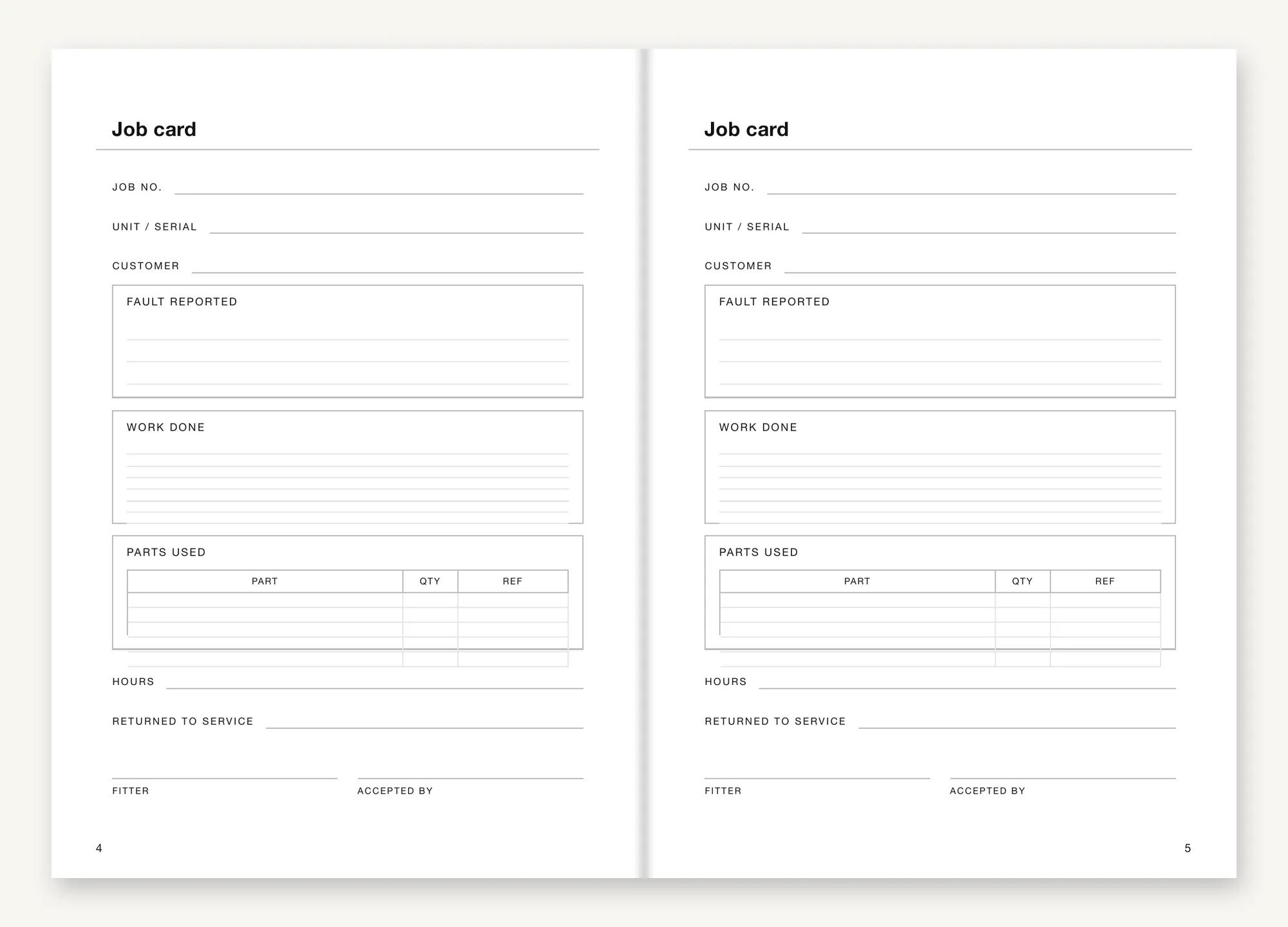
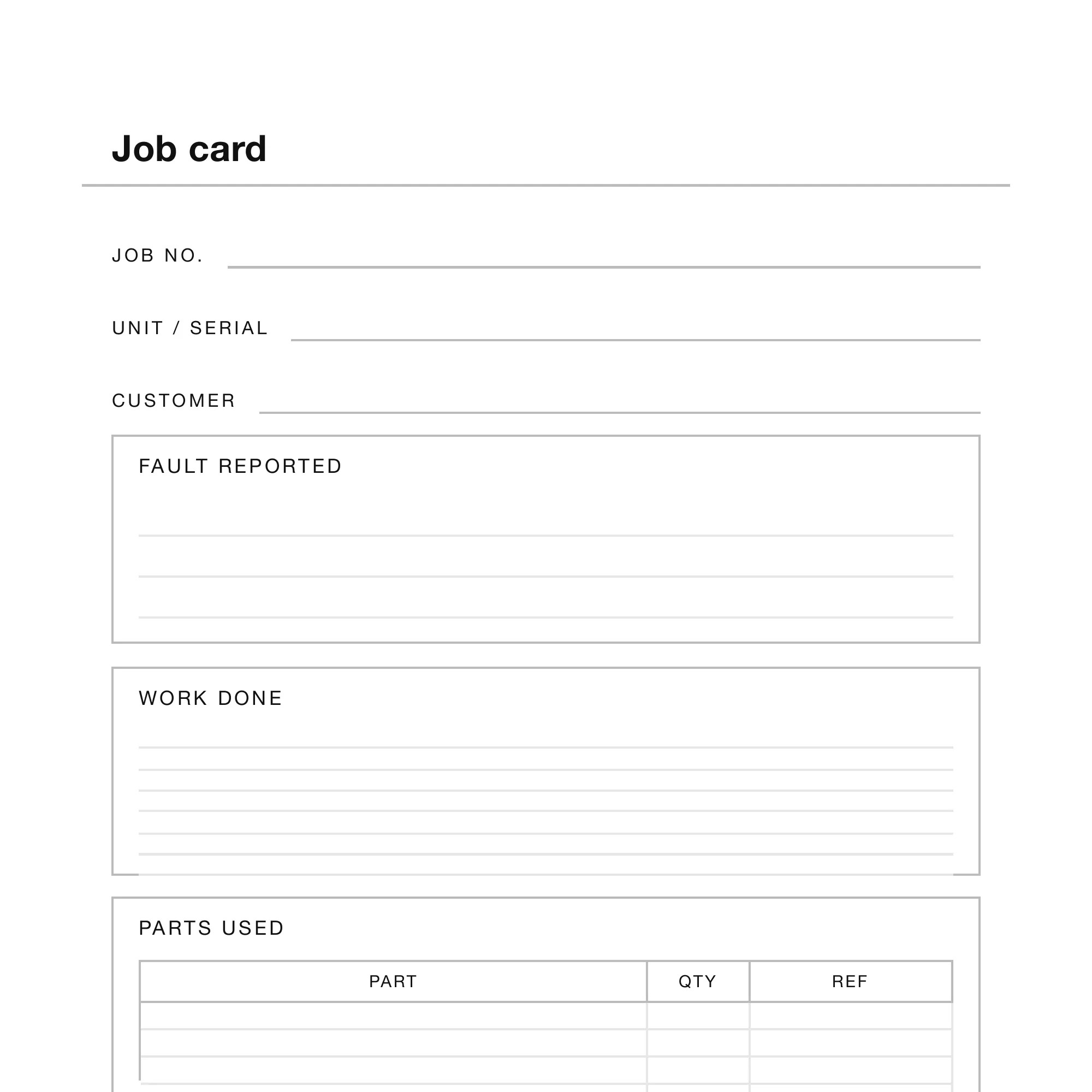
A job card exists because a memory of a Tuesday fades faster than anyone expects. Forty-four cards ask the same handful of things on every job: what the work was, what changed on arrival, what was actually done, and who signed it off. Filled in from memory once the shift is over, a card tends to record what the writer thinks should have happened rather than what did.
Seventy-nine college-ruled pages follow the cards, for the part no fixed card was built to hold: a supplier who never called back, a part ordered twice by mistake, a brief the client changed halfway through the job. A card with five boxes cannot carry a paragraph, and a paragraph is sometimes exactly what the job needs written down.
I have filled out a card after the fact more than once, working from a phone photo and a rough guess at the order things happened. It reads fine on the page. It is not the same record as one written the day the job was done.
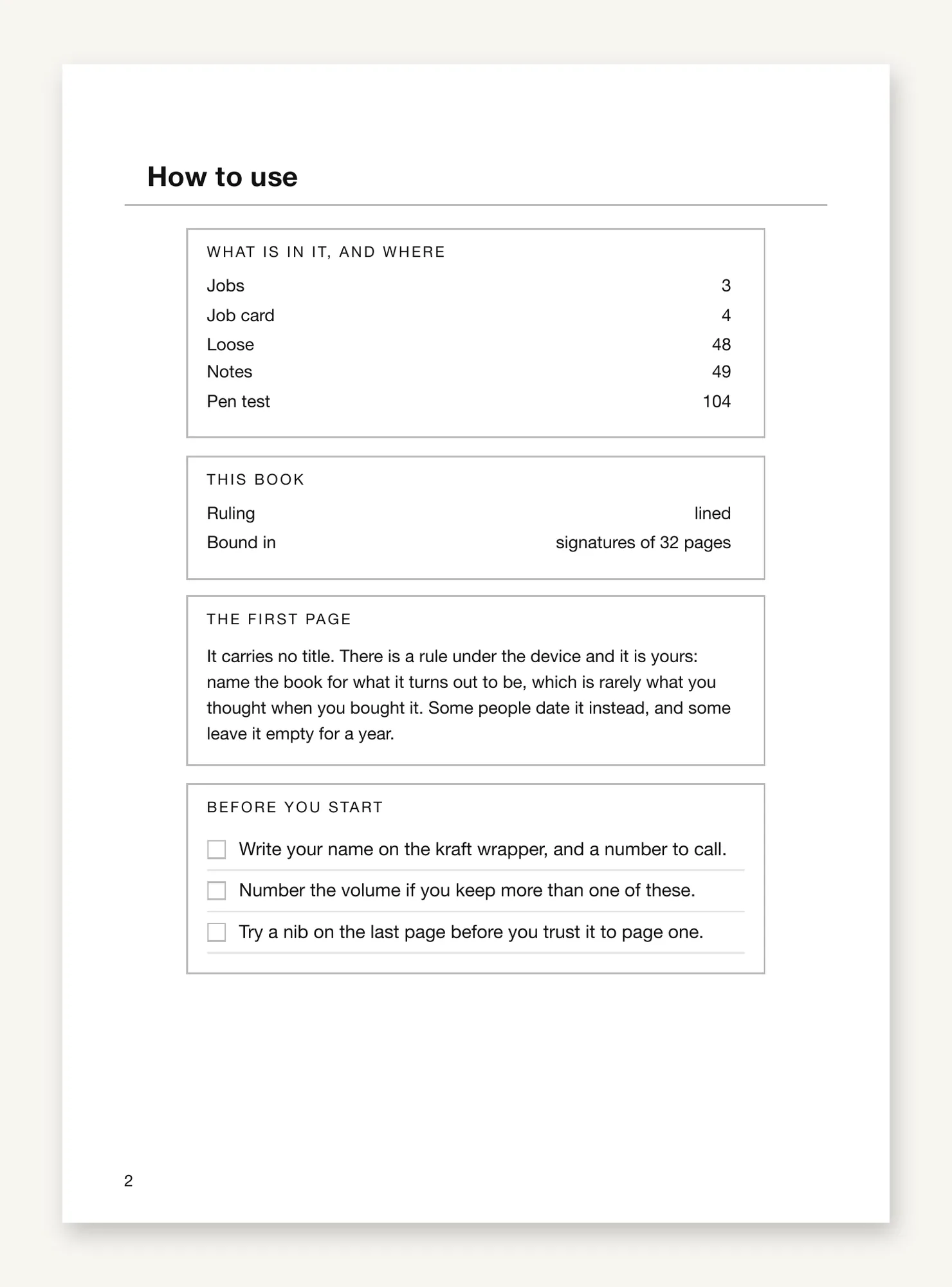
What is inside
- Job cards
- 44pp
- What the work was, what changed on arrival, what was done, and who signed it off.
- Notes
- 79pp
- College-ruled space, 7.14 mm pitch, for anything a fixed card cannot hold.
The film
Page by page
A vertical film from our own bench — this page contacts nobody's server to play it, and downloads nothing until you press play.
Real pages
Made at the Hibrkraft bindery, Bogor · about the maker
Books that sit alongside it
- Accounting NotesWorks alongsideshares note-taking
- Boiler Operation LogWorks alongsideshares field-work
- Field Notes InsertWorks alongsideshares field-work, note-taking
- Meeting Notes InsertWorks alongsideshares note-taking
Questions
What does a job card ask for?
What the job was, what changed on arrival, what was done, and who signed it off.
What is the ruled section for?
Anything a fixed card cannot hold: a delayed supplier, a part ordered twice, a brief that changed mid-job.
Is it dated?
No. Start a card whenever a job starts.
Does it come with a cover?
No. It is the sewn block, sized for a leather cover made separately.
How big is it?
Five by seven inches, one hundred twenty-eight pages, sewn in four signatures of thirty-two.
Indeed it is proverbial that the bad workman never yet had a good tool.