

Gratitude Journal
by Aika Mentari · August 5, 2025

In the bustle of modern life our brains naturally tend to fix on the negative. Complaints, worries and the list of unresolved problems often dominate our thinking—a phenomenon known as “negativity bias”. Keeping a gratitude journal is the antidote. It is a mental exercise that is simple and yet very deep. By picking up a pen and writing “Today I am grateful for…”, we actively work against that natural tendency. We train our brains to scan for the positive, however small: the warmth of a cup of coffee in the morning, a short and pleasant conversation with a friend, or even the plain fact that we can breathe easily.
A gratitude journal is more than a collection of lists. It is an archive of happiness, a catalogue of the small moments that so often slip past. Opening its pages again later on is like opening a treasure chest of reminders that goodness is always there, even on the hardest days. Using a well-made leather journal for this practice adds a further layer to the experience. The smooth touch of the leather and its natural scent turn the ritual of writing into a sensory experience, a calming act of caring for yourself. The journal itself becomes a cherished object, a sacred physical vessel for the thoughts that lift the spirit most.
The Science Behind the Smile: Why Is Gratitude So Powerful?
Ancient Roots, Modern Benefits
The practice of gratitude is not a new wellness trend. It is a virtue that has been honoured across many philosophies and spiritual traditions for thousands of years. Stoic philosophers such as Seneca and Marcus Aurelius wrote about the importance of valuing what you have rather than lamenting what you do not. Cicero called gratitude “the mother of all virtues.” Almost every major religion in the world has a central teaching on the importance of giving thanks to a higher power or to other people. This shows that human beings have long understood the power of gratitude intuitively.
In recent decades, however, modern science, and the field of positive psychology in particular, has begun to provide strong empirical evidence for what the ancient sages already knew. Research pioneered by psychologists such as Dr Robert A. Emmons and Dr Martin E. P. Seligman has consistently shown that a regular practice of gratitude has a real and measurable effect on our wellbeing.
Study after study has uncovered a range of remarkable benefits. Mentally, people who practise gratitude regularly report higher levels of happiness and optimism, along with lower levels of depression and stress. Socially, they tend to be more forgiving, more generous, and to feel less lonely. There are even documented physical benefits: sounder sleep, lower blood pressure and a stronger immune system. This is not magic; it is the science of how changing the focus of the mind can change our biological and emotional reality.
How a Gratitude Journal ‘Hacks’ Your Brain

What actually happens inside our brains when we write in a gratitude journal? The process runs far deeper than merely feeling good for a moment.
- Countering the Negativity Bias: The human brain evolved to notice threats in order to survive. This is why we remember criticism more easily than praise. By consciously looking for positive things to write down, we actively retrain the neural pathways in our brains. We build a positive “muscle”, making it easier and more automatic to see the good in future.
- Activating the Reward Centre: When we feel and express gratitude, the brain releases neurotransmitters such as dopamine and serotonin. These are the same chemicals associated with pleasure, motivation and happiness. In other words, the practice of gratitude literally makes us feel better at a chemical level.
- Improved Emotional Regulation: Brain imaging research shows that gratitude activates the medial prefrontal cortex, the area of the brain involved in decision-making, emotional regulation and empathy. This helps us to manage negative emotions better and to respond to difficult situations more calmly.
Writing in a journal strengthens these effects. The physical act turns abstract thought into something concrete. You are not only ‘thinking about’ gratitude, you are ‘doing’ it, which sends a stronger signal to your brain.
Keeping a gratitude journal does not make the storms in your life disappear, but it does give you a sturdy anchor in the middle of the waves.
Your Practical Guide to Starting a Gratitude Journal
The idea of starting a new practice can feel daunting, but the beauty of a gratitude journal lies in its simplicity. There are no rigid rules, and you need nothing beyond a pen, paper and a few minutes of your time. The aim is to create a habit you can sustain, not a burdensome chore.
First Steps: Setting Up Your Ritual
Creating an enjoyable ritual around this practice is the key to consistency.
- Choose Your Vessel: You can use any notebook at all. Many people find, though, that having a beautiful journal kept for the purpose—such as a leather journal from Hibrkraft—makes the practice feel more sacred and more special. It becomes an object you look forward to holding and writing in every day.
- Decide on a Time and a Place: Set aside 5 to 10 minutes at the same time every day. Many people like to do it in the morning, to start the day with a positive perspective. Others prefer the evening, as a way of reflecting on the day just gone and settling the mind before sleep. Create a comfortable setting: sit in your favourite chair, perhaps with a cup of tea.
- Start Simply: Do not feel under pressure to fill a whole page. Begin with a simple goal: write down three to five things you are grateful for each day. Quality matters more than quantity.
Remember, the aim is to build a habit. It is better to write three points every day than three pages once a month.
What Should You Write? Going Beyond the Obvious
At first it is easy to write the big things: “I am grateful for my family, my friends, my health.” That is fine, but to really feel the benefit, try to be more specific and to dig deeper. Detail is the key that unlocks the true feeling of gratitude.
- Dig into the Specifics: Instead of “my family,” write “I am grateful for my father's joke that had me laughing out loud over dinner.” Instead of “my work,” write “I am grateful for the colleague who helped me finish a difficult project today.”
- Notice the Small Things: Beauty is often hidden in ordinary things. Give thanks for the sweetness of a mango, the quiet of the house in the morning, the warmth of a blanket, or the perfect playlist that kept you company on a journey.
- Give Thanks for Other People: Think of someone who made your day better. Write about them and about what they did. This not only deepens your own gratitude but also strengthens your social relationships.
– Focus on Your Senses: What beautiful sight did you see today? What soothing sound did you hear? What delicious smell did you catch?
– Look for the Good in a Challenge: This is an advanced exercise. Can you find something to be grateful for in a difficult experience? Perhaps the lesson you took from it, the strength you found in yourself, or the support from other people that appeared.
– Do Not Forget Yourself: Give thanks for something about yourself. Perhaps the patience you showed, a task you managed to finish, or simply your decision to take the time to look after yourself.
Using writing prompts such as “The unexpected thing that made me smile today was…” or “A small luxury I enjoyed today was…” can help a great deal if you feel stuck.
Overcoming Common Obstacles
It is natural for this practice to feel strange or difficult at first.
- “It Feels Forced.” Yes, at first it may well feel so. Think of it as going to the gym for the first time. Your muscles are not used to it yet. Keep practising. Over time your brain will become better trained at seeing the positive naturally, and the practice will feel more sincere.
- “I Had a Bad Day and There Is Nothing to Be Grateful For.” This is the moment when a gratitude journal is needed most. Lower your standards. Do you have a roof over your head? Food to eat? Air to breathe? The ability to read this sentence? Starting from these basics can give a powerful perspective on the darkest days.
- “This Is Just ‘Toxic Positivity’.” There is a big difference. “Toxic positivity” means denying or suppressing negative emotions. A gratitude journal is not about pretending everything is perfect. It is about acknowledging that both things can be true at the same time: you can be having a very hard day, AND at the same time there are still good things (however small) in the world. It is a tool for resilience, not for denial.
In the end, a gratitude journal is a gift you give to yourself. It is an invitation to take an active part in creating your own happiness, one sentence of thanks at a time.
FAQ
What is the difference between a gratitude journal and an ordinary diary?
The main difference lies in the focus. An ordinary diary is a place to record all kinds of events, thoughts and feelings, complaints and frustrations included. A gratitude journal has one very specific purpose: to look deliberately for the positive and for what you are grateful for and write it down, in order to train your brain towards a more optimistic perspective.
How often should I write in a gratitude journal to feel the benefit?
Consistency matters more than frequency. Starting with 3-4 times a week is enough to begin feeling a positive change. Where possible, making it a daily habit of 5-10 minutes will have the most significant effect. The key is not to let one or two missed days stop you carrying on.
What should I do if I feel there is nothing new to be grateful for each day?
This is perfectly natural. Try digging deeper into the same things. For example, rather than only writing “I am grateful for coffee,” describe it in more detail: “I am grateful for the smell of coffee filling the kitchen this morning,” or “I am grateful for the warmth of a cup of coffee in my hands when the weather is cold.” Look for a new nuance in what has already become familiar.
Is a gratitude journal really supported by science?
Yes. The field of positive psychology has carried out a great deal of research over more than two decades on the effects of gratitude. Studies by researchers such as Robert Emmons and Martin Seligman have consistently shown that a regular practice of gratitude correlates strongly with increased happiness, reduced symptoms of depression, better sleep and stronger social relationships.
References
- Greater Good Science Center at UC Berkeley. “Gratitude Journal.”
- PositivePsychology.com. “The Ultimate Gratitude Journal Guide (+ 31 Prompts & PDF).”
- Harvard Health Publishing. “Giving thanks can make you happier.”
- Psychology Today. “7 Scientifically Proven Benefits of Gratitude.”

Your Personal Gratitude Journal
Create a beautiful space dedicated to your gratitude practice. A personalised leather journal makes the daily ritual more special.

A Gift of Gratitude
Give a gift that is genuinely meaningful. A custom gratitude journal is a thoughtful way to improve the wellbeing of your team or your clients.
Preserve Your Memories
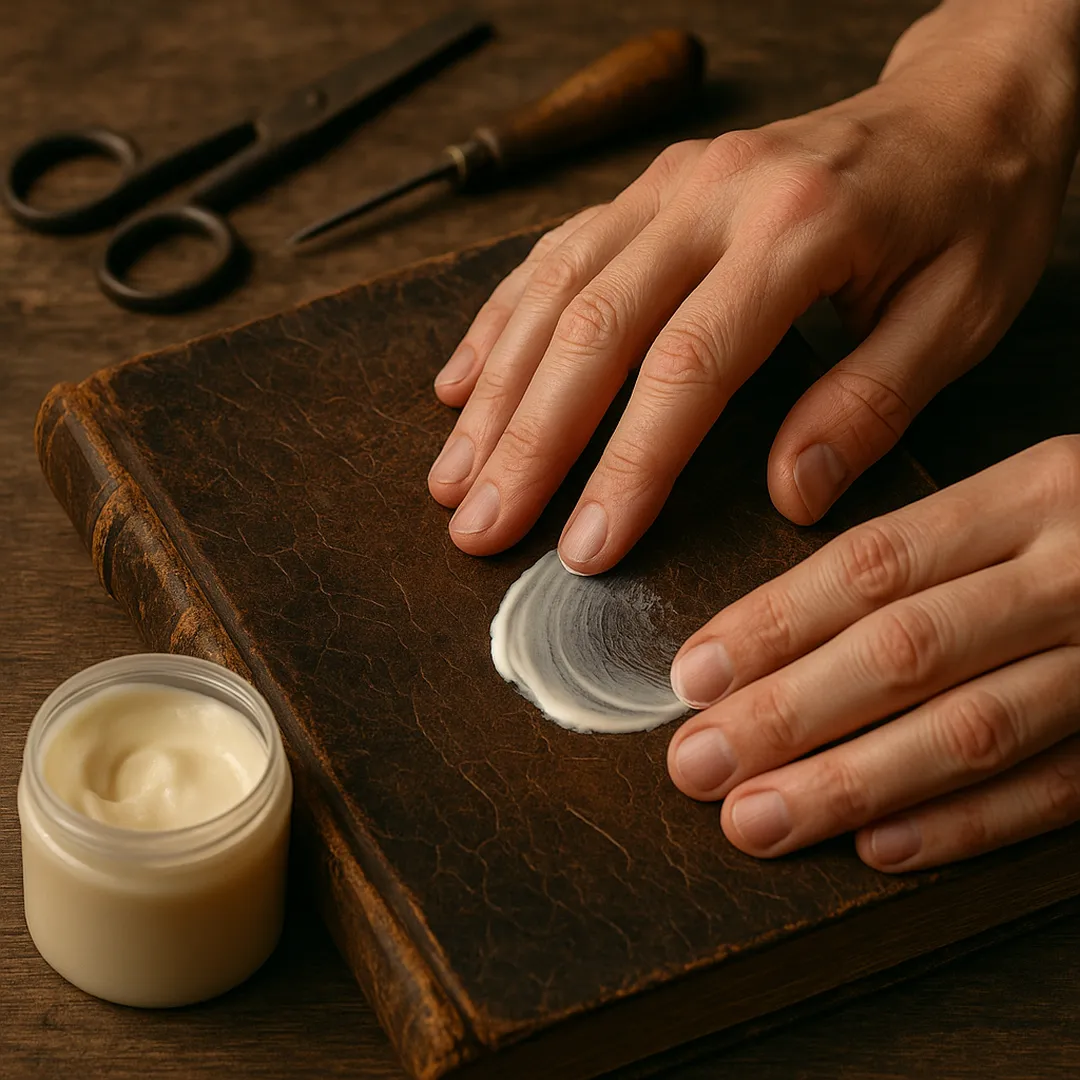
Have you filled your gratitude journal? We can help rebind or conserve it, turning your precious thoughts into a family heirloom.