
Bullet Journal
by Aika Mentari · August 5, 2025
Amid an ocean of digital productivity apps and online calendars, the Bullet Journal arrives as an analogue oasis. It invites us back to basics: pen and paper. But make no mistake — its simplicity is its strength. Unlike a conventional diary that comes with its page format already decided, a Bullet Journal is a blank canvas. You are its architect. You decide the layout, what is worth recording, and how it looks. The system lets you build a tool that genuinely fits the way your mind works and the particular shape of your life.
That is what made BuJo a global phenomenon. It is the meeting point of structure and freedom. For some it is an efficient, minimal productivity tool for managing a crowded set of tasks. For others it is an art journal full of colour, stickers and calligraphy, where planning meets self-expression. Whatever form it takes, the aim is the same: to help you sort through the noise, focus on what genuinely matters, and live more deliberately. It is not simply a notebook but a reflection of your own mind on paper.
The art of being your life's architect: the origins and philosophy of BuJo

Born out of a personal need
The Bullet Journal method was not born in a technology company's meeting room but out of a personal struggle. Ryder Carroll, a digital product designer, created the system in the early 2000s as a way of managing the attention deficit disorder he had lived with since childhood. He found it hard to focus and was overwhelmed by a pile of disorganised notebooks kept for different purposes. He needed one system that could hold all his jumping thoughts — tasks, appointments, stray ideas — in one coherent place. After years of experiment he refined a framework that was flexible and yet structured, and shared it with the world in 2013. That system is what we know as the Bullet Journal.
The core philosophy behind BuJo is to “track the past, order the present and design the future”. It is not only about completing more tasks but about completing the right ones. The method pushes its user to pause regularly, review their commitments, and decide consciously what is worth carrying into the next day and what can be let go. That process, called “migration”, is a powerful mindfulness practice, helping us be more deliberate with our time and our energy.
The anatomy of a Bullet Journal: four core modules
Flexible though BuJo is, the original system has four core modules that serve as its foundation. Understanding them is the key to starting.
- The index: the first few pages of your notebook, working like a table of contents. Every time you begin a new “collection” — a monthly log, meeting notes, a list of books to read — on any page, you record the topic and its page number in the index. That lets you find anything quickly, however random the order within the journal.
- The future log: usually made after the index, this is where you record events, deadlines or goals falling in the months ahead. Think of it as a bird's-eye view of the next 6–12 months. When the month in question arrives, you move these items into your monthly log.
- The monthly log: the pages for planning the current month. The left page usually works as a traditional calendar, where you note appointments and important events. The right page is the task page, a list of everything you want to achieve that month. It is an overview of your commitments for the next 30 days.
- The daily log: the heart of the BuJo system, where you record from day to day. Unlike an ordinary diary, you do not need to set it up in advance. You simply write today's date and begin recording tasks, events and notes as they arise.
These four modules create a framework that flows, letting information move from long-range planning (the future log) to medium-range (the monthly log) and finally to daily execution (the daily log).
A Bullet Journal is not about filling pages. It is about designing a life, one bullet, one task and one day at a time.
The secret language of BuJo: rapid logging

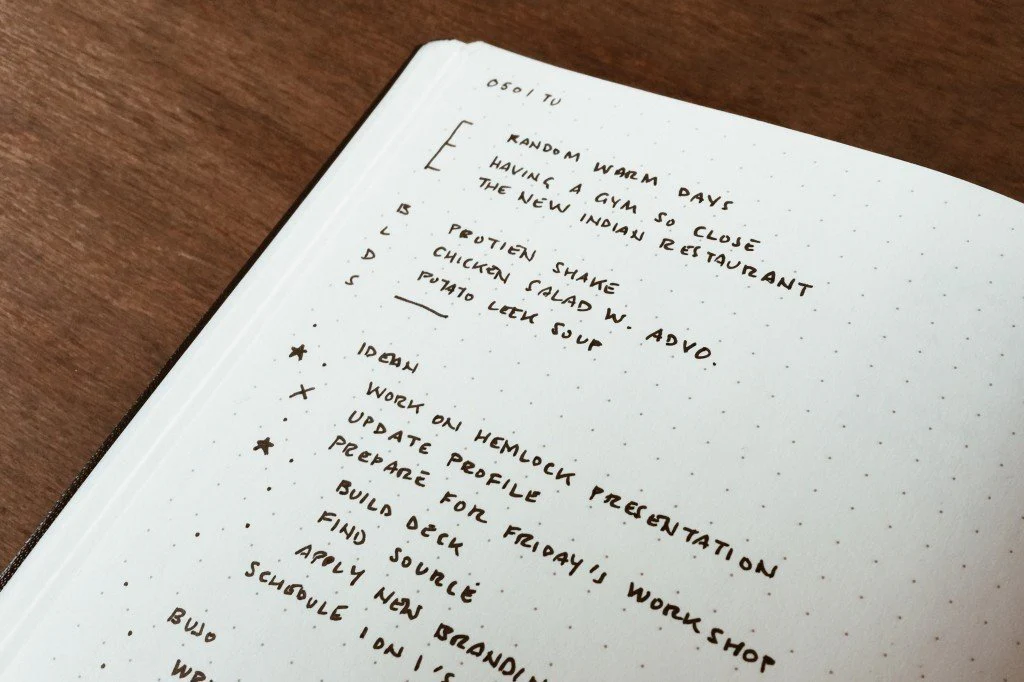
The key to BuJo's efficiency is “rapid logging”. This is a shorthand using different symbols to categorise each entry. The basic system is:
- • (task bullet): for things you need to do.
- X (task complete): when you finish a task, you simply turn the bullet into an X. Deeply satisfying.
- > (task migrated): if you do not finish a task today and want to move it to the next day or into the monthly log, you turn the bullet into a >.
- < (task scheduled): for a task or event scheduled further ahead, you turn the bullet into a < and record it in the future log.
- ○ (event bullet): for an appointment or a time-bound event.
- – (note bullet): for a fact, an idea, an observation or a thought you want to remember.
You can also add “signifiers” beside these bullets, such as * for priority or ! for inspiration. The system lets you capture and categorise information very quickly without writing long sentences.
More than bullets: the creative evolution of the Bullet Journal
Since Ryder Carroll shared his method, the Bullet Journal has evolved enormously. The online community, particularly on Instagram, Pinterest and YouTube, has taken the basic framework and turned it into an art form. That has created a broad spectrum of styles, from the purely functional to the highly artistic.
Minimalist against maximalist: the two main schools
Explore the #bulletjournal tag and you will find two main camps:
- Minimalist BuJo: this style stays faithful to Ryder Carroll's original vision. The focus is function and efficiency. Usually it uses a single black pen, clean layouts, and no unnecessary decoration. The aim is purely productivity and clarity of mind. It suits people short of time who want a strong system of organisation.
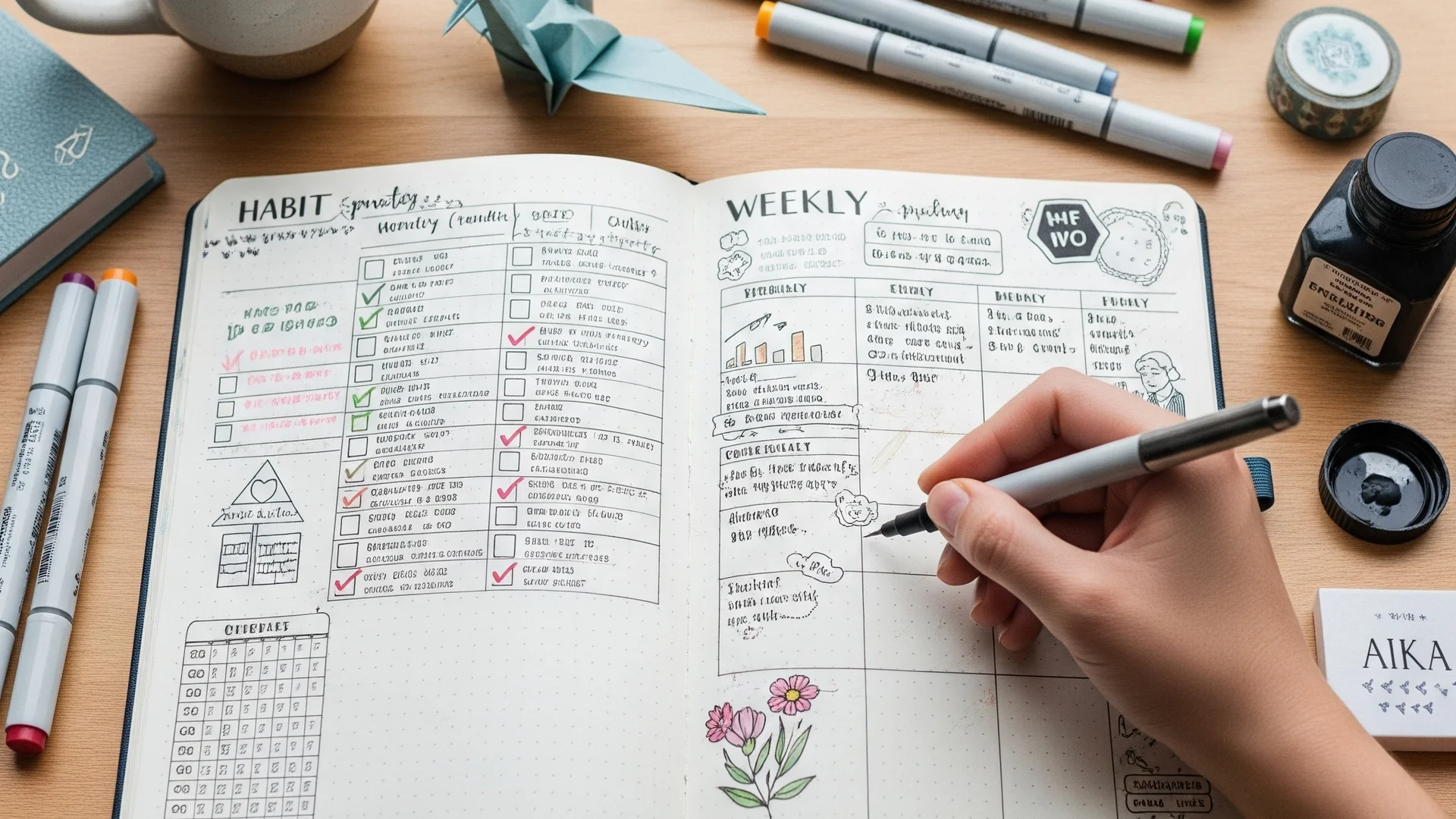
- Maximalist (artistic) BuJo: this style sees a blank page as a canvas. Users spend time building beautiful “spreads” with monthly themes, using calligraphy, stickers, washi tape, watercolour and intricate drawing. For them, the creative process of decorating the journal is part of the mindfulness practice itself — a calming escape.
It is worth remembering that there is no right or wrong way. The beauty of BuJo is that you can sit anywhere between the two. You might keep a largely minimal journal with a little colour, or combine highly functional pages with purely artistic ones.
Collections and trackers
One of BuJo's most powerful features is the idea of a “collection”. A collection is essentially any page dedicated to one particular topic. It is how you customise your journal beyond the core modules. The possibilities are unlimited. Popular collections include:
- Habit trackers: a table for monitoring daily habits such as drinking water, exercising or reading.
- Mood trackers: a visual way of recording your mood each day, often colour-coded, to see patterns over time.
- Gratitude logs: a place to write one thing you are grateful for each day.
- Reading or watching lists: a page for books you want to read or films you want to see.
- Meal planners: for planning a week's menu and a shopping list.
- Brain dump: a blank page dedicated to emptying every thought, idea and worry out of your head and onto paper.
Every time you make a new collection, do not forget to add it to your index.
Choosing your weapons: the right journal and tools
Although you can start a BuJo with any notebook and any pen, certain tools improve the experience.
- The notebook: a journal with dot grid paper is the most popular choice for BuJo. The dots give a guide for drawing straight lines and boxes without being as intrusive as full lines or squares. Choose thick paper — 100 gsm at minimum — to prevent ghosting and bleed-through, particularly if you plan to use markers or watercolour.
- Pens and markers: a black fine-liner, such as a Sakura Pigma Micron or a Staedtler Pigment Liner, is the mainstay for sharp, water-resistant writing. Brush pens are excellent for headings and calligraphy, while highlighters work well for colour coding.
- Other tools: a ruler, stencils, washi tape and stickers are good friends to anyone wanting to add design elements quickly and easily.
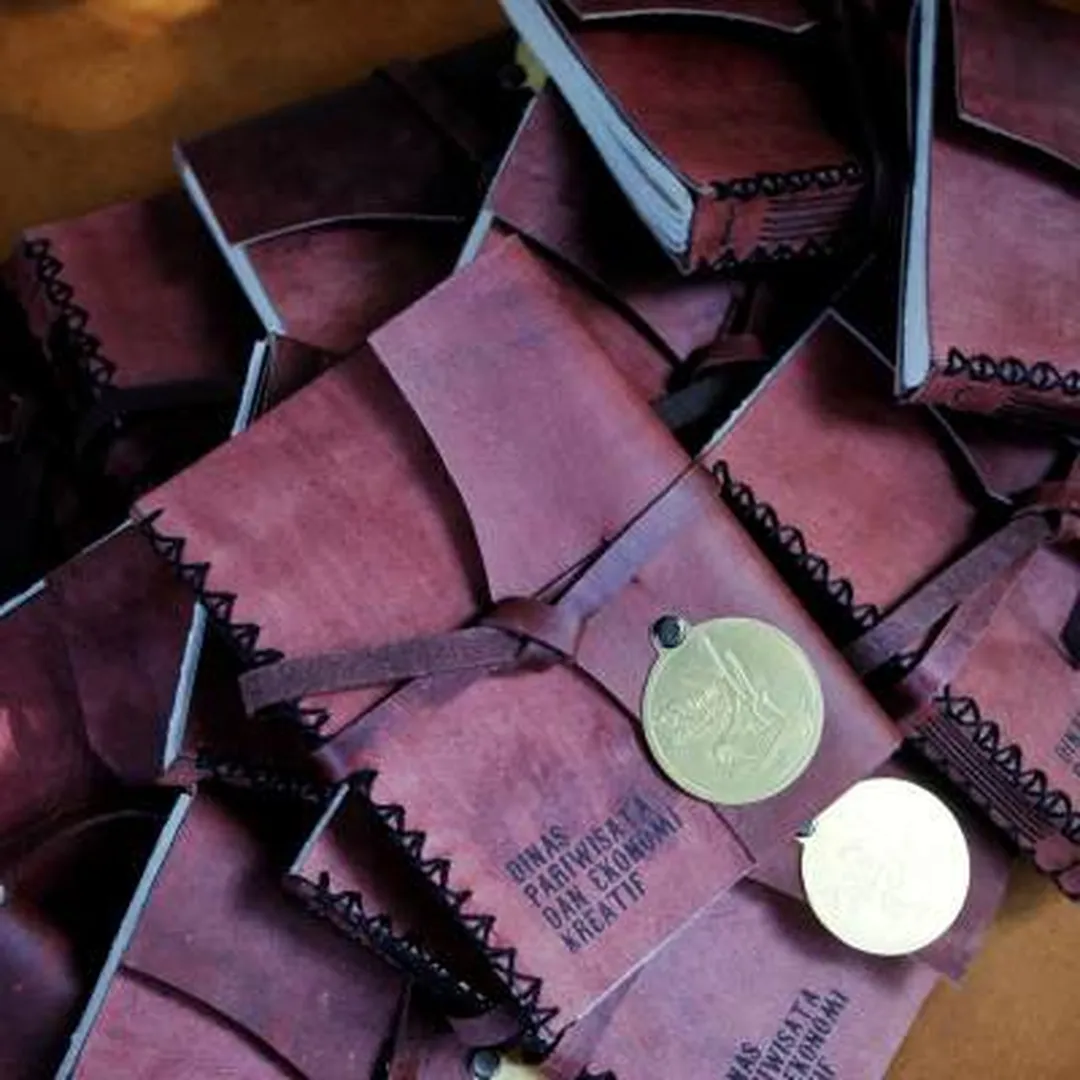
At Hibrkraft we make leather journals with a choice of good dot grid paper — a perfect foundation for beginning your Bullet Journal, minimal or artistic.
FAQ
What is the difference between a Bullet Journal and an ordinary planner or diary?
The main difference is flexibility. An ordinary diary has a printed layout that cannot be changed. A Bullet Journal is a system you build yourself in a blank notebook. You decide what goes in, where, and how it looks. That makes it entirely adaptable to needs that change.
I cannot draw and my handwriting is poor. Is a Bullet Journal still for me?
Absolutely. It is worth remembering that at its heart the Bullet Journal is a productivity tool, not an art competition. Ryder Carroll's original version is highly minimal and functional. Focus on the function of the system first. Artistic beauty is a bonus, not a requirement.
What sort of notebook is best for a Bullet Journal?
A notebook with dot grid paper is the most popular, because it guides without confining. Look for thick paper, 100 gsm at minimum, to avoid bleed-through. A5 is the most common size, being roomy enough to write in while staying portable.
Doesn't keeping a Bullet Journal take a lot of time?
It depends on your style. If you choose a minimal approach, setting up takes only a few minutes a day. An elaborate artistic style can indeed take longer. But many people find the creative process a form of relaxation and meditation, so the time spent is worth it for the benefit to their mental health.
References
- Bullet Journal. “The Official Website by Ryder Carroll.”
- The New York Times. “The Art of the Bullet Journal.” (the original link is dead; the reference is kept without it)
- The New Yorker. “The Allure of the Bullet Journal.” (the original link is dead; the reference is kept without it)
- Good Housekeeping. “What Is a Bullet Journal? How to Start a ‘BuJo’ to Get Your Life in Order.”

Your Perfect BuJo Notebook
Design a high-quality leather journal with thick dot grid paper, the perfect foundation for your bullet journaling practice.
Boost Team Productivity
Equip your team with custom-branded notebooks, ideal for implementing the Bullet Journal method for better organization.

Refills for Your System
Love your Hibrkraft Traveler's Notebook? We provide dot grid refill inserts to keep your BuJo system going.