
Bulk & White Label
Bulk Ordering Guide: Counting Back from the Handover Date
This page answers one question: how to schedule a bulk order so that it is ready on time. The sequence is counted backwards from the date the goods must be in the recipient’s hands, not forwards from the date the order is placed.
- 6 stages
- 4–5 weeks production
- Backwards from handover
Tell us the date the goods must be in the recipient’s hands, and we will work the schedule backwards with you.
Sequence
Counting backwards, not forwards
This schedule assumes the prices, the MOQ and the payment terms have already been read — all of them are on the bulk & white label page. What is not necessarily clear is when each decision has to be made for the goods to arrive on time. The right sequence begins at the date the goods must be in the recipient’s hands, then runs backwards. The stage that slips most often is not production — it is the stage that is waiting for an answer.
| Counting back | Stage | What it waits on |
|---|---|---|
| 1 | Handover date | The zero point. It cannot be moved, so everything else adjusts to it. |
| 2 | Shipping | Between islands takes longer than within the city, and both stretch in the run-up to the holidays. |
| 3 | Packing and final inspection | Per-unit personalisation adds time here, not in production. |
| 4 | Production | The most predictable part of the whole sequence. |
| 5 | Sample approval | Waiting on a decision, not on work — the stage that most often consumes time without being visible. |
| 6 | Final data: logo file and list of names | The deadline that actually binds. |
Our standard lead time for a bulk order is 4–5 weeks after approval of the digital proof (the sample) — that is the span to set aside for the Production stage above. If your deadline is tighter, a rush order is available for an additional fee; state the deadline at the first consultation so that we can judge whether it is feasible.
Final data also covers the logo die. For a first order with a new logo there is a one-off charge to make the deboss/emboss die, and that die cannot be cut before the final logo file has arrived — which is why the sixth row of the table above is the deadline that actually binds. A repeat order with the same logo is not charged for the die again.
Where it slips
What delays the schedule most often
Waiting for sample approval, and a list of names that changes after the marking has begun. Both are decisions rather than work — and both can be settled early at no additional cost.
Scale
What changes as the quantity grows
An order of ten units and an order of a thousand run through the same sequence. What differs is how many decisions are made up front, because a decision that is repeated a thousand times has to be right from the start.
| Aspect | Small quantity | Large quantity |
|---|---|---|
| Cutting | Sheet by sheet, measured directly | Templates and a cutting machine |
| Marking | Can be adjusted as the work goes | The die is cut once and used for every unit |
| Quality inspection | Every unit is looked at | A sample per batch, against a tolerance |
| Leather colour variation | Barely visible | Real; the leather is selected from the same part of the hide |
| Main point of failure | A misunderstanding about the design | A change of request after the die has been made |
The last row is the hidden cost that comes up most often. A metal die is cut once; changing the logo after production has begun means cutting a new one, and that holds for fifty units just as much as for five hundred.
Material preparation
Preparing the material for one batch
Cutting and laying out the material is the most visible stage, and the most predictable one in the table above.
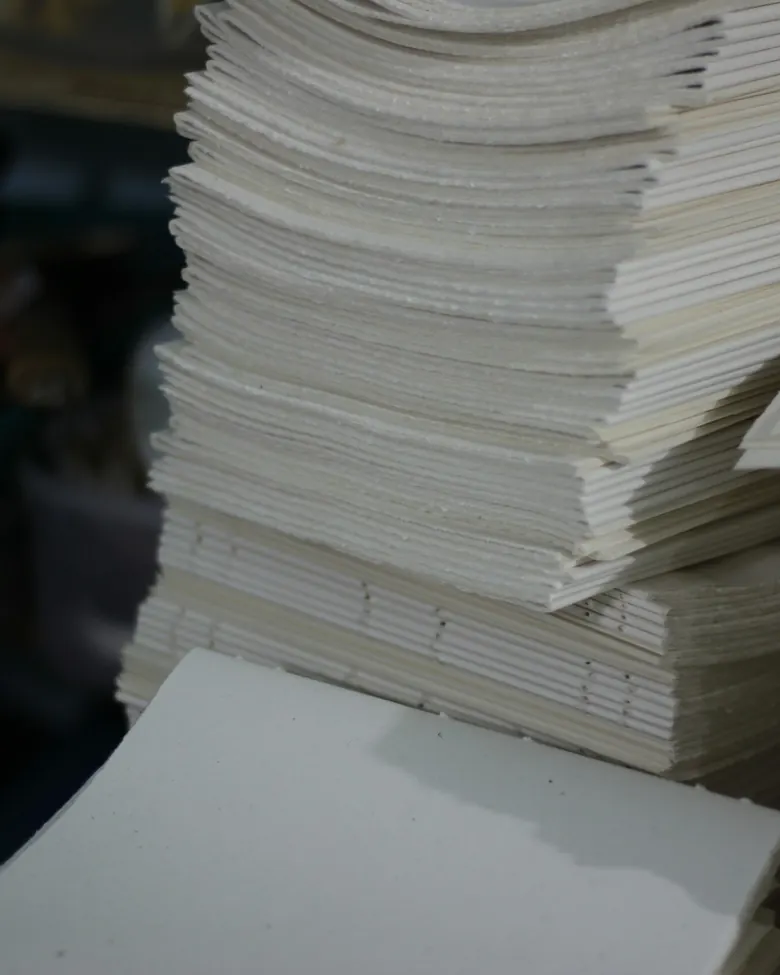
Cutting
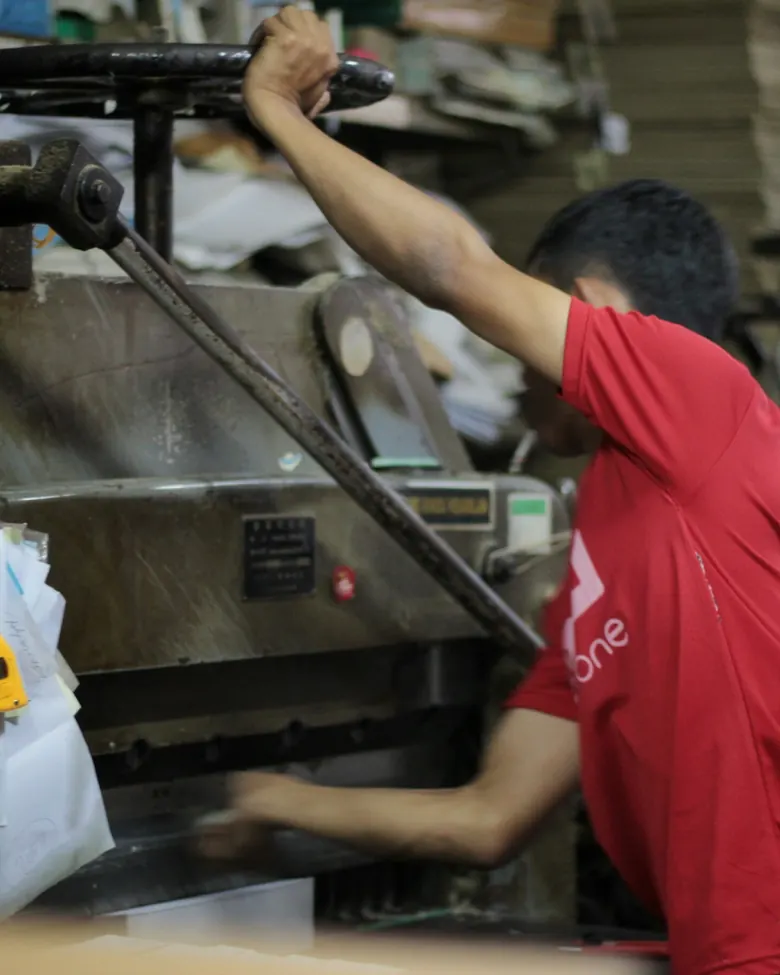
Manual cutting machine
The template settles the size before the first sheet is cut.
Collating
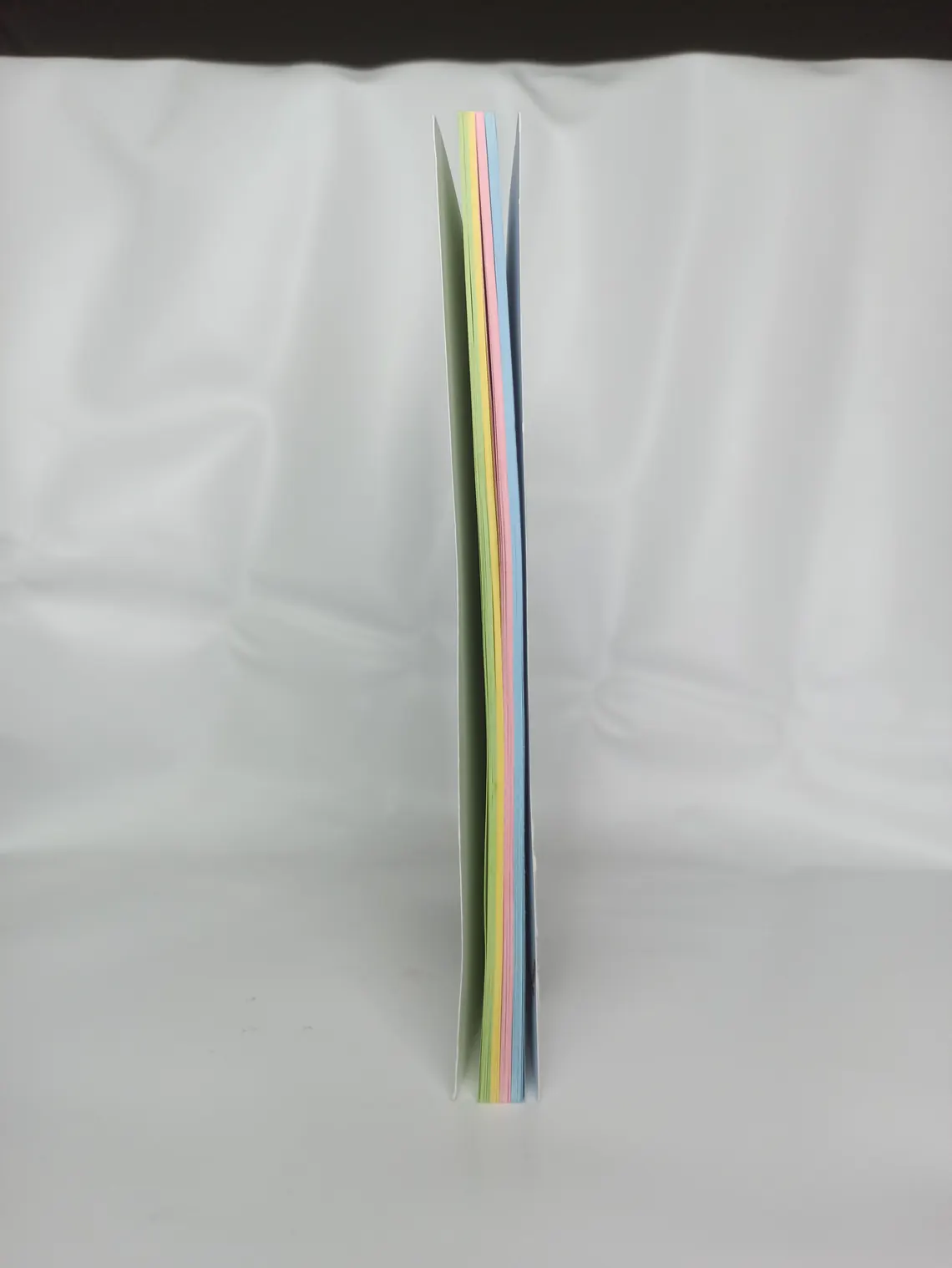
Signatures ready to sew
Every stack is collated in the same order across the whole batch.
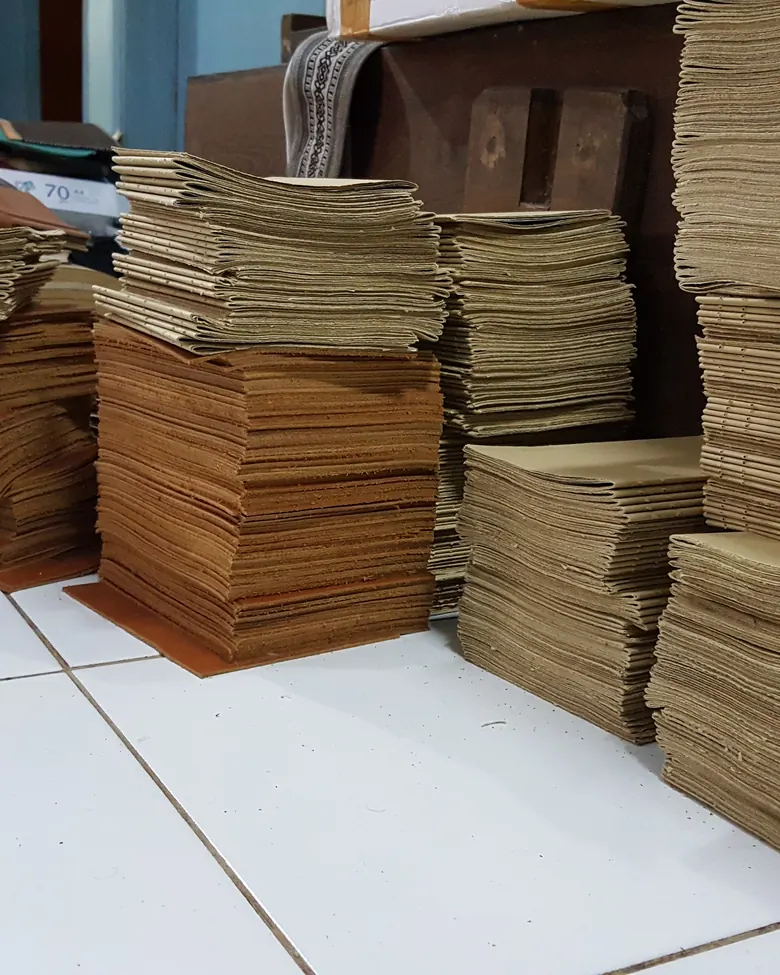
Stocking
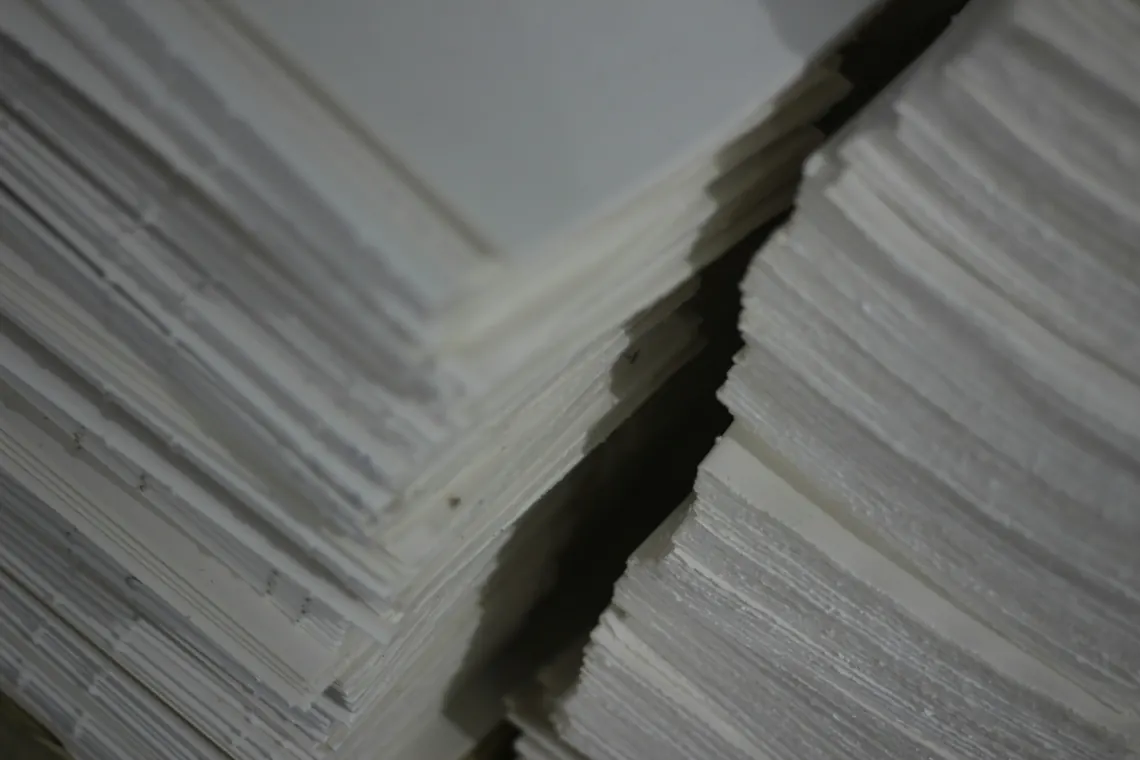
Stock waiting on the schedule
Material is prepared in advance so that production never waits on procurement.

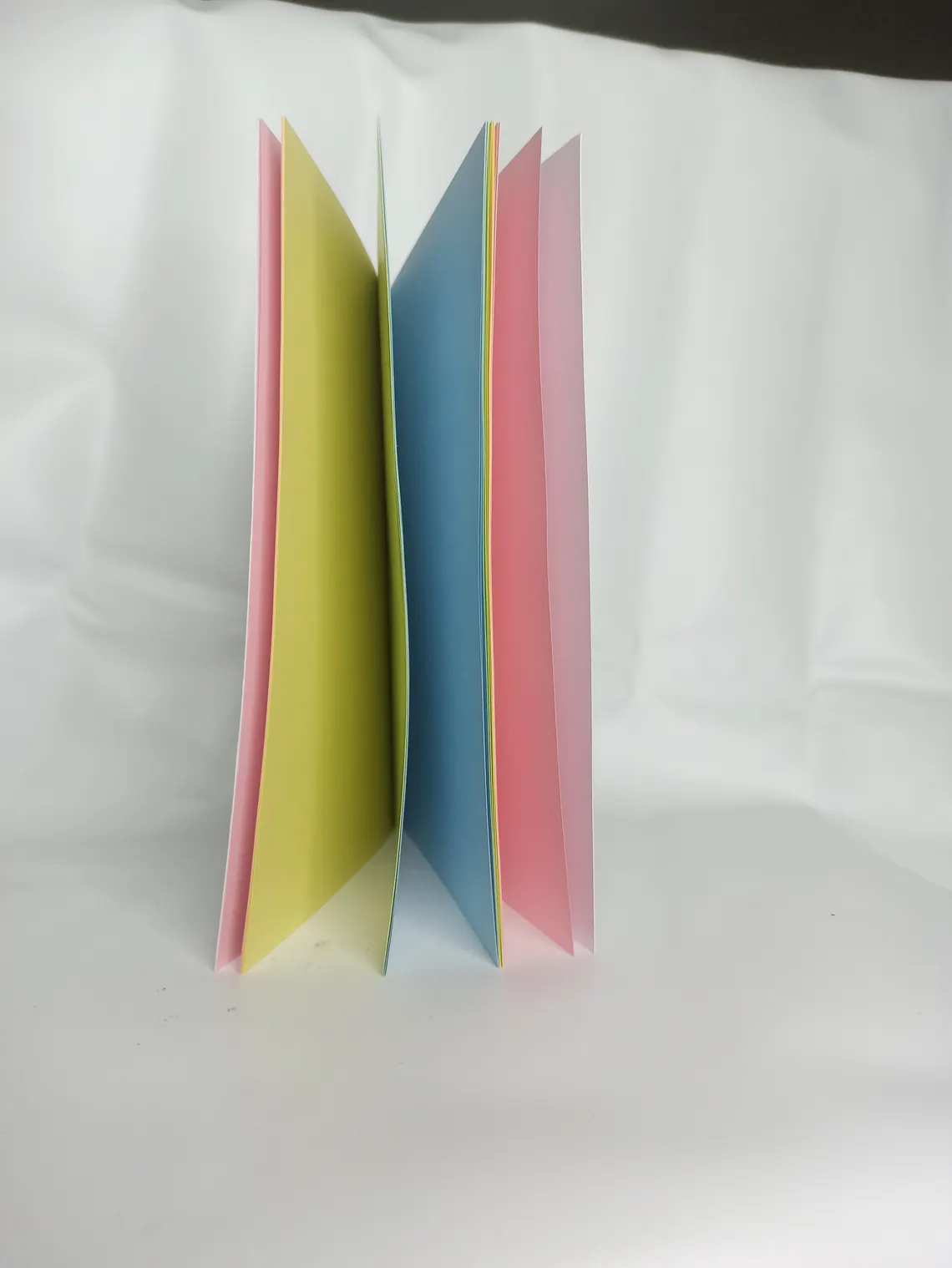
Inspection
A clean cut edge
The cut is checked for neatness before the sheets move on to binding.
Questions
The questions we are asked most
Can several models be ordered together?
Yes. The combinations, and how the quantity is counted across models, are set out on mixed bundles.
Can the goods ship without the Hibrkraft brand on them?
Yes. That is the white label route, and the terms to be agreed before the first unit is cut are on private label requirements.
What happens if a unit is faulty?
Units are inspected before dispatch, and one that gets past the inspection with a fault is replaced. A sewn book can also be taken apart and resewn — that is what its structure allows, set out in the bookbinding category.
Is there any example of previous work?
Yes, with the institutions named by permission, in the case studies.
In summary
Send the requirement and the deadline
Tell us the quantity and when it has to be finished. We reply with an estimated price and a schedule.
A large order does not fail on production. It fails on one decision that arrives late — and it is almost always the same decision: the logo die, or the list of names.
In 60 words: production is the most predictable part of a large order. What cannot be predicted is the waiting on decisions — a sample not yet approved, a list of names not yet final, a logo still under discussion. Counting backwards from the handover date, rather than forwards from the order date, is the only way this schedule holds.