Specifying Archival Resilience for Custom Leather Journals: The Technical Case for Professional Conservation and Treatment
The technical case for professional conservation of white label journals.
by Aika Mentari · February 9, 2026
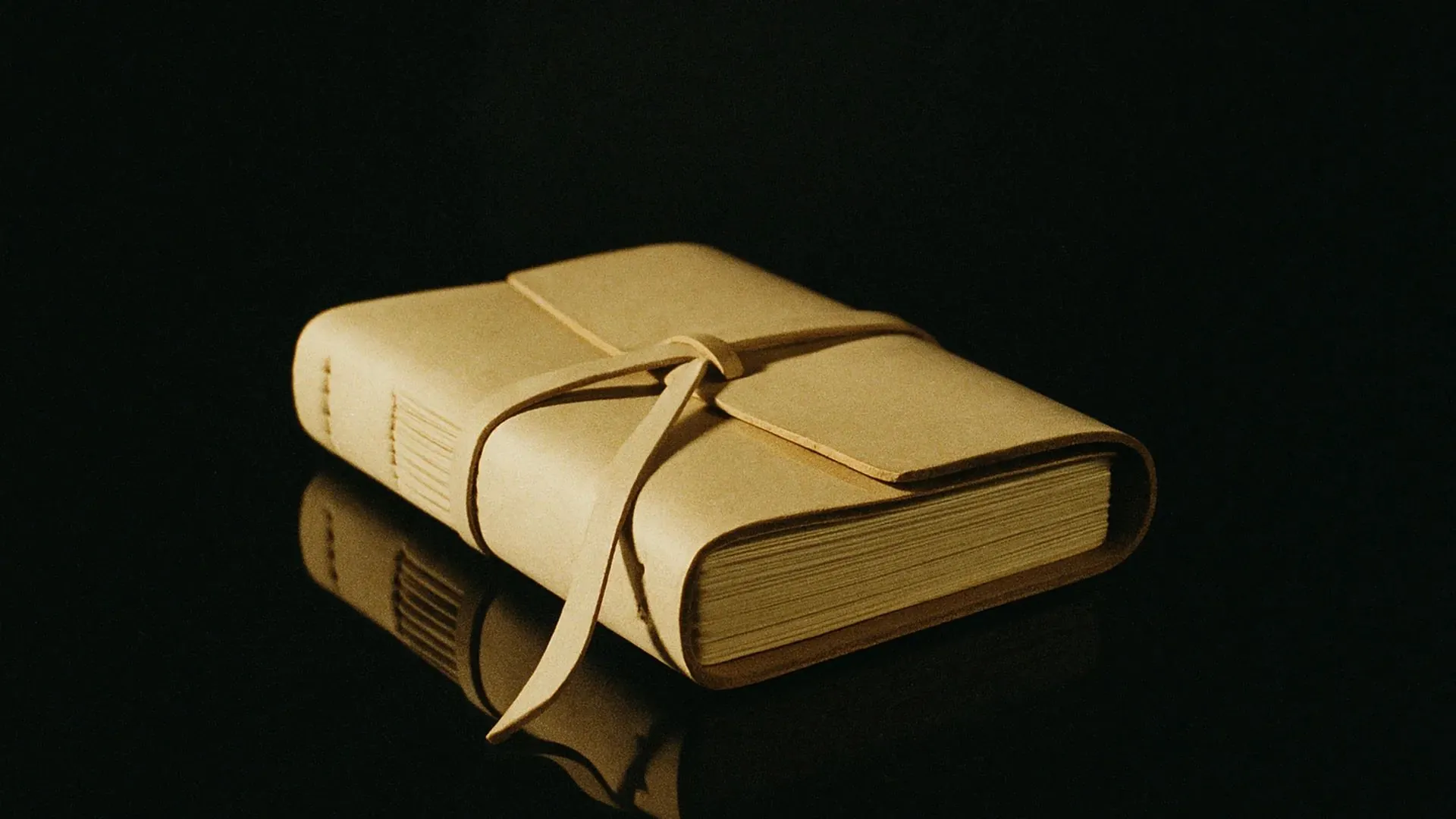
The image above presents a journal not merely as a notebook, but as an artifact. Bathed in warm, dramatic light against a stark, reflective void, it evokes a sense of permanence and value. The exposed Coptic stitching on the spine speaks of ancient techniques, while the simple leather wrap tie suggests a personal, treasured object. This is the ideal state of a Hibrkraft journal—a perfect, self-contained vessel for stories, resting in a stable environment, waiting for its purpose. In our Cileungsi workshop, this is the final vision we hold in our minds as our craftsmen set the last stitch and trim the last thread. It is a moment of pure potential.
But what happens when this ideal is compromised? Imagine discovering this very journal, not pristine, but with the faint, musty odor of mildew, or with pages that feel unnervingly stiff and brittle to the touch. The temptation for a warehouse manager or a business owner is to “fix it”—to wipe it with a cloth, to air it out, to try and press the pages flat. This is where the line is crossed between simple maintenance and complex conservation. The elegant object in the photograph is a complex matrix of organic materials—cellulose, collagen, natural oils, and dyes. When it begins to fail, it is not like a machine with a broken part; it is like a living system with an illness. You would not perform surgery on a family member; you call a doctor. Similarly, for a high-value archival asset, you call a conservator.
Hibrkraft builds resilience and longevity into every fiber of our products, but true archival management requires knowing the limits of your own expertise and when to call in a specialist to protect your investment.
In the field of archival strategy, procurement managers for B2B and white label programs must adopt a “monitor and mitigate” protocol to safeguard the long-term Return on Investment (ROI) of their premium assets. Engineering standards for high-performance paper and leather care dictate that material health must be assessed periodically for signs of structural or chemical failure. At Hibrkraft, we perform a 100% inspection on every unit before it leaves our workshop. However, deterioration caused by subsequent environmental exposure is a different challenge, one that requires vigilance and, in advanced cases, specialized intervention.
The monitoring process is a sensory audit. The key indicators of advanced deterioration are often subtle at first:
- Discoloration
- Yellowing or browning, particularly at the edges of the text block, is a primary marker that the paper’s pH-neutral state has been compromised. This suggests that environmental acids have overwhelmed the paper’s internal chemical buffering capacity.
- Stains
- Localized stains or “shadows” often point to “acid migration” from improper storage materials (like a cheap cardboard box or an acidic bookmark left inside).
- Odors
- A distinct musty, ammoniacal, or pungent smell is a critical sensory benchmark. It often indicates the off-gassing from the decomposition of organic matter, such as mold growth or bacteria degrading the sizing or adhesives within the material assembly.
- Brittleness
- If the paper feels stiff and cracks or snaps when a corner is gently flexed, the cellulose matrix has lost its essential moisture and polymer chain length. This is a state of extreme fragility.
- Physical Tears or “Crushing”
- This indicates that the fibers have lost all tensile strength and are failing under their own weight or minor manipulation.
Source: the five signs and their descriptions above are restated from this article’s own diagnostic list — an ordering of symptoms, not an independent measurement.
When these indicators are detected, the asset has moved beyond the need for simple preventative storage and into the realm of active conservation.
| Deterioration Symptom | Typical In-House “Fix” (Incorrect) | Professional Conservator’s Intervention (Correct) | Outcome |
|---|---|---|---|
| Visible Mould/Mildew | Wiping with bleach or alcohol. | Mechanical surface cleaning with HEPA vacuum, controlled desiccation. | In-house fix destroys paper fibers. Professional method removes spores and stabilizes the material. |
| Brittle Paper | Applying lotion or oil; spraying with water. | Slow, controlled re-humidification in a specialized chamber. | In-house fix causes staining and warping. Professional method restores flexibility without damage. |
| Deep Stain on Leather | Scrubbing with soap and water. | Using pH-neutral solvents and poultices to draw the stain out. | In-house fix often spreads the stain and strips leather’s finish. Professional method targets the stain at a molecular level. |
Source: all three rows above are restated from this article’s own comparison table — not independent findings, and every professional intervention listed here is reversible or non-destructive; none involves adhesive, tape or lamination.
As the table demonstrates, good intentions can be destructive. The chemistry of conservation is precise and unforgiving.
Before You Call a Conservator
Three free guides on recognizing and handling damage
The signs above tell you when to call a professional — these three guides, the same ones our own workshop uses, cover recognizing early damage before you touch it, safe handling while you wait for an assessment, and how the four levels of book repair differ, so a conservator’s time goes only to what genuinely needs it. All three open directly in your browser, free.

Atlas visual
Atlas Kerusakan Buku
Mengenali kerusakan dari wujudnya, sebelum menyentuh apa pun. Foxing, jamur, kertas rapuh, halaman lepas — apa namanya, apa penyebabnya, dan apa yang memperburuknya.
Baca PDF
Sebelum dikirim
Merawat, Mengemas, Mengirim
Merawat seadanya, memotret, mengemas, dan tahu kapan berhenti menyentuh. Yang paling sering merusak buku adalah pertolongan pertama yang keliru.
Baca PDF
Beda tingkat
Empat Tingkat Perbaikan Buku
Reparasi, rekondisi, restorasi, konservasi — dan apa yang hilang di tiap tingkat. Menentukan tingkat lebih dulu membuat harga dan hasilnya bisa diperkirakan.
Baca PDFBerkas terbuka di peramban Anda, tidak langsung terunduh ke penyimpanan. Semuanya berbahasa Indonesia, ukuran A5, dan boleh dicetak untuk keperluan sendiri.

The Role of the Qualified Conservator
When deterioration is identified, the standard operating procedure is to seek professional advice from a “qualified conservator.” This is a professional with a deep background in material science, chemistry, and the specific craft history of the object. They understand that standard office-level cleaning can catalyze further fiber degradation. For example, if you try to clean a mouldy page with an alcohol wipe, the alcohol can act as a solvent for the paper’s sizing and ink, causing it to feather and bleed. A conservator, by contrast, might use a specialized micro-spatula and a variable-suction HEPA-filtered vacuum to physically lift dormant mould spores from the paper’s surface without abrading it.
The process is diagnostic. A conservator will assess the full scope of the damage. Is the brittleness confined to the edges, or does it affect the entire text block? Is the odor chemical or biological? This analysis informs a treatment proposal that balances restoration with preservation. Sometimes, the goal is not to make the object look “new” again, but to stabilize it and halt all further degradation.
This is especially critical if the paper has reached a state of extreme brittleness or has begun to rot due to improper environmental exposure. In such cases, only professional conservation can stabilize the cellulose matrix. This might involve a process of “leaf-casting,” where a pulp of new, archival fibers is used to fill in losses and tears, or a non-aqueous “de-acidification” spray that introduces an alkaline buffer to neutralize acids within the paper itself. These are laboratory-grade procedures that are far beyond the scope of a warehouse or office.
The Core: Leather Restoration and Biological Threats
For the leather components of a white label journal, the calculus is similar. At Hibrkraft, we use high-quality Full Grain and Top Grain leathers from Indonesian tanneries, which are tanned to be resilient. Our pull-up leathers, for instance, are imbued with a high density of oils and waxes that provide a natural barrier to moisture and stains. However, severe neglect can overwhelm these defenses.
If initial, gentle cleaning with a pH-neutral leather cleaner fails to remove deep-seated stains (like an ink spill or a water ring), professional help is required. A professional leather restorer has access to a range of specialized solvents and poultices that can draw contaminants out of the leather’s pore structure without stripping the original dyes or fatliquors. They can also perform “color matching” to restore areas where the finish has been abraded or faded, ensuring the aesthetic integrity of the journal matches the archival longevity of the internal paper block.
Technical monitoring must also be vigilant for biological threats. The pungent ammoniacal odors mentioned in archival literature are a key sensory benchmark. This smell is often the result of bacteria degrading organic matter—specifically, the proteins in traditional hide glues or even the collagen fibers of the leather itself if it has remained wet for a prolonged period. This is a sign of active rot, and it requires immediate professional intervention to sterilize and stabilize the material.

“A craftsman’s job is to build a strong ship. A conservator’s job is to rescue it from the storm. A wise captain knows when to call for a pilot to navigate the dangerous waters of repair.” – Head Craftsman, Hibrkraft
This quote encapsulates our philosophy. We build the strongest ship we can, using robust materials and time-tested binding techniques like the Coptic stitch seen in the photo. But when faced with the “storm” of a catastrophic environmental failure—a flood, a fire, a prolonged period of neglect—it is the conservator who has the specialized skills to salvage the vessel.
Imagine you have a limited-edition run of 200 white label journals, hand-numbered and signed by your company’s CEO, intended for your most valuable clients. A small leak in your storage facility damages a case of 25 of them. The potential loss in value and goodwill is immense. Trying to “fix” them in-house risks making them unusable. Spending a fraction of their value on a professional conservator could potentially recover most of the units to a presentable, stable condition, saving the project and protecting a significant financial and reputational investment.
The Solution: ROI and the Logic of Intervention
By mandating professional intervention for advanced damage, corporate stationers ensure that their custom products function as permanent documentation vessels rather than disposable commodities. The decision to call a conservator is an ROI calculation. If the cost of conservation is less than the value of the asset being saved, it is the logical choice. For a single journal, it may not be economical. For a case, a pallet, or a critically important limited edition, it is essential.
This strategy protects your brand in two ways. First, it prevents you from sending out a compromised product. Second, it reinforces the message that these are not disposable items but valuable objects worthy of care. It elevates the entire product category.
Our Hibrkraft defect replacement policy is your assurance against flaws in our craftsmanship. If a stitch is loose or a cover is scarred upon arrival, we make it right. But the journey of preservation that follows is a shared one. We provide the archival-quality foundation, and by understanding when professional help is needed, you ensure that foundation can withstand the test of time, no matter what challenges it faces.

Why Partner with Hibrkraft?
Choosing Hibrkraft is choosing a partner who understands the deep science of the materials we use. Our workshop in Cileungsi, Bogor, is a place of hands-on expertise, where our team of ~9 craftsmen produces up to 2,000 units per month. We are intimately familiar with the properties of the Indonesian leathers we source from Garut, Magelang, and Malang, and the archival-grade papers we bind into them.
Our White Label service is built on a foundation of quality that minimizes the need for future conservation. We use inert, stable materials and robust mechanical bindings that are inherently resilient. We build for the long haul. And because we are craftsmen, not just factory workers, we have a profound respect for the materials and their longevity.
We have the logistical experience to ship these carefully crafted items globally via DHL Express to our partners in Malaysia, the Netherlands, the UAE, Germany, and beyond. We are more than a manufacturer; we are your first line of defense in the project of preservation. We provide the knowledge and the quality foundation so that your investment remains secure, beautiful, and valuable for decades.
Ready to start? Message us on WhatsApp at +62 815 1119 0336 to discuss building a resilient, archival-quality product line for your brand. Click here to chat.
Sources & References
Checked 26 August 2026 — Berisford is a real, live author on stepbystepart.co.uk, an art-tutorial hobby site, not a paper-conservation authority, so it does not carry this article’s treatment claims. The Chiles and SWITCH-Asia entries below could not be independently re-verified tonight — search tooling was unavailable in this session — so neither is confirmed nor found broken. The Library of Congress and AIC entries added below are live, on-topic authorities for the conservation-treatment claims made in this article.
- Berisford, K. M. (2024). Acid-Free vs Archival: What You Need to Know About Paper Quality for Your Art. STEP BY STEP ART, an art-tutorial site.
- Chiles, J. (2024). What Is Pull Up Leather? – An In-Depth Look.
- SWITCH-Asia (2021). Best Practice Guide for Sustainable Vegetable-Tanned Yak Leather Manufacturing.
- Library of Congress, Preservation Directorate. Preserving Your Books — Storing: a cool (70°F or below), 30–55% relative-humidity environment is safe for most books.
- American Institute for Conservation. Code of Ethics and Guidelines for Practice — the reversibility standard a qualified conservator works to.
Disclaimer: this post is written in English to reach a wider, international audience.