

Plain Lab · notebook
Two-Column Insert 6 mm
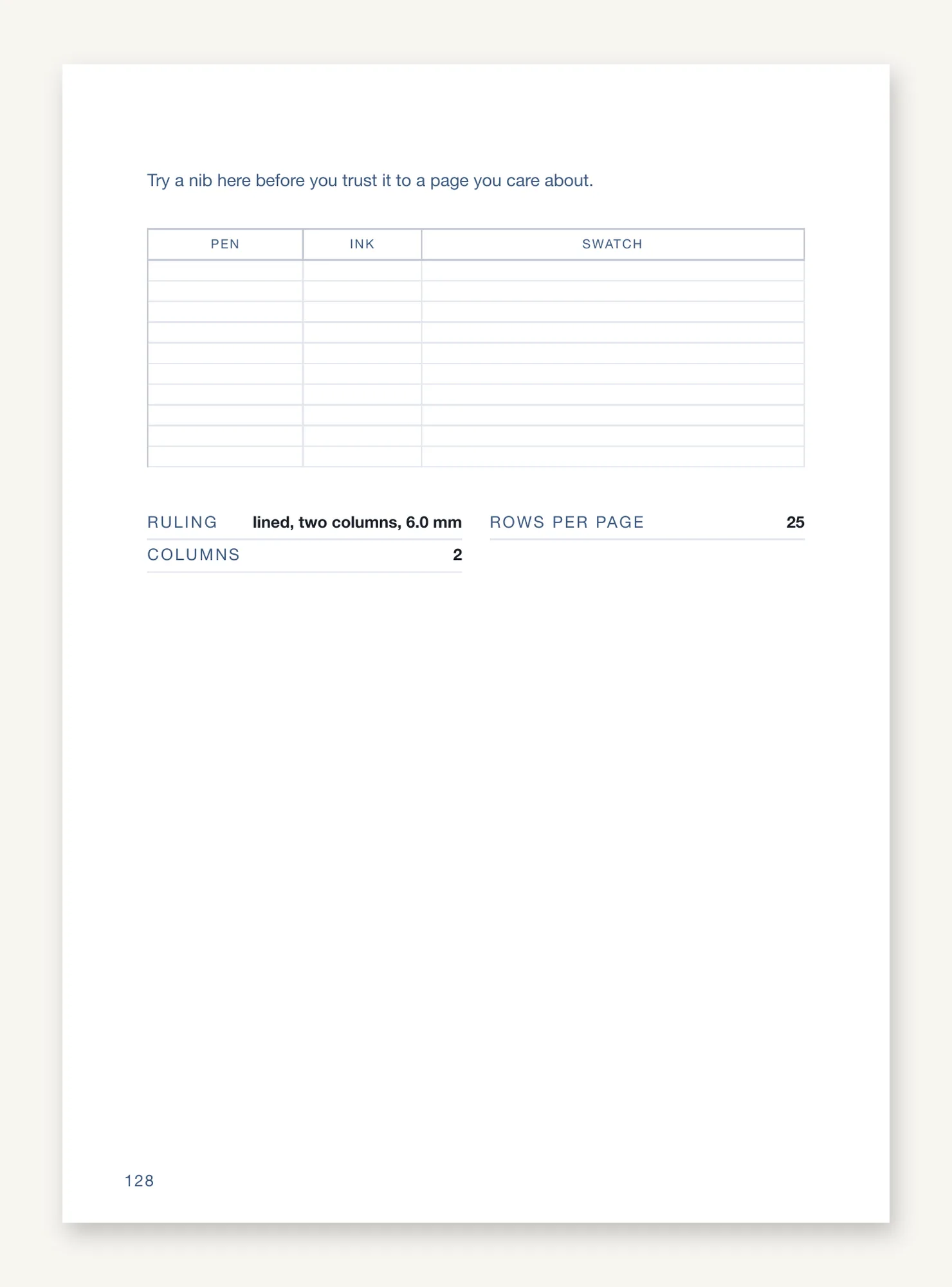
Two ruled columns per page at six millimetre pitch, and the rule stops at the gutter instead of running across it.
Specification
- Trim
- 127 × 177.8 mm · 5 × 7 in
- Pages
- 128
- Leaves
- 64
- Sheets
- 32
- Signatures
- 4 × 32pp
- Spine
- 7.32 mm
- Paper
- white
- Ruling
- twocolumn
- Ruling pitch
- 6.00 mm · 17.01 pt
- Rows per page
- 25
A rule that crosses the gutter turns two columns into one wide column with a stripe running down the middle of it, which defeats the point of ruling a page in two. Every line on this page stops short of the centre and starts again on the other side, so the two columns stay cleanly separate rather than merely marked.
Twenty-five rows fit the page at 6.0 mm pitch, the same rule used on the single-column lined insert at this pitch elsewhere on this shelf. Two columns side by side suit a vocabulary pair, a question and an answer, or any note that wants to sit next to its counterpart rather than under it.
Nothing about the ruling tells you which column comes first. That is still your decision, made new on every page.
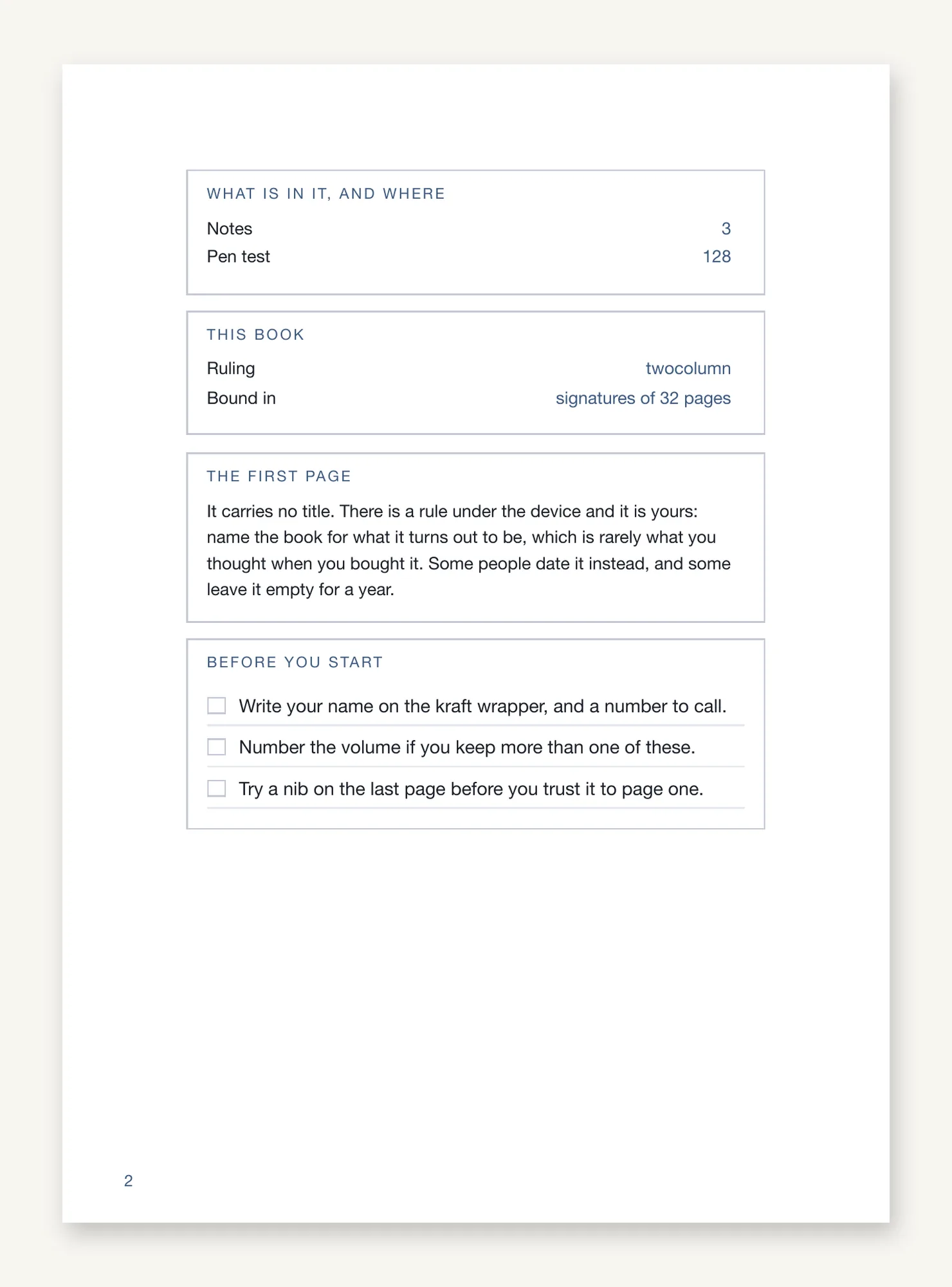
What is inside
- Notes
- 125pp
- Two ruled columns per page at 6.0 mm pitch, the rule stopping at the gutter rather than crossing it.
The film
Page by page
A vertical film from our own bench — this page contacts nobody's server to play it, and downloads nothing until you press play.
Real pages

Made at the Hibrkraft bindery, Bogor · about the maker
Books that sit alongside it
- Illuminated InsertAlso in Plain Lab
- Day Book InsertAlso in Plain Lab
- Language InsertAlso in Plain Lab
- Expense InsertAlso in Plain Lab
Questions
Does the ruling cross the gutter?
No. Every line stops short of the centre and starts again on the other side.
What is the pitch?
6.0 mm, twenty-five rows to the page.
What is a two-column page good for?
A vocabulary pair, a question and an answer, or any note meant to sit beside its counterpart.
Is it dated?
No.
Does it come with a cover?
No. It is the sewn block, sized for a leather cover made separately.
Have you never observed that any room without a fire-place is always close?