
Plain Lab · notebook
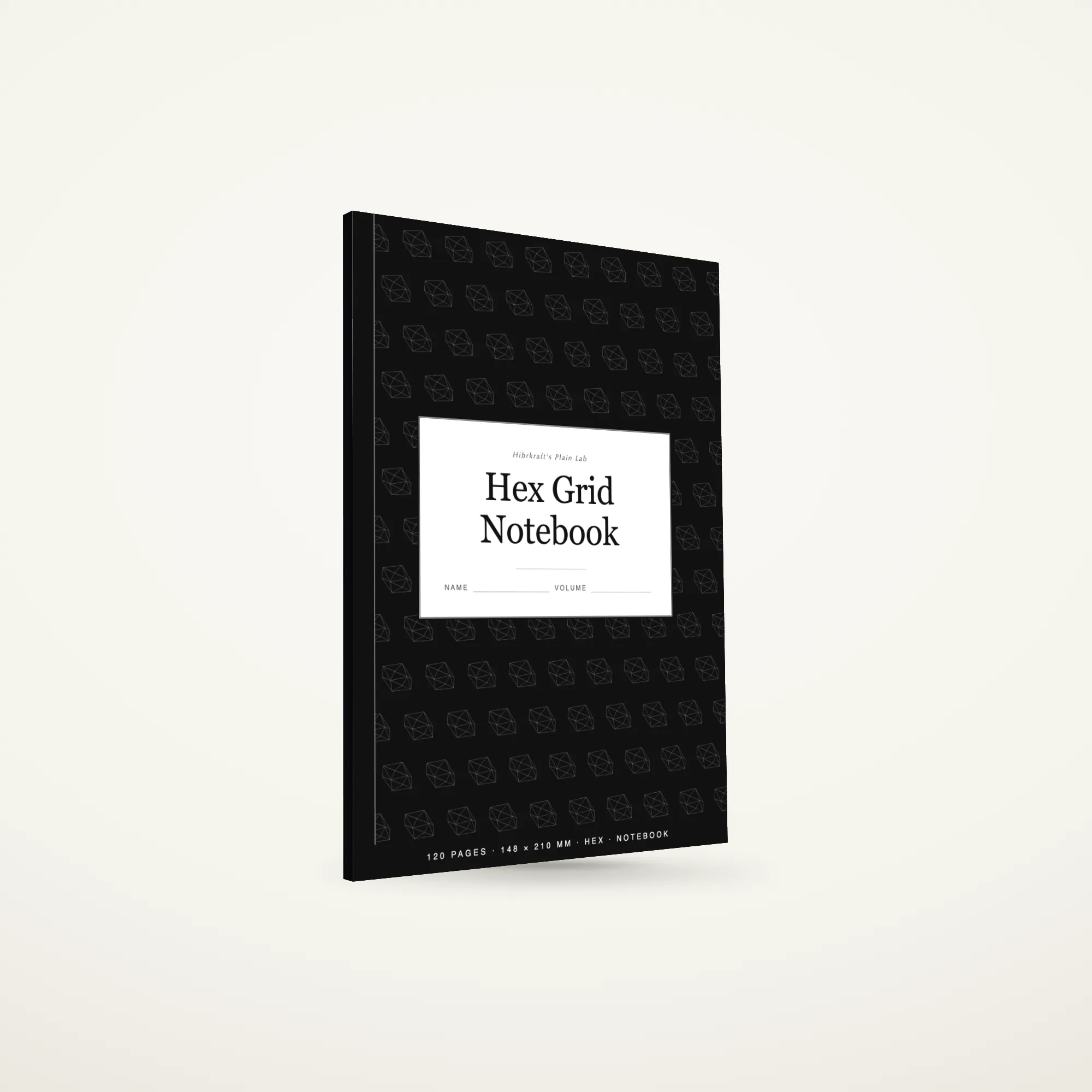
Hex Grid Notebook
A5 hexagon ruling at 4.94 millimetres, ninety-six pages, for pattern work a square grid cannot hold evenly.
Price
from Rp 59.000
Softcover, French link sewing. Printed and sewn to order.
Ships in 6–14 business days · 7-day returns
Order on WhatsAppTokopediaSoonShopeeSoon
Every cover and binding option is quoted when you order.
Specification
- Type
- Notebook
- Trim
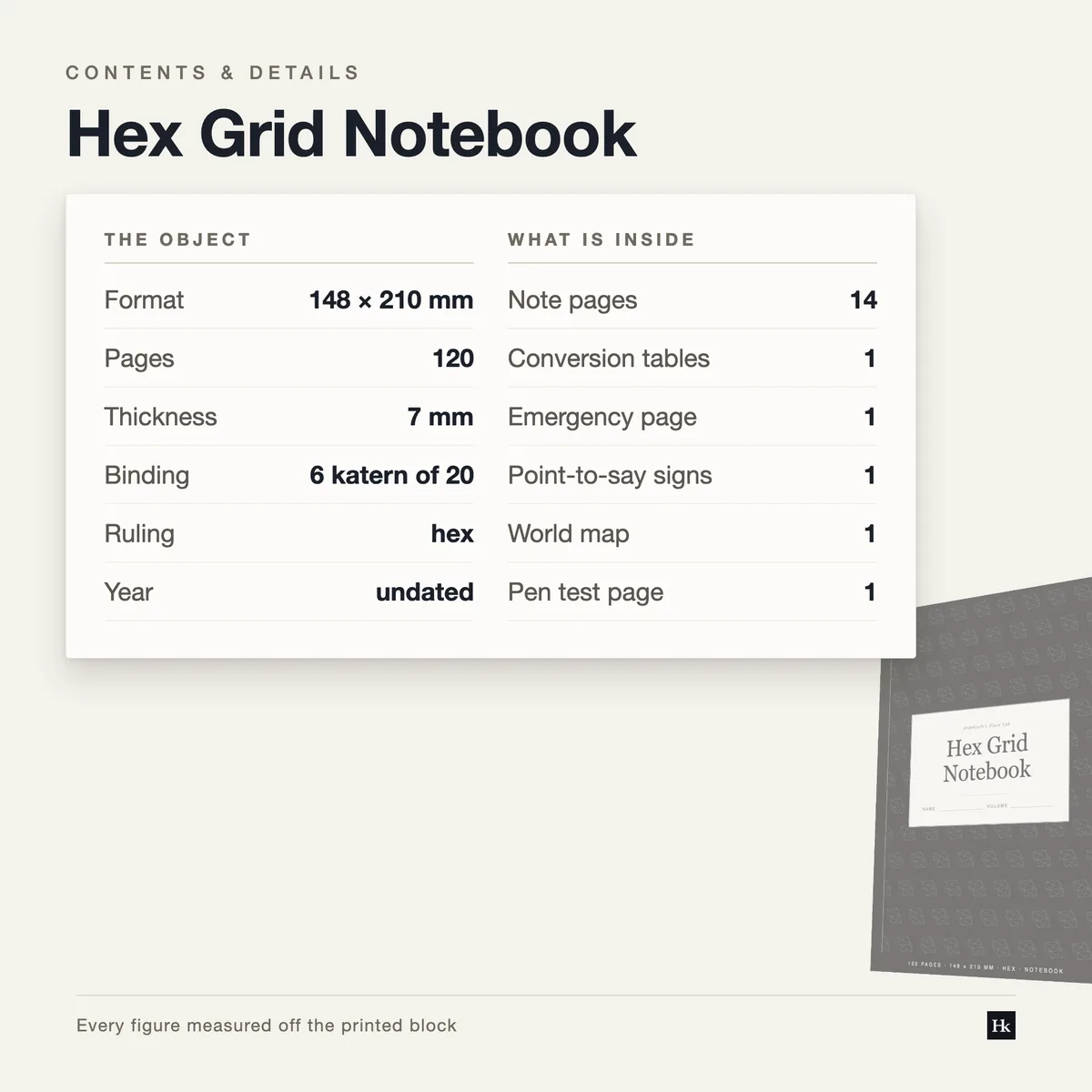
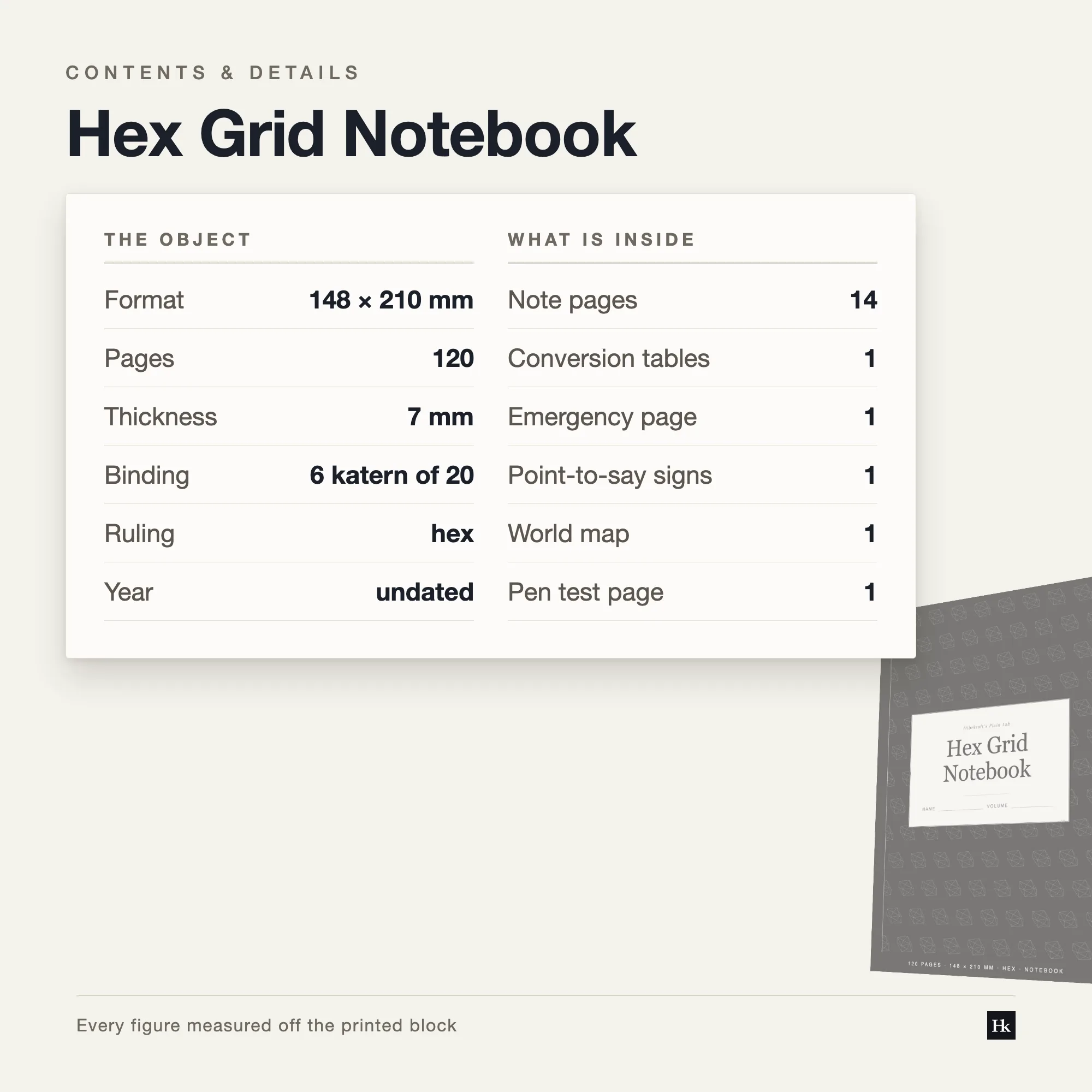
- 148 × 210 mm · 5.827 × 8.268 in
- Pages
- 120
- Leaves
- 60
- Sheets
- 30
- Signatures
- 6 × 20pp
- Spine
- 6.86 mm
- Paper
- white
- Ruling
- hex
- Ruling pitch
- 4.94 mm · 14.00 pt
- Rows per page
- 35
- Dating
- Undated
Build it
Rp 59,000
A square cell gives two directions to draw a straight line in, and two more at an angle that agrees with nothing else on the page. A hexagon gives six, all the same length, so a shape built from one side of a cell sits flush against a shape built from any other. That is the whole argument for ruling a page this way instead of the ordinary square.
Ninety-six pages carry the hexagon at 4.94 millimetres, thirty-five rows deep, behind one divider. A further fourteen lined pages sit at the back, because not every note belongs inside a cell.
The book does not know what gets drawn in the hexagons. A honeycomb of six-sided cells with nothing on it yet is as far as a printed page can go; what goes in the cells is the reader's.
What is inside
- Grid
- 96pp
- Pointy-top hexagons at 4.94 mm, every side the same length in six directions.
- Notes
- 14pp
- Plain lined pages for whatever does not belong inside a hexagon.
In every book
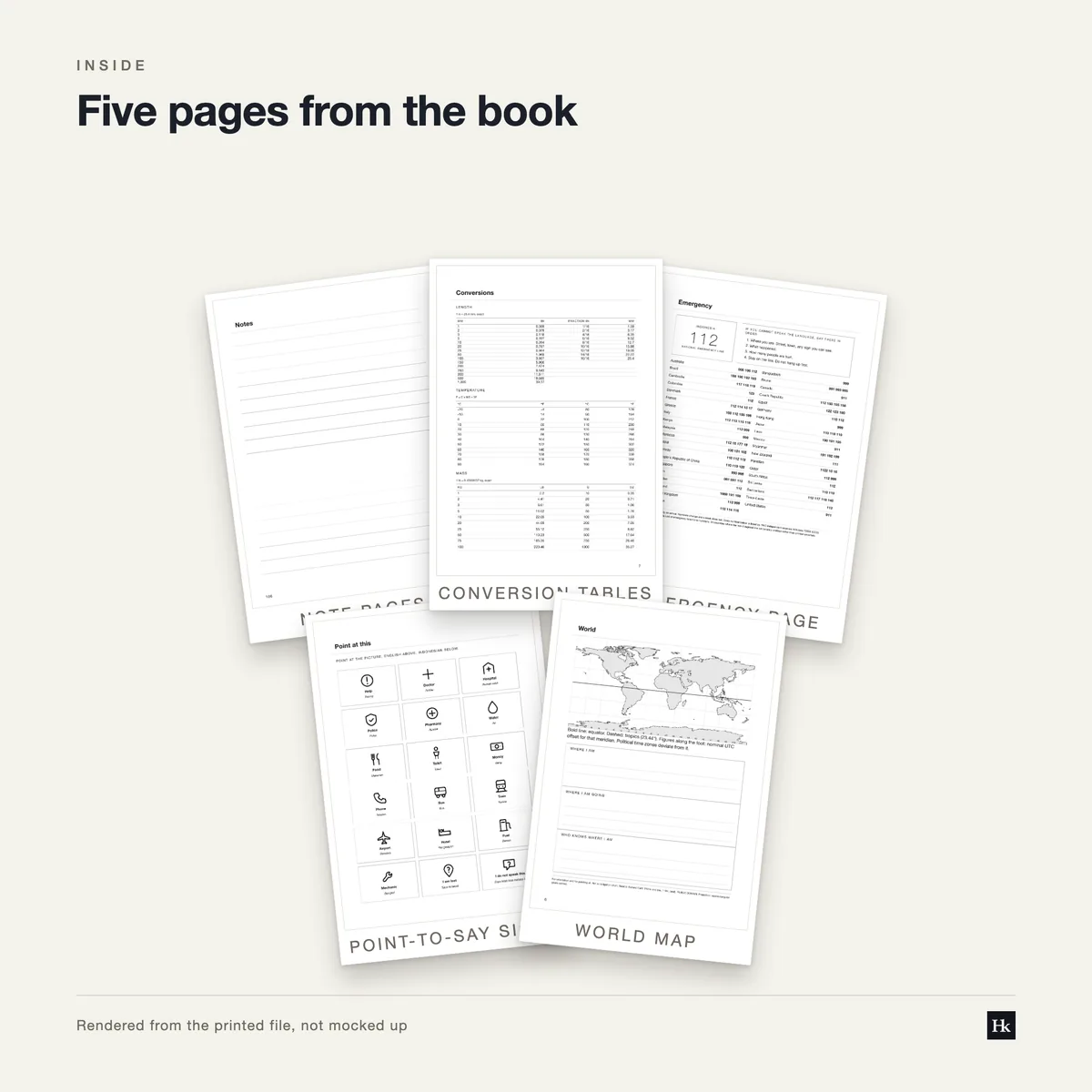
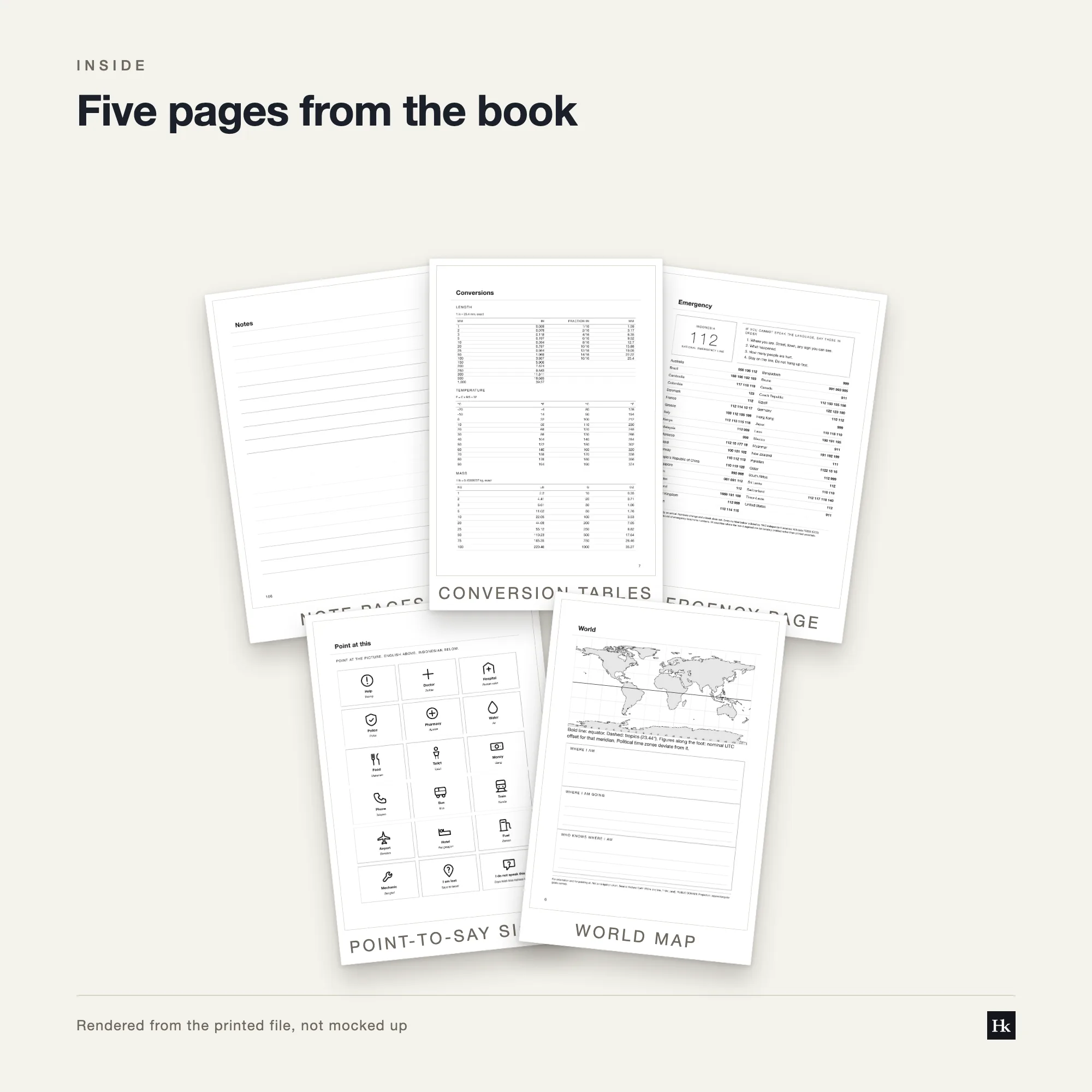
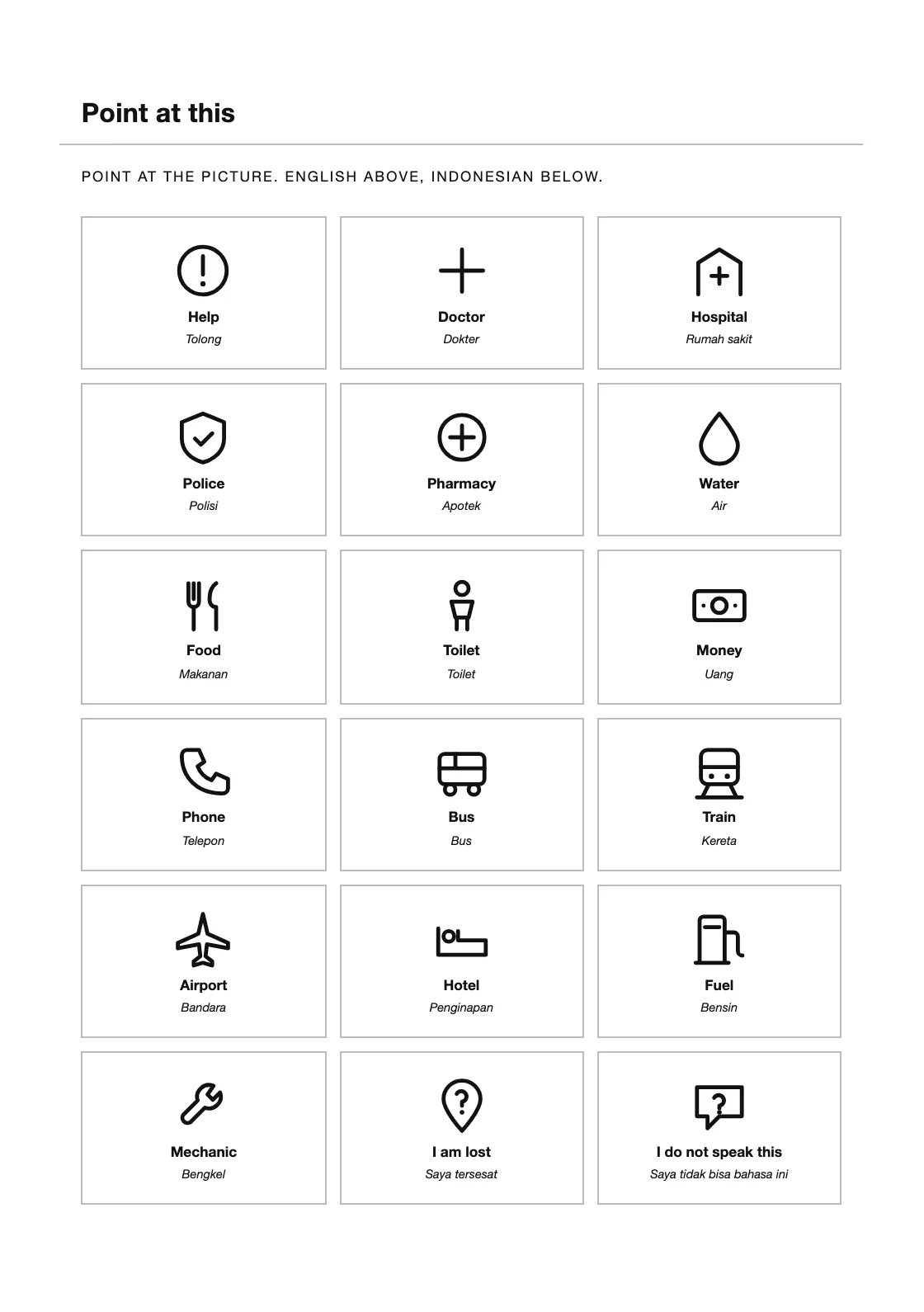
The same six pages open every book: your details, who to call, the signs to point at when you have no shared language, and the map. They sit at the front because the moment you need them is not the moment to be flicking through.
- This book belongs to
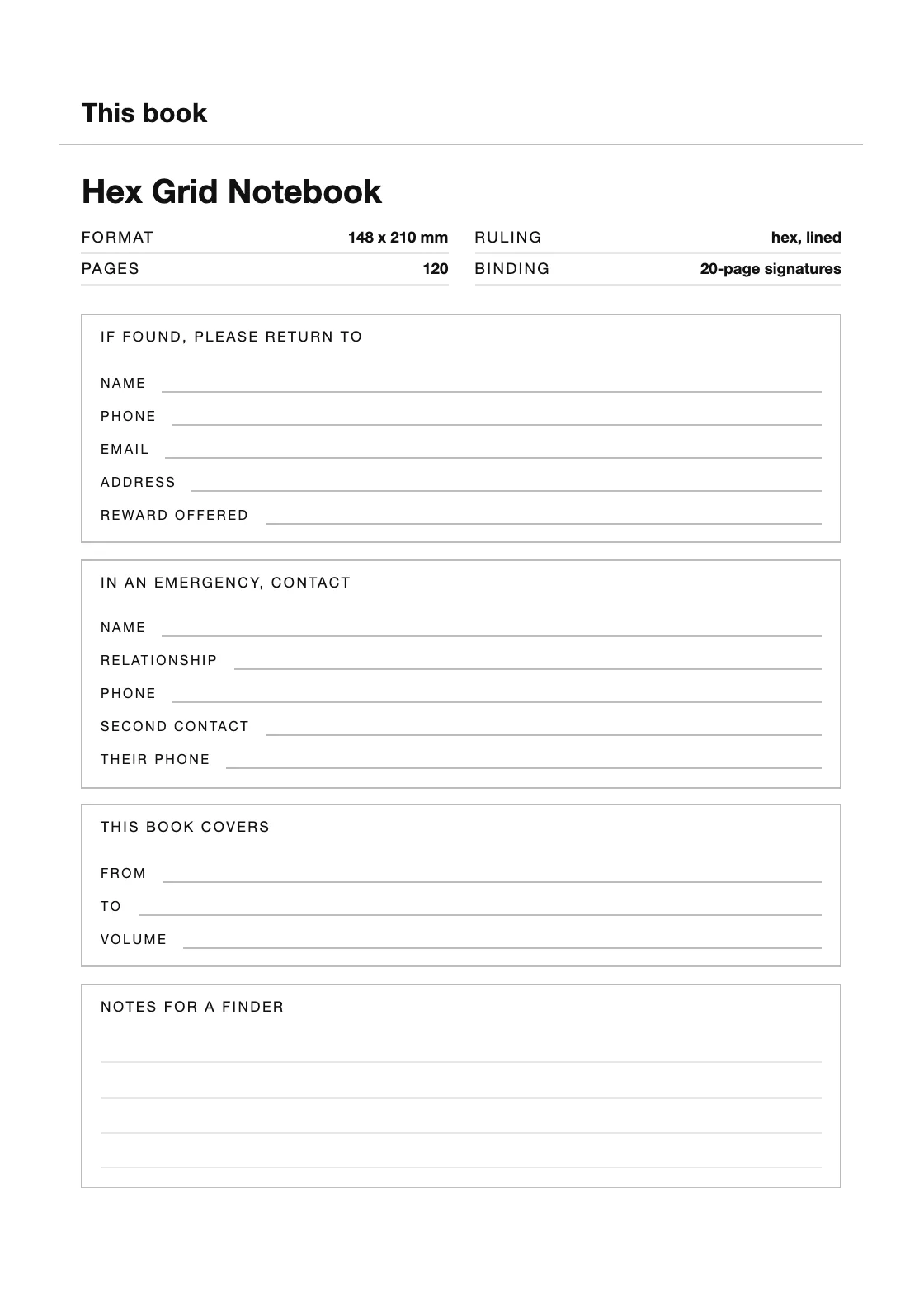
- One page for your name and number, so a book that goes missing can come back.
- My details
- Blood group, allergies, who to call. Written once, carried everywhere.
- Emergency numbers
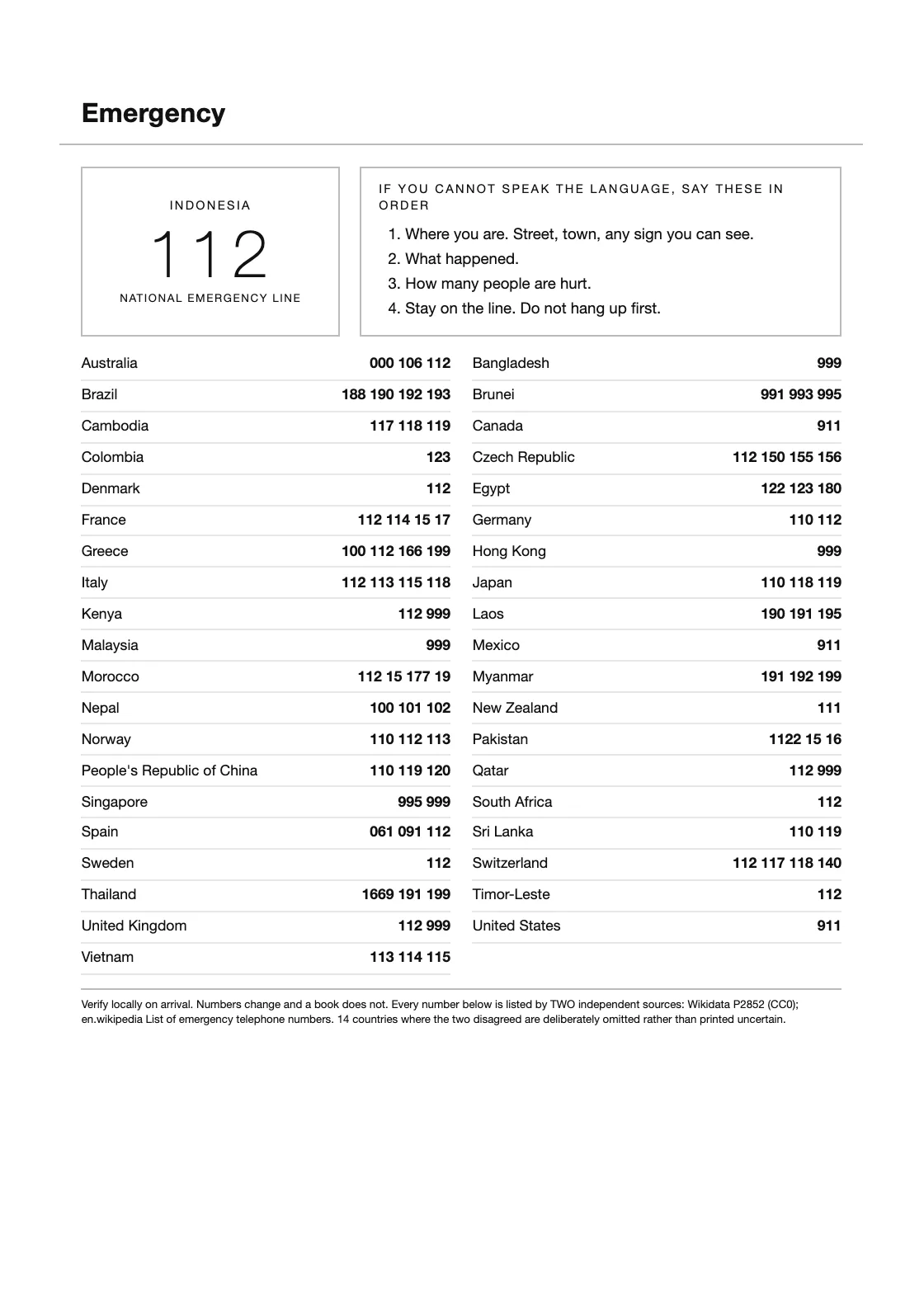
- Forty countries, taken from Wikidata property P2852 (CC0), agreed across two sources, every row carrying its QID. Numbers change and a book does not — verify locally on arrival.
- Point at this
- A pictogram grid captioned in English above and Indonesian below, for when there is no shared language.
- World map
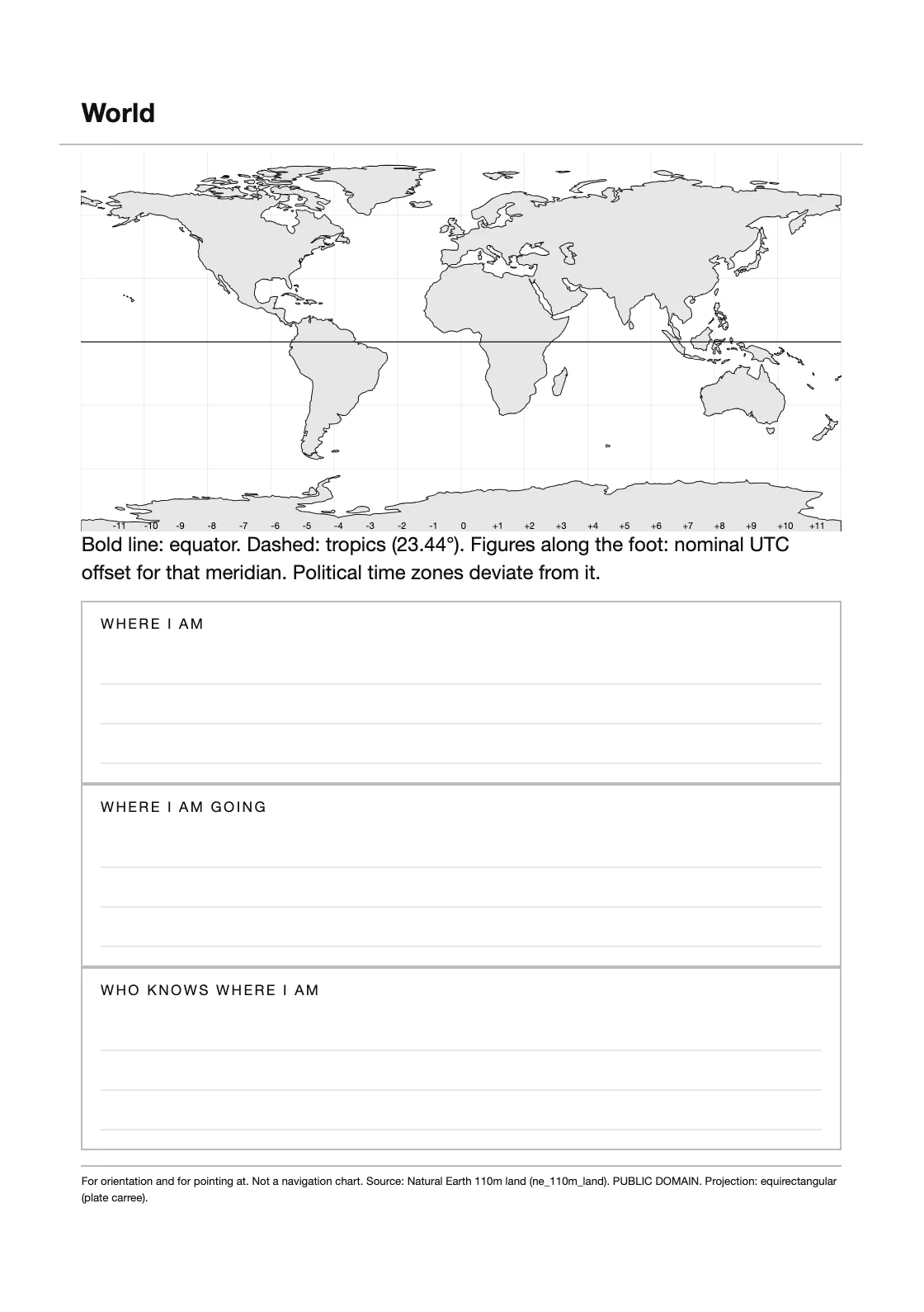
- Natural Earth 110m, public domain, equirectangular, with UTC hour meridians computed from the projection rather than from a timezone database. For orientation and for pointing at, not a navigation chart.
- Conversion tables
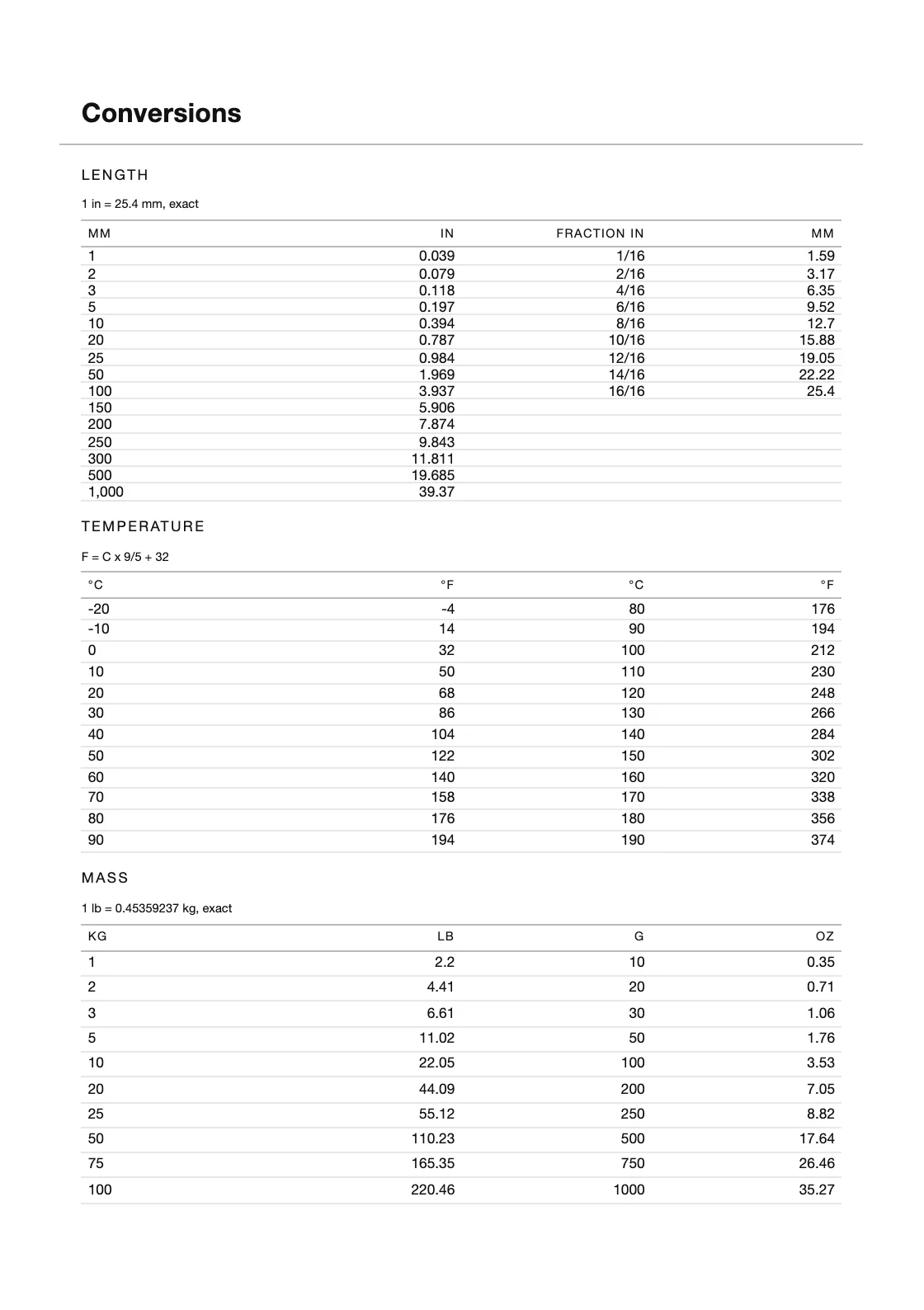
- Computed from definitions — 25.4 mm to the inch — and not copied from anywhere, so every row can be checked by anyone holding the book.
- Pen test leaf
- The last page, printed for it on purpose. Every notebook is used this way; printing it deliberately is cheaper than losing the last leaf to it by accident.
The film
Page by page
A vertical film from our own bench — this page contacts nobody's server to play it, and downloads nothing until you press play.
What is inside this book?
The PDF of this book.
We do not sell the design or the PDF. Download it free, with no conditions at all, not even tracking. What we sell is the book, a real object that is genuinely useful and can help your life.
Download PDF PDF · 120 pages · 1.1 MB
Made at the Hibrkraft bindery, Bogor · about the maker
Compared with
Books that sit alongside it
- Hex Grid InsertSame ruling, other trimhex at 4.94 mm: 35 lines at a5 against 30 at 5x7
Questions
What is the hexagon pitch?
4.94 millimetres, corner to corner across the cell.
How many rows to a page?
Thirty-five.
How big is it?
A5, 148 x 210 mm, 120 pages, 6.86 mm across the spine.
Why does the line between two hexagons not look doubled?
A shared edge is drawn once, in an opaque line, rather than twice by each neighbouring cell.
Is it dated?
No.
Has nature covenanted with me that I should never appear to disadvantage, never make a ridiculous figure?
Price
from Rp 59.000
Order on WhatsAppTokopediaSoonShopeeSoon