
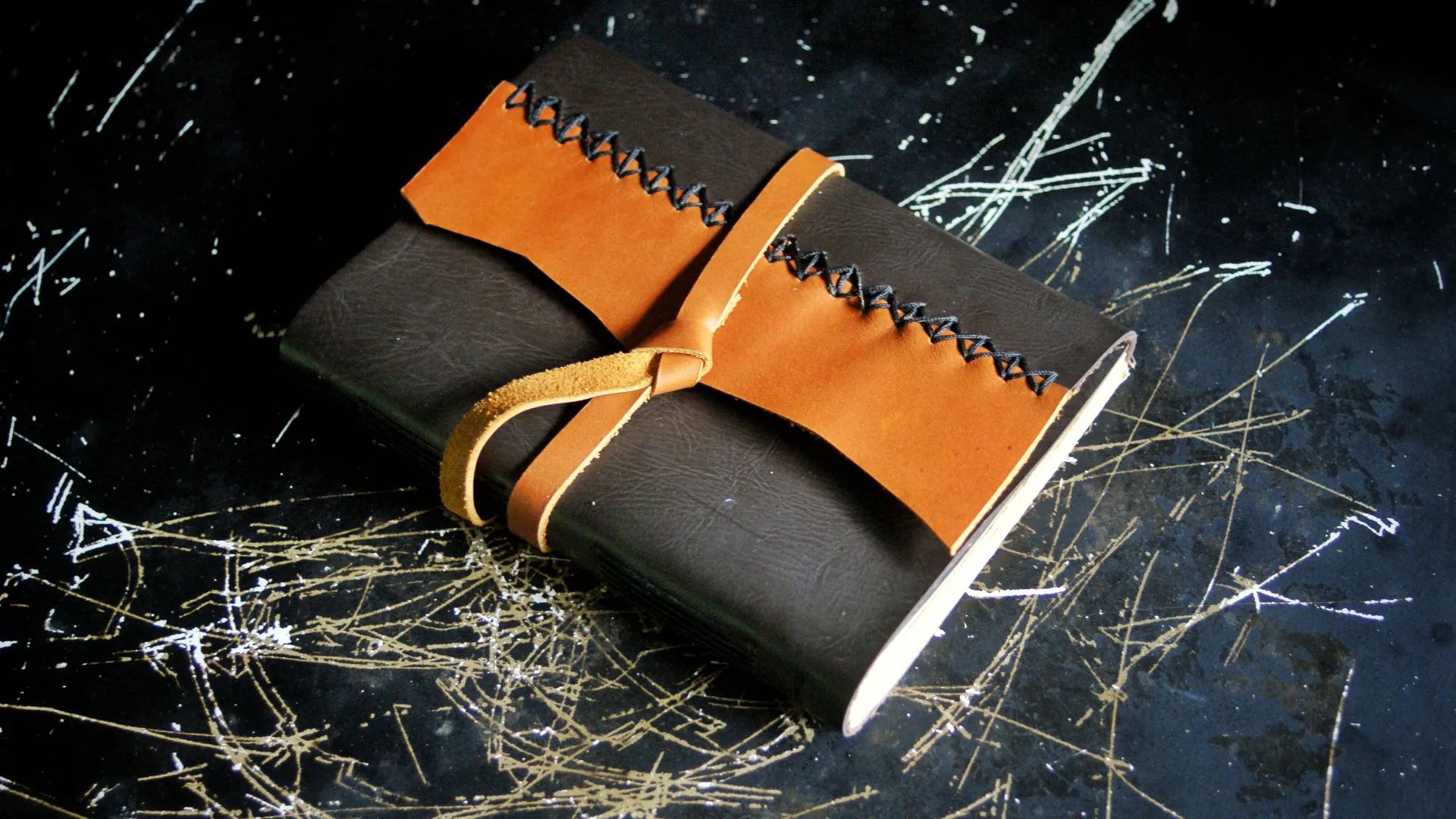

The image above captures the essence of the Hibrkraft promise. A journal, meticulously hand-stitched with contrasting thread, rests on a dark, scarred surface. The visual is a dialogue between elegance and resilience, between delicate craft and the harshness of the world. In our workshop in Cileungsi, Bogor, our small team of craftsmen imbues every piece with this spirit. We select Full Grain leather from Indonesian tanneries in Garut and Malang not just for its beauty, but for its strength. We use waxed thread not just for aesthetics, but because it locks each stitch with tension and durability. We build each journal to be a fortress for the thoughts and stories it will one day hold.
But a fortress is only as strong as its location and its upkeep. Once a bulk shipment of 1,000 or 2,000 of these vessels leaves our hands, they enter a new phase of their existence, one governed by the laws of chemistry and physics. The rich, earthy aroma of the leather, the crisp snap of the paper—these are sensory indicators of a healthy, stable organic object. Maintaining that state is not a matter of luck; it is a matter of rigorous science. This guide serves as a comprehensive technical protocol for our White Label and B2B partners, providing the engineering framework required to preserve the integrity of your investment and ensure that the hundredth journal unboxed is as perfect as the first.
Hibrkraft does not just sell products; we forge partnerships in preservation, ensuring the assets we create for your brand endure.
Archival Integrity and Substrate Preservation: A Technical Protocol for White Label Leather Journals
From a product engineering perspective, paper and leather care is a rigorous strategy designed to maintain the chemical and structural stability of high-performance organic substrates. The term “archival” is not a marketing adjective; it is a technical standard of permanence. For a B2B client, achieving this standard is the difference between offering a premium, lasting brand ambassador and a disposable commodity that degrades on the shelf. This protocol is a holistic system. Failure in one area will inevitably compromise the others.
The foundation of this system is environmental control. To ensure the longevity of custom leather journals, the storage environment must be strictly regulated. Deviations accelerate the catalytic degradation of cellulose fibers in the paper and the desiccation of collagen fibers in the leather, leading to brittleness, discoloration, and failure. Proper asset management requires housing journals in a cool, dry, clean, dark, and stable environment to mitigate the kinetics of chemical decay. The two most critical variables are temperature and humidity. A constant temperature of approximately 20°C slows molecular activity, effectively putting the materials in a state of suspended animation. For a deeper technical analysis of how thermal energy impacts paper and adhesives, it is essential to understand the principles of Optimizing Archival Longevity for Custom Leather Journals: The Technical Requirement for 20°C Storage Environments.
Similarly, a stabilized relative humidity of 55% maintains the ideal moisture balance within the organic fibers. Too low, and they become brittle; too high, and you invite the catastrophic risk of mould growth. The science behind this balance is explored in our guide, Archival Environmental Engineering: The Critical Role of 55% Relative Humidity in Custom Journal Preservation. Together, these environmental benchmarks form the bedrock of any serious preservation strategy.
| Preservation Pillar | Archival Protocol (The Hibrkraft Standard) | Standard Negligence | Resulting Loss of Value |
|---|---|---|---|
| Environment | Climate-controlled at 20°C and 55% RH. | Uncontrolled warehouse with temperature/humidity swings. | Accelerated aging, mould growth, warping. |
| Enclosures | Acid-free, lignin-free, buffered, and correctly sized boxes. | Standard acidic corrugated cardboard boxes. | Acid migration causing yellowing and embrittlement. |
| Handling | Clean hands or gloves; no prohibited fasteners. | Handling with unwashed hands; using rubber bands/clips. | Staining, tearing, chemical damage from sulfur. |
| Monitoring | Scheduled sensory audits and professional consultation. | “Set and forget” mentality until a problem is obvious. | Minor, treatable issues become catastrophic, unsellable losses. |
This table codifies the core tenets of preservation. More than just a list of suggestions, these are the Technical Preservation Strategies for White Label Procurement that separate professional-grade asset management from amateur inventory handling.

The Armor: Enclosure Engineering and Handling Protocols
The engineering of storage enclosures is critical to preventing “acid migration,” the invisible transfer of harmful acids from external sources into the paper matrix. Procurement managers must specify that all storage furniture, boxes, and folders be manufactured from materials that are acid-free, lignin-free, and chemically buffered. Lignin, the natural glue in wood pulp, breaks down into acid over time, causing the familiar yellowing of old newspapers. A lignin-free box eliminates this internal threat, while an alkaline buffer (typically calcium carbonate) actively neutralizes acids from the environment. For a full breakdown of these material specifications, see our guide on Specifying Acid-Free and Buffered Storage Systems. Utilizing pH-neutral tissue paper for internal wrapping serves as an additional safeguard. Furthermore, enclosures must be precisely fitted to prevent mechanical warping.
Material handling protocols are the next layer of defense, essential for preventing surface contamination and localized fiber breakdown. Handlers should maintain strictly clean hands or utilize professional-grade gloves and spatulas to eliminate the transfer of acidic skin oils and salts. This is not optional for maintaining archival integrity. Standard office fasteners—including adhesive tapes, metal clips, and rubber bands—are strictly prohibited as they introduce chemical instability and risk mechanical tearing. Rubber bands, in particular, are destructive, as they release sulfur compounds during degradation that can permanently mar leather and paper. The comprehensive guidelines for this are detailed in our article on Technical Handling Protocols for Archival Journals.
The Vigil: Active Monitoring and Mitigation
Ongoing monitoring for signs of deterioration is mandatory for maintaining brand perception and asset value. This involves a scheduled “sensory audit” for pungent ammoniacal odors, staining, or a loss of tensile strength. These are red flags indicating chemical failure. For a detailed checklist of what to look for, refer to our protocol on Monitoring Material Deterioration. This active vigilance must also include a strategy for mitigating catastrophic risks like fire, water, pests, and mould. Storing inventory on powder-coated steel shelves at least six inches off the ground and away from plumbing or electrical panels is a fundamental step. The complete defense-in-depth strategy is outlined in our guide on Archival Preservation: Fire, Water, Pest, and Mould Mitigation.
If structural or chemical failure is detected despite these precautions, the standard protocol is to seek the specialized treatment of a qualified conservator. Attempting “DIY” repairs often causes more harm than good. A conservator has the chemical knowledge and specialized tools to stabilize the material and halt further degradation. Understanding when to escalate an issue is a key component of professional asset management, a topic we explore in our discussion on The Technical Case for Professional Conservation and Treatment.

“We build the journal to last a lifetime, but a lifetime is not a guarantee—it is a responsibility. The craftsman’s work ends at the final stitch, but the custodian’s work begins at the first touch.” – Head Craftsman, Hibrkraft
This philosophy is at the heart of our B2B partnerships. We recognize that the product’s journey extends far beyond our workshop doors. The leather cover itself is a sensitive material. It must be stored away from direct UV exposure, which causes fading, and away from heat and ignition sources that cause desiccation and cracking of the collagen fibers. Adhering to these comprehensive archival care standards ensures the final product functions as a permanent documentation vessel rather than a disposable commodity. It transforms a simple notebook into a true brand asset.
Imagine the “Life of a Journal” intended as a corporate gift. It sits in your warehouse for three months, travels via courier, is handled by event staff, and finally lands on the client’s desk. Every step in that chain is a potential point of failure. By implementing this technical protocol across your entire logistics chain, you are ensuring that the journal that reaches the client’s hands is in the same pristine, archival-ready condition as when it left our workshop.
This comprehensive approach is the only way to truly protect your investment. A piecemeal strategy is a failed strategy. You cannot have perfect handling protocols in a damp warehouse, nor can a climate-controlled room protect a journal from the acids in a cheap cardboard box. The system must be complete.
Why Partner with Hibrkraft?
At Hibrkraft, we are not just a supplier; we are your strategic partner in creating premium physical assets. Our workshop in Cileungsi, Bogor, is staffed by a small team of ~9 highly skilled craftsmen, allowing us to deliver “Handcraft at Scale” with a capacity of up to 2,000 units per month. This unique position allows us to offer the consistency and volume required for B2B and White Label orders without sacrificing the soul and attention to detail of true artisanship.
We provide total transparency. We source our leathers directly from some of Indonesia’s best tanneries and offer a range of materials to fit your brand’s specific needs and budget, from luxurious Full Grain to durable PU leather. Our branding methods, from the subtle elegance of debossing to the striking art of woodburning, are executed with precision. Our quality control is not based on statistical sampling; we conduct a 100% inspection of every single unit. We believe in our work, and we back it with a clear defect replacement policy.
When you work with Hibrkraft, you are communicating directly with the owners and makers. We provide the technical expertise and logistical experience—shipping globally via DHL Express to clients in Germany, Canada, the UAE, and beyond—to make your project a success. We build beautiful, lasting products, and we empower you with the knowledge to keep them that way.
Ready to start? Message us on WhatsApp at 0815 1119 0336 to discuss your archival-quality White Label project. Click here to chat.
Sources & References
- Berisford, K. M. (2024). Acid-Free vs Archival: What You Need to Know About Paper Quality for Your Art.
- Chiles, J. (2024). What Is Pull Up Leather? – An In-Depth Look.
- StepbyStepArt. (2025). Comments on Acid-Free vs Archival.
- SWITCH-Asia. (2021). Best Practice Guide for Sustainable Vegetable-Tanned Yak Leather Manufacturing.
Disclaimer: this post are written in english to reach more audience.