
In the quiet, focused atmosphere of our workshop in Cileungsi, Bogor, the air is thick with the scent of vegetable-tanned leather and the subtle, dusty aroma of raw paper stock. It is a sensory environment that tells the story of organic materials. Here, amidst the rhythmic thud of the mallet and the friction of waxed thread pulling through distinct signatures, we understand that we are not working with inert plastic, but with living fibers. When we cut a hide of Full Grain leather or stack a ream of Bookpaper 90gsm, we are acutely aware of the moisture content in the air. The tropical humidity of Indonesia is a constant variable we must manage, ensuring that when a journal leaves our hands, it is in a state of perfect equilibrium. However, once that shipment is sealed and handed over to logistics, the responsibility of preservation shifts. The journey from our workbench to your customer’s desk is fraught with environmental variables that can compromise the meticulously crafted object inside.
This transition from creation to custody is where the true challenge of White Label procurement lies. You are not just buying a product; you are inheriting the stewardship of organic materials that react to their surroundings. The image of a pristine, leather-bound journal—perhaps featuring the distinctive color bursts of Pull-Up leather or the matte elegance of Crazy Horse—evokes a promise of longevity. It implies that the thoughts written within will be safe for decades. But that promise is physical, not just conceptual. It relies on the structural integrity of cellulose fibers in the paper and the collagen network in the leather. Without adherence to strict storage protocols, that promise can degrade into brittle pages and cracked spines, turning a premium asset into a liability.
Hibrkraft does not merely manufacture notebooks; we engineer vessels for legacy, and we equip our partners with the knowledge to protect that legacy.
Archival Storage Protocols for Custom Leather Journals: Technical Preservation Strategies for White Label Procurement
For B2B procurement managers and brand owners dealing in white label leather journals, achieving archival permanence is not a matter of luck; it is a discipline of environmental engineering. The term “archival” is often tossed around loosely in marketing, but in the workshop, it refers to specific chemical stabilities. The core challenge is the preservation of the internal paper substrate. Paper is composed of cellulose fibers, which are hygroscopic—they absorb and release moisture from the air. When you store a bulk order of 500 or 1,000 custom journals, you are essentially storing a massive block of cellulose that wants to reach equilibrium with its environment.
To prevent the catalytic degradation of these fibers, high-performance acid-free and archival papers must be housed in a cool, dry, clean, dark, and stable environment. The technical benchmarks for these conditions are rigorous. We recommend a stabilized temperature of approximately 20°C (68°F) and a relative humidity (RH) of 55%. Why these specific numbers? At temperatures significantly above 20°C, the rate of chemical reactions—specifically acid hydrolysis, which breaks down the polymer chains of cellulose—accelerates. For every 10°C increase in temperature, the rate of chemical degradation roughly doubles. If your inventory sits in a non-climate-controlled warehouse in the summer, the paper is aging decades in a matter of months.
Relative humidity is equally critical. If the RH drops below 30%, the paper fibers release too much moisture, becoming brittle and prone to snapping during page turning. If the RH rises above 65%—common in uncontrolled environments—the paper absorbs moisture, leading to “cockling” (rippling) of the pages. Worse, high humidity creates the ideal breeding ground for mold and mildew. Mold spores are ubiquitous, but they require moisture to germinate. Once mold sets into a leather journal, specifically the paper signatures or the inner flesh side of the leather, it is virtually impossible to remove without damaging the item.
Exposure to direct sunlight is another vector of destruction. UV radiation provides the energy to break chemical bonds in both the paper (causing photolytic degradation) and the leather (causing fading and drying). Significant fluctuations in humidity are perhaps the most insidious threat. As paper absorbs and releases moisture, it expands and contracts. This cycling places mechanical stress on the binding—whether it is our signature Coptic Stitch or a Case Binding—eventually loosening the structure and warping the covers.
| Parameter | Hibrkraft Archival Standard | Typical Warehouse Risk | Impact on Product |
|---|---|---|---|
| Temperature | Stabilized ~20°C (68°F) | Fluctuating 15°C – 35°C+ | Accelerated aging, glue failure, leather desiccation. |
| Relative Humidity | Constant 50-55% | High (>70%) or Low (<30%) | Mold growth, paper warping, brittle fibers. |
| Light Exposure | Dark / UV Filtered | Direct Sunlight / Fluorescents | Fading of leather dye, yellowing of paper. |
| Air Quality | Filtered / Dust-Free | Pollutants / Dust Accumulation | Acid migration, surface abrasion, staining. |
As illustrated above, the delta between “standard warehousing” and “archival storage” is where profit margins are lost. A journal that has warped due to humidity cannot be sold at premium prices. It becomes “B-Stock” or waste. In the B2B context, where you might be holding stock for corporate gifting seasons or quarterly subscription boxes, this stability is your insurance policy. We utilize papers like Bookpaper 90gsm and HVS which are chosen for their durability, but even the finest paper cannot withstand the laws of physics if the storage environment is hostile.
Furthermore, the interaction between the cover and the text block must be considered. In mass production, factories often use synthetic glues that degrade and off-gas over time, turning yellow and brittle. At Hibrkraft, we prioritize adhesives and mechanical bindings (like stitching) that allow for natural movement. However, if a journal is stored in an environment with high pollutant levels (sulfur dioxide, nitrogen oxides), these pollutants can react with moisture in the air to form acids within the paper itself—a process known as acid deposition. This is why clean air circulation is not just a luxury; it is a chemical necessity for preservation.

Enclosure Strategy and Physical Handling Protocols
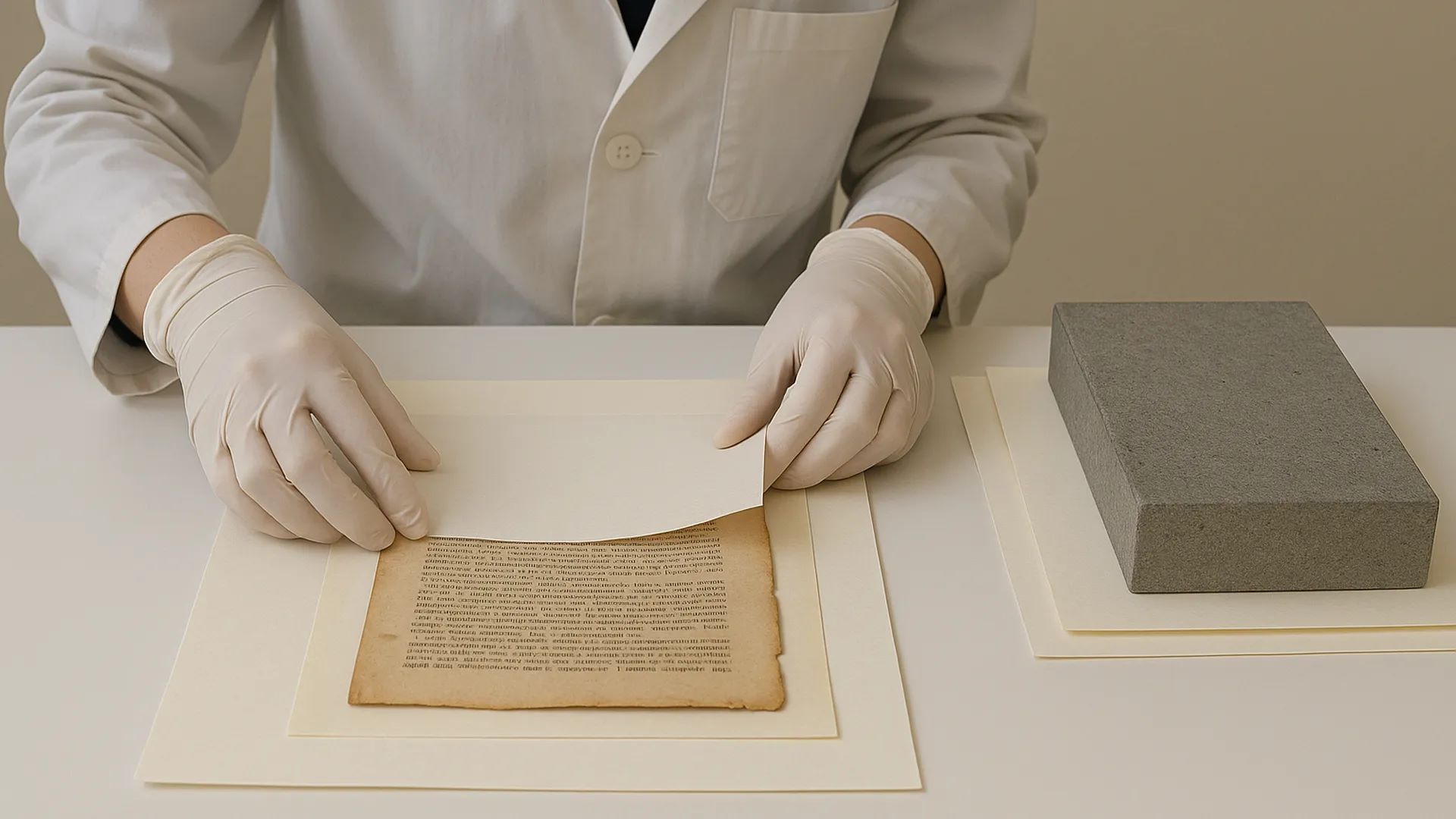
The enclosure strategy is equally critical; high-value documentation should be stored in boxes, folders, or sleeves manufactured from acid-free and lignin-free buffered materials. When we ship a bulk order from Bogor, we package them with transit protection in mind, but your long-term storage solution must be more sophisticated. Standard cardboard boxes are often acidic. Over time, the acid from a cheap box can migrate into the premium leather and paper of the journals stored inside, causing “acid migration” which manifests as discoloration or streaking. Buffered enclosures contain an alkaline reserve (usually calcium carbonate) that neutralizes acids before they can reach the journal.
These enclosures must properly fit the journal to provide adequate physical support. A box that is too large allows the journals to slide and impact corners; a box that is too tight exerts pressure that can crush the spine or imprint the texture of the leather onto adjacent units. This is particularly relevant for our debossed logos. If you stack journals with deep debossing directly on top of each other under weight without interleaving sheets or proper spacing, the pressure can flatten the debossing or cause “ghosting” on the surface of the journal below.
Professional handling protocols are non-negotiable. The human hand is a source of oils, salts, and acids. In a workshop setting, our craftsmen constantly clean their hands and tools, but in a warehouse picking line, hygiene standards can slip. We recommend clean hands or the use of cotton gloves and spatulas to prevent the transfer of skin oils or acids to the paper surface. When a worker grabs a journal by the text block with sweaty hands, that salt deposit remains on the paper. Six months later, that thumbprint appears as a yellow or brown stain (foxing). Procurement managers should mandate that no adhesive tapes, metal clips, rubber bands, or acidic inserts are utilized during storage.
Let us discuss the physics of these prohibited items. Rubber bands contain sulfur. As they degrade (vulcanization breakdown), they melt, become sticky, and release sulfur compounds that blacken silver foil stamping and stain paper. Metal clips, even “stainless” ones, can rust in humid environments, leaving permanent orange iron oxide stains. Acidic inserts, such as standard bookmarks or marketing flyers printed on cheap paper, introduce a “Trojan horse” of acid into the center of your archival journal. Every element that touches the product must be chemically inert.
The Core: Monitoring Material Health and Leather Science
Material health must be monitored periodically for technical indicators of deterioration, such as discoloration, brittleness, staining, or distinct odors. In instances of advanced degradation, consultation with a qualified conservator is recommended for specialized treatment, though for commercial inventory, prevention is the only viable economic strategy. The “smell test” is often the first indicator. A sharp, vinegar-like smell suggests “vinegar syndrome” (acetate degradation), while a musty odor indicates active mold growth. If you detect these in your storage facility, immediate isolation of the affected stock is required to prevent cross-contamination.
Premium white label journals often utilize high-grade covers, such as pull-up leather. As noted by leather experts, pull-up leather is finished with a combination of oils and waxes that give it a unique, dynamic color behavior when stretched or folded. This creates a “two-tone” effect that is highly prized. However, this high oil content makes the leather reactive to temperature. Storage in cool, dry areas away from direct sunlight is essential. If stored in a hot warehouse (above 30°C), the oils and waxes can liquefy and migrate to the surface (spew) or transfer onto the paper text block, leaving translucent oil stains on the first few pages. Conversely, extreme cold can cause the waxes to crystallize, creating a white bloom on the surface.

“A journal is a vessel for time. If the vessel rots before the ink touches it, we have failed the future. We build the structure, but the environment dictates its lifespan.” – Head Craftsman, Hibrkraft
Utilizing protective dust bags or cloth covers is a recommended technical safeguard to protect both the leather and the internal archival sheets from dust accumulation and environmental contaminants. Dust is not just aesthetic; it is often hygroscopic (attracts water) and can contain sharp silica particles that micro-abrade the leather surface during handling. For our White Label clients, we often recommend or supply unbleached cotton dust bags. These allow the leather to “breathe” (exchange moisture vapor) while blocking light and dust. Plastic bags, unless they are specific archival polyester (Mylar), should be avoided for long-term storage as they can trap moisture and plasticizers, leading to a sticky, degraded leather surface.
Imagine the scenario: Your corporate client orders 500 custom-branded journals for a year-end summit. You store them in a standard logistics shed for three months. When the client opens the boxes in the boardroom, the leather is dull and dry because the humidity was too low, and the paper has curled at the edges. The perceived value of your brand drops instantly. Conversely, with proper protocols, that same unboxing reveals the rich, heady smell of preserved leather and crisp, flat paper that invites the pen. The physical condition of the product is the first touchpoint of brand trust.
At Hibrkraft, we perform a 100% inspection on every unit before it is packed. We check for grain consistency, stitching tension, and paper alignment. We ensure that no unit leaves our Bogor workshop with existing defects. However, we cannot control the physics of the world once the package is with DHL. By educating our B2B partners on these storage protocols, we are extending our quality control into your facilities, ensuring that the end-user receives the masterpiece exactly as it was intended.
The Result: ROI and Brand Asset Protection
The result of this rigorous adherence to storage protocols is inventory that retains its value indefinitely. In the world of high-end stationery, “New Old Stock” (NOS) can actually increase in value if preserved correctly, as leather develops a patina even in storage if allowed to breathe. However, stock that has been subjected to acid migration or mold is a total write-off. There is no salvaging a moldy book for a commercial client. Therefore, investing in climate control and proper acid-free enclosures is not an expense; it is asset protection.
For your Return on Investment (ROI), this means zero shrinkage due to environmental damage. It means you can confidently order 2,000 units to secure a lower per-unit cost, knowing that the 2,000th unit sold a year later will be as perfect as the first. This stability allows you to scale your operations without the fear of product perishability. In the niche of “Buy It For Life” goods, the customer expects the product to survive decades of use. If it cannot survive months of storage, the brand promise is broken immediately.
We also believe in transparency. While Hibrkraft offers a replacement policy for manufacturing defects (loose stitching, glue failure, leather scars not within the natural range), we cannot replace stock damaged by improper storage. This is why we write guides like this. We want your business to thrive. We want your “unboxing experience” to be flawless every single time. When you treat the inventory with the same respect our craftsmen treat the raw materials, the profit compounds not just in currency, but in reputation.

Why Partner with Hibrkraft?
Hibrkraft is uniquely positioned to serve the high-volume, high-quality B2B market. With a capacity of up to 2,000 units per month, we bridge the gap between the small artisanal workshop and the soulless industrial factory. Located in Cileungsi, Bogor, we have access to some of the finest tanneries in Indonesia (Magelang, Garut), allowing us to source materials that are fresh and high-grade. We don’t use “dead stock” leather that has been rotting in a damp warehouse; we cut from fresh hides that are tanned to our specifications.
The White Label advantage we offer is total brand immersion. Your logo, your specs, our hands. We are the silent engine behind your brand’s physical product. We understand the nuances of export logistics, having successfully shipped to Germany, Canada, and the UAE. We know how to pack for the journey, using moisture-absorbing silica packets and sturdy, impact-resistant outer cartons to mitigate the risks of transit.
When you partner with us, you are getting more than just a manufacturer; you are getting a technical consultant. We can advise you on which papers (Bookpaper vs. HVS) will hold up best in your target market’s climate. We can suggest leather finishes that are more resistant to humidity if you are selling in tropical regions. We build for the real world, so you can sell with confidence.
Ready to start? Message us on WhatsApp at 0815 1119 0336 to discuss your bulk order and preservation strategy. Click here to chat.
Sources & References
- Berisford, K. M. (2024). Acid-Free vs Archival: What You Need to Know About Paper Quality for Your Art.
- Chiles, J. (2024). What Is Pull Up Leather? – An In-Depth Look.
Disclaimer: this post are written in english to reach more audience.