
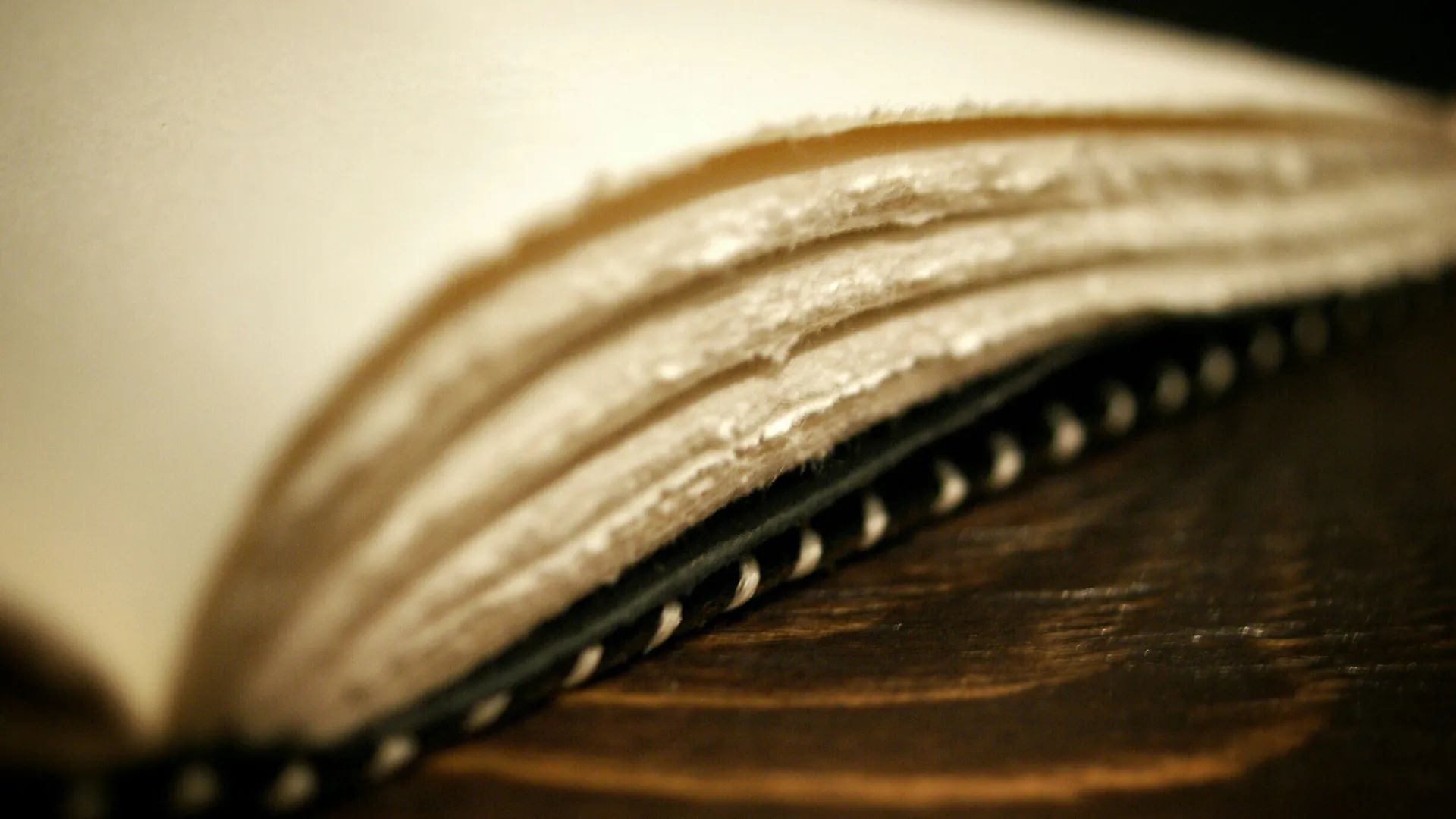

The image before you is a landscape of texture and structure. It’s a close, intimate view of what makes a book a book. You can see the soft, fibrous edges of the paper, gathered into distinct bundles called signatures. You can see the rhythm of the waxed thread as it weaves through the spine, a testament to the Coptic stitch binding method—a technique thousands of years old. In our workshop in Cileungsi, Bogor, this is the sensory world we inhabit daily. It’s the crisp sound of a bone folder creasing a sheet of paper, the low hum of a sewing needle piercing a signature, and the faint, pleasant scent of leather and bookbinding adhesive. This is not the sterile, high-speed environment of a factory; it is a place where human hands ensure every stitch contributes to a legacy.
This macro view, revealing the very heart of the journal’s construction, perfectly illustrates our manufacturing philosophy. The visible strength of the interlocking thread is a direct reflection of the invisible strength engineered into the paper itself. Each of those signatures is a building block, and the longevity of the entire structure depends on the integrity of each individual page. A journal that looks this well-made on the outside must be equally well-engineered on the inside, at a chemical level. This is the crucial intersection of craft and science, where understanding the distinction between merely “acid-free” paper and a truly “archival” substrate determines whether a brand creates a disposable gift or a permanent artifact.
We don’t just assemble journals; we engineer archival systems for your brand.
Specifying Permanence for Custom Leather Journals: Why Acid-Free Paper is Not Necessarily Archival
For a B2B buyer, procurement manager, or brand strategist, the technical jargon of papermaking can seem overwhelming, yet it holds the key to a product’s long-term ROI. The terms “acid-free” and “archival” are often used interchangeably in marketing, but from a product engineering perspective, they represent vastly different levels of quality and permanence. “Acid-free” is a chemical state. It means the paper has a neutral or alkaline pH (7.0 or higher) at the time of manufacture. This is a critical first step, as it prevents the paper from containing the very acids that would accelerate its own chemical breakdown. However, this designation alone is not a guarantee of longevity. It’s like building a house with wood that isn’t currently on fire, but tells you nothing about whether that wood has been treated to resist termites or dry rot.
| Attribute | “Acid-Free” Paper (The Baseline) | True Archival Paper (The Hibrkraft Premium Standard) |
|---|---|---|
| Pulp Source | Can be made from any pulp, including groundwood pulp which contains lignin, the primary source of acid. | Must be made from high-alpha cellulose pulp. Lignin must be completely removed. Often 100% cotton fiber for maximum purity and stability. |
| pH Level & Buffering | pH is 7.0 or higher at manufacture. May or may not contain an alkaline buffer to resist future acid contamination. | pH is alkaline (typically 8.5+). Always contains an alkaline buffer (e.g., calcium carbonate) to actively neutralize environmental acids over time. |
| Additives | May contain Optical Brightening Agents (OBAs) to appear whiter, which can break down and cause discoloration. | Strictly limits or eliminates OBAs, metallic content, and other impurities that could compromise long-term chemical stability. |
| Longevity & Brand Impact | Prevents rapid yellowing. Good for products with a 5-20 year expected life. A good-quality consumer product. | Engineered to last for centuries. Positions a brand as a purveyor of permanent, heirloom-quality goods. A true brand artifact. |
The primary vulnerability in a non-archival “acid-free” paper is often the presence of lignin. Lignin is the organic polymer that binds cellulose fibers together in wood. If paper is made from groundwood pulp (where wood is simply ground up), the lignin remains. Over time, lignin oxidizes and breaks down, releasing acids and destroying the very paper it’s a part of. This is the ticking time bomb in low-quality paper. Engineering a truly archival substrate requires starting with a pulp source that is either naturally lignin-free (like cotton) or has had the lignin chemically removed (purified wood pulp). This is a more expensive and intensive process, but it’s the only way to guarantee the paper’s foundational stability.
Furthermore, the term “archival” remains unregulated in the stationery industry. This lack of a standardized global definition means manufacturers can apply the label with little accountability. For a discerning B2B client, this is a significant risk. The only way to mitigate this risk is to partner with a manufacturer who understands the material science and can provide technical justification for their material choices. It requires scrutinizing supplier specifications for things like fiber composition, alkaline reserve percentages, and lightfastness ratings (often measured on the Blue Wool scale). Understanding that “acid-free” is merely the price of entry—not the guarantee of archival performance—is the first step to commissioning a product that truly reflects a brand’s commitment to enduring quality.

The Anatomy of Permanence: Fiber, Buffers, and Binding
When you commission a white label journal from Hibrkraft, we build it from the inside out. The process begins with a deep dive into your project’s specific permanence requirements. Is this a journal for daily notes, or is it a corporate registry meant to last 200 years? The answer determines our material strategy. For the highest level of permanence, we specify paper made from 100% cotton fibers, sometimes known as rag paper. Cotton is naturally lignin-free and consists of almost pure, long-chain cellulose. This gives it incredible physical strength and chemical stability, making it the undisputed king of archival substrates.
The second critical component is the alkaline buffer. An unbuffered paper, even if it has a neutral pH, is a passive victim in a hostile world. It is vulnerable to acids from the environment (like air pollution) or from “acid migration” from other materials within the book itself, such as a cheap, acidic cover board. A buffered archival paper is an active defender. During its creation, an alkaline agent like calcium carbonate is added to the pulp. This alkaline reserve lies dormant within the sheet, ready to neutralize acids on contact. A crucial failure point we see in mass-produced goods is when the buffering capacity is insufficient for the amount of acid the paper is exposed to over its life, leading to eventual degradation despite the “acid-free” claim.
This is where the human element of our Cileungsi workshop becomes a critical quality control asset. A machine can’t detect the subtle difference in texture that might signal a batch of paper has poor sizing, which would lead to ink feathering. Our craftsmen, who handle these materials daily, can. They feel the grain of the paper, ensuring each signature is folded correctly so the finished book lays flat and opens gracefully, as seen in the photograph. This minimizes physical stress on the spine. When performing a Coptic stitch, they feel the tension of the thread with every pull, ensuring it’s secure enough to last a lifetime but not so tight it tears the paper. This tactile feedback loop is an irreplaceable part of building a truly permanent object. A machine can follow a program; a craftsman can feel integrity.
The Litmus Test: A Holistic Approach to Quality Assurance
The ultimate test for archival integrity is, of course, time. But since we cannot wait a century to validate our work, our quality assurance process is a holistic system designed to simulate the rigors of time by eliminating every known point of failure from the start. This goes far beyond a simple pH strip test on the paper. It’s an audit of the entire material ecosystem of the journal. Is the thread we’re using for the Coptic stitch pH neutral? Is the adhesive used to secure the endpapers archival-grade PVA, which remains flexible and acid-free, or a cheaper glue that will become brittle and acidic? Are the cover boards we use also acid-free to prevent acid migration?
The physics of book failure is predictable. In a cheaply made book, failure is a cascade event. The acidic paper becomes brittle. The inflexible, acidic glue cracks. The brittle paper tears at the stressed spine, and pages fall out. The Coptic stitch journal shown in the image is a masterclass in durable engineering precisely because it mitigates these risks. The binding relies on the mechanical strength of thread interlocking through multiple, independent signatures. If one thread were to fail, the rest of the book remains intact. By ensuring the paper itself is strong, pliable, and chemically stable, we build a system where the components work in harmony to resist both mechanical stress and chemical decay.

“A book’s strength is not in its glue, but in the integrity of its parts. We build each signature to stand on its own, and then unite them so they can stand together for a century. This is how you bind a legacy, not just a notebook.”
This philosophy from our Head Craftsman is the essence of our approach. We build in redundancies. We build with the best possible components. The signatures in the photograph are not just stacks of paper; they are the fundamental modules of the book’s architecture. By ensuring each one is made from archival-grade material and folded correctly, we guarantee the strength of the whole.
For our white label clients, this translates into profound brand safety. When your brand’s logo is debossed into the cover of one of our journals, you can be confident that the product will not fail. It will not yellow on a shelf, and its pages will not fall out. It will continue to be a handsome, functional object that reflects the quality and foresight of your brand for years to come. It becomes a permanent, positive touchpoint, whether it’s on an employee’s desk or in a valued client’s home.
Our 100% inspection policy is the final backstop in this process. We do not use statistical sampling, where a certain percentage of defects is deemed acceptable. Every single unit that leaves our workshop is personally opened, flexed, and examined by a member of our team. We check for the uniformity of the stitching, the smoothness of the cover, and the alignment of the book block. We ensure the object as a whole lives up to the quality of its individual, archival parts.
The Result: A Future-Proof Asset with Tangible ROI
The result of this fanatical commitment to the science of permanence is a product that transcends the category of “promotional good.” It is a durable brand artifact. It is an asset engineered to be future-proof, safeguarding both the information written inside it and the brand identity embossed on its cover. This is a product that will never become a source of embarrassment for your brand, but will instead continue to function as a testament to your commitment to quality.
The Return on Investment (ROI) for a product of this caliber is measured not in months, but in decades. A cheap notebook offers fleeting impressions before it is discarded. An archival-quality journal becomes a long-term companion. The cost-per-impression becomes infinitesimally small over its long life. More importantly, the quality of each impression is exponentially higher. It’s the difference between a disposable flyer and a hardcover book. One is an expense, the other is an investment in brand equity and lasting goodwill.
We are completely transparent about this process. In any handcrafted product, there can be minor variations that are a mark of its unique character. However, we guarantee its structural and material integrity. Our defect replacement policy is simple: if a product fails due to a flaw in our craftsmanship or the materials we’ve selected, we replace it. This is the foundation of a true B2B partnership—shared standards and absolute accountability.

Why Partner with Hibrkraft for Your Custom Journals?
Hibrkraft is a specialized leather journal workshop, not a high-volume factory. Our small, dedicated team of approximately nine craftsmen in Cileungsi, Bogor, allows us to focus on quality over quantity. With a capacity of up to 2,000 units per month, we operate in the sweet spot of “handcraft at scale,” offering the consistency and reliability of a professional manufacturer alongside the attention to detail of a master artisan.
Our White Label service is designed to make our workshop an extension of your brand. We are your production partners. The final product is 100% yours, built to your specifications and bearing your branding, with no Hibrkraft marks. We offer direct communication with the owners for a transparent and collaborative process, leveraging our expertise in bookbinding mechanics and our network of high-quality Indonesian material suppliers to bring your vision to life.
We have a proven track record of shipping our handcrafted goods globally, with established clients in Canada, Germany, the Netherlands, the UAE, and more. We handle the complexities of international logistics via trusted carriers like DHL Express, ensuring your investment arrives safely and on schedule. Partner with us to create a product that is not just made, but engineered to last.
Let’s build something permanent together.
Sources & References
- Berisford, K. M. (2024). Acid-Free vs Archival: What You Need to Know About Paper Quality for Your Art.
- StepbyStepArt (2025). Comments on Acid-Free vs Archival.
Disclaimer: this post are written in english to reach more audience.