
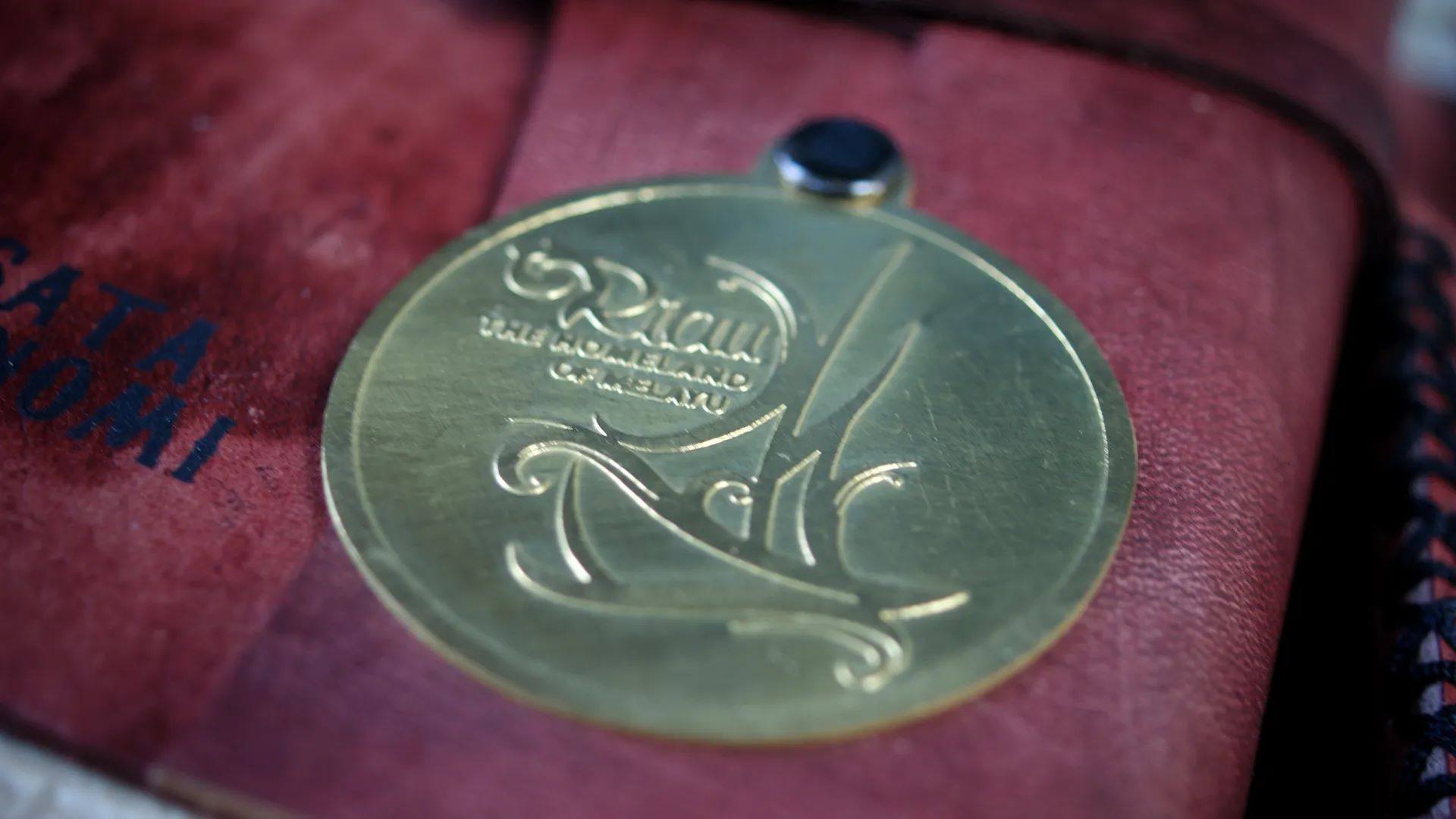

The air in our Cileungsi workshop carries a different weight when we work on a piece like the one in the image. The standard, earthy scent of vegetable-tanned leather is overlaid with the sharp, clean smell of metal polish from the custom-engraved brass medallion. The rhythmic sounds of production are punctuated by the high-frequency whine of a precision engraver, a sound of intricate detail being permanently etched into metal. This journal is more than a notebook; it’s a commemorative object, a statement piece. The deep, oxblood-red leather evokes a sense of occasion, while the complex, interwoven stitching speaks of hours of focused, manual labor. It is, in every sense, the perfect holiday gift—unique, valuable, and imbued with a story.
This object, in its finished state, represents the end of a long and complex journey. A journey that began months earlier, not in our workshop, but in a tannery in Garut and with a metalworker in Jakarta. The creation of every component—the custom-dyed leather, the intricately engraved medallion, the specially ordered thread—had its own timeline, its own supply chain. For the brand owner who commissioned this piece, a successful Q4 sales season was not the result of a great Black Friday promotion, but of a decision made under the hot sun of August. This article is about that decision. It is a deep dive into the logistical realities of “handcraft at scale” and a strategic guide to ensuring your brand is prepared, not panicked, for the most critical sales period of the year.
We provide the timeline transparency and production reliability that turns Q4 from a gamble into a predictable, profitable success.
Seasonal Inventory Planning: Preparing Your Brand for Q4 Holiday Rush
The fourth quarter—October, November, December—is the crucible where a retail brand’s annual success is forged. For many, this period can account for 40% or more of yearly revenue. It is a time of immense opportunity, but also of immense risk. The single greatest operational risk is inventory stock-out. Running out of your best-selling holiday edition journal on December 1st is not a sign of success; it is a catastrophic planning failure that leaves a mountain of money on the table and sends your eager customers to competitors. To avoid this, you must work backward from your desired “in-stock” date, respecting the immutable laws of the physical supply chain. A handcrafted product cannot be summoned into existence overnight. Its creation is a linear, multi-stage process that requires time, care, and foresight.
| Planning Stage | The Strategic Brand (Partnered with Hibrkraft) | The Panicked Brand (Using a Typical Factory) |
|---|---|---|
| July/August | Finalizes holiday designs. Orders physical samples. Confirms PO for the main production run with a clear 8-week timeline. | Still in the design phase, assuming production is a quick process. |
| September/October | Production is underway. Receives “behind-the-scenes” updates from the workshop to use in marketing teasers. Plans marketing calendar. | Frantically trying to get quotes from factories, discovering that lead times are now 10-12 weeks due to the global rush. |
| November | Inventory arrives. Conducts photoshoots. Prepares for Black Friday launch with confidence and a full warehouse. | Pays exorbitant rush fees. The factory cuts corners on QC to meet the deadline. Product arrives late, with a 15% defect rate. |
| December | Manages sales, focusing on marketing and customer service. Considers a small, final re-order for January. | Apologizes to customers for shipping delays. Deals with returns of defective products. Brand reputation is damaged during peak season. |
The two paths laid out in the table illustrate a fundamental truth: the holiday rush begins in the summer. The decisions you make in August will determine your revenue ceiling in December. As your production partner, our responsibility is to provide you with a predictable, reliable manufacturing timeline so you can plan with confidence. Our 8-week production window is not a vague estimate; it is a calculated schedule based on the real-world processes required to create a high-quality, handcrafted product. Let’s break down exactly what happens during those eight weeks.
This proactive approach transforms your Q4 from a reactive scramble into a proactive, strategic campaign. You control the narrative, build anticipation, and execute your sales plan from a position of strength, not desperation. The foundation of this control is acknowledging the physical reality of production and giving the process the time it deserves. The medallion on the journal in the image is a perfect example; that component alone likely had a 4-week production lead time from the specialist who made it *before* it even arrived at our workshop for assembly.

Deconstructing the 8-Week Production Timeline
To truly understand why planning is so critical, you need to understand the journey of your product. An order for 1,000 journals doesn’t just “get made.” It moves through a series of sequential, often overlapping stages, each with its own irreducible time requirement. This is the physics of our craft.
- Weeks 1-2: Material Sourcing & Allocation. The moment you confirm your order, we trigger our supply chain. We don’t hold vast quantities of every leather and paper type. We place an order with our partner tannery in Magelang or Garut for the specific hides needed for your project. If you’ve requested a custom color, the dyeing process begins. Simultaneously, we order the specific HVS 90gsm, Bookpaper, or Ivory paper from the mill. These suppliers have their own production queues, especially leading into Q4. This stage is about securing your raw materials.
- Weeks 3-4: Preparation & Initial Processing. The leather hides arrive and are inspected for quality. Our craftsmen then begin the meticulous process of cutting the cover pieces. For a 1,000-unit order, this means thousands of precise cuts made with templates and keen eyes. The paper arrives, is cut to size, and if your design includes printed pages (lines, grids, logos), it goes through the printing process. It is then folded and collated into “signatures”—the small booklets that will form the text block.
- Weeks 5-6: The Core of the Craft – Binding. This is the most time-intensive, hands-on stage. For a Coptic stitch journal, our team of ~9 craftsmen will sit for hours, hand-stitching each signature to the next, creating the strong, lay-flat spine. A single craftsman can only complete a certain number of these per day without sacrificing quality. This stage cannot be rushed. It is the literal bottleneck of quality, where speed is the enemy of durability. For Case Binding, this is when the text blocks are glued, rounded, and pressed, and the cover boards are assembled.
- Weeks 7-8: Finishing, QC, and Packing. Once the journals are bound, they move to finishing. This is where your logo is applied via debossing, foil stamping, or laser engraving. Any additional components, like the metal medallion in the photo, are attached. Then comes the most critical step: our 100% inspection protocol. Every single journal is opened, flexed, and examined. We don’t check 1 in 100; we check 100 in 100. Finally, the approved units are carefully wrapped and packed for their journey via DHL Express.
This eight-week process is a finely tuned dance of logistics and craftsmanship. A delay in any one stage has a cascading effect on all subsequent stages. Understanding this timeline is the first step to mastering your seasonal inventory.
The Q4 Stress Test: Buffers, Logistics, and Murphy’s Law
A wise brand owner knows that a plan is not a prediction. For a high-stakes period like Q4, you must plan for imperfection. This is the concept of a “supply chain buffer.” Our 8-week timeline is a reliable operational schedule, but it does not account for external forces. What if a monsoon in West Java delays the paper shipment by a week? What if an international holiday slows down customs clearance for the special foil you ordered from Japan? This is Murphy’s Law: anything that can go wrong, will go wrong.
Therefore, the “Stress Test” for your Q4 plan is to add your own buffer. We strongly advise our partners to add a two-week buffer to our production timeline. If you need your inventory in your warehouse by November 15th, you should calculate backward 8 weeks for production, and then add another 2 weeks for safety. This means you should be placing your final, confirmed purchase order with us around August 20th. This 10-week planning cycle is the professional standard. It transforms potential disasters into minor inconveniences. That extra two weeks allows for a potential shipping delay or a minor production snag without jeopardizing your entire holiday launch.

“Time is the most valuable raw material in our workshop. We can source more leather, we can buy more thread, but we cannot create more hours. By planning ahead, our clients gift us the time we need to honor their brand with our best work.”
This philosophy is central to the partnership we build with our clients. When you rush us, you are asking us to compromise the very craftsmanship that justifies your premium price. A rushed debossing job can be crooked. A rushed glue-up in a case binding can fail. Our timeline is a shield that protects the integrity of your product and, by extension, your brand.
Let’s simulate the nightmare scenario. It’s Black Friday. Your new holiday journal is a massive hit. You sell out in five hours. You’re swimming in revenue, but you’re also flooded with emails from disappointed customers. You contact us in a panic: “I need 1,000 more units, and I need them before Christmas!” The honest, professional answer we must give you is, “That is physically impossible.” The leather for your journal is still on a cow in a field in Central Java. The paper is still pulp at the mill. By failing to plan, you have not only capped your own success but also created a negative customer experience during the most emotional buying season of the year.
The buffer is your insurance policy against this scenario. It is the single most important strategic decision you will make for your Q4 season. It is the difference between a triumphant sell-out and a tragic one.
The Result: A Profitable, Stress-Free Holiday Season
The result of this disciplined, proactive planning is not just a successful quarter, but a less stressful one. When your inventory arrives in mid-November, you are calm. You can focus your energy on what you do best: marketing, storytelling, and creating a magical customer experience. You are not wasting your days chasing tracking numbers or your nights worrying about production delays. Your business is operating from a position of control.
This has a direct and profound impact on your ROI. You maximize your sales potential by having enough stock to meet the full height of holiday demand. You can confidently invest in advertising, knowing that every click you pay for can lead to a conversion, not a “sold out” page. You avoid the need for expensive rush shipping or the brand-damaging practice of making promises to customers that you cannot keep.
Furthermore, because of our unwavering commitment to our 100% inspection protocol, you know that the inventory you receive is ready to sell. There is no need for you to spend a frantic week sorting through your shipment, discovering a 10% defect rate, and having to recalculate your available stock. The quantity you ordered is the quantity of perfect, sellable products you receive. This is the Hibrkraft guarantee, and in the chaos of Q4, this reliability is priceless.

Why Hibrkraft is Your Q4 Production Partner
In the high-stakes environment of Q4, your choice of manufacturing partner is paramount. Our workshop in Cileungsi, Bogor, is structured to be the ideal partner for growing brands. With a dedicated team of ~9 craftsmen and a capacity of up to 2,000 units per month, we offer the quality and attention to detail of an artisan studio with the process and reliability of a professional manufacturer. Our “handcraft at scale” model is built for brands that refuse to compromise on quality, even at peak volume.
Our White Label service allows you to leverage our expertise as your own. We build your holiday vision to your exact specifications, with your branding front and center. Our transparent 8-week production schedule is the bedrock upon which you can build a stable and predictable seasonal plan, turning inventory management from a source of anxiety into a strategic advantage.
We have extensive experience navigating the complexities of peak-season global logistics, shipping on-time orders via DHL Express to clients in the most demanding markets, including Germany, Canada, and the Netherlands. When you partner with us, you get more than a supplier; you get a dedicated team that is as invested in your Q4 success as you are. You get direct communication, unwavering quality control, and a predictable timeline you can build your business on.
Disclaimer: this post are written in english to reach more audience.