
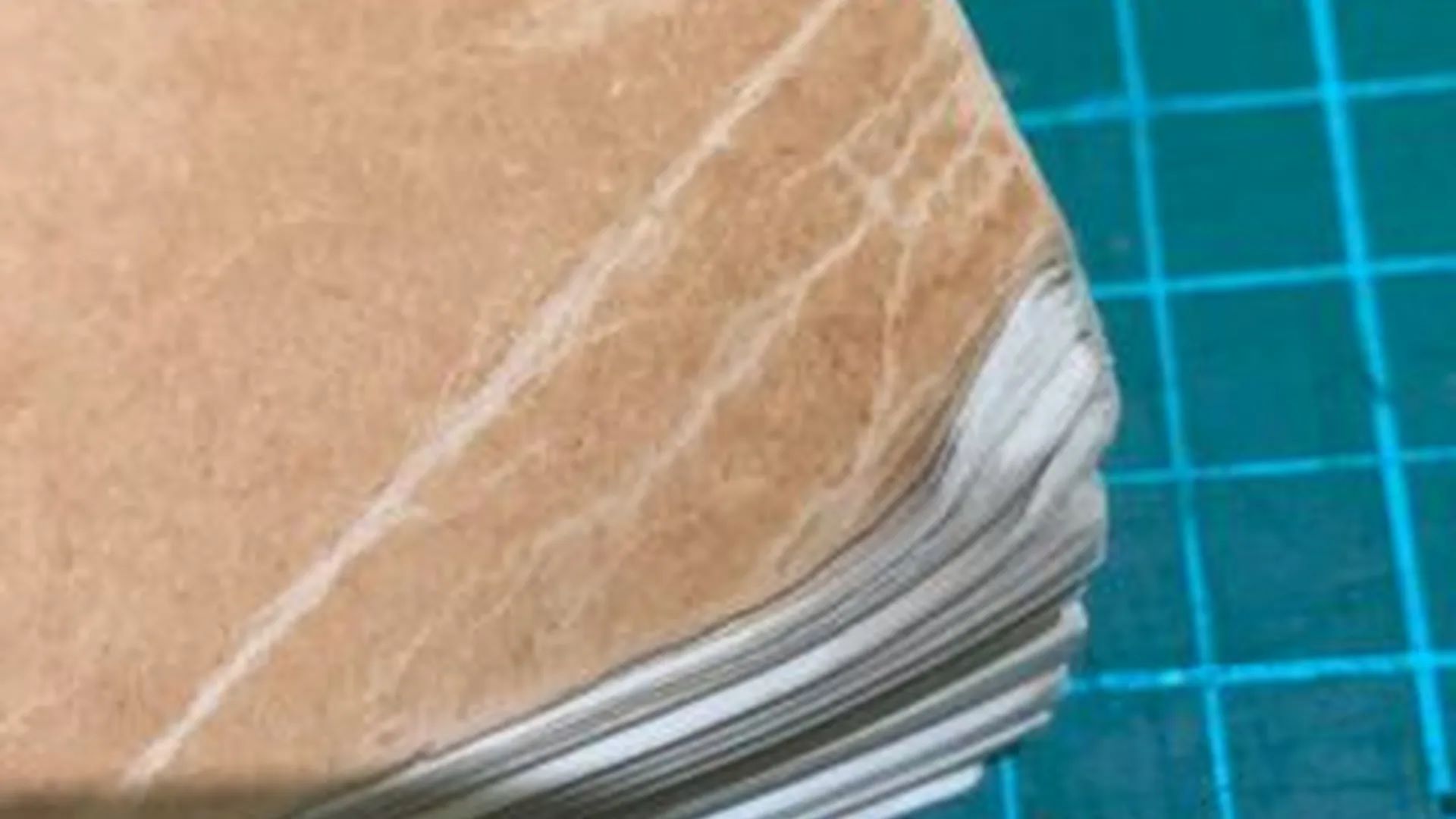

The image above captures a fleeting, vulnerable moment on the green self-healing cutting mats of our Cileungsi workshop. What you see is a “naked” text block—a stack of signatures that have been folded and collated, resting under the ambient light of the workbench. The rough, fibrous texture of the kraft outer leaf and the distinct, layered strata of the paper edges reveal the organic nature of the material. In this state, before the leather cover is applied and the spine is reinforced with mull and glue, the paper is most susceptible to the elements. The slight curl at the corner of the stack is a whisper of physics; it is the paper reacting to the humidity in the room.
This visual serves as a stark reminder of what lies beneath the premium leather exterior of a Hibrkraft journal. While the leather provides the armor, the internal paper substrate is the soul of the product. When we hand-craft a bulk order of 500 or 2,000 units, we are essentially assembling a massive reservoir of cellulose fibers. In our workshop, we manage this through constant vigilance and rapid processing. However, once these journals leave the controlled chaos of our production line and enter your logistics chain, they face their greatest enemy: thermal instability.
The difference between a journal that lasts a century and one that becomes brittle in a decade is often decided in the warehouse. Hibrkraft does not just supply stationery; we supply archival-grade assets, and maintaining that status requires a partnership in preservation.
Optimizing Archival Longevity for Custom Leather Journals: The Technical Requirement for 20°C Storage Environments
From a material engineering perspective, maintaining a stable thermal environment is not merely a “best practice”—it is a critical technical requirement for preserving the structural integrity of both the paper substrate and the leather cover. The specific technical benchmark for archival storage is approximately 20°C (68°F). Why this specific number? In the chemistry of conservation, heat is energy. As thermal energy increases, the molecules within the paper (cellulose) and the leather (collagen) vibrate more vigorously. This increased kinetic energy lowers the barrier for chemical reactions, specifically acid hydrolysis and oxidation.
At 20°C, paired with a relative humidity of 55%, the environment serves to mitigate the catalytic degradation of cellulose fibers. If the temperature rises to 30°C—a common temperature in unventilated storage units or shipping containers—the rate of chemical decay does not just increase linearly; it compounds. This is based on the Arrhenius equation, which roughly dictates that the rate of chemical reaction doubles for every 10°C rise in temperature. Therefore, a white label journal stored at 30°C is aging twice as fast as one stored at 20°C.
Deviating from this 20°C standard introduces significant material risks that can jeopardize a B2B investment. Elevated temperatures cause “sizing breakdown.” The sizing (the substance applied to paper to control ink absorption) can deteriorate, leading to feathering or bleeding when the end-user eventually writes in the journal. Furthermore, the high-density collagen found in our Full Grain and Top Grain leathers relies on a precise balance of moisture and natural oils. Excessive heat drives this moisture out, causing the protein chains to shrink and stiffen—a process known as gelatinization.
| Storage Variable | Hibrkraft Recommended (20°C / 55% RH) | Uncontrolled Warehouse (30°C+ / Fluctuating) | Consequence for Brand |
|---|---|---|---|
| Cellulose Stability | Inert. Fibers remain flexible. | Accelerated hydrolysis (brittleness). | Pages snap when turned; perception of “old stock.” |
| Leather Oils | Balanced distribution. | Migration to surface (Spew) or evaporation. | Sticky covers or dry, cracking spines. |
| Adhesive Bond | Strong, flexible hold. | Shear stress failure due to expansion/contraction. | Spine detaches from cover (catastrophic failure). |
| Acid Migration | Minimal / Contained. | Rapid transfer between materials. | Yellow stains on endpapers; ruined aesthetic. |
The table above illustrates the hidden costs of poor storage. When a procurement manager buys 1,000 units, the assumption is that the unit cost is the final cost. However, if 10% of that stock becomes unsellable due to heat-induced warping or leather blooming, the effective cost per unit skyrockets.

The Thermodynamics of Material Integrity
Let us delve deeper into the mechanics of heat and glue. In bookbinding, particularly in Case Binding (Hardcover) or even our exposed spine Coptic stitching, we use specific adhesives to secure the signatures and attach the cover. While we use high-grade, flexible glues, every adhesive has a “glass transition temperature” and a failure point. Fluctuating temperatures cause the different materials in a journal to expand and contract at different rates.
Paper, being hygroscopic, expands across the grain as it absorbs moisture. Leather expands differently. The greyboard inside a hardcover expands at yet another rate. When a journal is subjected to a cycle of hot days (35°C) and cool nights (20°C) in a warehouse, these materials are constantly pulling against each other. This creates “shear stress” along the glue lines. Over time, this mechanical fatigue causes the endpapers to bubble or the text block to pull away from the spine. By maintaining a constant 20°C, you effectively “freeze” these dimensions, ensuring the structural bonds remain unstressed until the customer opens the book.
Furthermore, stable thermal conditions are necessary to prevent “acid migration.” This is the movement of harmful acids between components that often occurs in unstable environments. If you place a non-archival bookmark or a cheap packing slip inside a journal and heat it up, the acids from that cheap paper become mobile. They migrate into the archival paper of the journal, leaving permanent yellow rectangles. Heat acts as the vehicle for this destruction. In a cool environment, molecular mobility is reduced, and this migration is significantly slowed.
The Core: The Stress Test and Environmental Insulation
At Hibrkraft, we understand these variables because we test for them. While we do not have a cryogenic lab, we observe how our materials behave in the tropical heat of Bogor versus the air-conditioned office. We know that Pull-Up leather, for instance, is rich in waxes. If stored in a hot environment, these waxes can melt and migrate to the surface, creating a white, hazy film known as “blooming.” While this can often be buffed out, a customer receiving a “foggy” leather journal thinks it is moldy or defective. This compromises the professional brand perception of custom goods immediately.
To achieve the technical standards required for White Label success, procurement managers should mandate that journals be stored in cool, dry, clean, and dark areas away from direct sunlight or ignition sources. “Dark” is a key keyword here. UV light acts similarly to heat; it provides energy that breaks chemical bonds. A leather journal sitting on a windowsill in a corporate office for two months will show distinct fading on the spine compared to the covers.

“We can stitch with the strength of a ship’s sail, but we cannot stitch against the laws of thermodynamics. If you cook the leather, you cook the brand.” – Head Craftsman, Hibrkraft
For high-value documentation or premium limited editions, the use of archival-grade enclosures is recommended. This involves utilizing acid-free, lignin-free buffered boxes. These boxes do more than just organize; they provide a micro-climate. The cardboard of a buffered box acts as a thermal insulator, smoothing out rapid temperature spikes. If the warehouse AC fails for 2 hours, the journals inside these boxes will not feel the temperature spike nearly as fast as those sitting exposed on a pallet. This thermal lag can be the difference between a pristine product and a warped one.
Consider the “Trunk Scenario.” A sales representative takes a box of your branded journals to distribute to clients. They leave the box in the trunk of their car during a client lunch. Inside the trunk, temperatures can hit 50°C. In just two hours, the glues soften, the leather dries out, and the paper curls. When they hand that journal to a CEO, it feels “off.” It feels cheap. The brand damage is instant. Education on storage protocols must extend from the warehouse manager down to the distribution team.
The Solution: Archival ROI
By adhering to these rigorous storage protocols, organizations ensure that their white label leather journals function as a permanent, high-performance asset rather than a disposable commodity. The Return on Investment (ROI) here is calculated in “Brand Equity.” A journal that is still beautiful and usable 5 years after it was gifted is a 5-year advertisement for your company.
Additionally, proper storage mitigates the risk of “foxing”—those reddish-brown spots that appear on old paper. Foxing is often caused by fungal growth on metallic impurities in the paper, accelerated by—you guessed it—humidity and heat. By keeping the environment at 20°C and 55% RH, you are starving that fungus of the energy and moisture it needs to grow.
Hibrkraft’s replacement policy covers manufacturing defects—a missed stitch, a scar in the leather that compromises integrity, or a glue failure upon arrival. However, we cannot be held responsible for “environmental abuse” once the product is in the client’s custody. This is why we are so transparent about these protocols. We want you to avoid the losses associated with environmental degradation so that your re-order cycle is driven by sales success, not inventory spoilage.

Why Partner with Hibrkraft?
When you choose Hibrkraft for your White Label manufacturing, you are choosing a team that understands the entire lifecycle of the product. We are not a “fire and forget” factory. We are a workshop of 9 skilled craftsmen producing up to 2,000 units a month with a focus on “Handcraft at Scale.”
We source our materials from the best tanneries in Magelang and Garut, ensuring that the leather starts its life in optimal condition. Our binding styles—from the lay-flat Coptic Stitch to the robust Case Binding—are engineered to withstand normal use, but we rely on you to manage the storage environment.
We act as your production partners, offering advice not just on design, but on logistics and preservation. We have experience shipping globally to Canada, Germany, and the UAE, understanding the climatic shifts cargo undergoes. We pack with moisture mitigation in mind, but the baton passes to you upon delivery. Let’s build a product that defies time, together.
Ready to start? Message us on WhatsApp at 0815 1119 0336 to discuss your bulk order and preservation strategy. Click here to chat.
Sources & References
- Berisford, K. M. (2024). Acid-Free vs Archival: What You Need to Know About Paper Quality for Your Art.
- Chiles, J. (2024). What Is Pull Up Leather? – An In-Depth Look.
Disclaimer: this post are written in english to reach more audience.