
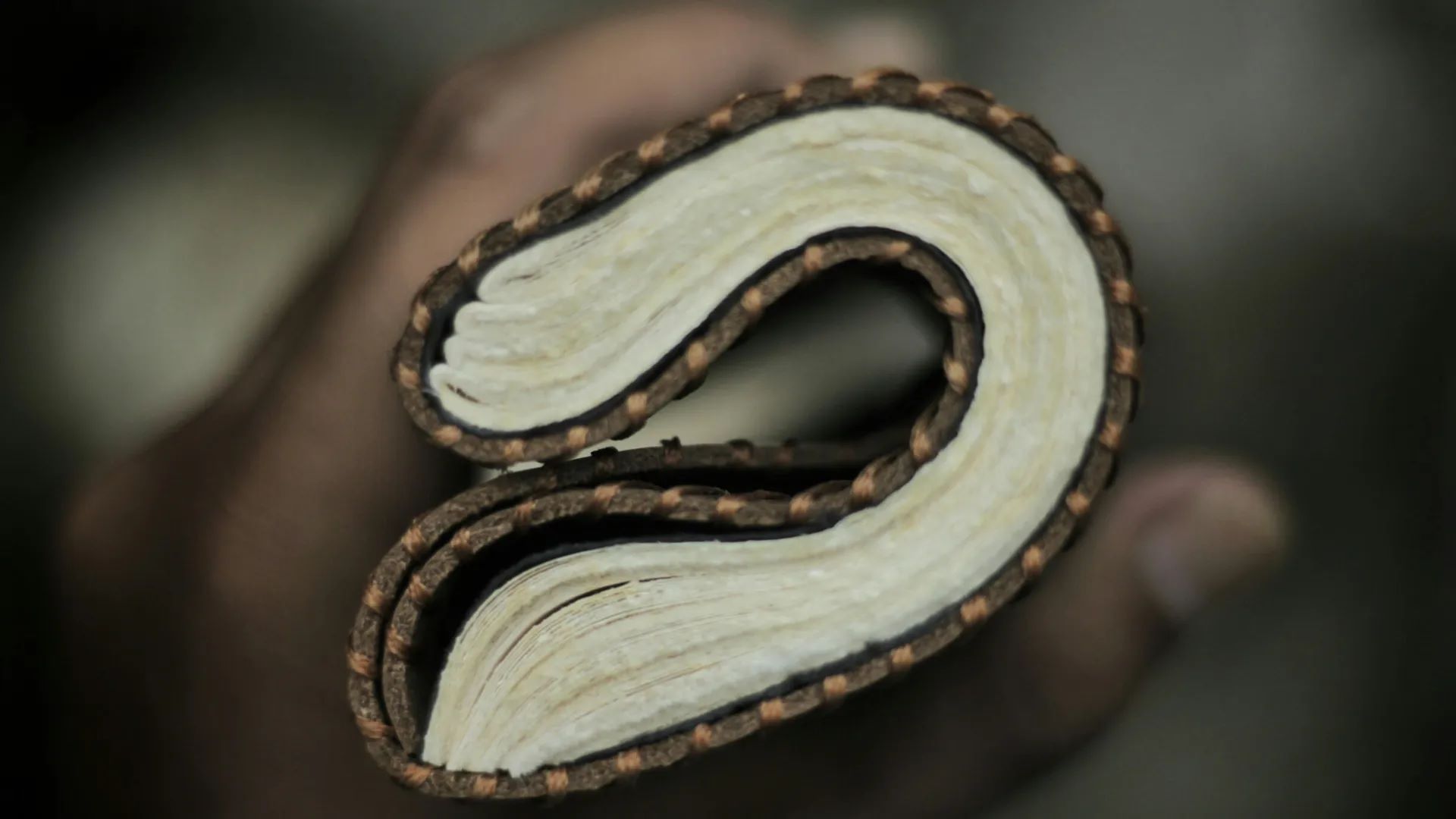

The image captures a powerful demonstration of structural integrity. A handcrafted journal is bent back upon itself in a graceful, dramatic curve, a feat of flexibility that would cause a lesser book to crack and break. You can almost feel the supple resistance of the Indonesian leather and the smooth, cooperative flex of the paper within. In our workshop in Cileungsi, this is the feeling of confidence we build into every single journal. It’s a confidence born from the scent of real full-grain hide, the sight of waxed thread being pulled taut by our craftsmen’s hands, and the knowledge that every component has been chosen not just for its beauty, but for its resilience.
This extreme flexibility is not merely a product of the binding technique—the intricate long-stitching visible along the spine—but is a testament to a holistic engineering philosophy. The binding can only be this flexible if the paper signatures it holds are equally strong and pliable. This is where the invisible science of papermaking becomes the hero. A paper made with impure, short fibers would tear at the stitch points under this strain. The journal in the image survives this stress test because its core is built from high-purity, groundwood-free paper, a substrate whose long, stable cellulose fibers provide the hidden strength that makes this elegant durability possible.
We don’t just build flexible bindings; we engineer the archival core that makes them possible.
Specifying High-Purity Substrates for White Label Leather Journals: The Engineering Requirement for Groundwood-Free Archival Paper
In the world of B2B manufacturing and premium corporate gifts, durability is brand equity. For a procurement manager specifying a custom leather journal, the most critical decision impacting that durability happens at the microscopic level of the paper’s fiber composition. While many manufacturers will promote their paper as “acid-free,” this term can be dangerously misleading. A paper can have a neutral pH on the day it’s made and still contain the seeds of its own destruction. The true technical differentiator for archival permanence is the complete exclusion of groundwood and unbleached pulp. This is not a matter of preference; it is a fundamental engineering requirement for any brand that wants its physical merchandise to reflect a legacy of quality.
| Engineering Parameter | Hibrkraft Archival Standard (Groundwood-Free) | Commodity “Acid-Free” Paper (Contains Groundwood) |
|---|---|---|
| Pulping Process | Chemical pulping, which dissolves and removes unstable lignin, leaving pure, long, and strong cellulose fibers. | Mechanical pulping (grinding), which retains the lignin. It’s cheaper and higher yield but creates a fundamentally unstable paper. |
| Lignin Content | Effectively zero. This eliminates the primary internal source of acid formation, guaranteeing chemical stability. | High. The lignin will oxidize over time, creating acid that breaks down the paper, causing yellowing and catastrophic brittleness. |
| Fiber Strength & Flexibility | Long, pure cellulose fibers provide high tensile strength and flexibility, allowing the paper to bend without tearing, as seen in the image. | Short, weak fibers damaged by the grinding process. Prone to cracking and tearing under mechanical stress. Research shows up to 74.3% less strength. |
| Long-Term Brand Impact | Becomes a permanent, reliable brand artifact. Communicates foresight, quality, and a commitment to legacy. | Degrades visibly within years, becoming a liability. Communicates a focus on short-term cost-cutting over long-term value. |
The technical justification for rejecting groundwood pulp lies in its chemistry. Groundwood pulp is produced by mechanically grinding logs into fiber, a process that is cheap and high-yield but fails to remove lignin. Lignin is the organic polymer that binds wood fibers together, and it is the arch-nemesis of permanence. It is photosensitive and highly prone to oxidation. As it breaks down, it generates potent acids that attack the paper’s own cellulose fibers, shortening them and making the entire sheet brittle and weak. A paper containing groundwood pulp has a built-in, chemically-timed self-destruct sequence. For a white label journal bearing your brand, this is an unacceptable risk. By specifying a groundwood-free substrate—typically 100% cotton or high-purity chemical pulp—we eliminate this risk entirely, building your product on a foundation of pure, stable cellulose.
This commitment to fiber purity is not just about preventing chemical decay; it is about ensuring mechanical durability. The impressive flexibility shown in the image is a direct result of the paper’s high tensile strength. Long, interwoven cellulose fibers create an internal matrix that can withstand the stress of bending, flexing, and page-turning for decades. Lower-tier fibers, especially those damaged by mechanical grinding or repeated recycling, can be up to 74.3% weaker. This weakness manifests as pages tearing out at the spine, corners becoming dog-eared and frayed, and a general failure of the book as a physical object. Specifying groundwood-free paper is therefore the first and most critical step in engineering a product that feels, performs, and lasts like a premium artifact.

The Anatomy of Resilience: A Technical Breakdown of Fiber Purity
When a client partners with Hibrkraft for a white label project, we guide them through the science of our materials. The journey to a groundwood-free sheet begins with the pulping process. Unlike mechanical pulping, which is a brute-force grinding process, chemical pulping uses a controlled chemical solution to gently dissolve the lignin and other impurities from the wood, leaving the long, undamaged cellulose fibers intact. This is a more complex and resource-intensive method, but it is the only way to produce a pulp that is inherently stable and strong. The ultimate expression of this principle is 100% cotton paper, which requires no pulping at all, as its fibers are already 98% pure cellulose, making it the gold standard for archival permanence.
The absence of groundwood pulp also ensures aesthetic consistency and superior performance. Impure pulps can result in an inconsistent surface texture and can even cause a phenomenon known as the “candle effect,” where the paper is more translucent in some areas than others. For professional documentation, artistic applications, or simply a premium writing experience, a uniform, opaque sheet is essential. Furthermore, the metallic contaminants often found in unrefined pulp can react poorly with inks and environmental factors, leading to unexpected discoloration or spotting over time. A high-purity substrate provides a clean, predictable, and stable canvas worthy of your brand and your users’ content.
At our workshop in Bogor, our craftsmen’s deep familiarity with these materials provides an extra layer of quality control that a machine cannot replicate. They can feel the difference in the “hand” of a paper—its combination of stiffness, texture, and weight. They understand how a paper’s internal structure will behave under the pressure of a debossing plate or at the point of a needle. This tactile expertise ensures that we not only start with the right materials but also handle them in a way that maximizes their inherent strengths. This is the art behind the science of bookbinding, a crucial part of our “Handcraft at scale” philosophy.
The Core – The Mechanical Stress Test: Bending Without Breaking
The image of the journal bent into a U-shape is the perfect embodiment of the ultimate mechanical stress test. This is not a gentle page turn; it is an extreme flex that puts maximum tension on the binding threads, the spine material, and, most critically, the fold of every single page within the text block. A journal’s ability to withstand this test is a direct measure of its engineering quality. It is a test of the entire system, and the system is only as strong as its weakest component.
The physics of this test is clear. In a journal made with brittle, lignin-rich groundwood paper, the fibers at the fold of each page would crack and break under this strain. The stress would concentrate at the stitch holes, causing them to elongate and tear. The book’s spine would be permanently damaged, and it would never close properly again. The journal in the image survives because it is an integrated system of resilience. The strong, flexible Indonesian leather, the robust long-stitching, and the pliable, high-purity groundwood-free paper all work in concert. The long cellulose fibers of the paper can bend without breaking, distributing the stress evenly along the fold instead of allowing it to concentrate at a single point of failure.

“A book must be alive. It must be able to move, to bend, to adapt to the hands that hold it. We do not build rigid objects. We build resilient partners. This resilience comes from purity—pure leather, pure thread, and pure paper. Without this purity, a book is just a beautiful corpse.”
This philosophy from our Head Craftsman is at the heart of our 100% manual inspection process. We don’t just look for defects; we feel for them. Every journal we produce is flexed and handled to ensure it has this “liveliness,” this resilience. We are confirming that the system is working as intended, that the paper is not fighting the binding, and that the cover is moving in harmony with the text block. This is a level of quality assurance that cannot be automated; it requires the experienced hands of a craftsman.
The real-world application for your brand is profound. A journal that can be casually tossed in a bag, bent back on itself for easy writing, and used daily for years without falling apart becomes an object of trust. That trust is then transferred directly to the brand debossed on its cover. By specifying a groundwood-free substrate, you are not just making a technical choice; you are making a strategic investment in a product that will actively communicate your brand’s reliability and resilience every single day.
The Solution: A Legacy Asset Built on a Foundation of Purity
By making the exclusion of groundwood and unbleached pulp a non-negotiable technical requirement, the result is a product that transcends its category. It is a legacy asset, engineered from its very fibers to endure. This is a white label journal that will not yellow in a few years, will not become brittle, and will not fail under the stress of daily use. It will protect the information it holds and serve as a permanent, high-quality ambassador for your brand.
The Return on Investment (ROI) for this level of quality is clear and compelling. You are investing in a product with a vastly extended lifespan, dramatically lowering its long-term cost-per-impression. More importantly, you are investing in brand safety and reputation management. A product that fails reflects poorly on the brand that commissioned it. A product that endures becomes a testament to that brand’s commitment to excellence, generating goodwill and reinforcing a premium identity for decades.
Our commitment to these high standards is absolute. We are transparent about the materials we source and the processes we use. Our defect replacement policy is our guarantee to you. While every handcrafted book has its own unique soul, its structural and material integrity is guaranteed. If any product fails to meet the technical benchmarks we have agreed upon, we will replace it. This is the foundation of the trust we build with our B2B partners.

Why Partner with Hibrkraft Kreasi Indonesia?
Hibrkraft is a specialized workshop located in Cileungsi, Bogor, where the art of traditional bookbinding meets the science of material permanence. Our dedicated team of approximately nine craftsmen operates on a unique model of “handcraft at scale,” which allows us to produce up to 2,000 bespoke units per month with an unwavering focus on quality that larger, automated factories cannot replicate.
Our White Label service is a true partnership. We become your expert manufacturing arm in Indonesia, bringing your vision to life. The finished product is exclusively yours, built to your exact specifications and bearing your branding, with no Hibrkraft markings. You benefit from direct communication with the owners, ensuring a clear, responsive, and transparent process from the initial quote to the final delivery.
We are seasoned experts in global logistics, with a proven track record of successfully delivering custom orders to clients in Canada, Germany, the Netherlands, the UAE, and many other countries. We manage the complexities of international shipping with trusted carriers like DHL Express, ensuring your valuable investment arrives safely and on schedule. Partner with us to create a product that is not just made, but engineered to last a lifetime.
Let’s build something resilient together.
Sources & References
- Berisford, K. M. (2024). Acid-Free vs Archival: What You Need to Know About Paper Quality for Your Art.
- Buffalo Jackson. (2024). Full Grain Leather vs. Top Grain Leather – What’s the Difference?
- StepbyStepArt. (2025). Comments on Acid-Free vs Archival.
- Suryandono, A. R., et al. (2023). The experiment of recycled paper-making process and its water resistance on a household scale.
- Wikipedia. (2024). Tree-free paper.
Disclaimer: this post are written in english to reach more audience.