
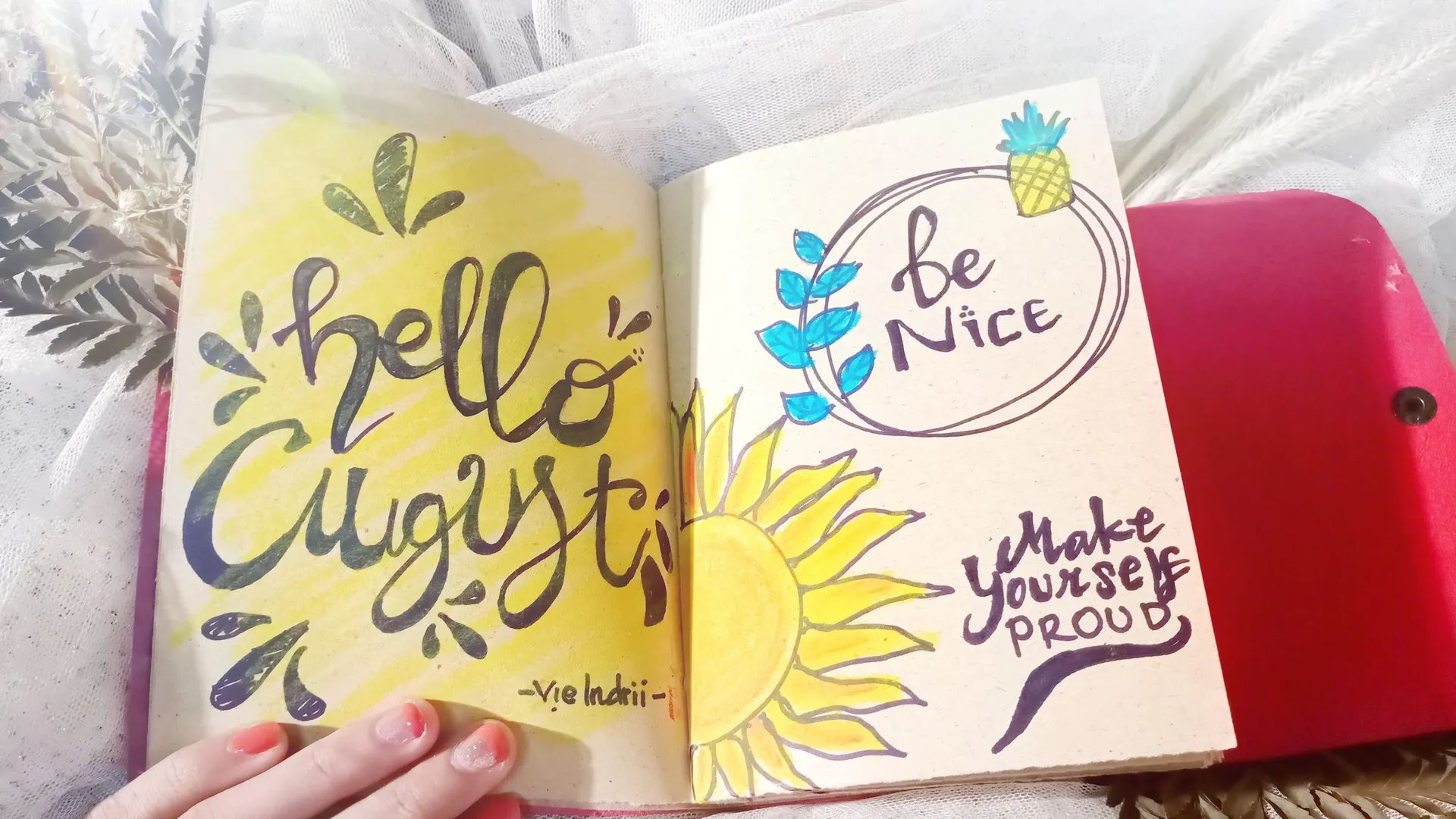

The image before you is one of pure, uninhibited creation. A wash of vibrant yellow, bold calligraphy, and cheerful doodles fill the pages of an open journal. You can almost feel the soft, fibrous texture of the paper under the artist’s hand, a willing canvas for their expression. In our Cileungsi workshop, this is the moment we build for—the instant a blank book becomes a personal artifact. The air here isn’t sterile like a factory; it’s alive with the earthy scent of Indonesian full-grain leather, the hum of our vintage sewing machines, and the focused silence of our nine craftsmen as they transform raw materials into vessels for creativity like this one.
This explosion of color and personal expression on a simple paper spread is the end of a long story. It’s a story that begins not in our workshop, but in a forest, a field, or a recycling facility. The paper’s ability to absorb those pigments without bleeding, its warm, inviting color, and the satisfying way it lays open—these are not happy accidents. They are the result of a conscious engineering philosophy that extends beyond the book itself to the very source of its components. It’s a philosophy that asks: what is the true cost of this page? And how can we, as craftsmen, honor both the user’s creativity and the environment that provides our materials?
We build more than journals; we build tangible proof of your brand’s commitment to sustainability.
Environmental Engineering in White Label Stationery: The Sustainable Advantages of Acid-Free and Tree-Free Substrates
For the modern procurement manager, brand strategist, or HR director, the term “sustainability” has evolved from a vague ideal into a critical business metric. When commissioning branded goods, the material choices made have a direct impact on brand perception, employee engagement, and corporate social responsibility reporting. In the world of stationery, this conversation begins with the paper. The transition to acid-free paper is the first step. Characterized by a neutral or alkaline pH, this paper is engineered for longevity, resisting the yellowing and embrittlement that plagues cheaper, acidic alternatives. But its advantages are also environmental. The processes required to create stable, acid-free pulp are often cleaner and lay the groundwork for a more sustainable product lifecycle. However, true environmental engineering goes much deeper, questioning the very source of the cellulose fibers themselves.
| Feature | Hibrkraft White Label Sustainable Option | Conventional Mass Production |
|---|---|---|
| Material Source | Certified FSC wood pulp, recycled/upcycled paper, or tree-free agricultural residues (sugarcane bagasse, bamboo, hemp). | Uncertified virgin wood pulp, often from poorly managed forests. No supply chain transparency. |
| Resource Intensity | Significantly lower water and energy consumption. Recycled paper saves ~26,500L of water per ton. Tree-free crops have high yields and short growth cycles. | Extremely high. Averages 2,700 liters of water per ton of paper from virgin pulp. Energy-intensive pulping process. |
| Ethical Benchmark | Independent third-party certifications (e.g., FSC Chain of Custody) provide verifiable proof of sustainable sourcing. | Relies on self-reported, often unsubstantiated “eco-friendly” marketing claims. High risk of greenwashing. |
| Brand Message | Demonstrates a sophisticated, proactive commitment to ESG goals. Aligns the brand with modern consumer and employee values. | Communicates a disregard for environmental impact or, at best, a focus on minimizing upfront costs over long-term brand value. |
The traditional manufacturing of paper from virgin wood pulp is a resource-intensive industrial process. It requires vast amounts of water—an average of 2,700 liters per ton of paper—and significant energy to break down wood chips and chemically separate the cellulose fibers from lignin. While modern mills have improved efficiency, the fundamental impact remains substantial. This has driven material engineers and conscious brands to seek alternatives. One of the most effective strategies is the use of recycled or upcycled paper. The environmental ROI here is staggering: recycling a single ton of paper saves not just water, but approximately 1,400 liters of oil and reduces the energy needed for fiber development by around 7%. For a B2B client, choosing recycled paper for a bulk order of 2,000 journals is not a small gesture; it is a quantifiable contribution to their corporate sustainability metrics.
Beyond recycling, the frontier of sustainable stationery lies in “tree-free” substrates. These are papers made from plants that are not trees, often utilizing agricultural residues or fast-growing, high-yield crops. In Indonesia, with our rich agricultural landscape, this is a particularly exciting frontier. Materials like sugarcane bagasse (the fibrous residue left after crushing sugarcane stalks), bamboo, kenaf, and hemp are becoming viable, high-quality alternatives. From an engineering perspective, these fibers are often easier to process, requiring fewer chemical inputs to achieve a desirable pulp. They also divert waste streams from landfills and reduce the pressure on our planet’s forests. As a white label partner, Hibrkraft can leverage its Indonesian network to source these innovative materials, allowing your brand to be at the forefront of this sustainable shift.

From Forest to Fiber: A Technical Breakdown of Sustainable Sourcing
When a client requests a sustainable white label journal, our role transcends simple assembly. We become supply chain consultants and material authenticators. If wood pulp is the chosen path, we insist on sourcing from mills that carry Forest Stewardship Council (FSC) certification. This is not just a logo; it’s a rigorous, technical guarantee. FSC’s “Chain of Custody” certification is an unbroken trail of accountability, tracking the wood from an FSC-certified forest, through every stage of processing and distribution, all the way to our workshop in Cileungsi. This guarantees that the paper in your journal did not contribute to deforestation, that forestry workers were treated fairly, and that indigenous rights were respected. It is the gold standard for responsible forestry and a non-negotiable benchmark for any brand serious about its environmental claims.
The material science of tree-free fibers is equally fascinating. Bamboo, for instance, is a type of grass that can grow to maturity in 3-5 years, compared to 20-80 years for the trees typically used for paper. It requires no pesticides and self-regenerates from its own roots. Sugarcane bagasse is an even more compelling story of upcycling. It is a waste product of the massive global sugar industry. By turning this residue into high-quality paper, we are creating value from something that would otherwise be incinerated or left to rot. The resulting paper has a wonderful character and texture, a subtle story of its own circular journey that adds a unique dimension to the final product.
This commitment to sustainability can and should extend to the cover. While we take great pride in our full-grain leathers sourced from respected Indonesian tanneries, we recognize the growing demand for vegan and bio-based alternatives. The material engineering in this space is incredible. We can now source materials like “apple skin leather,” which is made by upcycling the peels and cores from the apple juice industry, or “wine leather,” derived from the grape residue of winemaking. These innovative textiles offer a premium look and feel with a fraction of the environmental footprint of traditional plastics-based faux leathers (pleather). They are often produced with zero harmful chemicals and minimal water waste, offering an ethical and compelling story for your brand. Our role in a white label project is to present these options, explain the technical trade-offs, and help you select a material matrix that perfectly aligns with your brand’s values and budget.
The True Test: Aligning Brand Values with Material Choices
The ultimate stress test for a sustainable product is not physical, but ethical. Does it stand up to scrutiny? In an age of widespread greenwashing, consumers and employees are more skeptical than ever. A vague claim of being “eco-friendly” is no longer sufficient and can even be damaging. The test is whether a brand can provide transparent, verifiable proof of its sustainable claims. This is why we prioritize materials with independent, third-party certifications like FSC. It moves the conversation from a marketing narrative to a statement of fact.
The physics of brand alignment is simple: every touchpoint should reinforce the core values of the company. If your company publishes an annual ESG report detailing its commitment to reducing its carbon footprint, but then distributes thousands of corporate gifts made from uncertified virgin materials in a plastic wrapper, you create a cognitive dissonance. This erodes trust. Conversely, imagine a new employee receiving an onboarding kit. Inside is a beautifully crafted journal. On the inside back cover is a small, debossed note: “This journal is bound by hand in Indonesia. The cover is made from upcycled apple skins and the pages from 100% recycled, FSC-certified paper.” In that single moment, the company’s stated values are made tangible. The journal ceases to be just a gift; it becomes a piece of evidence that the company practices what it preaches.

“Wood, water, and human hands. These are the three ingredients of our craft. To disrespect one is to disrespect them all. True sustainability is not a marketing trend; it is the foundation of a craft meant to last for generations.”
This ethos from our Head Craftsman guides our entire production philosophy. We see ourselves not as consumers of materials, but as stewards. This responsibility informs how we work. We optimize our leather cutting to minimize waste, and the smaller offcuts are used to create small goods like bookmarks or cable holders. We use water-based adhesives where possible. This mindset is the essence of “Handcraft at scale”—a deep respect for the materials that only comes from working with them intimately every single day. This is a level of mindfulness that a fully automated, high-volume factory simply cannot possess.
The real-world application for our B2B clients is profound. When your salesperson leaves a journal with a potential client, they are leaving behind more than a branded object. They are leaving a conversation starter. A journal made from sugarcane bagasse paper is unique; it has a story. It allows your team to talk about innovation, circular economy, and a commitment to looking for smarter solutions—qualities you likely want associated with your own business. It elevates the interaction from a simple sales call to a discussion of shared values.
We address potential failure points with transparency. Sourcing these specialized materials can sometimes mean longer lead times or different pricing structures. We address this upfront. We work with you to build a realistic timeline and provide clear, component-level pricing so you can make informed decisions. Our 100% inspection policy remains critical. We check every single unit to ensure that these novel materials meet our rigorous standards for durability and finish. If a batch of recycled paper has too many inconsistencies or a bio-based cover doesn’t deboss cleanly, we identify it and solve it, protecting your investment and your brand’s reputation.
The Result: A Demonstrable ROI on Environmental Responsibility
The outcome of this environmentally-engineered approach is a white label product that does more than just carry your logo. It actively communicates your brand’s values. It is a powerful tool for stakeholder engagement, from attracting top talent who want to work for a responsible company, to building loyalty with customers who preferentially buy from sustainable brands. This is not a disposable commodity; it is a carefully considered brand ambassador.
The ROI on this strategy is multi-faceted. Firstly, there is the direct brand equity. Associating your company with quality, innovation, and sustainability creates a premium perception that can support higher price points for your core products or services. Secondly, it is a tool for employee engagement. Gifting sustainable products internally reinforces company culture and makes employees proud of their organization. Thirdly, it is a risk mitigation tool. By relying on certified, transparent supply chains, you protect your brand from the reputational damage of being associated with deforestation or unethical production practices. The 76% of consumers demanding sustainability are not just a market segment; they are the market.
Our commitment to quality is absolute, regardless of the material. Our defect replacement policy applies to every product that leaves our workshop. While handcrafted items have unique character, we guarantee their functional and aesthetic integrity. Should any product fail to meet the standards agreed upon during our transparent consultation process, we will replace it. This is the Hibrkraft promise: innovative materials, traditional craftsmanship, and unwavering accountability.

Why Partner with Hibrkraft for Sustainable Stationery?
Located in Cileungsi, Bogor, Hibrkraft operates as a focused workshop, not a massive, impersonal factory. Our team of around nine dedicated craftsmen allows us to maintain an exceptional level of quality control and flexibility, producing up to 2,000 bespoke units per month. This “Handcraft at scale” model is perfectly suited for clients who need premium quality and a compelling production story, without sacrificing the capacity for a significant bulk order.
Our white label service is a true partnership. We bring our deep knowledge of materials—from traditional Indonesian leathers to innovative bio-based textiles—to the table. Your brand, your vision, and your values lead the project. We are the skilled hands and logistical experts who bring it to life, ensuring the final product is exclusively yours, with no Hibrkraft branding. You get direct access to the owners for clear, efficient communication throughout the process.
We are experienced international shippers, with a strong record of delivering on time to clients in Canada, Germany, the Netherlands, the UAE, and beyond via trusted carriers like DHL Express. We manage the complexities of production and global logistics so you can focus on the bigger picture: building a brand that is as responsible as it is successful.
Let us help you create a product that reflects not only your brand’s aesthetic, but its conscience.
Sources & References
- Berisford, K. M. (2024). Acid-Free vs Archival: What You Need to Know About Paper Quality for Your Art.
- Batista, C. (2022). Is Leather Ethical? The Full Story Behind The Popular Material.
- Forest Stewardship Council (2025). Paper & Packaging.
- Suryandono, A. R., et al. (2023). The experiment of recycled paper-making process and its water resistance on a household scale.
- Wikipedia (2024). Tree-free paper.
Disclaimer: this post are written in english to reach more audience.