
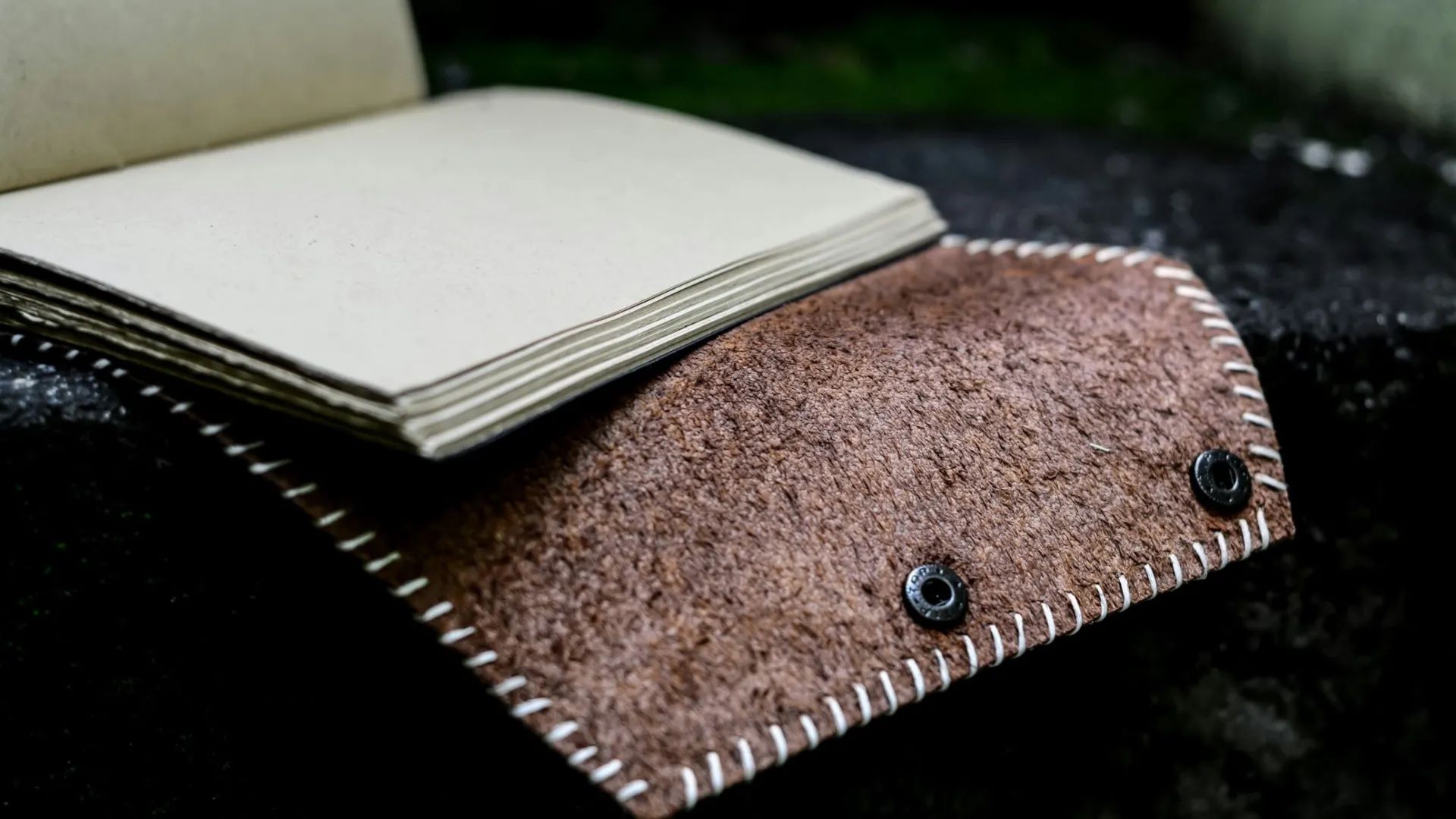

The image before you evokes a raw, tactile honesty. A journal with a napped, fibrous cover, perhaps of rough-out Indonesian leather or a dense felt, is held together by bold, contrasting saddle stitching. The paper block, with its deckled, natural-looking edges, rests on top. In our workshop in Cileungsi, Bogor, this is a familiar landscape of textures. It’s the scent of leather hides from our suppliers in Malang, the slight friction of waxed thread pulled through an awl hole, and the satisfying heft of a finished text block in a craftsman’s hand. This is a product that speaks of its own making, honestly and without artifice.
This powerful sense of authenticity, communicated by the rugged cover and visible stitching, must be matched by an equal integrity within. The paper cannot be a lie. A journal that looks this genuine on the outside cannot have a core that relies on chemical tricks to appear “high quality.” This is the foundation of our manufacturing philosophy: true permanence is holistic. It requires that the invisible science of the paper—its very molecular makeup—is as honest and enduring as the visible craft of the binding. This is why we must have a critical conversation about a deceptive, and ultimately destructive, component found in most commodity papers: Optical Brightening Agents.
We build authentic brand artifacts, engineered for chemical honesty from the inside out.
Engineering Structural Permanence for White Label Journals: The Technical Requirement for Optical Brightener-Free Archival Paper
For a B2B buyer, procurement manager, or brand strategist, the color “white” in paper is not a simple attribute; it is an engineered feature with profound implications for a product’s longevity and brand perception. The crisp, brilliant white of standard office paper is almost never natural. It is an illusion created by chemical additives called Optical Brightening Agents (OBAs), also known as fluorescent whitening agents. While a paper treated with OBAs may be labeled “acid-free” due to its neutral pH, it fundamentally fails to meet the rigorous technical standards of a true archival substrate. The exclusion of OBAs is a critical, non-negotiable benchmark that separates a permanent, legacy-quality asset from a disposable commodity destined to yellow and degrade.
| Engineering Parameter | Hibrkraft Archival Standard (OBA-Free) | Standard “Acid-Free” Paper (with OBAs) |
|---|---|---|
| Source of Whiteness | Inherent purity of the cellulose fibers (e.g., 100% cotton or purified chemical pulp). Results in a stable, warm, natural white. | Relies on OBAs, fluorescent dyes that absorb UV light and re-emit it as blue light, creating an artificial, brilliant white. |
| Chemical Stability | Extremely high. The color is stable because the underlying molecular structure of the cellulose is pure and unchanging. | Low. OBAs are complex organic molecules that are not lightfast. They break down under UV exposure (sunlight, office lighting). |
| Long-Term Appearance | Maintains its consistent, natural color for centuries. Ages gracefully without discoloration. | The paper reverts to its natural, often yellowish, color as OBAs degrade. This can happen unevenly, creating a blotchy, cheap look. |
| Degradation Byproducts | No harmful byproducts. The paper’s buffered, lignin-free nature ensures a non-destructive aging process. | The breakdown of OBA molecules can create acidic byproducts, which can then attack the paper’s own cellulose fibers, accelerating its decay. |
| Brand Implication | Communicates authenticity, integrity, and a long-term vision. A permanent asset that reflects enduring quality. | Communicates a preference for short-term, superficial appearance over long-term substance. A ticking bomb for brand reputation. |
The technical case against OBAs is rooted in their very function. These fluorescent dyes work by absorbing invisible ultraviolet (UV) light and re-emitting it as visible light in the blue spectrum. This addition of blue light counteracts the natural yellowish cast of wood pulp, making the paper appear brighter and “whiter” to the human eye. This is a clever chemical trick, but it comes at a steep price: the complex organic molecules that make up these dyes are not stable. They are highly susceptible to degradation from continued exposure to UV light—whether from direct sunlight or, more insidiously, from the constant hum of fluorescent office lighting. As these molecules break down, two things happen. First, they stop working, causing the paper to revert to its natural, yellower color. Second, and more destructively, the byproducts of their decay can be acidic, introducing a new agent of degradation into what was once a pH-neutral sheet of paper.
For a B2B client commissioning a premium white label journal, this is a critical failure point. A journal specified with OBA-treated paper is a product with built-in obsolescence. It may look brilliantly white when it’s delivered, but over the course of a few years on a desk or a shelf, it will begin to visibly yellow and discolor, often in an uneven, blotchy pattern. This makes the product—and by extension, the brand on its cover—look cheap and poorly made. A true archival strategy mandates the complete exclusion of OBAs. The beautiful, warm, natural white of an archival sheet comes from the inherent purity of its fibers—typically 100% cotton or meticulously purified, lignin-free chemical pulp. This color is stable, honest, and will not change over centuries, ensuring your brand is associated with enduring, authentic quality, not a fleeting chemical illusion.

The Anatomy of Authenticity: A Technical Breakdown of True Whiteness
When you partner with Hibrkraft for a white label project, we build your product on a foundation of chemical honesty. Sourcing OBA-free paper is a core part of this commitment. The process begins with a deep dive into our paper suppliers’ manufacturing data. Since the term “archival” is not globally regulated, we cannot rely on marketing claims. We must scrutinize the technical specifications to verify that OBAs have not been used at any stage of the process, from the initial pulp slurry to the final surface coatings.
The material science of a naturally white sheet is one of subtraction, not addition. The goal is to remove all the impurities from the cellulose—the lignin, the hemicellulose, the metallic contaminants—until only the strong, stable, and naturally bright cellulose fibers remain. This is a more difficult and resource-intensive process than simply bleaching a low-quality pulp and then adding OBAs to mask the remaining yellowness. However, it is the only path to true permanence. The resulting paper has a subtle, warm, and inviting color that is consistent through and through. It is a color that does not need to shout; it communicates its quality quietly and confidently.
This commitment to purity extends to every component of the book. An OBA-free text block can still be compromised if it’s bound with cover boards or endpapers that are not also chemically stable. This is why our workshop in Bogor takes a holistic approach. Our craftsmen, who handle these materials every day, understand this interplay. They are trained to spot the tell-tale, almost bluish, artificial cast of a paper treated with OBAs, distinguishing it from the authentic warmth of an archival sheet. This hands-on, sensory verification is an integral part of our 100% inspection process and a key benefit of our “Handcraft at scale” model. It’s a level of nuance that a high-speed, automated production line simply cannot achieve.
The Core – The UV Stress Test: Simulating a Lifetime of Exposure
The ultimate test of a paper’s color stability is its performance under long-term UV exposure. We call this the “UV Stress Test.” While we don’t operate a formal laboratory, our quality control is informed by the principles of this test, which is often quantified in the industry using the “Blue Wool” scale. Imagine two of your branded journals placed on a windowsill. One is made with standard, OBA-treated paper. The other is made with our true archival, OBA-free paper. After just one year, the difference would be stark.
The physics of this failure is clear. The journal with OBAs would show a noticeable yellowing, particularly on the exposed page edges. The brilliant white you started with would look faded and uneven. The OBA-free journal, however, would look virtually unchanged. Its color is not dependent on unstable additives, so there is nothing to break down. This test reveals the fundamental difference between a cosmetic product and an engineered one. One is designed to look good in the short term; the other is engineered to last for a lifetime. When you commission a white label journal, you are deciding which of these two categories your brand belongs to.

“Authenticity is the most permanent quality. A material that is honest about what it is—pure fiber, natural color—has no secrets to hide and no lies that will be exposed by time. We build with honest materials because a brand’s reputation should be built on the same.”
This principle from our Head Craftsman is our promise to our clients. We build products that are as good on the inside as they look on the outside. This commitment to avoiding chemical shortcuts like OBAs is a direct reflection of our respect for the craft, for the materials, and for the brand that will ultimately put its name on our work.
The real-world application for your business is a matter of long-term brand perception. The journal you give to a key client or a new employee is a physical representative of your company. If that object visibly degrades over time, the subconscious message it sends is one of decay and unreliability. It suggests a focus on superficial appearances over underlying substance. Conversely, a journal that maintains its integrity year after year sends a powerful message of stability, quality, and timelessness. It becomes a constant, quiet affirmation of your brand’s own enduring values.
The Solution: A Visibly Authentic Asset That Builds Trust
By making the exclusion of optical brighteners a non-negotiable technical requirement, the result is a product of visible and verifiable authenticity. It is a brand asset that is engineered to age gracefully, maintaining its color stability and structural integrity for generations. This is a white label journal that will not betray your brand with blotchy yellowing or chemical decay. It is a permanent vessel that builds trust through its own unwavering quality.
The Return on Investment (ROI) of this choice is immense. You are investing in a product that eliminates the risk of reputational damage from a failing, degrading physical good. You are aligning your brand with the values of authenticity and long-term quality, which builds deep and lasting customer loyalty. Over the long life of the journal, the initial investment in a superior, OBA-free paper pays for itself many times over in sustained brand equity and positive perception.
Our commitment to this standard is absolute, and so is our transparency. Our defect replacement policy is a core component of our B2B service. While every handcrafted object has unique nuances, its technical and chemical integrity is guaranteed. If any product fails to meet the agreed-upon archival benchmarks—including the exclusion of OBAs—due to a flaw in our materials or craftsmanship, we will replace it. This is the foundation of a true, accountable manufacturing partnership.
Why Partner with Hibrkraft for Your White Label Journals?
Hibrkraft is a specialized workshop in Cileungsi, Bogor, where traditional Indonesian craftsmanship is guided by a rigorous understanding of material science. Our dedicated team of approximately nine artisans operates on a model of “handcraft at scale,” which allows us to produce up to 2,000 premium units per month with a focus on quality and material integrity that large, automated factories cannot match.
Our White Label service is a true collaboration. We act as your expert manufacturing partner, transforming your vision into a tangible product. The finished journal is exclusively yours, built to your exact technical specifications and bearing your branding, with no Hibrkraft markings. You benefit from direct communication with the owners for a responsive, transparent, and efficient process from start to finish.
We are seasoned professionals in managing the complexities of global logistics, with a proven history of successfully delivering bulk orders to clients in Canada, Germany, the Netherlands, the UAE, and worldwide. We use trusted carriers like DHL Express to ensure your valuable investment is protected and arrives safely and on schedule. Let us manage the details of production and shipping, so you can focus on building your brand with a product of true, enduring, and authentic quality.
Let’s build something honest together.
Sources & References
- Berisford, K. M. (2024). Acid-Free vs Archival: What You Need to Know About Paper Quality for Your Art.
- StepbyStepArt (2025). Comments on Acid-Free vs Archival.
Disclaimer: this post are written in english to reach more audience.