
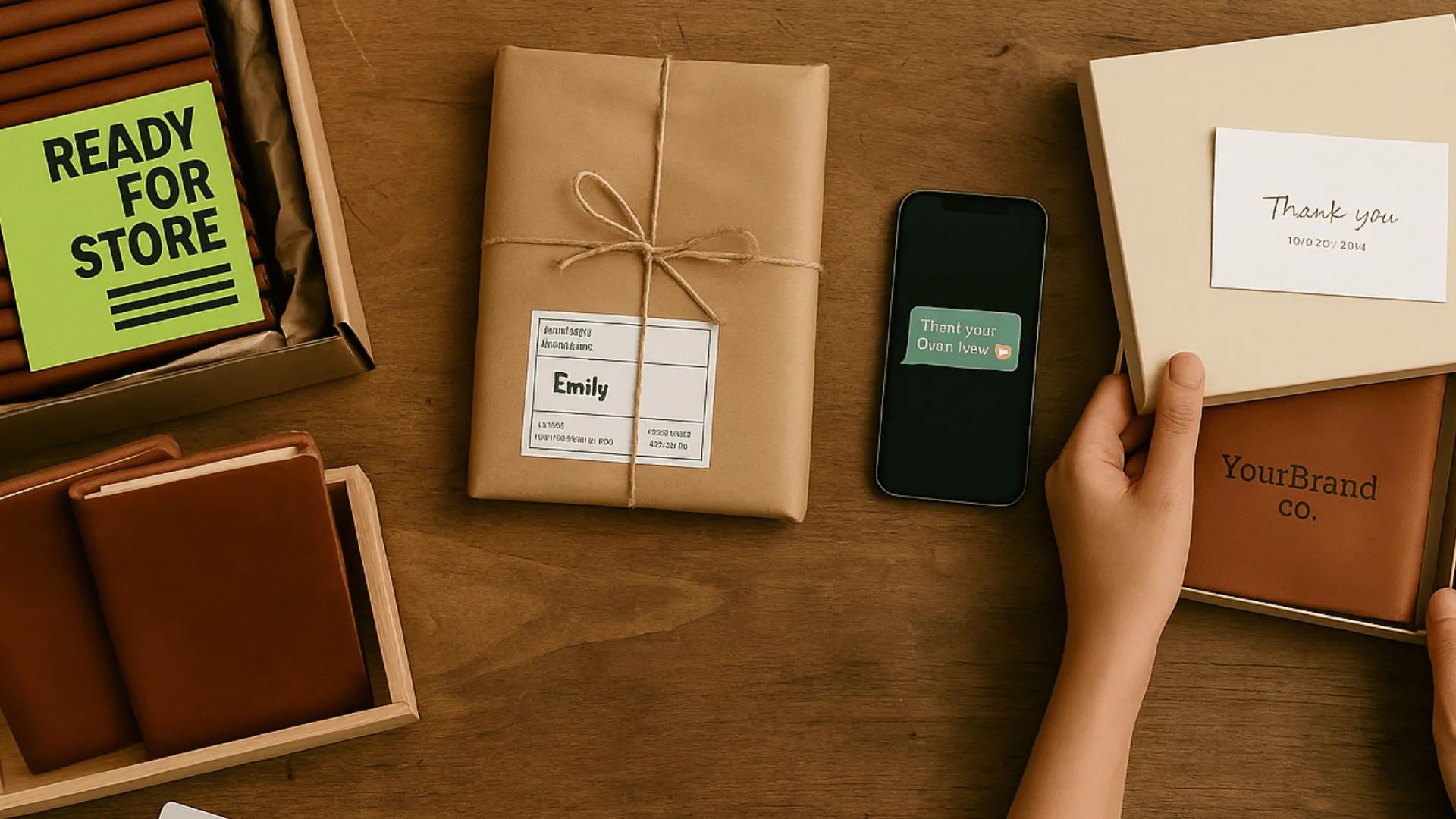

The scene in the image is the final, most critical meter of a thousand-kilometer journey. A journey that began in the sun-drenched fields of Central Java, moved through the skilled hands of tanners in Magelang, and culminated on a craftsman’s bench in our Cileungsi workshop. Now, it’s in your customer’s hands. The box, bearing your brand, is opened. Inside lies a leather journal, debossed with your logo. This is the moment of truth where perception becomes reality, and your brand’s reputation is either solidified or questioned. It’s the moment a customer decides if the item is perfect, or if it’s flawed.
This single unboxing experience is the culmination of our partnership. Every choice we made in our workshop—the specific hide selected, the tension of the waxed thread, the depth of the debossing—was made to ensure this moment is a success for your brand. The image shows more than just a product; it shows a system. A box of “Ready for Store” inventory, a package addressed to an end-customer, and the final, premium presentation. This entire ecosystem hinges on a shared understanding of one crucial concept: the difference between authentic character and actual damage.
Your profitability depends not just on the quality of the product, but on the quality of the story you tell about it.
Managing Defects and Returns: Creating a Customer Service Policy for Handmade Goods
For any entrepreneur building a brand with handmade goods, the customer service inbox can be a source of both pride and anxiety. While positive reviews build momentum, a single complaint about a “scratched” or “discolored” product can feel like a direct challenge to your quality standards. The most common source of friction in the world of leather goods stems from a fundamental misunderstanding of the material itself. Mass-market consumers, conditioned by the sterile uniformity of synthetic “PU leather,” often perceive the natural markings of genuine, full-grain leather as defects. It is your primary responsibility as the brand owner to bridge this knowledge gap. Your customer service policy should not be a reactive defense, but a proactive educational tool.
The core of this strategy is to clearly and confidently differentiate between “Character” and “Damage.” Character refers to the unique, natural, and unavoidable markings inherent to a high-quality, natural material like full-grain leather. These are the signatures of the animal’s life—healed scars, insect bites, fat wrinkles, and subtle variations in color. These marks are not flaws; they are proof of authenticity and what makes each piece a one-of-a-kind item. Damage, on the other hand, refers to mistakes made during the manufacturing process. This includes functional failures or aesthetic blemishes that are a result of poor craftsmanship, not the nature of the material. This is what our 100% manual inspection process is designed to eliminate entirely.
| “Character” (Proof of Authenticity) | “Damage” (Manufacturing Defect) |
|---|---|
| Healed Scars & Stretch Marks: Faint lines or patterns on the leather surface from the animal’s life. These do not compromise the leather’s integrity. | Fresh Scratches or Gouges: Deep cuts that have occurred post-tanning, often exposing the raw fibers beneath. A clear sign of mishandling. |
| Color & Grain Variation: Subtle differences in hue or texture across the surface of the hide. Every piece of leather absorbs dye uniquely. | Glue Stains or Ink Marks: Unintended blemishes from the assembly process. A clear sign of a quality control failure. |
| Fat Wrinkles: Natural creases, often around the neck or shoulder area of the hide, indicating a strong, flexible piece of leather. | Broken or Skipped Stitches: A failure in the binding process that compromises the structural integrity of the journal. |
| Insect Bites: Small, pin-point marks on the surface that are fully healed over. | Misaligned or Crooked Branding: A debossed, foiled, or engraved logo that is noticeably off-center or tilted. |
| Natural Patina Development: The darkening and polishing of the leather over time through handling and exposure to oils and sunlight. A desirable trait. | Cracked or Peeling Finish: A sign of a low-quality hide or improper finishing, which is not characteristic of our sourced Full or Top Grain leathers. |
By defining these terms for your customer on your product pages, in an FAQ section, or even on a small card included with your packaging, you set the expectation of authenticity. You transform what could be a complaint—”Why is there a weird line on my cover?”—into a point of appreciation—”Wow, this is real leather, not a cheap imitation.” This doesn’t just reduce returns; it actively builds a more sophisticated customer base that values the very things that make your product special. It shifts the conversation from a search for machine-like perfection to an appreciation for handcrafted uniqueness.
Let’s examine the material science. Full-grain leather is the highest quality grade. It comes from the very top layer of the hide and includes all of the natural grain. The dense fiber structure in this layer is what gives the leather its incredible strength and durability. The “defects” are part of this structure. A healed scar is a point where the skin’s collagen fibers knitted themselves together even more densely. A fat wrinkle is a testament to the life and movement of the animal. To sand these away, as is done with lower grades of leather, is to literally weaken the material in the pursuit of a sterile, plastic-like uniformity. When we, at Hibrkraft, cut a pattern from a hide sourced from our partners in Garut, we do it with an artisan’s eye, ensuring major blemishes are avoided but that the natural character of the hide is honored. This is the story your brand can proudly tell.

Implementing a Fair & Protective Returns Policy
With the foundation of “Character vs. Damage” established, you can now build your policy. Your returns page should state clearly that you do not accept returns for natural leather characteristics, and you should provide a link to a page that visually explains what those are. Conversely, you should state with absolute confidence that you offer a 100% guarantee against any manufacturing defects. This positions your brand as an expert curator of quality, not an unreasonable seller.
Here’s how to structure your communication for maximum clarity and brand protection:
- Product Descriptions: Don’t hide the fact that your products are made from natural materials. Celebrate it. Use phrases like: “Crafted from genuine Indonesian full-grain leather, each journal possesses its own unique character. Please expect minor variations in color and texture, and natural markings that are a sign of the high-quality, authentic material we use.”
- Packaging Insert Card: A small, beautifully designed card included in the box can work wonders. One side can be a “Thank You” note, and the other can be “A Note on Your Handmade Journal,” briefly explaining the nature of real leather and how it will develop a beautiful patina with use. This intercepts a potential complaint at the most emotional moment: the unboxing.
- The FAQ Page: Create a dedicated section on your website titled “Our Materials & Craftsmanship.” Include high-quality photos that show examples of leather character. Answer questions proactively: “Is a mark on my journal a defect?” “Why doesn’t my journal look exactly like the one in the photo?”
The human element in this process is paramount. Just as our craftsmen in Cileungsi see the unique potential in each hide, your customer service should see the person behind each query. If a customer emails with a complaint, your first response should be empathetic. Ask for a photo. If the photo clearly shows a manufacturing defect (Damage), immediately apologize and initiate your replacement process. If it shows a natural marking (Character), this is your opportunity to educate and delight. Explain what the mark is and why it’s a sign of quality. More often than not, this turns a potential detractor into a loyal brand advocate.
The Hibrkraft Safety Net: Our 100% Manual Inspection
Our role as your manufacturing partner is to give you the confidence to implement this type of assertive, education-based customer service policy. We provide the “safety net.” You can be firm about not accepting returns for leather character precisely because we are so rigorous about eliminating true manufacturing damage. Before a single journal is packed into a carton destined for your warehouse, it undergoes a multi-point inspection by human hands and eyes.
This is not statistical quality control, where only a fraction of a batch is checked. We inspect every single unit. Our craftsmen run their fingers along every line of stitching to feel for snags or loose threads. They hold each cover up to the light to check for post-production scuffs or glue residue. They open and close every book to ensure the binding is sound and the paper block is perfectly set. They verify the placement and clarity of your debossed logo. This meticulous process is designed to filter out the entire “Damage” column from the table above. We take responsibility for the craftsmanship so you can focus on selling the story.

“The hide tells the story of a life lived. Our job is not to erase that story, but to give it a strong and beautiful structure. A broken stitch is our failure. A healed scar is nature’s signature. We must know the difference.”
This is the guiding principle in our workshop. We believe that honesty in materials is fundamental to the integrity of a product. When you partner with Hibrkraft, you are leveraging this philosophy. We empower you to have transparent conversations with your customers because we are transparent with you. You will never receive a shipment where known defects are hidden or passed along. Our direct owner communication ensures that any concerns about quality are addressed at the source, long before they can become a problem for your end-customers.
Imagine your customer unboxing your product, as seen in the photo. They feel the texture of the leather. They see your logo, clean and sharp. They open the cover and the book lays flat. The experience is seamless. Even if they notice a small, natural line on the back cover, the overwhelmingly positive quality of the construction reinforces the messaging you’ve provided on your website. They recognize it not as a flaw, but as a feature. This alignment of physical quality and brand storytelling is the bedrock of a premium, defensible brand.
Our quality control is your insurance policy. It protects your investment, your brand’s reputation, and your bottom line. We address the potential failure points—the weak glues, the uneven stitching, the crooked branding common in mass production—so they never reach your inventory. We build the quality in, so you can build your brand on it.
The Result: Reduced Chargebacks, Increased Loyalty
The immediate, tangible result of this combined strategy—proactive customer education backed by rigorous workshop QC—is a dramatic reduction in returns and chargebacks. You spend less time and money on reverse logistics and more time on growing your business. Customer complaints related to quality will dwindle, replaced by emails from enthusiasts who appreciate the unique nature of their handmade product.
The long-term ROI is even more significant. You are building a brand that commands trust and can justify a premium price point. Customers who feel educated and respected become repeat buyers and brand evangelists. They leave 5-star reviews that mention the “beautiful, authentic leather” and the “obvious quality of the craftsmanship.” This user-generated content is marketing gold, reinforcing your brand story and attracting new customers who value authenticity over sterile perfection.
And in the spirit of a true partnership, Hibrkraft stands behind you with our 100% Defect Replacement Policy. In the exceptionally rare case that a product with genuine manufacturing damage (as we define it) makes it to your customer, we will replace it. This is our guarantee. We share the risk because we are confident in our process. We are not a faceless supplier; we are your workshop.

Why Partner with Hibrkraft?
Our workshop in Cileungsi, Bogor, is the engine for ambitious brands who want to deliver premium, handcrafted goods without the risks of managing production themselves. With a capacity of up to 2,000 units per month, our small team of ~9 dedicated craftsmen can support your brand as it grows, from initial sample batches to consistent, monthly inventory fulfillment.
Through our White Label service, your brand is the hero. We work in the background, applying our expertise in leatherwork and bookbinding to bring your vision to life. Your brand, your specifications, our hands. We provide the manufacturing foundation and the quality assurance that allows you to build a powerful, profitable brand story.
With proven experience shipping globally via DHL Express to clients from Europe to the Middle East, we are a reliable partner in your supply chain. We offer transparent pricing and direct communication, ensuring a smooth and predictable production cycle. Let us handle the craft, so you can handle the customer.
Let’s build a brand that’s built to last.
Disclaimer: this post are written in english to reach more audience.