
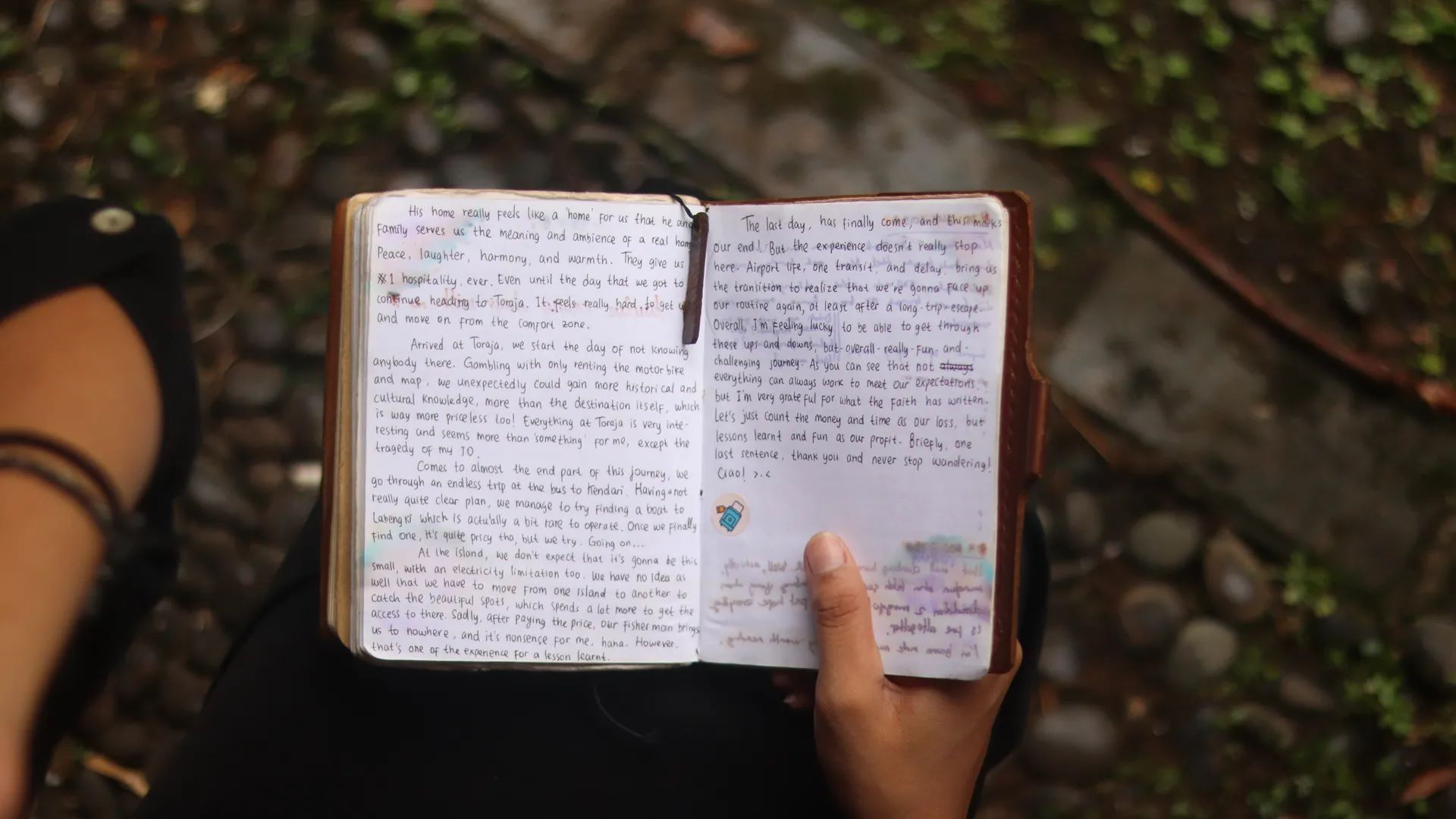

The image before you captures the very essence of a journal’s purpose: it is a repository for a story, a vessel for a journey. The pages are filled with dense, handwritten text, a personal archive of experiences and reflections. In our workshop in Cileungsi, Bogor, this is the end-use that inspires our craft. The air here, fragrant with the scent of full-grain leather from our Indonesian suppliers and the clean, earthy smell of high-quality paper, is the atmosphere in which we build these vessels. Our nine craftsmen, with the steady focus of artisans, understand that they are not merely binding paper; they are creating a trusted companion for someone’s life story.
This intimate act of recording memories, so beautifully depicted, is a mirror for the professional world. A travel log is a personal archive; a corporate notebook is a professional one, containing project notes, strategic plans, or proprietary research. In both cases, the value lies in the information captured on the page. That value is completely dependent on the legibility of the text. This is where the invisible science of archival engineering becomes paramount. The paper must be a stable, non-reactive canvas, specifically designed to resist the relentless, destructive power of light.
We don’t just build journals; we engineer permanent, lightfast archives for your brand’s most important stories.
Engineering Archival Permanence: Utilizing the Blue Wool Scale for High-Performance White Label Journals
For a procurement manager or brand strategist, the concept of “quality” in a paper product must extend beyond its immediate look and feel. True quality is synonymous with permanence, and the greatest threat to permanence is light. All light, from direct sunlight to the ambient glow of office fluorescents, contains ultraviolet (UV) radiation. This UV radiation is a form of high-energy photons that, upon striking a sheet of paper, can break the chemical bonds of the cellulose fibers, the lignin (if present), and the ink pigments. This molecular-level damage is what we perceive as fading, yellowing, and embrittlement. Therefore, a paper’s ability to resist this degradation—its lightfastness—is one of the most critical performance metrics for any journal intended to be a long-term asset.
| Performance Metric | The Hibrkraft White Label Archival Standard | Commodity-Grade Stationery Paper |
|---|---|---|
| Lightfastness Rating | Engineered to achieve a high rating on the Blue Wool scale (BW6-BW8), ensuring minimal fading over many decades. | Unrated and highly variable. Prone to rapid, noticeable fading within a few years of regular exposure to light. |
| UV Degradation | Uses purified, lignin-free cellulose and stable pigments that are inherently resistant to being broken down by UV photons. | Often contains lignin, which is highly photosensitive and breaks down into yellow acidic compounds (chromophores), accelerating decay. |
| Data Integrity | Protects the legibility of written content for generations. Safeguards intellectual property and historical records. | Compromises data. Faded ink and a discolored background can render important notes illegible, resulting in permanent data loss. |
| Brand Implication | Associates the brand with permanence, stability, and foresight. A product that visibly endures builds trust. | A journal that fades suggests the brand is temporary and its quality is superficial. It becomes a tangible symbol of unreliability. |
To move this critical characteristic from a vague concept to a verifiable technical benchmark, the archival industry uses a standardized test known as the Blue Wool scale. This is not a subjective assessment but a rigorous, comparative scientific method. A sample of the paper to be tested is placed in a controlled chamber and exposed to a powerful, calibrated light source designed to simulate accelerated aging. Alongside the sample are eight strips of wool, each dyed with a blue pigment of known, progressively increasing lightfastness. The paper’s performance is rated from BW1 (fugitive, fades very quickly) to BW8 (extremely lightfast) based on which strip of blue wool fades at the same rate. A paper rated BW7 or BW8 is considered to have excellent archival permanence, suitable for museum-quality documents.
For a B2B client, specifying a paper with a high Blue Wool rating is the ultimate form of risk management. It is a technical guarantee that the branded journal you commission will not become a faded, illegible liability in five or ten years. It ensures that the vital information recorded within—be it a decade of meeting notes, the genesis of a patented invention, or a personal family history—will remain crisp and clear for generations. While it’s important to be realistic—no cellulose-based material is 100% immune to fading under constant, intense exposure—a high-performance, lightfast paper slows the rate of degradation so dramatically that, for all practical purposes, it ensures permanence.

The Anatomy of Stability: A Technical Breakdown of Lightfast Materials
When a client partners with Hibrkraft for a white label project requiring archival lightfastness, we initiate a meticulous material sourcing process. Our role is to act as your expert consultant, navigating the technical specifications of our Indonesian paper suppliers to find a substrate that meets these demanding benchmarks. The engineering of a lightfast paper begins at the pulp stage. It must be made from high-purity, lignin-free cellulose. Lignin, the organic polymer found in wood, is the primary culprit in light-induced yellowing, making its complete removal a non-negotiable first step.
The stability is further enhanced through the use of light-stable pigments and sizing agents within the paper itself. The entire chemical composition of the sheet is designed to be as non-reactive to UV radiation as possible. This commitment to a holistic, stable system extends beyond the paper. For our premium leather journals, we can collaborate with our tannery partners in Garut and Magelang to select hides that have undergone retanning processes. This involves using specific dyes and fatliquors that improve the leather’s own lightfastness and resistance to heat-yellowing, ensuring that the cover of your journal ages as gracefully as the archival paper it protects.
This deep material knowledge is where the value of our “Handcraft at scale” model becomes clear. In our Bogor workshop, our craftsmen are not just assemblers; they are artisans with a deep, tactile understanding of their materials. They can discern the subtle differences between paper stocks and understand how a paper’s surface texture and hardness will interact with different inks. While we don’t supply the pens, we understand that our paper must provide a stable canvas. A chemically reactive, non-lightfast paper can actually accelerate the fading of certain inks. By providing a pure, stable, and archival-quality substrate, we are creating the best possible environment to preserve the writing itself, ensuring the entire system—paper and ink—achieves maximum longevity.
The Core – The Decades-on-a-Desk Stress Test
The truest test of a journal’s lightfastness is a decade on a desk. This is the real-world stress test. The journal is not stored in a dark, climate-controlled archive. It is left open, exposed to the daily cycle of sunlight from a window and the constant exposure to fluorescent or LED office lighting. This is a relentless, low-level chemical assault. Our quality assurance process is designed to select materials that can win this long, slow war of attrition.
The physics of this battle is a game of molecular stability. Every photon of UV light that strikes the page is a tiny energy bullet. If the molecules of the paper and ink are unstable, these bullets will easily break them apart, causing fading and discoloration. If the molecules are inherently stable, they can absorb or deflect this energy without breaking. Specifying a paper with a high Blue Wool scale rating is, in essence, choosing a material with superior molecular armor. It is a proactive engineering decision to ensure the product’s long-term survival in its natural habitat.

“A story is a fragile thing. It can be forgotten or it can be erased by the very light that allows us to read it. Our task as craftsmen is to build a home for that story that is stronger than the forces that would reclaim it. A truly archival book is a fortress for memory, and its walls are made of lightfast paper.”
This philosophy from our Head Craftsman guides our commitment to our clients. While we engineer our products for maximum resilience, we also believe in empowering our clients with knowledge. For true archival preservation, a stable storage environment is key. We recommend that when not in use, journals containing critical information be stored away from direct light in a stable environment, ideally around 20°C and 55% relative humidity. For documents that need to be displayed, using UV-protected or museum-quality glass in the frame is a crucial secondary safeguard. Our role is to provide the best possible archival vessel, and then to provide the knowledge to ensure its contents last for centuries.
For your brand, the real-world application is one of profound trust. When you give a client or an employee a journal engineered for lightfastness, you are giving them a tool they can rely on. They can write in it, reference it for years, and trust that their notes will remain clear and legible. This reliability becomes directly associated with your brand. It is a powerful, subconscious message that your company builds things—products, relationships, plans—that are meant to last.
The Solution: A Verifiable, Future-Proof Asset That Safeguards Data
By making lightfastness, as quantified by the Blue Wool scale, a core technical requirement, the result is a product that is verifiable, predictable, and future-proof. It is a white label journal that is not just beautiful on day one, but is engineered to remain beautiful and, more importantly, functional for generations. It is a brand asset that actively safeguards the data it contains, protecting your intellectual property and preserving your corporate or personal history.
The Return on Investment (ROI) for this level of technical specification is clear and compelling. It is an investment in data security, brand reputation, and long-term customer goodwill. The marginal cost of sourcing a high-performance, lightfast paper is insignificant compared to the potential cost of losing critical data or the reputational damage caused by a branded product that visibly fails and degrades over time. It is a strategic choice to align your physical merchandise with the same high standards of quality and reliability that you claim for your core business.
Our commitment to delivering on these technical promises is backed by our absolute guarantee. Our 100% inspection process and transparent defect replacement policy are the cornerstones of our B2B service. While every handcrafted journal has its own unique character, its performance against agreed-upon technical benchmarks is non-negotiable. If any product fails to meet the standards of quality and permanence we have promised, we will make it right. This is the foundation of a true, accountable manufacturing partnership.
Why Partner with Hibrkraft for Your High-Performance Journals?
Hibrkraft is a specialized workshop in Cileungsi, Bogor, where the art of Indonesian craftsmanship is fused with a rigorous, engineering-led approach to material science. Our dedicated team of approximately nine artisans gives us the unique ability to produce up to 2,000 premium units per month with the meticulous attention to detail and material expertise that a large, automated factory cannot provide.
Our White Label service is a fully collaborative partnership. We act as your expert production team in Indonesia, transforming your vision into a tangible, high-performance product. The final journal is exclusively yours, built to your exact specifications and bearing your branding. You benefit from direct communication with the owners for a transparent and efficient process, allowing you to leverage our deep knowledge of archival materials and traditional bookbinding techniques.
We are highly experienced in managing the complexities of global logistics, with a proven history of successfully delivering custom orders to clients in Canada, Germany, the Netherlands, the UAE, and worldwide. We use trusted carriers like DHL Express to ensure that your valuable investment is protected and arrives safely and on time. Let us manage the complexities of production and shipping, so you can focus on building your brand with a product of true, enduring, and verifiable quality.
Let’s build a product that will stand the test of time, and the test of light.
Sources & References
- Berisford, K. M. (2024). Acid-Free vs Archival: What You Need to Know About Paper Quality for Your Art.
- StepbyStepArt (2025). Comments on Acid-Free vs Archival.
- SWITCH-Asia (2021). Best Practice Guide for Sustainable Vegetable-Tanned Yak Leather Manufacturing.
Disclaimer: this post are written in english to reach more audience.