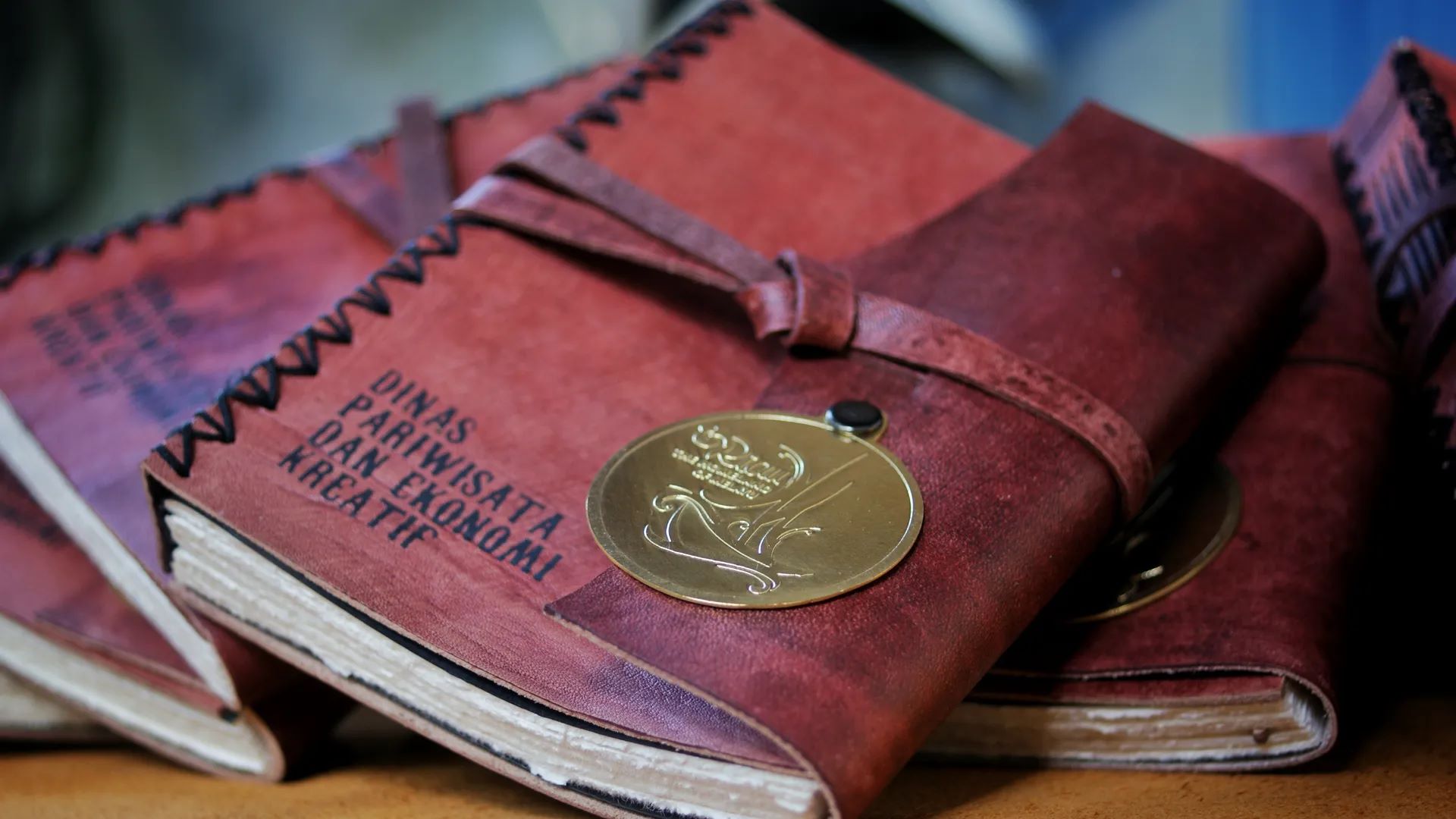

The air in the finishing section of our Cileungsi workshop is thick with the scent of dyed leather and curing ink. On a large wooden table sits a small batch of journals, the result of a high-profile commission, identical to the ones in the image. The leather is a deep, variegated crimson, sourced from a tannery in Malang, with a rugged texture that begs to be touched. Thick, black waxed thread is woven through the spine in a bold saddle stitch, a testament to the strength of its construction. On the cover, the screen-printed name of a government creative agency sits in sharp contrast to the rustic hide. But the centerpiece is a custom-made, laser-engraved brass medallion, affixed to the wraparound strap. It’s a stunning, multi-layered piece of craftsmanship.
This object is the physical proof of a successful collaboration. It’s the point where a client’s vision, an artist’s skill (in the medallion’s design), and our workshop’s execution converge. Each element—the specific stitch, the screen-printed text, the metalwork—had to be perfectly integrated to create a cohesive, premium product that feels important and permanent. This is the challenge and the opportunity that every brand faces when they decide to elevate their product line with commissioned art. It’s a journey from a simple idea to a tangible, story-rich artifact that commands respect and a premium price.
We are the hands that bridge the gap between an artist’s digital file and a customer’s physical experience.
Collaborating with Artists: How to Commission Cover Art for Your Brand
In the modern e-commerce landscape, the story behind a product is often more valuable than the product itself. A collaboration with an artist is one of the most authentic and powerful ways to create that story. It transforms a journal from a mere commodity into a statement of taste, a piece of a creator’s legacy, and a collectible item. For business-minded founders, this isn’t just an aesthetic choice; it’s a shrewd strategic decision. An artist collaboration allows you to tap into an existing creative community, generate organic marketing buzz, and, most importantly, justify a premium price point that lifts your brand out of the competitive mire of generic, mass-produced goods.
The key is to approach the collaboration not as a simple transaction, but as a partnership. The artist brings their unique vision and audience; your brand brings the platform and the high-quality canvas; and we, as the manufacturer, bring the technical expertise to ensure the final product honors the integrity of the original artwork. When these three elements are in perfect alignment, the result is a product that feels special because it is special. It has a soul that a stock graphic or a generic pattern can never replicate. This is how you build not just a customer base, but a loyal following of collectors who eagerly await your next “artist series” drop.
| Element | Brand-Artist Collaboration | Using Stock Graphics / Generic Designs |
|---|---|---|
| Brand Story | Rich and authentic. “We partnered with [Artist Name] to create this limited edition.” Creates a narrative and a human connection. | Shallow and generic. “A stylish notebook with a floral pattern.” Lacks a unique selling proposition. |
| Perceived Value | High. Perceived as a piece of “usable art.” Justifies a premium price point (e.g., $50). | Low. Perceived as a commodity. Must compete on price (e.g., $20). |
| Target Audience | Engages both your audience and the artist’s audience, creating a powerful cross-promotional effect. Builds a tribe of collectors. | Appeals to a broad, undiscerning market. Fails to build deep brand loyalty. |
| Marketing | Generates its own organic buzz. Unboxing videos and posts feel like sharing art, not just a product. | Requires constant, paid advertising to remain visible. Lacks organic shareability. |
| Defensibility | The unique, copyrighted artwork creates a strong, defensible product that is difficult for competitors to copy legally. | Easy for any competitor to replicate using similar stock assets. Leads to price wars and margin erosion. |
The strategic advantage is undeniable. A successful artist collaboration creates a “halo effect” for your entire brand. The prestige and creativity associated with your limited artist series elevate the perceived quality of your core product line. It signals to the market that you are a brand that values quality, creativity, and craftsmanship. This is a long-term investment in your brand’s equity, an investment that pays dividends in customer loyalty and pricing power for years to come.
At Hibrkraft, we are structured to be the ideal production partner for these high-stakes projects. Our “handcraft at scale” philosophy means we can produce a run of 500 journals with the same attention to detail as a single prototype. We understand that when we are applying an artist’s work to a cover, we are handling more than just ink and leather; we are handling two brands’ reputations—yours and the artist’s.

Finding Talent and Structuring the Agreement
The first step in any collaboration is finding the right creative partner. Your goal is to find an artist whose style complements your brand’s ethos. Platforms like Instagram, Behance, Dribbble, and even local art markets are treasure troves of talent. Search hashtags related to your niche (e.g., #linework, #botanicalillustration, #darkart) and look for artists with a consistent style and an engaged following. When you reach out, be professional. Introduce your brand, explain why you admire their specific work, and be clear about your intention to commission a piece for a commercial product.
Once an artist is interested, the conversation must turn to the structure of the agreement. This is a critical step that protects both you and the artist. There are two primary models for compensation:
- Flat Fee: This is the simplest and most common arrangement. You and the artist agree on a fixed price for the creation of the artwork. This fee typically includes a set number of revisions. Once you pay the fee, you own the rights to use that specific artwork on your products as outlined in your contract. This model is excellent for managing your cash flow and calculating your cost of goods sold (COGS) with precision. It’s a clean, straightforward transaction.
- Royalty Agreement: In this model, the artist receives a percentage of the revenue from each product sold featuring their art. This often involves a smaller upfront payment (an “advance”) against future royalties. For example, you might pay a $500 advance and offer a 10% royalty on the wholesale price of each journal sold. This model can be attractive to artists as it gives them a stake in the product’s success and the potential for long-term passive income. For the brand, it lowers the initial cash outlay but requires more complex accounting and a long-term relationship.
The choice between these models depends on your brand’s financial position, the artist’s profile, and your long-term goals. A flat fee is often best for brands that need predictable costs, while a royalty can be a great way to partner with a more established artist who can drive significant sales. Regardless of the model, a formal artist collaboration agreement is non-negotiable. This contract should clearly define the scope of work, revision rounds, payment terms, timeline, and, most importantly, the usage rights (e.g., exclusive or non-exclusive, for what products, for how long, in which territories).
The Technical Handover: From Artist’s Vision to Workshop Floor
Once the agreement is signed and the art is created, the most critical technical step begins: the file handover. This is where many collaborations falter. An artist’s beautiful digital creation can become a distorted, blurry mess if not prepared correctly for the physical production process. As your manufacturing partner, we are obsessed with getting this right, because we know the final product’s quality is entirely dependent on the quality of the source file.
The primary distinction we educate our clients on is Vector vs. Raster files.
- Raster images (.JPG, .PNG, .PSD) are made of pixels. They are perfect for detailed, photographic, or painterly work. Their weakness is that they have a fixed resolution. If you try to enlarge a low-resolution raster file, it will become blurry and pixelated. For our processes, we require high-resolution raster files (300 DPI or higher at the final print size).
- Vector images (.AI, .EPS, .SVG) are made of mathematical paths, not pixels. They can be scaled to any size—from a business card to a billboard—with zero loss of quality. This makes them the absolute gold standard for branding methods that require clean, sharp lines, such as debossing, foil stamping, and most screen printing.
To ensure a seamless process, we provide our clients with downloadable cover templates. These templates show the artist the exact dimensions of the cover, the bleed areas, and the safe zones for art placement. This simple tool eliminates guesswork and prevents costly errors, ensuring the file we receive is ready for production. The physics of our branding methods demand this precision. For a debossing die, a CNC machine carves the artist’s vector lines into a solid block of brass. Any imperfection in the vector path will be permanently carved into the die. For laser engraving, the laser’s path is guided directly by the file. Clean lines in the file result in clean, crisp lines burned into the leather.

“A machine can copy a line. A craftsman must understand the artist’s hand that drew it. Our job is to be the bridge between the artist’s soul and the customer’s hands.”
This quote from our head craftsman defines our role in your artist collaboration. We see ourselves as translators. We take the artist’s digital language and translate it into the physical language of leather, ink, thread, and metal. This requires more than just technical skill; it requires an artistic sensibility. When we review a file, we are looking for potential issues. Are the lines too thin to be resolved in a debossing die? Is the detail in the raster file too complex for a clean laser engraving? We engage in this dialogue with you proactively to ensure the final product is a faithful and beautiful representation of the original art.
Our 100% manual inspection process takes on a new level of importance for these projects. Each journal is checked not just for structural defects, but for the quality of the artistic reproduction. Is the screen print perfectly aligned? Is the debossing deep and even? Is the laser engraving free of scorch marks? A single flawed unit in an artist series doesn’t just disappoint a customer; it disrespects the artist’s work. We take this responsibility seriously. For brands seeking the pinnacle of on-product art, we even offer collaboration with our in-house artist, Belgi Al Huda, for truly one-of-a-kind, hand-applied wood-burned designs—a level of artistry that is impossible to replicate at scale and offers the ultimate in brand differentiation.
The Result: A Defensible, High-Margin Brand Asset
The final result of a well-executed artist collaboration is a product line that is both highly profitable and legally defensible. The unique, copyrighted artwork creates a powerful moat around your brand. Competitors can’t simply copy your design without risking legal action. This allows you to command a premium price based on artistry and scarcity, rather than competing on cost.
The ROI extends far beyond the initial sales. You are building a brand story that generates its own content. Customers unbox their “artist edition” journals on social media. The artist promotes the collaboration to their own dedicated following. This creates a virtuous cycle of organic marketing that builds brand equity and attracts a more sophisticated, loyal customer base. These are the customers who will eagerly await your next collaboration, turning your product launches into highly anticipated cultural events.
Our commitment to quality, backed by our 100% defect replacement policy, is the safety net that allows you to pursue these ambitious projects with confidence. We ensure that the physical product lives up to the promise of the art, protecting the reputation of your brand and your creative partners.

Hibrkraft: Your Workshop for Wearable Art
Hibrkraft is more than a manufacturer; we are a production studio for ambitious brands. Our workshop in Cileungsi, Bogor, with its dedicated team of ~9 craftsmen and a flexible capacity of up to 2,000 units per month, is perfectly suited for producing the kind of high-quality, detailed products that artist collaborations demand.
Our White Label service is a confidential partnership. We provide the diverse palette of manufacturing capabilities—from the bold saddle stitching and screen printing seen in the photo to delicate laser engraving and premium wood-burning—that can bring any artistic vision to life on leather or PU. You are the creative director; we are your expert in-house production team.
With transparent pricing, direct owner communication, and a proven track record of shipping globally with DHL Express, we make the process of creating a custom, art-driven product line seamless and reliable. We are your trusted partner in turning creativity into commerce.
Let’s create something beautiful and valuable, together.
Disclaimer: this post are written in english to reach more audience.