

In the Hibrkraft workshop in Cileungsi, Bogor, the air tells a story. We are located in one of the most rain-dense regions of Indonesia, a place where humidity is not just a weather report but a physical presence. When our craftsmen handle a hide of Full Grain leather from Magelang, they can feel its temper change with the barometric pressure. The leather is alive; it breathes, expands, and contracts. The paper we use, whether it is the creamy Bookpaper 90gsm or the crisp HVS, acts as a sponge, constantly seeking equilibrium with the moisture in the room.
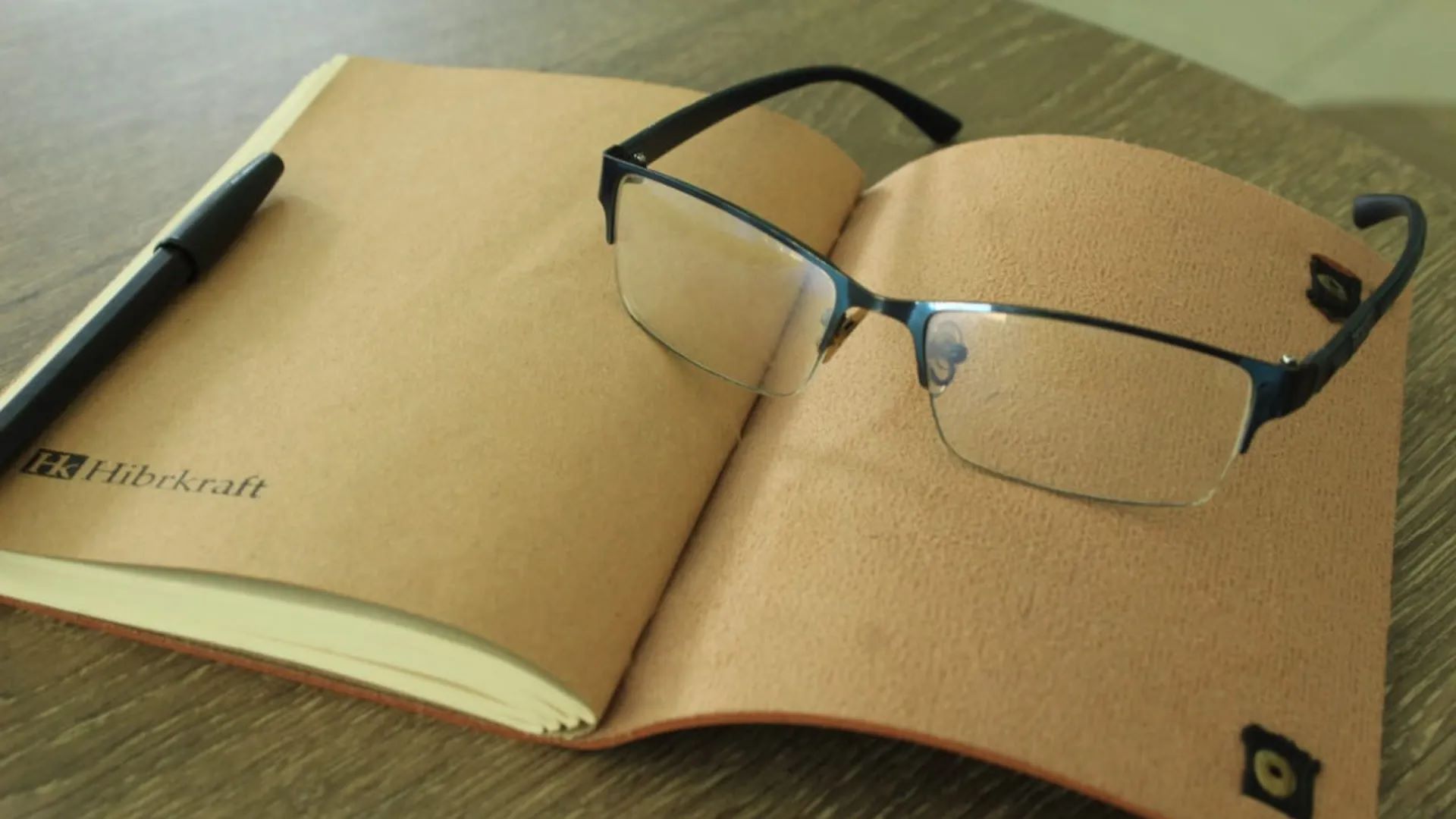
This invisible dance between material and moisture is the heartbeat of our production, but it poses a significant challenge for post-production storage. The image above—a pair of reading glasses resting on the raw, fibrous “flesh side” of a leather cover—symbolizes the level of scrutiny required to manage this risk. To the naked eye, a journal stored at 70% humidity looks identical to one stored at 55%. But under the lens of material science, the difference is catastrophic. One is a stable asset; the other is a petri dish waiting to bloom.
As a B2B procurement manager or brand owner, you are not just buying a physical object; you are buying a complex arrangement of organic fibers. If you treat these journals like plastic widgets, tossing them into a damp storage container, you are actively dismantling the craftsmanship we built. Understanding the hydro-dynamics of leather and paper is the difference between a product that builds a legacy and one that crumbles in the customer’s hands.
Archival Environmental Engineering: The Critical Role of 55% Relative Humidity
Procurement managers must realize that material durability is not just a factor of initial quality but of rigorous environmental maintenance. Engineering standards for archival paper and premium leather components specify a stabilized relative humidity (RH) of approximately 55%. This is not an arbitrary number. It is the “Goldilocks” zone for cellulose and collagen.
Cellulose, the primary structural component of paper, is hygroscopic. It has a natural affinity for water molecules. At 55% RH, the cellulose fibers contain just enough water to remain flexible and resilient (high tensile strength) but not enough to trigger chemical degradation. If the RH drops below 40%, the water molecules that act as a lubricant between the fiber chains evaporate. The paper becomes brittle, snapping audibly when turned. This is “desiccation,” and it turns a premium journal into a fragile relic.
Conversely, if the RH rises above 65%—a common occurrence in unconditioned warehouses in Southeast Asia or coastal regions—the risks shift from mechanical to biological. High moisture content provides the activation energy for mold spores to germinate. It also accelerates “acid hydrolysis,” a chemical reaction where water breaks the glycosidic bonds of the cellulose, causing the paper to lose strength and yellow rapidly.
| Humidity Range | Material Behavior (Paper) | Material Behavior (Leather) | Risk Profile |
|---|---|---|---|
| Low (<40% RH) | Fibers shrink, becoming brittle and rigid. | Oils evaporate; surface cracks; “boardy” feel. | Mechanical Failure (Snapping/Cracking). |
| Optimal (50-55% RH) | Flexible, resilient, flat lay. | Supple, distinct aroma, stable patina. | Archival Stability. |
| High (>65% RH) | Fibers swell (cockling); absorbs pollutants. | Absorbs moisture; ideal host for mildew/mold. | Biological Contamination (Mold/Rot). |
For custom leather journals, maintaining this 55% threshold is essential to preserve the high-density collagen of the cover material. Leather is technically skin; it is a protein network. The “flesh side” of the leather (the rougher interior surface seen in the image above) is particularly porous. In high humidity, this surface acts as a trap for moisture. If a journal is stored closed, that moisture is trapped between the leather and the first page of the paper block. This micro-environment becomes a breeding ground for mildew, which manifests as a powdery white or green bloom. Once mold penetrates the fiber structure of the leather, it is virtually impossible to remove without damaging the finish.

The Physics of Expansion and Contraction
The issue extends beyond chemistry into physics. Leather and paper have different “coefficients of hygroscopic expansion.” This means they expand at different rates when they absorb water.
Imagine a Hardcover Case Bound journal. It consists of greyboard (cardboard), glue, the leather cover, and the paper text block. If the humidity spikes to 80%, the greyboard might expand by 2%, the paper by 1.5%, and the leather by 1%. This mismatch creates immense shear stress at the glue lines. The cover wants to grow bigger than the paper inside it. The result is warping—the cover bows outwards, refusing to close flat. This is the hallmark of a “cheap” journal, but in reality, it is often a sign of a premium journal stored poorly. Cheap, plastic-coated covers don’t react to humidity; organic, high-quality materials do.
In our workshop, we use specific binding techniques like the Coptic Stitch and Long Stitch which allow for some degree of movement. The exposed spine allows the signatures to “breathe” more freely than a glued spine. However, even these robust mechanical bindings cannot compensate for extreme environmental swings. If the thread (usually waxed polyester or nylon) remains static while the paper swells with moisture, the thread can cut into the paper at the binding holes, damaging the structural integrity of the book.
The Core: Monitoring and The “Sniff Test”
To implement these standards, journals should be housed in stable, dark environments—ideally at a constant 20°C—away from direct sunlight and humidity fluctuations. But how does a warehouse manager monitor this effectively? Digital hygrometers are cheap and essential. They should be placed not just on the wall, but inside the storage boxes or pallets. The micro-climate inside a stack of 500 journals can be very different from the air in the hallway.
Regular monitoring for technical indicators of deterioration is a required protocol. The most effective tool is often the nose. A sharp, vinegar-like smell indicates “vinegar syndrome,” the breakdown of acetate or certain acidic glues (though less common in our vegetable-tanned products). A musty, earthy smell is the unmistakable sign of active mold growth. If you smell this, the damage is already occurring.

“Humidity is the silent thief. It steals the snap of the paper and the strength of the leather, and it leaves behind nothing but the smell of neglect.” – Head Craftsman, Hibrkraft
We once had a client in a coastal city who stored their shipment of White Label journals in a storage unit near the harbor. The salty, humid air infiltrated the standard cardboard boxes. Within three months, the brass hardware on the closures had tarnished (green verdigris), and the paper edges had waved. They assumed it was a manufacturing defect. We had to explain that metal and paper are reactive materials. This is why we now emphasize the importance of where you store the goods as much as what you buy.
The “Flesh Side” vulnerability is critical here. As seen in the header image, the interior of our covers is often left raw to showcase the authenticity of the hide. This raw surface is more absorbent than the “grain side” (the smooth outer surface). In high humidity, this surface absorbs moisture rapidly. If you are inspecting your inventory, open a random unit and feel this inner surface. It should feel dry and fibrous. If it feels cool or damp to the touch, your storage environment is failing, and you must dehumidify immediately.
The Solution: Micro-Climates and Buffered Enclosures
The archival strategy is further reinforced through the use of acid-free and lignin-free buffered enclosures. If you cannot control the humidity of your entire warehouse (which is expensive), you can control the humidity inside the box. Buffered boxes contain an alkaline reserve (calcium carbonate) that helps neutralize acids, but they also act as a buffer against humidity swings (hysteresis).
When a journal is inside a tight, archival-quality box, the air volume is minimized. If the external warehouse humidity spikes for 12 hours due to a rainstorm, the air inside the box changes very slowly. This “thermal and hygroscopic lag” protects the journal from the shock of rapid expansion and contraction. For high-value Limited Edition runs, we recommend wrapping each unit in unbleached tissue paper before boxing. The tissue acts as a sacrificial layer, absorbing excess moisture before it reaches the leather.
From an ROI (Return on Investment) perspective, this is insurance. The cost of a dehumidifier or proper archival boxes is a fraction of the cost of writing off 500 custom-branded units that have become moldy. Furthermore, preserving the “crispness” of the product ensures that when your client finally receives the gift, the tactile experience is premium. A soggy, limp journal feels cheap, regardless of how much you paid for the leather.

Why Partner with Hibrkraft?
Hibrkraft is more than a manufacturer; we are custodians of a craft that dates back centuries. Located in Cileungsi, Bogor, we operate with a capacity of 2,000 units per month, balancing the scalability of a factory with the soul of a workshop. Our team of ~9 craftsmen understands the local materials better than anyone. We know which Indonesian vegetable-tanned leathers resist humidity best and which papers hold their structure in tropical heat.
When you order White Label services from us—where your brand replaces ours—we transfer that knowledge to you. We provide the “Hibrkraft Standard” of quality: 100% inspection, fresh materials, and robust packaging. But the partnership requires you to uphold the environmental standards on your end.
We have successfully navigated the logistics of shipping to diverse climates—from the dry heat of the UAE to the cold winters of Germany. We pack our shipments with desiccants to control moisture during transit (DHL Express), ensuring the journals arrive at your door in equilibrium. By following the 55% RH and 20°C protocols outlined here, you ensure that they stay that way.
Ready to start? Message us on WhatsApp at 0815 1119 0336 to discuss your bulk order and preservation strategy. Click here to chat.
Sources & References
- Berisford, K. M. (2024). Acid-Free vs Archival: What You Need to Know About Paper Quality for Your Art.
- Chiles, J. (2024). What Is Pull Up Leather? – An In-Depth Look.
Disclaimer: this post are written in english to reach more audience.