
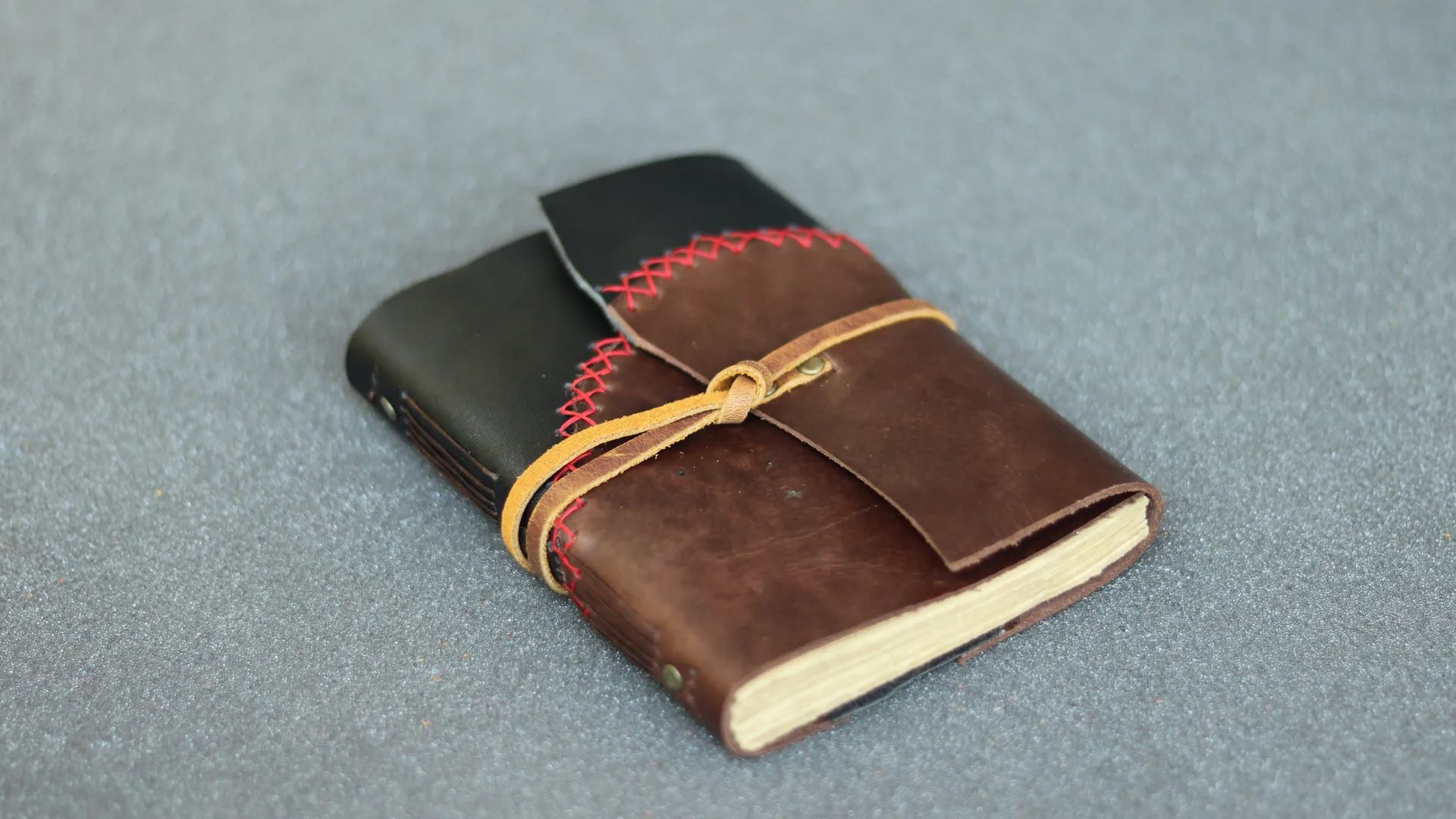

In our Cileungsi workshop, the air is often filled with the rhythmic *thump-pull, thump-pull* of an awl and a waxed needle passing through leather and paper. The journal in the image above is a perfect example of this human touch—the vibrant red thread creates a “cross-stitch,” a decorative and incredibly strong method of joining two pieces of hide. It is a bold, deliberate choice, a statement of craft. When our artisan pulls that final stitch tight, the journal is at its peak of structural and chemical integrity. The rich, earthy aroma of the vegetable-tanned brown leather, the clean matte finish of the black hide, and the crisp, woody scent of the paper block all signal a pristine, archival-grade object.
This moment of creation, however, is just the beginning of the journal’s life. As a B2B partner procuring hundreds or thousands of these units for your brand, you become its custodian. The journey from our workbench in Bogor to your client’s hands is fraught with environmental variables. That vibrant red thread, the supple leather, the pH-neutral paper—they are all organic materials engaged in a constant, slow-motion dialogue with their surroundings. They are assets that require management. Learning to listen to what the materials are telling you through subtle shifts in color, texture, and smell is the core discipline of archival asset management.
Hibrkraft does not just manufacture products; we engineer legacies, and we provide our partners with the technical knowledge to monitor and protect those legacies.
Archival Asset Management: Technical Protocols for Monitoring Material Deterioration in White Label Journals
For B2B procurement managers and stationers, the longevity of a white label leather journal is not merely a marketing claim but a function of ongoing technical oversight. An investment in 2,000 units of custom-branded journals is a significant capital outlay. Allowing that inventory to degrade due to neglect is a direct loss of that capital. Monitoring for signs of deterioration is a critical industrial protocol required to ensure that high-value documentation remains a permanent asset rather than a decaying liability. From a material engineering perspective, regular inspection must focus on both chemical shifts in the paper substrate and structural changes in the leather assembly. This is not a passive activity; it is an active audit.
Technical indicators of paper deterioration often begin with subtle sensory cues that precede catastrophic failure. The most common is a visual shift. Discoloration and yellowing are primary markers of the breakdown of a pH-neutral state. This often indicates that environmental acids (from air pollution or improper storage boxes) have overwhelmed the paper’s internal buffering capacity. Procurement experts should also inspect for “staining,” which often points to acid migration from adjacent non-archival materials or the breakdown of cheap adhesives.
Beyond visual cues, odors serve as a powerful sensory benchmark for material health. A healthy, archival-grade paper stock should have a neutral, slightly woody, or clean smell. If you fan the pages of a journal from your inventory and detect a distinct ammoniacal, pungent, or vinegary smell, you are smelling the off-gassing of chemical decomposition. These odors typically emanate from the breakdown of lignin (if present), the deterioration of certain sizing agents, or the release of chemical residues as the cellulose fibers themselves begin to degrade. A musty, “damp basement” smell is the unmistakable signature of active mold or mildew growth.
| Indicator | Technical Observation | Underlying Chemical/Physical Cause | Brand Implication |
|---|---|---|---|
| Yellowing | Paper edges turning yellow/brown. | Acid hydrolysis and/or lignin oxidation from light exposure. | Product appears “old” or “cheap” before sale. |
| Brittleness | Paper cracks or snaps when folded. | Loss of moisture, breakdown of cellulose polymer chains. | Catastrophic failure in user’s hands. |
| Musty Odor | A “damp earth” or mildewy smell. | Active fungal growth (mould/mildew) due to >65% RH. | Product is a health hazard and unsellable. |
| Leather Cracking | Fine cracks appearing on the leather surface. | Evaporation of fatliquors, desiccation of collagen fibers. | Perceived as poor quality, low-grade material. |
Structural integrity must be assessed through careful physical handling. Brittleness and a loss of tensile strength in the cellulose fibers indicate advanced aging. A healthy sheet of our HVS 90gsm paper should be able to be folded back and forth multiple times without breaking. If a corner feels stiff and threatens to tear or “crush” when manipulated, the paper has lost its internal moisture and flexibility. This is often caused by storage in an environment with excessively low humidity.

The “How”: Implementing a Scheduled Audit Protocol
Monitoring is not a random act; it requires a scheduled audit. We recommend a quarterly inspection of your inventory, especially if it is stored in a non-climate-controlled facility. This audit should be systematic.
Step 1: The Box Inspection. Before even touching a journal, inspect the storage boxes. Are there water stains? Signs of crushing? Evidence of pests (droppings, chew marks)? The health of the enclosure is the first line of defense.
Step 2: The Random Sample. Select a few units from different boxes and different positions on the pallet (top, middle, bottom). Environmental conditions are often not uniform.
Step 3: The Sensory Audit. This is where the technical skill comes in. It is recommended to handle the sample units with clean cotton gloves to prevent the transfer of skin oils.
- Visual Check: Open the journal to the center. Compare the color of the paper in the middle of the book to the color at the very edge of the text block. The edges are most exposed to light and air; any yellowing will appear there first. Inspect the leather for any fading, particularly along the spine, which indicates UV exposure.
- Tactile Check: Gently feel the paper. Does it feel supple or stiff? Flex a corner. Does it resist or feel brittle? Feel the leather. Our Full Grain leather should feel supple and slightly oily or waxy. If it feels dry, “boardy,” or rough, it is losing its essential fatliquors due to heat or low humidity.
- Olfactory Check: This is the most sensitive test. Fan the pages a few inches from your face and inhale. The smell should be neutral and clean. Any sharp, musty, or “off” odors are red flags that require immediate investigation of the entire case.
This disciplined process turns a subjective feeling into a data point. By keeping a log of these quarterly checks, you can track the stability of your inventory over time and intervene before minor issues become major losses.
The Core: Differentiating Patina from Damage in Leather
In the context of the journal’s cover, procurement managers must learn to distinguish between desirable aging (patina) and destructive degradation. Our high-quality leathers, particularly vegetable-tanned and pull-up varieties, are designed to develop a rich patina over time with handling. This involves the leather absorbing oils from the user’s hands, darkening in color, and developing a unique sheen. This is a sign of quality.
Damage, however, looks very different. Here are the technical indicators to monitor:
Drying & Cracking: This is the most common form of leather damage, caused by prolonged exposure to heat or UV radiation. The heat causes the natural oils and fats (“fatliquors”) that keep the collagen fibers lubricated to evaporate. Without this internal lubrication, the fibers rub against each other, become brittle, and break. This first appears as a network of fine surface cracks, which will eventually deepen and lead to catastrophic failure.
Fading: All dyes are susceptible to fading from UV light, but cheap dyes fade faster. Our leathers from Indonesian tanneries use high-quality dyes, but if a journal is left in direct sunlight, the side facing the light will noticeably fade compared to the other side. This is a clear sign of improper storage or display.
Spew & Bloom: In conditions of high heat or fluctuating humidity, the waxes and fats in the leather can migrate to the surface. This can appear as a hazy white film (bloom) or as sticky, greasy spots (spew). While sometimes treatable, it indicates an unstable storage environment and is perceived by customers as a serious defect.
Monitoring should also include checks for biological threats. The suede-like “flesh side” of the leather can be a prime spot for mold to take hold in humid conditions. Any fuzzy or powdery spots (typically white, green, or black) are a critical alert. Similarly, pests may be drawn to the organic materials, so look for any signs of gnawing on the leather edges.

“Leather whispers its needs. Dryness is a cry for moisture; a musty scent is a sign of fever. A good custodian learns to listen to the language of the material.” – Head Craftsman, Hibrkraft
If signs of discoloration, brittleness, or odors are detected during an audit, what is the next step? The standard archival strategy dictates immediate isolation of the affected units to prevent cross-contamination. If the issue is minor (e.g., slight dryness in the leather), a simple intervention like applying a quality leather conditioner may suffice. However, if you are seeing widespread mold or significant paper embrittlement, it is time to reassess your entire storage environment. For truly high-value or sentimental items, consultation with a qualified paper or book conservator for specialized treatment is the final step, though for commercial inventory, prevention is the only economically viable strategy.
The Solution: Protecting Brand Perception and Your Bottom Line
By implementing these rigorous monitoring standards, organizations can safeguard the brand perception and material integrity of their custom leather goods for a lifetime of use. When you can confidently state that your products are stored under archival conditions, it becomes a powerful part of your brand story. It demonstrates a commitment to quality that extends far beyond the point of sale.
The Return on Investment (ROI) is clear and direct. An effective monitoring program dramatically reduces inventory loss due to spoilage. This means fewer write-offs, higher profit margins, and the ability to capitalize on the full value of your production run. It also prevents the immeasurable brand damage that occurs when a customer receives a defective, smelly, or degraded product.
At Hibrkraft, our 100% inspection policy ensures that every journal that leaves our workshop meets our exacting standards. Our defect replacement policy covers any flaws in craftsmanship or materials upon arrival. This monitoring guide is our way of extending that quality control into your domain, empowering you to protect the asset you have purchased.

Why Partner with Hibrkraft?
Partnering with Hibrkraft means you are working with a team that is deeply invested in the entire lifecycle of the product. Our workshop in Cileungsi, Bogor, is home to a team of ~9 dedicated artisans who understand the nuances of the local Indonesian materials we use. With a capacity of up to 2,000 units per month, we offer the scale needed for significant B2B projects without sacrificing the hands-on quality of true craftsmanship.
Our White Label service is a deep collaboration. We are your silent production partner, bringing your vision to life with our hands. We offer a wide range of materials, from Full Grain leather to PU, and a variety of binding styles, from the rustic Long Stitch to the classic Case Binding. We leverage our expertise in global logistics (shipping via DHL Express to clients in Canada, the UAE, Germany, and more) to ensure your product arrives safely.
But our partnership goes further. We believe in transparency and education. We provide this expert knowledge on asset management because your success is our success. We don’t just want to be your supplier; we want to be your trusted technical resource for creating and preserving beautiful, lasting products.
Ready to start? Message us on WhatsApp at 0815 1119 0336 to discuss how we can build and preserve a premium product line for your brand. Click here to chat.
Sources & References
- Berisford, K. M. (2024). Acid-Free vs Archival: What You Need to Know About Paper Quality for Your Art.
- Buffalo Jackson (2024). Full Grain Leather vs. Top Grain Leather – What’s the Difference?.
- Chiles, J. (2024). What Is Pull Up Leather? – An In-Depth Look.
- Suryandono, A. R., et al. (2023). The experiment of recycled paper-making process and its water resistance on a household scale.
- SWITCH-Asia (2021). Best Practice Guide for Sustainable Vegetable-Tanned Yak Leather Manufacturing.
Disclaimer: this post are written in english to reach more audience.