
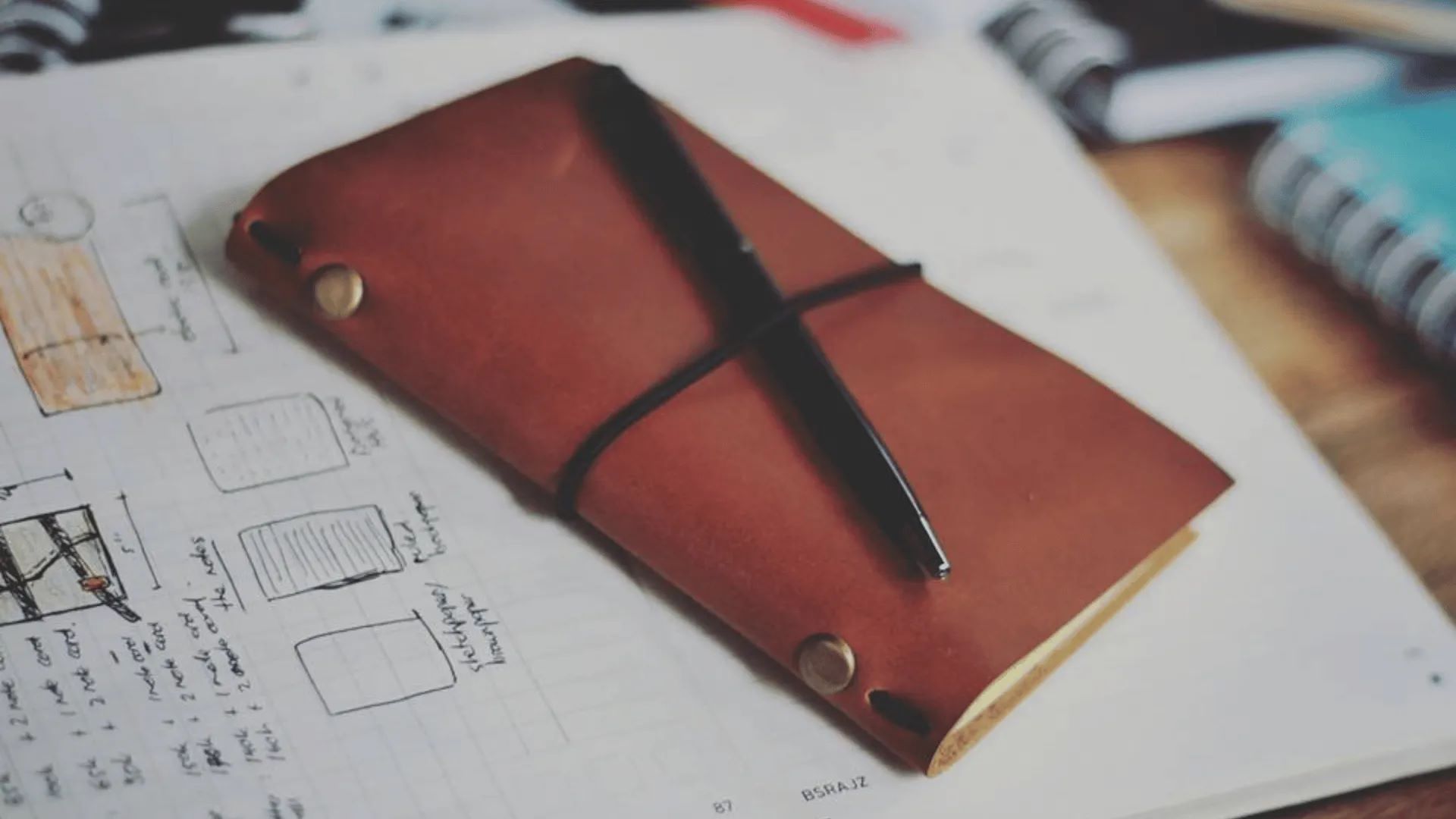

The image captures a scene of creation in progress. A handsome, top-grain leather journal, secured by a simple elastic band, rests atop a page of design sketches. It’s a snapshot from the world of a designer, an architect, an engineer—a professional whose ideas are their most valuable asset. In our workshop in Cileungsi, Bogor, this is the environment we build for. The air smells of Indonesian leather from our partners in Garut, of the clean, fibrous scent of quality paper, and of the focused energy of our nine craftsmen. We understand that a journal like this isn’t a passive object; it is an active tool, a partner in the process of innovation.
The journal in the image, with its sturdy brass rivets and supple leather cover, exudes reliability. This tangible sense of quality, however, must be more than skin deep. Our manufacturing philosophy is built on the principle that the invisible, chemical integrity of the paper inside must be even more robust than the visible, physical strength of the cover. This requires a deep, scientific understanding of material permanence, including the nuanced and often deceptive relationship between the terms “acid-free” and “archival.” It is in navigating this technical paradox that we engineer a product truly worthy of holding your brand’s next great idea.
We don’t just build reliable tools; we engineer the verifiable, long-term stability that makes them trustworthy.
Specifying Permanence for White Label Journals: The Technical Paradox of “Archival” Paper
For a procurement manager or B2B buyer, the terms “acid-free” and “archival” are the go-to indicators of quality and permanence in paper. They are often used interchangeably in marketing materials, creating a dangerous and misleading equivalence. From a material engineering perspective, this is a critical error. While the two terms are related, they are not synonymous, and in some cases, can even be mutually exclusive. This technical paradox is a significant risk for any brand commissioning a premium product. The reality is that a paper can be labeled “archival” by a manufacturer but be built on a foundation of acidic pulp, while another paper can be inherently acid-free but lack the durability standards to be considered truly archival. Navigating this distinction is the key to specifying a product that endures.
| Paper Type | Technical Description | Long-Term Risk / Brand Impact |
|---|---|---|
| True Archival (The Hibrkraft Standard) | Inherently acid-free (pH 7.5+) from purified, lignin-free pulp. Contains an alkaline buffer (e.g., calcium carbonate) to neutralize future environmental acids. | Extremely low risk. Engineered for multi-generational permanence. Reinforces a brand message of stability, foresight, and uncompromising quality. |
| “Faux Archival” (Buffered Acidic Pulp) | Made from acidic pulp but treated with a high concentration of alkaline buffers to achieve a neutral pH at the point of sale. It is “archival” only as long as the buffer lasts. | Very high risk. The buffer will eventually be exhausted by the paper’s own internal acid, leading to sudden and catastrophic yellowing and brittleness. A hidden liability. |
| Unbuffered Alkaline Paper | Inherently acid-free and alkaline, but lacks a chemical buffer. Pure, but defenseless. | Moderate risk. Vulnerable to “acid migration” from other materials (e.g., cheap packaging) and acidic air pollutants, which can degrade it over time. |
The core of this paradox lies in the science of chemical buffering. A “buffer” in this context is an alkaline substance, typically calcium carbonate, added to the paper pulp during manufacturing. Its job is to lie in reserve, ready to neutralize any acids the paper might encounter over its lifetime. The paradox arises because manufacturers can, in theory, start with a cheap, acidic, lignin-rich wood pulp and add a large quantity of alkaline buffer to it. This will force the paper’s pH into the neutral or alkaline range, allowing it to be labeled as “acid-free” or even “archival” at the time of sale. However, this is a chemical trick. The paper still contains its original acidic sin. Over time, as the internal acids continue to form and external acids are absorbed, they will wage a war against the alkaline buffer. Eventually, the buffer’s capacity will be exceeded, and the paper will rapidly revert to its natural acidic state, beginning the process of yellowing and decay.
This “Faux Archival” paper is a ticking time bomb and the single greatest material risk in the premium stationery market. Because the term “archival” is not legally regulated or globally standardized, this practice is not technically fraudulent, but it is deeply misleading. True archival performance, the standard we adhere to at Hibrkraft, requires a substrate that is both inherently acid-free—meaning it is made from purified, lignin-free pulp from the start—and contains a sufficient alkaline buffer to defend against future environmental attacks. This dual-pronged strategy is the only way to engineer for true, predictable, generational permanence.

The Anatomy of a Chemical War: Buffering Capacity and Acid Migration
To understand the risk, you have to visualize the chemical war happening on a microscopic level within the paper. Every sheet of paper has a specific “buffering capacity”—the total amount of acid it can neutralize before its alkaline reserve is depleted. In a true archival paper, this buffering capacity only has to contend with external threats, like acid rain pollutants in the atmosphere. In a “Faux Archival” paper, the buffer is fighting a war on two fronts: against the same external threats, and against the paper’s own internal, ever-present acidic nature. Its buffering capacity will therefore be exhausted much, much faster.
Another insidious threat is “acid migration.” Paper is porous. If a high-quality, truly archival text block is stored inside a cheap, acidic presentation box, the acid from the box will literally migrate through the air and be absorbed by the edges of the paper. Over time, this can overwhelm the buffer and cause the pages to yellow from the outside in. This is why a holistic approach to permanence is critical. Every component must be chemically stable. At Hibrkraft, we consider the entire product ecosystem, advising clients on everything from the cover boards to the endpapers to ensure that no single, low-quality component can sabotage the integrity of the whole.
This is where the human element of our workshop provides an advantage that machines cannot. Our craftsmen, who handle these materials daily, develop an intuition for quality. They can feel a subtle brittleness or see a slight mottling in a batch of paper that might indicate an impure pulp, even if its spec sheet claims it is “acid-free.” This sensory quality control, part of our 100% manual inspection process, is a crucial defense against the misleading specifications that plague the commodity paper market. It’s the practical application of our “Handcraft at scale” philosophy, where deep material knowledge protects our clients’ investments.
The Core – The Time-Accelerated Sabotage Test
The truest test of a paper’s archival quality is to simulate the long, slow process of decay. This is the “Sabotage Test”: did the manufacturer build a hidden flaw into the product that time will eventually reveal? For a “Faux Archival” paper, the answer is always yes. The test is to predict when that flaw will manifest.
The physics of this failure is a simple matter of chemical titration. The alkaline buffer is neutralizing the paper’s internal acid day by day, year by year. For a while, nothing appears to happen. The paper looks and feels fine. But once the last molecule of the buffer is used up, the paper hits a chemical tipping point. The degradation process, which was being held in check, is suddenly unleashed. The yellowing and embrittlement can then proceed at a surprisingly rapid pace. This is why a 20-year-old book made from acidic pulp can seem to “suddenly” fall apart. Its chemical defenses were silently failing for years, and then they collapsed all at once.

“A paper’s chemistry is its character. A paper made from pure pulp has an honest character. It is what it is, and it will endure. A paper made from acidic pulp and then masked with chemicals has a dishonest character. It pretends to be something it is not, and time will always reveal the truth. We choose to build with honest materials.”
This principle from our Head Craftsman is our commitment to our white label partners. We see it as our professional duty to demystify these technical issues and to be your expert guide in specifying materials that are truly permanent, not just temporarily stable. Our role is to protect your brand from the hidden risks of material science, ensuring the product you commission is a genuine asset, not a latent liability.
The real-world application for your brand is profound. The designer’s sketches in the image represent valuable intellectual property. The journal is a legal record of the creative process. If that journal were to degrade in 15 years, those records could be lost. By investing in a verifiably archival product from the start, you are practicing sound data management and risk mitigation. You are ensuring that your physical assets are as robust and reliable as your digital ones, a powerful statement of professional competence.
The Solution: A Verifiably Stable Asset with Predictable Longevity
By understanding and navigating this technical paradox, the result is a product with verifiable stability and predictable longevity. It is a white label journal engineered on a foundation of chemical honesty, free from the hidden flaws that plague mass-market goods. This is how you create a brand asset that you can trust to represent your company’s commitment to quality for decades to come, not just for the next fiscal year.
The Return on Investment (ROI) is measured in brand safety and long-term equity. The marginal cost of specifying a truly archival, lignin-free paper is insignificant when weighed against the potential cost of product failure. A degrading product actively damages a brand’s reputation, suggesting a lack of foresight and a preference for superficiality over substance. A product that endures, by contrast, becomes a silent, powerful ambassador for your brand’s own reliability and long-term vision.
Our commitment to this standard is absolute. We are transparent about the materials we source and the reasons behind our recommendations. Our defect replacement policy is our guarantee that we stand behind the integrity of our products. If a product fails to meet the agreed-upon technical benchmarks due to a flaw in our materials or our craftsmanship, we will make it right. This is the foundation of a true, accountable B2B partnership.
Why Partner with Hibrkraft for Your White Label Journals?
Hibrkraft is a specialized workshop in Cileungsi, Bogor, where traditional Indonesian craftsmanship is fused with a rigorous, engineering-led approach to material science. Our dedicated team of approximately nine artisans operates on a unique model of “handcraft at scale,” which gives us the capacity to produce up to 2,000 premium units per month with a level of quality control and material expertise that large, automated factories cannot provide.
Our White Label service is a fully collaborative partnership. We act as your expert production team in Indonesia, transforming your vision into a tangible, high-performance product. The final journal is exclusively yours, built to your exact specifications and bearing your branding. You benefit from direct communication with the owners for a transparent and efficient process, allowing you to leverage our deep knowledge of archival materials and traditional bookbinding techniques.
We are highly experienced in managing the complexities of global logistics, with a proven history of successfully delivering custom orders to clients in Canada, Germany, the Netherlands, the UAE, and worldwide. We use trusted carriers like DHL Express to ensure that your valuable investment is protected and arrives safely and on time. Let us manage the complexities of production and shipping, so you can focus on building your brand with a product of true, enduring, and verifiable quality.
Let’s build something honest together.
Sources & References
- Berisford, K. M. (2024). Acid-Free vs Archival: What You Need to Know About Paper Quality for Your Art.
- StepbyStepArt (2025). Comments on Acid-Free vs Archival.
Disclaimer: this post are written in english to reach more audience.