
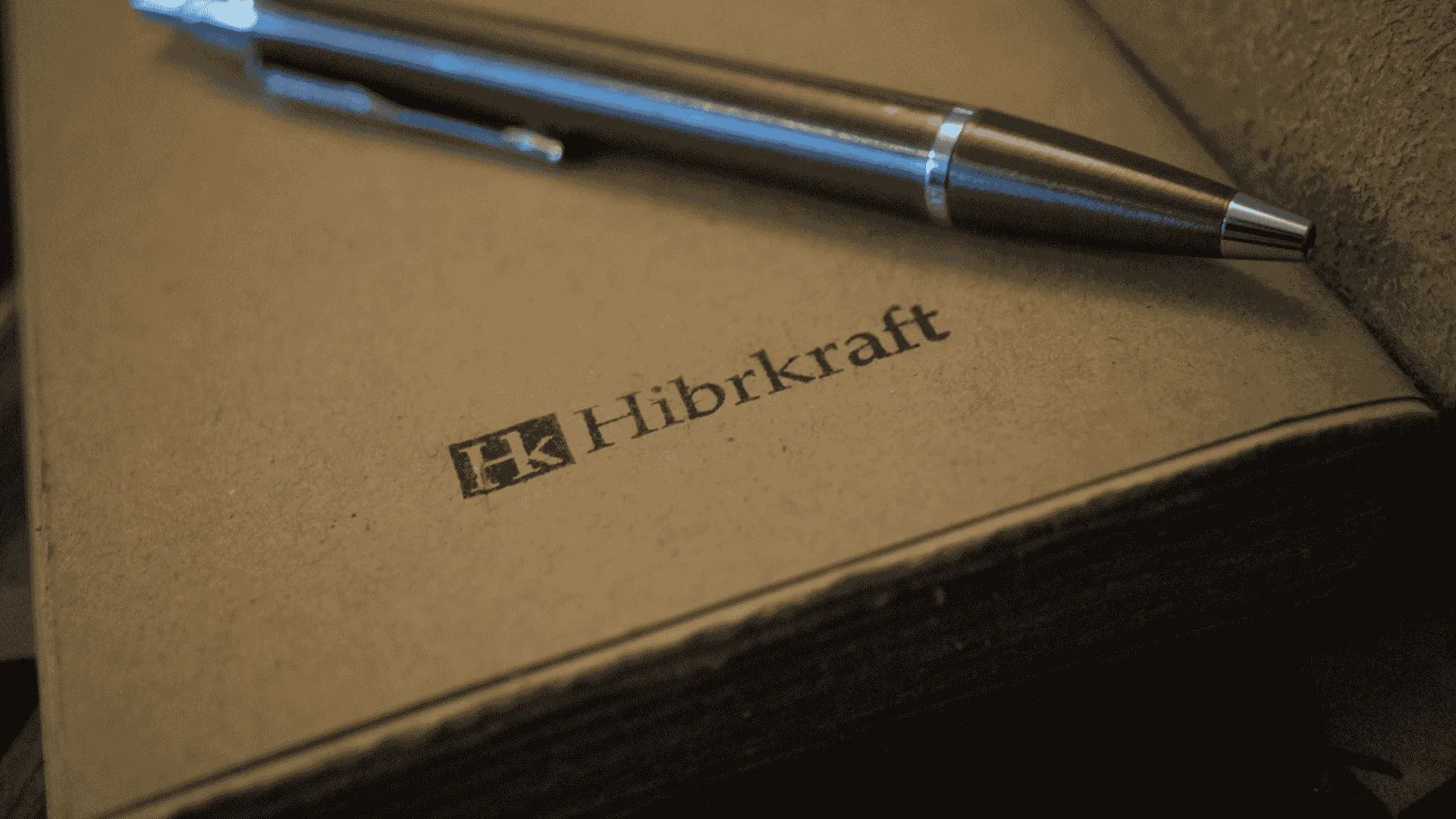

In our Cileungsi workshop, light is a tool. It streams through the windows, catching the fine dust of leather and paper that hangs in the air. We watch how that light falls across a finished journal cover, revealing the story of the material. In the user-submitted image, the light is soft, glancing across a textured, fibrous cover. It’s not leather; it’s something more organic, like a high-quality recycled board. You can see how the black ink of the screen-printed logo sits *on top* of the fibers, a distinct layer, unlike the impression of a deboss. The cool, machined gleam of the metal pen provides a stark, manufactured contrast to the warm, organic texture of the cover. It’s a study in sensory opposition, a microcosm of the challenge every online brand faces: how to make someone feel this through glass.
This challenge of representation is at the heart of our philosophy. Just as our craftsmen intentionally choose a specific needle gauge or thread tension to create a durable binding, a brand owner must intentionally choose their lighting and composition to communicate that durability. The act of making the product and the act of marketing it are two parts of the same promise of quality. We build the tangible truth; your photography must tell that truth compellingly. This is not just about taking pictures; it’s about translating craft into commerce.
We build products that are inherently photogenic, giving your brand a powerful visual story to tell.
Marketing on Mute: How to Sell Tactile Products Through Digital Screens
Your customer cannot pick up your journal. They can’t run their thumb over the deep impression of a debossed logo or feel the unique grain of full-grain Indonesian leather. They cannot smell it. All they have is a collection of pixels on a screen. Your entire brand story, the justification for your premium price, and the promise of quality must be communicated through these pixels. This is “Marketing on Mute”—selling a multi-sensory experience through a purely visual medium. The key is to stop thinking about *what* you’re shooting and start thinking about *how light interacts with it*. Texture is, in essence, a landscape of microscopic hills and valleys. To show it, you need shadows. Flat, direct light (like an on-camera flash) erases these shadows, making a rugged leather surface look like cheap plastic. A single, strong light source from the side—what photographers call a “raking light”—is what brings this landscape to life.
| Photography Element | The Hibrkraft Standard (Advised Photography) | Cheap Mass Production (Typical Product Photos) |
|---|---|---|
| Lighting | Single-source, soft, directional light (e.g., window light) at a low angle to create texture-defining shadows. | Flat, multi-source, or direct on-camera flash that eliminates all shadows, making the product look cheap and dimensionless. |
| Angle & Composition | Multiple angles, including macro shots of stitching, paper edges, and logo details. Uses Rule of Thirds to create visual interest. | A single, straight-on “passport photo” shot. Dead center, no detail, no artistry. |
| Props & Context | Minimal, niche-appropriate props (a fountain pen, a sprig of rosemary, a compass) that tell a story about the user. | No props, or generic props that don’t align with the brand. Product exists in a sterile white void. |
| The Result | Communicates premium quality, evokes an emotional response, and justifies a higher price point. The product feels tangible. | Communicates a cheap commodity. Looks flat, boring, and forgettable. Forces competition on price alone. |
The difference outlined in the table is the difference between creating desire and simply listing a product. As your manufacturing partner, our interests are perfectly aligned with yours. When you succeed, we succeed. We build a premium, tactile product for you; if your photography makes it look like a cheap commodity, we have all failed. That’s why we don’t just talk about leather grades and binding styles; we consult with our white-label clients on how to best represent the very features we work so hard to create. A crisp, deep deboss is pointless if it’s photographed with flat lighting that makes it invisible.
Think about the physics of it. A debossed logo is a valley pressed into the leather. For a viewer to perceive that valley, one side of it needs to be in light and the other in shadow. By simply moving your journal and your camera in relation to a window, you can dramatically alter the visibility of that texture. This doesn’t require an expensive studio; it requires intention and an understanding of how light works. This simple knowledge is the foundation of effective digital marketing for any physical product.

The Technical Breakdown: Lighting, Props, and Storytelling
Let’s move from theory to a practical, step-by-step guide. You can achieve world-class results with a modern smartphone camera and a single window. First, turn off all the overhead lights in your room. You want only one light source: the window. This is your key light. Position your journal on a surface (like a wooden table or a piece of slate) near the window. Don’t place it in direct, harsh sunlight, but in the soft, diffused light just out of the sun’s direct path. If the shadows are too dark, use a simple piece of white foam board or even a sheet of printer paper on the opposite side of the journal to bounce some light back and soften them. This simple “key light + reflector” setup is the basis of 90% of professional product photography.
Now, let’s talk about the material science of photography. Different materials demand different approaches.
- Full-Grain Leather: This is our premium material, sourced from the best tanneries in Indonesia. Its surface is a unique map of pores, wrinkles, and scars from the animal’s life. To capture this, get your camera low, almost parallel to the surface. Let the window light rake across it. This will make every tiny imperfection stand out, communicating authenticity and ruggedness.
- Foil Stamping: To capture the metallic brilliance of a gold or silver foil logo, you need to capture a “specular highlight”—the bright reflection of your light source. Position the journal so that the foil directly reflects the window’s light into your lens. You may need to move it around until you see that flash of brilliance. This communicates luxury and high-end finishing.
- Paper Texture: For showing the quality of our 90gsm Bookpaper or the unique tooth of Ivory paper, a macro shot is essential. Focus on the edge of the text block, showing the layers of individual pages. Or, open the book and use that same low, raking light to show the paper’s subtle surface texture. This signals to stationery aficionados that you’ve invested in a quality writing experience.
The human element in our workshop is our greatest strength, and the same applies to your photography. A machine can’t see that a slight turn of the journal will make the debossed logo “pop” better. It can’t decide that adding a half-full coffee cup will tell a story about a productive morning. Your props should be chosen with the same care we choose our thread. For an engineering field book, maybe it’s a graphite pencil and a scale ruler. For a recipe journal, a dusting of flour and a few scattered peppercorns. These elements provide context and help your ideal customer imagine your product in their own life. That act of imagination is the first step toward a purchase.
The Core: Passing the Digital “Feel Test”
In a physical store, customers perform a “feel test.” They pick up a product, judge its weight, and touch its surface. The digital equivalent is the “Scroll-Stop Test.” Your product image appears in a user’s social media feed, a chaotic river of information. Does it have enough visual power, enough sensory intrigue, to make them physically stop their thumb from moving? This is the first and most important hurdle. An image that successfully communicates texture is magnetic to the human brain. We are primal creatures, and for millennia, understanding texture was a survival skill. A photograph that triggers this deep-seated instinct creates an immediate, subconscious connection.
The “test” is to look at your own photos and ask: Can I *feel* this? If I close my eyes, can I remember the texture I just saw? Does the image of the Coptic stitch binding make me want to feel the tension in the threads? Does the photo of the cover make me imagine the sound my fingernail would make scratching across its surface? If the answer is no, the image has failed. It may be an accurate representation, but it’s not a compelling one. It’s a document, not an advertisement. Our job is to build a product that can pass any physical feel test. Your job is to create an image that can pass the digital one.

“Our craftsmen spend hours ensuring a stitch is perfect, a corner is square, a deboss is crisp. That work is silent until a camera and a skilled eye give it a voice. Our hands build the texture; your camera must reveal its soul.”
This philosophy is about honoring the entire chain of creation. The craftsman’s effort is wasted if the end customer can’t perceive it. When your customer, a corporate procurement officer, is browsing for high-end client gifts, they are scrolling through dozens of options. A flat, lifeless photo of a generic notebook gets a 0.5-second glance. A dramatic, textured shot of your white-label journal, with their potential client’s industry-related props artfully placed nearby, gets a 5-second pause. They zoom in. They can see the quality. They perceive the value. That pause is where the sale is made.
We see brands make avoidable mistakes all the time. They use busy, distracting backgrounds that pull focus from the product. They mix light sources, creating ugly, unnatural color casts. Or they fail to show the journal’s scale, so the customer can’t tell if it’s pocket-sized or desk-sized. These are the visual signals of an amateur brand. When you partner with us, you are investing in a professionally crafted product. It is critical to pair that with professional-quality visual marketing to protect and enhance your brand’s perceived value.
The Result: From Clicks to Conversions to Brand Equity
The direct result of mastering this visual language is a higher conversion rate and a stronger brand. You move from competing on price to competing on perceived value and storytelling. Your product is no longer just a “brown leather notebook,” but “The Writer’s Companion” or “The Architect’s Field Journal.” The photography creates the context that allows the product to transcend its physical components and become a solution, an identity, a lifestyle accessory.
This has a tangible impact on your Return on Investment. Better photography allows you to charge a premium price, which flows directly to your bottom line. It reduces bounce rates on your product pages, increases click-through rates on your ads, and generates more shares on social media. It transforms a simple commodity into a desirable asset. The investment of time to learn these techniques, or the money to hire a photographer who understands them, is one of the highest-leverage decisions a new e-commerce brand owner can make.
We at Hibrkraft understand this completely. The products we craft for our Bulk and White Label clients are designed to be heroes. The deep grain of our vegetable-tanned leather from Garut, the crispness of our debossing, the perfect rhythm of our hand-stitched spines—these are all features that photograph beautifully. We are creating the raw material for your brand’s powerful visual story. While we are not photographers, we are partners in your success and can advise on the best ways to feature the specific craftsmanship of the product we create for you, ensuring the digital promise matches the physical reality.

Why Partner with Hibrkraft?
At our core, we are makers of tangible things in a digital world. Our workshop in Cileungsi, Bogor, is home to a small, dedicated team that believes in the power of well-made objects. With a focused capacity of up to 2,000 units per month, we merge the precision of “handcraft at scale” with a deep understanding of the materials we use. We don’t just assemble products; we imbue them with the very tactile qualities that your photography needs to capture.
Our White Label program is designed to be your silent, expert partner. We build the physical foundation of your brand while you focus on telling its story. The rich Indonesian full-grain leather, the meticulously spaced Coptic stitching, the sharp detail of a foil stamp—we provide the photogenic details that will make your marketing efforts shine. Your success is a reflection of our craft.
With proven experience shipping globally to clients in competitive markets like Germany and Canada via DHL Express, we manage the production and logistics so you can focus on building your brand. You will always have a direct line of communication with our leadership, ensuring a transparent and collaborative process. Let’s create a product that not only feels incredible in the hand but also looks undeniable on the screen.
Disclaimer: this post are written in english to reach more audience.