
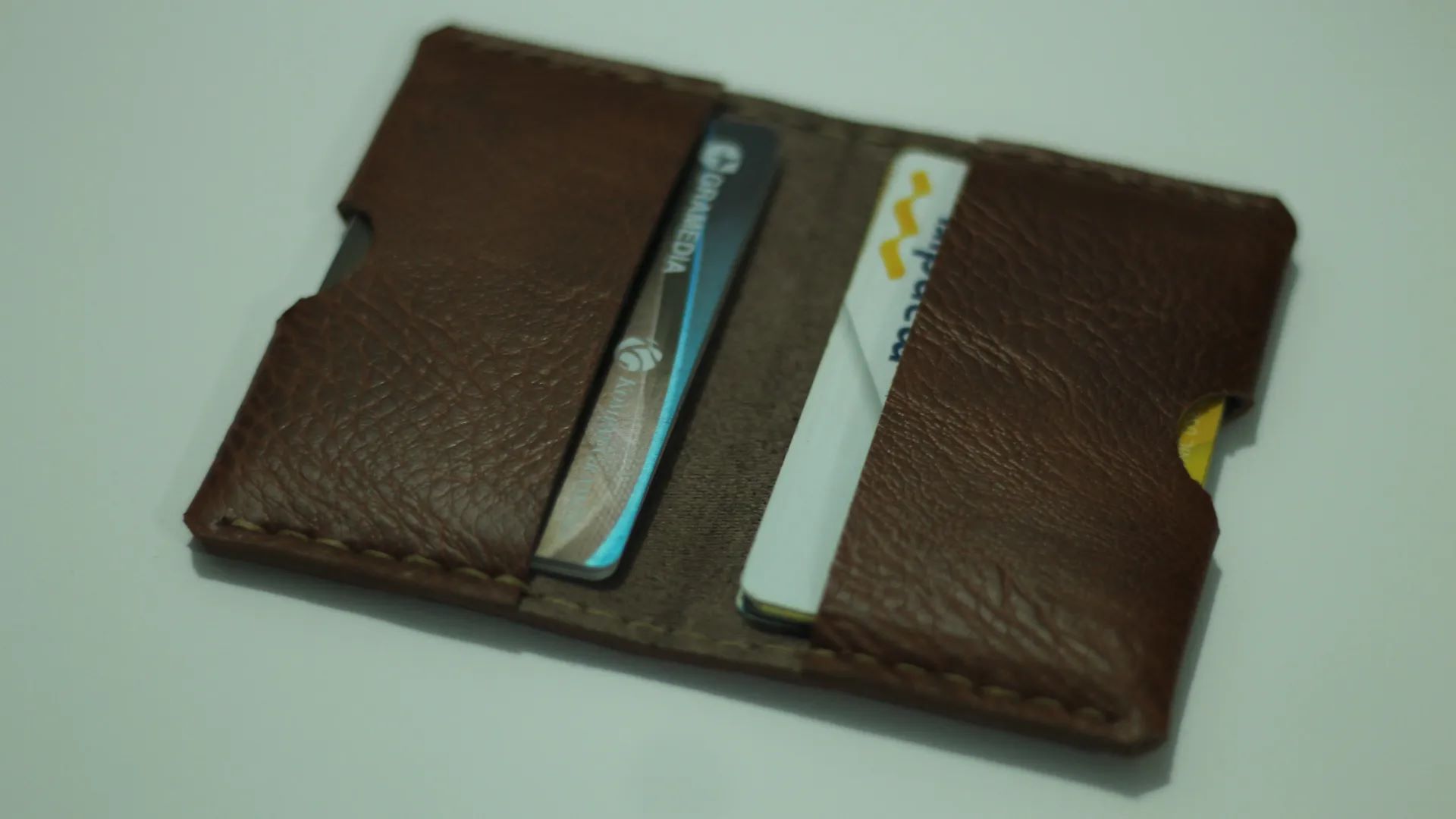

The scent of leather in our Cileungsi workshop is a constant. Today, it’s the earthy, robust aroma of a dark brown, full-grain hide sourced from a family-run tannery in Garut. On a craftsman’s bench, a piece of this hide has been transformed into the object you see pictured: a minimalist cardholder. It’s a simple item, yet it holds a complex story. You can see the geography of the leather’s surface, a landscape of natural grain that is as unique as a fingerprint. Along the edge, a line of saddle stitching, placed by a patient hand, provides a visual rhythm and a promise of immense strength. This wallet isn’t designed to be trendy for a season; it’s engineered to be a companion for a decade.
This single, humble cardholder is the physical embodiment of a sustainable philosophy. Its value isn’t derived from a flashy logo or a “recycled” tag of dubious origin. Its eco-friendly credentials come from its inherent longevity. It is the antithesis of disposable. The thick, durable leather is meant to absorb the oils from your hands, to mold to the curve of your pocket, to develop a rich patina that tells the story of its use. The waxed thread locking each stitch in place ensures it will not fail. This is the core of authentic sustainability: creating objects of such high quality that they drastically reduce the need for replacement, thereby reducing waste, consumption, and environmental impact.
We build products designed to last, giving your brand the integrity to speak truthfully about sustainability.
Eco-Friendly Branding: Marketing Sustainable Stationery to Gen Z
Marketing to Generation Z, a demographic defined by its digital fluency and deep-seated demand for authenticity, requires a radical shift in approach. This audience has a highly sensitive “greenwashing” detector. They are skeptical of vague claims, eco-buzzwords, and brands that wrap a fundamentally disposable product in recycled packaging and call it “green.” To connect with this value-driven demographic, your brand’s sustainability claims cannot be a veneer; they must be a verifiable, structural component of the product itself. The story you tell in your marketing copy must be provably true when the customer holds the product in their hands.
The most powerful sustainable marketing is, therefore, a form of radical transparency. It means moving beyond simplistic labels like “eco-friendly” and instead educating your customers about the why. Why is this specific leather a better choice? Why does this binding method contribute to a longer product life? What does “acid-free” actually mean for the paper’s longevity? This approach respects the intelligence of the consumer and builds a foundation of trust that is far more valuable than any short-term sales spike from a misleading marketing campaign. When your product is your proof, you don’t need to shout your credentials; you simply need to explain them with clarity and confidence.
| Attribute | Hibrkraft’s Transparent Approach (Verifiable Sustainability) | Mass-Market “Greenwashing” (Vague Claims) |
|---|---|---|
| Material Claims | “Crafted from full-grain leather sourced from our partner tannery in Magelang, Indonesia. This high-grade material is chosen for its durability and ability to develop a natural patina, ensuring the product lasts for years, not months.” | “Made from eco-friendly materials.” (Without specifying the material or its benefits). Often uses “bonded leather” (scraps glued together) or PU, which have a short lifespan. |
| Construction | “Each journal is bound using a traditional Coptic stitch with high-tensile waxed thread. This non-adhesive method allows the book to lay flat and provides mechanical strength that prevents pages from falling out.” | “A durable notebook.” (Uses a cheap “perfect binding” where pages are glued to a spine that cracks with use, leading to product failure and waste). |
| Paper Quality | “Our journals use 90gsm, acid-free, buffered paper. This archival quality prevents yellowing and brittleness, preserving your writing for generations.” | “Contains recycled paper.” (Often highly acidic, which yellows and degrades quickly, rendering the notebook unusable over time). |
| Core Philosophy | Sustainability through longevity and durability. The most eco-friendly product is one you never have to replace. | Sustainability through marketing language. The focus is on disposability and repeat purchase, masked by eco-friendly branding. |
The distinction is clear: one approach is based on engineering and material science, while the other is based on advertising copy. When a Gen Z customer reads your product description, they are looking for the details in the first column. They want to know the “what,” the “where,” and the “why.” By providing this information, you are not just selling a product; you are sharing your values and inviting the customer into a story of responsible craftsmanship. This is how you build a tribe, not just a customer list.
At Hibrkraft, our entire process is built to provide you with these verifiable truths. We don’t just offer “leather”; we offer you a choice of Full Grain or Top Grain hides, and we can tell you the Indonesian region they came from. We don’t just offer “binding”; we offer specific, named techniques like Saddle Stitch, Long Stitch, and Japanese Stab Binding, each with its own story and structural advantages. We provide you with a “Sustainability Specs” sheet for every order, empowering your marketing team to write with the confidence and precision that this discerning audience demands.

The Technical Language of True Sustainability
To avoid greenwashing, you must learn to speak the language of craft and material science. Let’s break down the key terms and explain the physics behind their sustainable claims. When we produce a wallet or journal for your brand, these are the built-in stories you can tell.
Leather: Full-Grain vs. “Genuine Leather.” The term “Genuine Leather” is a marketing euphemism for one of the lowest grades of leather, often made from split hides that have been sanded down and painted over to create a uniform appearance. It’s weak, lacks durability, and often cracks and peels within a year. In contrast, Full-Grain Leather, which we source, is the highest quality grade. It comes from the top layer of the hide and retains the full, dense grain structure. This fiber density is the source of its incredible strength and longevity. Marketing a full-grain product allows you to talk about its ability to patina—a process where the leather absorbs oils and burnishes over time, becoming more beautiful and personal with age. This is the language of “buy it for life,” the ultimate sustainable message.
Stitching: Saddle Stitch vs. Machine Lockstitch. Look closely at the stitching on the wallet in the image. This is a saddle stitch, a hallmark of high-quality leatherwork. It is done by hand with two needles passing through the same hole from opposite sides, creating a series of interlocking figure-eight knots within the leather. The “physics” of this stitch are remarkable: if one thread is ever abraded and breaks, the adjacent stitches on either side will hold the seam together perfectly. A machine lockstitch, used in 99% of mass-produced goods, is different. It loops a top thread with a bottom bobbin thread. If the top thread breaks, it can cause the entire seam to unravel like a zipper. A saddle stitch is sustainability through robust engineering; a lockstitch is efficiency designed for a limited lifespan.
Paper: Acid-Free Archival Paper. Paper’s greatest enemy is acid, which is often a byproduct of the wood pulp bleaching process. Acidic paper contains molecules that break down the cellulose fibers over time, causing the paper to become yellow, brittle, and eventually crumble. “Acid-free” paper is chemically different. It is manufactured in an alkaline Ph and is often buffered with an alkaline reserve like calcium carbonate. This neutralizes acids from the environment and prevents the internal degradation of the fibers. The result is a sheet of paper that can last for hundreds of years. When you sell a journal with acid-free paper, you are selling a potential heirloom. You are marketing a vessel for memories that will not self-destruct. This is a powerful and entirely truthful sustainability claim.
The QA Stress Test: Longevity as the Ultimate Green Credential
Every product we make in our workshop is built to pass the most important stress test: the test of time and daily use. This is where a brand’s sustainable claims live or die. A “green” product that ends up in a landfill after six months is a failure, and a direct hit to your brand’s credibility. Our 100% manual inspection is not just about catching cosmetic flaws; it’s a rigorous check for the structural integrity that ensures longevity.
Consider the life of a cardholder. It will be sat on, bent, and pulled from a pocket thousands of times. We test for this by reinforcing stress points. We check every single stitch to ensure the tension is perfect. We use a high-denier, waxed polyester thread that resists abrasion from the rough environment of a pocket and is impervious to moisture and UV degradation. Or consider a journal. It will be thrown into a backpack, crushed under a laptop, and its spine will be flexed open ten thousand times. Our Coptic and Long Stitch bindings are specifically chosen for this reality. They have a mechanical flexibility that a rigid, glued spine lacks. The stress is distributed across dozens of independent threads rather than concentrated on a single weak point. The journal is not just built to be filled; it’s built to be finished and kept.

“Respect for our materials means building something that honors their endurance. The cow’s hide was strong enough for a lifetime. The tree’s fiber was strong enough for a century. Our job is to not be the weakest link in that chain of strength. A product built to last is a product built with respect.”
This is the core belief of our head craftsman. Sustainability is not a marketing initiative for us; it is a direct consequence of a deep respect for our materials and a commitment to quality. This philosophy is embedded in every product that leaves our workshop. When you partner with us, you are inheriting this philosophy. Your brand gets to stand on a foundation of authentic, demonstrable quality that gives you the license to speak about sustainability with authority.
When your Gen Z customer receives their journal, they will feel the difference immediately. They’ll feel the weight of the dense paper, the strength of the binding, the ruggedness of the full-grain leather. The physical object itself will confirm the story you told them online. This alignment between promise and product is the holy grail of marketing to this generation. It is the antidote to greenwashing.
We proactively address the common failure points of mass-produced stationery. We avoid the brittle glues, the weak paper, the fraying thread, and the peeling “pleather” that are designed for a cycle of repeat consumption. Instead, we choose materials and methods designed for a cycle of use, patina, and preservation.
The Solution: Building a Brand on Verifiable Truths
The result of this approach is a brand that is not just profitable, but also respected and resilient. By rooting your marketing in the verifiable specifications of your Hibrkraft-produced products, you build immense trust with your target audience. This trust translates into higher conversion rates, greater customer loyalty, and a willingness to pay a premium price for a product they know is worth it.
The ROI of avoiding greenwashing is the protection of your brand equity. A single, viral takedown of your brand for making false sustainability claims can cause irreparable damage. In contrast, positive, user-generated content that celebrates the longevity and quality of your product—”I’ve had this journal for five years and it’s held up beautifully”—is the most powerful marketing you can get. Our job is to build the product that earns you those reviews.
Our “Sustainability Specs” sheet is a tool of empowerment for your brand. It will list the grade of leather, the tannery’s region, the type of thread, the binding method, the paper’s gsm, and its acid-free status. These are not buzzwords; they are facts. Facts you can use to write product descriptions, create social media content, and answer customer questions with complete transparency. In the rare event of a genuine manufacturing defect, our 100% defect replacement policy ensures that your brand’s promise of quality is never broken.
Why Partner with Hibrkraft?
Hibrkraft’s workshop in Cileungsi, Bogor, is the ideal production partner for brands that want to build their identity on authenticity and quality. Our team of ~9 craftsmen and our monthly capacity of up to 2,000 units allow us to focus on the details that create long-lasting products, making us perfectly suited for brands targeting a discerning, value-driven audience.
Through our White Label service, we provide a confidential, collaborative environment to create products that are 100% your brand, built with verifiable quality. You bring the vision; we provide the craftsmanship and the transparent specifications you need to market that vision with integrity.
We are experts in global logistics, shipping reliably with DHL Express to clients around the world. With direct owner communication and transparent pricing, we demystify the manufacturing process. We don’t just supply products; we supply the proof behind your brand’s promises.
Let’s build a brand that tells a true story.
Disclaimer: this post are written in english to reach more audience.